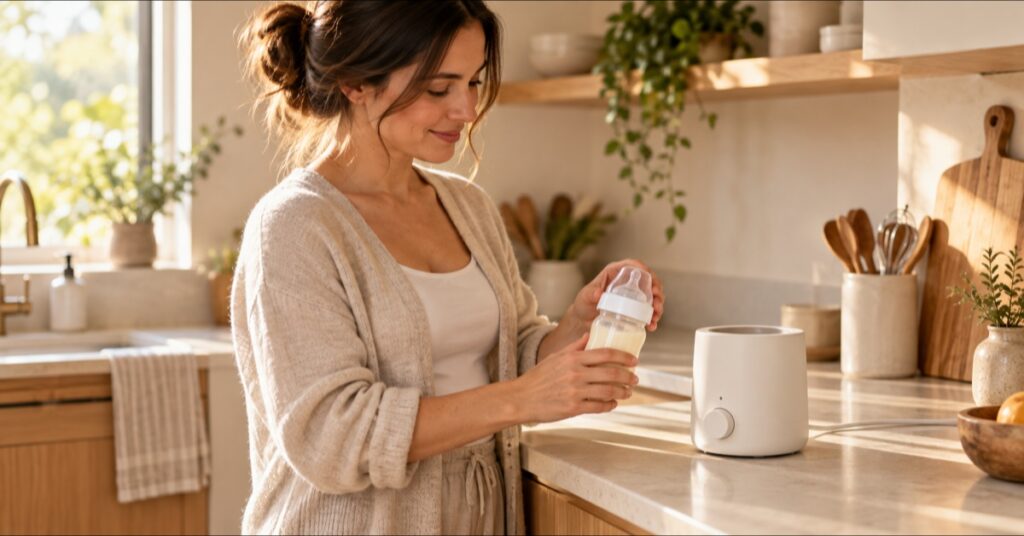
For one bottle at a time, I would start with the Philips Avent SCF358/00 if you prefer a dial, or the Momcozy MW01 if a lower price matters more. Choose the GROWNSY W3 for two similar bottles together, Chicco Digital for a separate steam-sanitizing cycle, or Momcozy NightPro for a clearer view of the water level.
Every one still needs the correct settings and a temperature check before feeding. If your baby accepts cold or room-temperature milk, warming is optional for both breast milk and formula. (CDC breast milk guidance; formula guidance.)
Match the warmer to the bottle your baby already accepts. Small feeds, glass bottles and milk bags may need different settings or may fall outside a model’s instructions. Our baby bottle guide can help if you are still choosing one.
| What would help at the next feed | My pick | The tradeoff |
|---|---|---|
| A dial for one bottle | Philips Avent SCF358/00 | Stay nearby and check the milk |
| Lower cost with several bottle settings | Momcozy MW01 | Measure water and learn the settings |
| Space for two bottles together | GROWNSY W3 | One shared set of controls |
| Warming plus a separate steam cycle | Chicco Digital | Slower warming and reuse steps |
| An easier view of the water line | Momcozy NightPro MW06 | Extra cost, touch controls and beeps |
On a small screen, swipe the table sideways.
Philips Avent for a straightforward dial
The Avent SCF358/00 is where I would start for a simple single-bottle routine. You turn the dial to the setting in its instructions and watch the progress light, rather than working through a touch menu. Its US guide includes a 1 oz setting, which is useful to know if you are buying for small feeds. Glass bottles and milk bags have different instructions, so the dial is not a universal “set it to the ounces in the bottle” shortcut. Philips US instructions.
The catch is temperature variation. BabyGearLab’s testing found inconsistent warming and overheating concerns, and owners also describe bottles coming out too hot or too cool. I would not choose it if the plan is to leave the bottle warming while you do something else. Its automatic switch-off is about 60 minutes from the start, including warming; it does not mean heating stops as soon as the progress light says the bottle is ready. Take the bottle out promptly, swirl, and check before feeding.
Momcozy MW01 for a smaller budget
If keeping the purchase price down matters more than having a dial, Momcozy’s MW01 is my lower-cost alternative. It lets you choose the bottle material, starting temperature and milk amount. Those are useful choices when the bottle in the fridge is different from the one you warmed earlier.
There is still a small measuring job: its fast-warming instructions call for 40 mL of water. You also need to learn the prescribed settings for your bottle. Hot-and-cold results are a real drawback in owner feedback, so I would buy it for the price and controls, without expecting it to deliver the same milk temperature every time. If correct use still gives erratic results, stop using it and arrange a return or support. Its long keep-warm setting is not permission to leave milk warm all day. MW01 instructions.
GROWNSY W3 for two bottles together
Two bottles waiting together change the decision. The GROWNSY W3 makes sense when two feeds happen close together and both bottles fit in its chamber. Both bottles can sit in the water bath while you get ready to feed.
But both bottles share the controls. A small glass bottle and a larger cold plastic bottle do not necessarily finish together. I would choose it for a similar pair of bottles and still swirl and check each one separately. If you need separate temperatures or separate timers, this does not solve that problem. In its milk-warming mode, the beep asks you to check the milk; the unit stops after 30 minutes, so do not treat the first beep as an automatic shutoff. Other modes have their own instructions. W3 instructions.
Chicco for warming and steam sanitizing
I’d choose Chicco’s Digital Bottle Warmer and Sterilizer if you also want to steam-sanitize a bottle or suitable small accessories. If a bottle warmer is the only thing missing from your counter, I would not pay extra just to add another function.
The tradeoff is waiting. BabyGearLab’s testing and owner accounts both point to slow warming, with some variation in the result. The US instructions cover 2–9 oz in a bottle and call for the STEADY setting for breast milk. This is not my choice for a 1 oz feed.
Consecutive feeds take more attention. The instructions generally recommend a 30-minute cool-down. There is an exception for two cycles in a row, but it means unplugging, carefully emptying the hot water and adding room-temperature water. If you are trying to get two feeds ready together, I would look at the W3 first. Chicco US instructions.
Momcozy NightPro for a visible water line
The clear chamber and built-in light are the reasons to consider Momcozy’s NightPro MW06. They make the water level easier to see. I would pay more than the MW01 for that visibility, not for a promise of more accurate warming.
It has touch controls and beeps, so it is not a silent bedside appliance. Keep it on a stable counter away from children and dangling cords. Wider bottles can displace enough water to cause overflow; check the instructions and fit before relying on it. Mommyhood101 also encountered overflow with wider bottles in a test using a sample supplied by Momcozy. Take the bottle out when warming finishes, rather than leaving it through the keep-warm countdown. NightPro instructions.
For one bottle at a time, choose between the Avent’s dial and the MW01’s lower cost. The W3’s second bottle space, Chicco’s steam cycle and NightPro’s light are worth the extra cost or space only when that feature helps your feeding routine.
When you need to warm a bottle away from home
This guide does not include a portable pick. The portable models reviewed for this shortlist left unresolved questions about model or charger identity, or concerns about charging, leaking or heating. That does not establish that every portable warmer has those problems.
If your baby accepts cold milk, there is no need to create a warming step for outings. Keep expressed milk properly chilled until needed. Our breast milk storage guide covers planning those feeds. Where you have access to warm water, the CDC describes warming a sealed bottle in a bowl of warm water. Keep the bowl stable and out of children’s reach, and stay with it.
Before the next feed
A few feeding rules matter more than the timer. Warmed breast milk should be used within two hours. Prepared formula has both a two-hour limit from preparation and a one-hour limit from the start of feeding; discard formula left after the feed. A warmer’s keep-warm button does not extend those limits. Never microwave a bottle. (CDC milk handling; formula storage.)
These appliances warm a prepared feed; they do not sterilize powdered formula. For babies younger than two months, born prematurely or with a weakened immune system, follow the CDC’s extra formula-preparation precautions and your clinician’s advice.
Try the warmer with your usual bottle during the day, following its instructions while you stay nearby. Note the correct water amount and settings before the next night feed. If it still heats unpredictably, use the return window instead of trying to work around it.