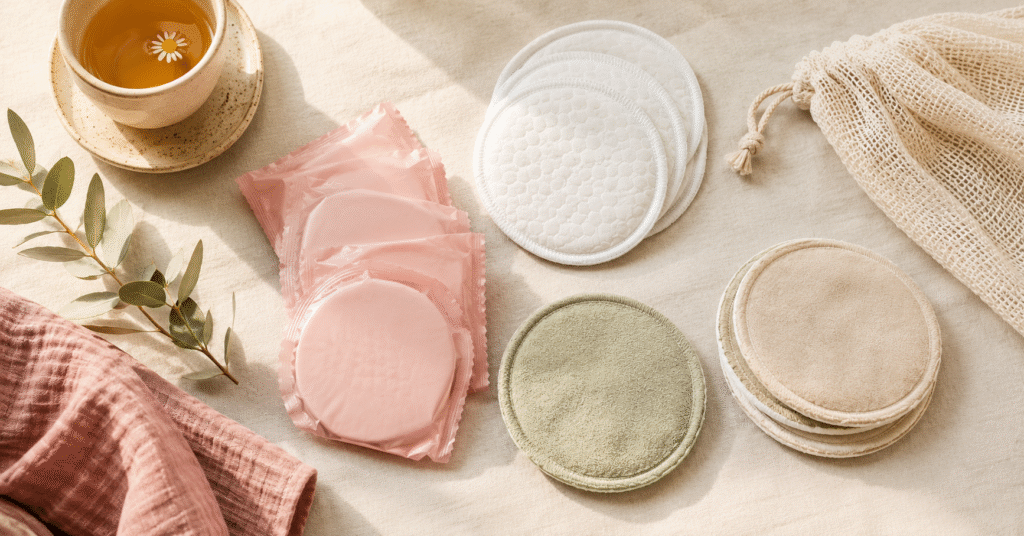
Postpartum milk letdown has a way of finding you at the worst possible moment: the grocery checkout, an in-law visit, or your first day back in a real bra. After three babies, I have learned that a nursing pad can be a small but useful part of an early-postpartum routine.
This researched guide compares seven nursing-pad designs: two disposable and five reusable. Three count choices for one Lansinoh design bring the total to nine current Amazon buying options, each pointing to an audited exact child listing. I checked the exact Amazon child listings against current brand specifications and reviewed independent testing where available; the product sections below do not claim that I personally used every exact SKU.
Pack size, fit, absorbency, and care matter more than a marketplace badge. Availability can change, so confirm the exact count, color, size, seller, and delivery date on the listing before buying.
Quick Picks: 7 Designs and 9 Exact Listings
🗑️ Disposable — 2 Designs, 4 Listings
| Pick | Why it’s here |
|---|---|
| Flexible Pack SizesLansinoh Stay Dry | One pad design with three exact count choices: 36, 100, or 200. InvisiLock core, contoured fit, waterproof backing, and individual wrappers. |
| Thin and BreathableMedela Ultra-Breathable — 120 Count | 1.6 mm thin, triple-layer absorbent core, side leak guards, and a brand-measured 20% breathability advantage over its leading comparator. |
♻️ Reusable — 5 Designs, 5 Listings
| Pick | Why it’s here |
|---|---|
| Contoured 10-PackKindred Bravely Organic Reusable — Regular 4.5" | Five pairs plus a waterproof carry pouch. The linked child is Regular Twilight, 4.5 inches, with an OEKO-TEX STANDARD 100 certification. |
| Day-and-Night MixBamboobies Variety Pack — 6 Ultra-Thin + 2 Overnight | Three pairs of heart-shaped daytime pads and one pair of thicker round overnight pads in one pack. |
| Organic Skin LayerLansinoh Washable — Beige, 10 Count | USDA Certified Organic bamboo-viscose top layer, microfiber core, waterproof outer, and OEKO-TEX STANDARD 100 certification. |
| Seven PairsKeaBabies Comfy — Pastel Touch, Large 5" | The exact linked child includes 14 pads plus a wet bag and wash bag. Its four-layer design has a bamboo-viscose skin layer, two absorbent inner layers, and waterproof backing. |
| Heavier LeaksBamboobies Overnight — 4 Pads | Two pairs of the larger, rounder reusable style intended for heavier leaks. Change them whenever they become wet. |
Disposable vs Reusable: How to Choose
Many parents use both types. Disposable pads reduce laundry and are individually wrapped; reusable pads avoid a new pad for every change but need washing and drying. Absorbency, fit, and change frequency vary by product and by how much you leak.
🗑️ Disposable
- Absorbency: The two designs here use absorbent polymer cores and waterproof back layers.
- Convenience: Unwrap, place the adhesive against the bra, wear, and discard after use.
- Cost over time: You make repeat purchases; the better count depends on your actual change rate.
- Best for: Travel, work, a diaper bag, or periods when laundry is difficult.
- Trade-off: Single-use waste, and fit or adhesive performance can vary by bra.
♻️ Reusable
- Absorbency: Construction varies by design; replace a pad when it feels wet rather than assuming one wear time.
- Convenience: Requires enough clean pairs for your wash schedule and the maker’s care method.
- Cost over time: Reuse can reduce repeat purchases, but lifespan depends on care and wear.
- Best for: Parents who prefer washable fabric and can keep up with laundering.
- Trade-off: Some designs are thicker or can shift in an unstructured bra.
A practical starting point is a small disposable pack plus one reusable set. That lets you learn your leak pattern, bra fit, and laundry rhythm before buying more.
Top 2 Disposable Nursing Pad Designs
Lansinoh Stay Dry — 36, 100, or 200 Count
One pad design with three exact buying options.
Lansinoh describes Stay Dry as a thin, contoured disposable pad with a quilted skin layer, an InvisiLock core that captures and disperses moisture, a waterproof backing, and two adhesive strips that attach to the bra. The pads are individually wrapped, fragrance-free, dermatologist tested, and made without BPA or BPS. The brand reports absorbency of up to 20 times each pad’s weight.
Choose the count for the job rather than treating each box as a different product: the 36-count is the smallest commitment, the 100-count is the middle option, and the 200-count is the bulk Amazon child. Compare current unit prices before choosing; pack pricing changes.
Check 36 Count →
Check 100 Count →
Check 200 Count →
✓ Pros
- Three exact pack sizes for trial, routine use, or bulk buying
- Individually wrapped and easy to carry
- Contoured shape and two bra-facing adhesive strips
- Fragrance-free, BPA/BPS-free, and dermatologist tested
✗ Cons
- Adhesive hold and contour can vary by bra and movement
- The bulk box takes more storage space
- Current unit price must be checked rather than assumed from pack size
Medela Ultra-Breathable — 120 Count
A 1.6 mm disposable with a measured breathability comparison.
Medela’s current product page describes a 1.6 mm contoured pad with a triple-layer absorbent core, waterproof backing, and side leak guards. The brand says it absorbs 50 times its own weight and is 20% more breathable than the leading competition. Those are brand-measured specifications with a named comparison boundary, not a claim that it outperforms every disposable.
This is the thinner disposable choice in this guide. It may suit fitted clothing or warm conditions, but no pad is invisible on every body or irritation-proof. Medela recommends changing it every three to four hours for hygiene, and sooner if it becomes wet.
✓ Pros
- 1.6 mm thin and contoured
- Triple-layer core with side leak guards
- Hypoallergenic, fragrance-free, and dermatologically tested
- Individually wrapped
✗ Cons
- Disposable, so it creates repeat cost and waste
- The 20% breathability claim is against Medela’s leading comparator, not the whole market
- Must still be changed regularly and whenever wet
Top 5 Reusable Nursing Pad Designs
Kindred Bravely Organic Reusable — Regular 4.5", 10 Pack
Five pairs plus a waterproof carry pouch.
The exact linked child is Regular Twilight, 4.5 inches. Kindred Bravely lists a skin-touch layer of 100% viscose from bamboo, a 100% polyester middle, and a waterproof 100% polyurethane outer. The ten pads come with a waterproof carrying bag. The brand’s current page says the product was tested for harmful substances under OEKO-TEX STANDARD 100, certificate 11-54221 SHIRLEY.
The brand also sells a larger Busty size, but it is a separate child listing; the Amazon link here is the Regular 4.5-inch configuration. Wash before use, machine wash warm, tumble dry, and avoid fabric softeners or dryer sheets according to the brand.
✓ Pros
- Ten pads plus a waterproof carrying bag
- Contoured 4.5-inch Regular fit
- OEKO-TEX STANDARD 100 harmful-substance certification
- Brand lists the product as HSA/FSA eligible
✗ Cons
- The linked child is not the larger Busty size
- No adhesive; stability depends on bra fit
- Requires washing and drying between uses
Bamboobies Variety Pack — 6 Ultra-Thin + 2 Overnight
Two shapes in one eight-pad pack.
The pack contains three pairs of heart-shaped Ultra-Thin pads for lighter leaks and one pair of larger round Overnight pads for heavier leaks. The exact listing gives the skin-touch layer as 57% bamboo viscose, 23% polyester, and 20% cotton; the absorbent inner layer is 55% ramie and 45% cotton, with a polyester outer layer and TPU waterproofing.
The mixed pack is useful if you want to compare the two shapes before buying more. BabyGearLab’s current testing praised comfort while also noting that the heart shape can shift and that the thinner pads are not the strongest option for heavy leaking.
✓ Pros
- Six daytime pads plus two overnight pads
- Soft velour-style skin surface
- Lets you compare two formats in one purchase
- Machine washable and dryer safe
✗ Cons
- Heart-shaped pads may take practice to position
- Ultra-Thin pads are intended for lighter leaks
- No adhesive; movement depends on bra structure and fit
Lansinoh Washable — Beige, 10 Count
One organic material claim and one harmful-substance certification.
This exact child is the Beige 10-count. Lansinoh describes a three-layer pad with a USDA Certified Organic bamboo-viscose layer next to the skin, a microfiber core, and a waterproof outer. The product also carries OEKO-TEX STANDARD 100 certification, which means the finished textile was tested for harmful substances; it is not a second organic certification.
Five pairs and a mesh wash bag are included. Lansinoh advises changing after a feeding or when saturated, rinsing milk from used pads, machine washing warm in the bag, and tumble drying low.
✓ Pros
- USDA Certified Organic bamboo-viscose skin layer
- OEKO-TEX STANDARD 100 harmful-substance certification
- Contoured three-layer design
- Ten pads and a mesh wash bag
✗ Cons
- Needs laundering after use
- Only the skin-touch material is described as USDA Certified Organic
- Five pairs may require frequent washing for frequent leakers
KeaBabies Comfy — Pastel Touch, Large 5", 14 Pack
The linked child is one exact color and size.
The Amazon link resolves to Pastel Touch, Large 5 inches, with 14 pads plus a wet bag and wash bag. KeaBabies’ current product page describes four layers: a bamboo-viscose skin layer, two absorbent inner layers, and a waterproof backing. How often you need to change them depends on leakage.
The product family also has other sizes, but those are different child listings. Choose by the exact size shown in the cart rather than assuming this link will preserve a changed selector.
✓ Pros
- Fourteen pads, a wet bag, and a wash bag
- Four-layer construction with waterproof backing
- Large 5-inch exact linked size
- Machine washable; tumble dry low per the brand
✗ Cons
- This link is not the Medium or X-Large child
- No adhesive; an unstructured bra may allow shifting
- Seven pairs do not guarantee a week between washes; change frequency follows leakage
Bamboobies Overnight — 4 Pads
Two pairs of the larger round style.
Bamboobies positions this round, thicker reusable for heavier or overnight leaking. The exact listing gives the material blend as 57% bamboo viscose, 20% cotton, and 23% polyester. The four-pad box provides two pairs.
“Overnight” describes the intended role, not a promise that one pad will stay dry until morning. Change it whenever it becomes wet. The pads are machine washable and dryer safe; Bamboobies says medium heat is acceptable.
✓ Pros
- Larger round shape for more coverage
- Thicker than the brand’s Ultra-Thin daytime pad
- Machine washable and dryer safe
- Can supplement the mixed variety pack
✗ Cons
- Thicker profile can show under fitted clothing
- Only four pads, so wash timing matters
- No fixed wear time; replace when wet
How to Choose for Your Current Routine
Your leak pattern can change during breastfeeding, so treat the first purchase as a starting set rather than a permanent system. Our first week with a newborn guide covers the wider feeding and recovery routine.
Care, Change Frequency, and Skin Health
Change any nursing pad when it becomes wet. Medela’s current guidance for its Ultra-Breathable disposable says every three to four hours for hygiene, and during an overnight feed if it has leaked. Other products may give different directions, so follow the exact package.
A wet pad does not prove or diagnose thrush. The NHS thrush guidance advises changing breast pads often during treatment. Seek assessment for persistent burning or itching, nipple or areola changes, or breast pain rather than trying to identify the cause from the pad alone.
For reusable pads:
- Wash before first use when the maker says to. Do not assume every fabric reaches a universal “full absorbency” after one wash.
- Use the exact care label. Kindred Bravely says machine wash warm, tumble dry, and avoid fabric softener or dryer sheets; Lansinoh says machine wash warm and tumble dry low; Bamboobies permits machine washing and medium-heat drying.
- Keep enough clean pairs for your own change rate. There is no universal minimum set size.
- Replace damaged or poorly performing pads. No fixed 12-month lifespan applies to every material or wash routine.
For disposables:
- Do not flush them. Put used pads in household waste.
- Place adhesive against the bra. It is not designed to touch the nipple or raw skin.
- Replace when wet and follow the package interval. Stop using a pad if it causes irritation.
Frequently Asked Questions
How many nursing pads do I need?
There is no reliable one-number answer because leaking and change frequency vary. A 36-count disposable box is the smallest exact option in this guide if you want to measure your use before buying 100 or 200. For reusables, count how many pairs you wet between laundry cycles, then keep enough clean pads for that interval without stretching wear time.
Can I sleep in disposable nursing pads?
Follow the exact product instructions. Medela says its Ultra-Breathable pads can be worn overnight, but recommends changing a leaked pad during an overnight feed and changing every three to four hours for hygiene. A soft sleep bra can help keep either a disposable or reusable pad in place.
Do nursing pads cause thrush?
A nursing pad alone does not diagnose the cause of nipple or breast pain. NHS guidance for breastfeeding thrush advises changing breast pads often during treatment. If you have persistent burning, itching, skin changes, or breast pain, ask a healthcare professional to assess you and your baby rather than self-treating from symptoms alone.
Are silicone nursing pads the same as absorbent pads?
No. Silicone products generally use a non-absorbent surface and some apply gentle pressure; absorbent pads collect leaked milk. Check the exact maker’s intended use, warnings, and cleaning instructions. A silicone product is not a direct substitute when you need absorbency.
Is organic cotton better than bamboo viscose?
Fiber name alone does not determine absorbency, comfort, or durability. Compare the whole construction, fit, waterproof layer, care instructions, and applicable certification. OEKO-TEX STANDARD 100 means a textile was tested for harmful substances; it does not mean the material is organic.
How can I reduce visible pad lines?
A contoured pad, a supportive bra, and smoothing the pad before dressing can help. Medela lists its Ultra-Breathable pad at 1.6 mm, making it the thinnest design in this guide, but no pad is guaranteed to disappear under every garment.
Can I use nursing pads during pregnancy?
Some people notice occasional milk leakage later in pregnancy. If the exact pad instructions allow use, a clean pad can protect clothing; change it when wet. Seek medical advice for unexpected nipple discharge, pain, a breast change that concerns you, or any other unexpected symptom.
The Bottom Line
This guide now covers seven distinct designs: two disposable and five reusable. The Lansinoh Stay Dry design has three exact count choices, so the article links to nine current Amazon buying options in total. Each option points to an audited exact child listing. That gives you a small trial box, two larger packs, a thinner disposable, and five reusable constructions without presenting count variants as separate pad designs.
A reasonable first purchase is the Lansinoh Stay Dry 36-count plus one reusable set that fits your bra and laundry routine. Change pads when wet, follow the exact care label, and scale the quantity only after you know your own use. For the wider setup, see our breastfeeding essentials for new moms.