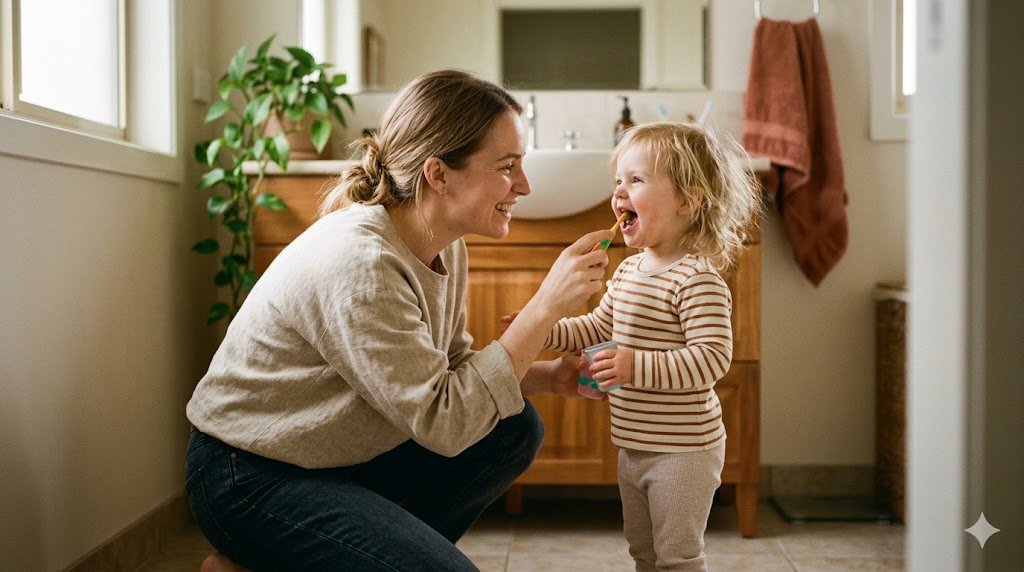
My youngest is nineteen months old, and for about six weeks this spring, toothbrushing in our house looked less like hygiene and more like a wrestling match with a very small, very loud opponent. Mouth clamped shut, head whipping side to side, the full back-arch the second the brush came near. If you’re reading this with a similar tiny human currently refusing to open up, I promise you’re not failing — toddlers fighting the toothbrush is so common it’s basically a developmental milestone nobody warns you about.
Here’s what kept me from giving up: baby teeth are not throwaway teeth. They hold space for the adult ones, they matter for speech and chewing, and decay in little kids is more common than most parents expect — the CDC lists tooth decay as one of the most common chronic conditions of early childhood. So we can’t skip it. But we can make it a lot less awful, and most of what worked for us didn’t cost a thing.
I’ll walk through the free strategies first (start here), then the small handful of tools — fun toothbrushes, timers, and the flavored-toothpaste question — that earned their place. I research this stuff constantly for the blog, and I’ll flag the products that get oversold, because a few of them really do.
Start free: the tricks that ended the battle for us
Before you buy anything, try these. With my youngest, the combination below took us from nightly meltdown to “mostly fine” in about a week, and none of them require a cart.
- Let them pick. A toddler who chose the blue brush over the green one has decided to participate. The illusion of control is your best free tool — same with flavor: let them sniff two and point.
- Brush yours at the same time. Mine copies everything. The day I started brushing my own teeth shoulder-to-shoulder with him at the mirror was the day he stopped treating the brush like a threat.
- “You brush mine, I’ll brush yours.” Hand them a brush to “clean” your teeth while you sneak in a few seconds on theirs. Ridiculous, effective.
- Count the teeth out loud. “Let’s find all the teeth! One… two… where’s the back one hiding?” Turns it into a game with a finish line.
- Open like a lion or an alligator. Animal mouths are funnier than “open wide.” My older son, three now and fully cooperative, still does the lion roar.
- Let them hold it first. A few seconds of gnawing on the brush themselves takes the fear out of it, and then you take a turn.
Not every trick lands for every kid. We tried singing and it did nothing for my youngest, but the mirror and the copying were magic. Rotate through, keep what sticks.
Why two minutes matters (and how to make it visible)
Dentists recommend two minutes, twice a day. The problem with two minutes and a toddler is that it feels like an hour to both of you. Making the time visible — something they can watch shrink — turns an abstract countdown into a finish line they can see. Three ways to do it, cheapest first:
- Free apps. Disney Magic Timer and Brush DJ both run a two-minute brushing timer with characters or music. Zero dollars, and the novelty alone buys you a few cooperative weeks.
- A built-in timer on the brush. Most of the toddler electric brushes below pulse every 30 seconds and stop at two minutes, so the brush does the timing for you. For under-3s, that’s usually all you need.
- A standalone visual timer. Useful once they’re around three and brushing more independently, or as one timer the whole family shares.
Learning Resources 2-Minute Toothbrushing Timer — best standalone timer
You tap the button, a light comes on, and a little “all done” chime plays at the two-minute mark — a clear, kid-readable start and stop. Reviewers love that it works even when their electric brushes have no timer. The one repeated gripe: the chime is loud. More than one parent mentioned taping over the speaker, which tells you it works as designed — maybe too well.
Power: 2 AAA batteries (not included)
Best for: independent brushers around 3+, or one shared family timer
Skip if: your child is under 3 (use the brush’s built-in timer or a free app), or noise is a sensory issue
Fun toothbrushes that actually help
A lights-up, buzzing brush does two real things: it makes the kid curious instead of scared, and the gentle vibration plus a little glow lets you see what you’re doing in a tiny dark mouth. The two below are the ones I’d point a friend toward. (If you want the full breakdown by age and brush type, our toddler toothbrush guide goes deeper.)
Papablic Toddler Sonic Electric Toothbrush (Dino) — best all-rounder
Built for ages 1–3, this one pairs a cute animal cover (the kind of thing that gets a toddler to walk toward the bathroom) with the practical stuff: sonic vibration, a soft LED light, a 2-minute smart timer with 30-second pulses to move you to the next part of the mouth, and a suction base so it stands upright instead of rolling into the sink.
Features: ~18,000 sonic vibrations/min, LED light, 2-min timer + 30-sec pulses, suction base
Power: AAA battery (included); ships with 2 brush heads
Note: small parts + battery — a supervise-during-use brush, not hand-it-over-and-walk-away
Brush-Baby BabySonic (0–3) — gentlest, best for babies & sensitive kids
This has the gentlest vibration of the bunch, which matters if your kid finds other electric brushes too intense (a complaint I see constantly in reviews). Usable from birth, it comes with a baby head (0–18 months) and a toddler head (18–36 months) so it grows with them, has a white LED light and the same 2-minute/30-second-pulse timer, and the brand reports it removes meaningfully more plaque than a manual brush. Telling backstory: the founder started the company because her own daughter chewed every toothbrush — and her sister is a dentist.
Features: white LED, 2-min timer + 30-sec pulses, BPA-free, 2 heads (0–18mo + 18–36mo)
Power: AAA battery (included)
The real downside: the soft heads wear out fast — budget for new heads every ~3 months
The flavored-toothpaste question (where parents get confused)
Fruit flavors are the single biggest lever for a toothpaste refuser — a kid who likes the taste stops fighting the paste. But flavor is also why this section needs a clear head, because “tastes like candy” plus “my kid swallows it” is a combination worth thinking about.
The big fork is fluoride vs. fluoride-free. And the surprising part: most of the best-selling “toddler” toothpastes are fluoride-free, marketed as “safe to swallow” — yet the guidance from the major dental bodies points the other way.
So why are fluoride-free pastes so popular? Because they take the swallowing worry off the table, which is reassuring during the stage when your kid can’t spit yet. That’s a valid reason to choose one. Just go in clear-eyed: fluoride-free training pastes don’t fight cavities the way fluoride does. Many lean on xylitol, which has some plaque benefits but isn’t a one-for-one replacement for fluoride’s proven decay protection. What matters is knowing which trade-off you’re making — and asking your pediatric dentist what’s right for your kid. (For more options than the three below, see our full toddler toothpaste roundup.)
If you want fluoride (the cavity-protection pick)
Tom’s of Maine Natural Kids Fluoride Toothpaste — Silly Strawberry
A fluoride toothpaste for ages 2+, in a strawberry flavor kids ask for, with no artificial dyes or preservatives. My top fluoride pick over the drugstore options because it carries the ADA Seal of Acceptance — the ADA’s independent vetting that a product does what it claims. (Look for the seal on the box to confirm.) Use the rice-grain amount under 3, pea-size after.
Ages: 2+
Trust signal: ADA Seal of Acceptance
Allergy note: a recent formula adds some fruit-juice flavoring (incl. citrus) — check the current panel if your child has food allergies
If you want fluoride-free (the “can’t spit yet” pick)
Dr. Brown’s Fluoride-Free Baby Toothpaste — Strawberry
A budget-friendly fluoride-free training paste with xylitol, made for 0–3, in a strawberry flavor that makes the brush something they want. It’s marketed as safe to swallow — the point of a training paste — but I’d still keep it to a pea-sized drop and supervise, because the goal is to teach spitting, not to lean on swallowing being okay. An easy, inexpensive on-ramp before you graduate to fluoride.
Ages: 0–3
Best for: the stage before your child can reliably spit
Tubby Todd Fluoride-Free Kids Toothpaste — Watermelon
From the small skincare brand a lot of parents already know, this fluoride-free, xylitol-sweetened paste uses naturally sourced silica and calcium, skips dyes and fragrances, and comes in a watermelon flavor that’s a nice change if your kid is over strawberry. A pricier “clean-ingredient” option for the flavor-motivated refuser.
Ages: 3 months+
Best for: flavor variety; clean-ingredient preference
A few things that aren’t optional
- Supervise, every time, until about 6–8. Little kids don’t have the dexterity to clean their own teeth well — and supervision is how you control the toothpaste amount.
- Twice a day, and don’t skip the bedtime one. Overnight is when saliva drops and decay creeps; the night brush matters most.
- Spit, don’t rinse. With fluoride paste, leaving a thin film does more good than washing it all away.
- Replace brush heads every ~3 months, and after any illness. Folding brushing into a predictable sequence helps it stick — our daily routine chart for toddlers (free printable) is one easy way to anchor it.
When to call the pediatric dentist
Most refusal is just toddler-being-a-toddler. But loop in a dentist if you see white or brown spots on the teeth, if your child seems to be in pain while eating, or if the refusal is so total that no teeth are getting cleaned at all. The AAPD recommends a first dental visit by age one. If you’re still tracking which teeth have come in, our teething timeline shows what to expect and when.
Quick answers
My toddler swallows toothpaste — is that dangerous?
With the recommended rice-grain (under 3) or pea-size (3–6) amount of fluoride paste, occasional swallowing isn’t a concern. The risk only comes from using too much over time. If your kid truly eats it like a snack and can’t spit yet, a fluoride-free training paste is a reasonable bridge while you teach spitting.
Are electric toothbrushes safe for a one-year-old?
Yes — the ones designed for that age use gentle vibration and soft, small heads. Just supervise during use, since they have batteries and small parts.
What if my kid hates every flavor and every trick?
Lower the bar. A few seconds of any brushing beats a full meltdown and zero brushing. Let them chew the brush, do it in the bath, do it while they watch a show — get teeth cleaned however you can, and the cooperation usually catches up later. It did for my older son.