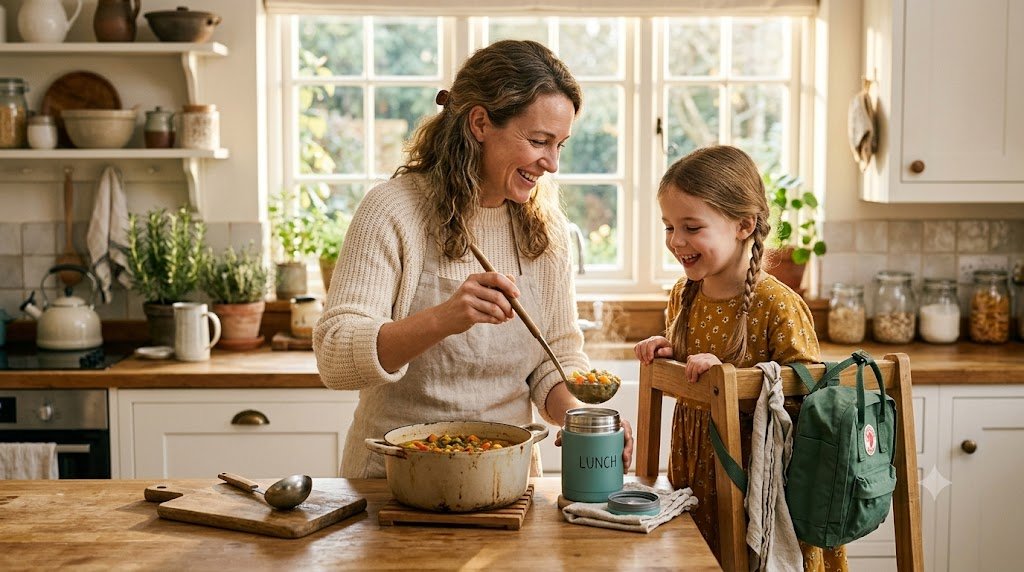
At 7:10 a.m., steam is still curling from the pasta as the lid goes on. By noon, the questions are simpler: Is lunch still safely hot, and can your child open the jar—or does an adult know to help? A jar that fails either test usually comes home full.
If you need a kids’ food thermos for a hot school lunch, start most K–2 children with the 10-ounce Thermos FUNtainer. Choose something else only when the twist lid, portion size, need for cold sides, or an older student’s routine makes the smaller jar a poor fit. The quick cards below handle those exceptions.
One important boundary comes before any shopping. An easier lid does not replace adult help with hot food. Thermos specifically requires adult supervision with hot contents, and I would use the same plan for any younger child: an adult opens the jar, stirs the food, and checks the temperature before the child eats.
Most families can stop with one suitable jar. If your child prefers cold lunches, the school already provides a hot meal, or there will be no adult help for a younger child, you may not need a hot-food jar at all.
Quick answer: which kids’ food thermos fits your child?
Starting point for most K–2 lunches
Thermos FUNtainer
- Capacity
- 10 oz or 16 oz
- Lid
- Twist lid; practice with cool food first
- Choose it for
- A compact early-elementary lunch; 16 oz only for a bigger appetite
- Trade-off
- The lid can tighten as contents cool; the larger jar is heavier
For preschool hands
Bentgo Kids Stainless Steel Food Jar
- Capacity
- 11.2 fl oz
- Lid
- Easy-open form with more shape to grip
- Choose it for
- A younger child who struggles with plain round lids
- Trade-off
- Smaller portion; the seal still needs care
For hot food and cold sides
OmieBox V2
- Capacity
- 8.5 oz removable food jar
- Lid
- Handle-style thermos lid
- Choose it for
- A warm main and cold sides in one box
- Trade-off
- Heavy, hand-wash only, daily seal cleaning
For older kids and teens
Stanley Classic Food Jar and Spork
- Capacity
- 14 oz
- Lid
- Built-in pressure-release valve
- Choose it for
- An older student who can operate the lid correctly
- Trade-off
- No official child-age minimum; not a preschool pick
The best insulated food jars for hot school lunches
Thermos FUNtainer — the starting point for most K–2 lunches
The FUNtainer is the simplest starting point for a typical early-elementary lunch. Its 10- and 16-ounce versions are one family decision, not two separate winners. Ten ounces keeps the container compact and suits a smaller portion. Sixteen ounces gives a bigger eater more room, but it also means more steel and more food to carry. Do not size up for an appetite that has not arrived.
The twist lid is the deal-breaker. Practice with cool food at home; if your child cannot open a fully closed jar, choose Bentgo or arrange help. Keep the gasket clean and seated, and never send the lid partly loosened. Thermos’s care guide lists top-rack dishwasher cleaning, though hand washing makes it easier to clean carefully around the gasket.
Bentgo Kids — for preschoolers who need an easier lid
Choose Bentgo when grip is the problem: its age-3+ lid and base bumper suit smaller hands. At 11.2 ounces it is not the bigger-appetite pick, and it still needs a fully closed lid and regular seal checks. Bentgo’s instructions list the jar as top-rack dishwasher safe but recommend hand washing to protect the leak-proof lid seal.
OmieBox V2 — for hot food and cold sides in one box
OmieBox V2 solves a different lunch: a warm main beside cold fruit or vegetables without packing two separate containers. Its removable food jar holds 8.5 ounces, so think modest hot portion, not a large bowl of soup.
The convenience at packing time comes back at the sink. The box is heavy compared with a stand-alone jar, and OmieLife recommends hand washing it with a non-abrasive sponge. Remove, clean, and fully dry the lid seal and gasket every day.
For packing, put wet foods such as soup or yogurt in the thermos, do not fill it past the ridge below the neck, and do not overtighten its lid.
Choose OmieBox when the one-box layout is worth that routine. If cold sides can ride in a regular bento beside a separate jar, the simpler arrangement is easier to maintain. My toddler lunch and bento box guide covers that half of lunch packing.
Stanley Classic — for older kids and teens
For an older child or teen, the current Stanley pick is the 14-ounce jar—not the unavailable 18-ounce model. The current Stanley jar has a pressure-release valve and an attached spork. Stanley gives no child-age minimum, so I would not send it with a preschooler. Inspect the body, lid, and spork attachment on arrival and return any damaged jar. Stanley recommends hand washing; use a dishwasher’s top rack only when the bottom of the jar is marked dishwasher safe.
How to help a hot school lunch stay warm until lunchtime
An insulated jar can hold heat, but it cannot make undercooked or poorly handled food safe. Four steps keep the routine clear:
- Start with safely cooked food. Follow the USDA minimum temperature for the food you are preparing. Reheat leftovers to 165°F with a clean food thermometer; bring reheated soups, sauces, and gravies to a rolling boil.
- Follow the preheating directions for the jar you bought. The USDA school-lunch guide gives a general insulated-container method, but brand directions differ. An adult should handle and empty the water with children out of reach.
- Leave room for the lid and close it fully. Transfer the food promptly, follow the fill line or headspace instructions, check that the gasket is present and seated, and wipe the rim and threads. Keep the jar closed until lunch. A partly loosened lid is not an easy-open solution. If a lid sticks, point the opening away from people and pets, do not use tools or force it, and follow the maker’s instructions. Use a built-in pressure-release valve only as designed.
- Test the real wait to lunch. At home, use the food, portion, starting temperature, and schedule you plan to pack. At the planned lunchtime, open the jar, stir the food, and check the center with a clean thermometer. If it is below 140°F, do not rely on that food–jar–schedule combination. A brand’s “hot for X hours” claim is not proof of safe holding. Repeat the check when the food, portion, starting temperature, or wait changes materially.
Preheating differs by jar: Thermos calls for hot tap water with the lid attached for 5–10 minutes. Stanley calls for warm tap water for 5 minutes. OmieLife calls for hot water from a kettle for 5 minutes with the lid off.
What 140°F means: FoodSafety.gov identifies 140°F as the minimum hot-holding temperature, not a child-safe serving target. Perishable food should not remain in the 40–140°F danger zone for more than 2 hours, or 1 hour when the surrounding temperature is above 90°F.
For younger children, an adult should stir and check the food before the first bite; do not make a preschooler the temperature tester. Discard the unfinished thermos meal after lunch.
Moist foods are the easiest place to begin: soup, chili, saucy pasta, curry, or rice with stew. Nuggets, quesadillas, and other crisp foods usually soften inside a sealed jar. That is trapped steam, not proof that the jar failed.
Choose the smallest jar that holds a real lunch and run the lunchtime thermometer check. If that exact routine passes, you do not need a cheaper backup jar or a matching collection.