Updated July 28, 2026
A rolling cart can be the reason crayons, chargers, and diaper creams stop wandering from room to room. It can also become a three-story junk drawer that nobody wants to sort.
What keeps a cart useful is not the number of hooks or the prettiest color. It needs one clear job, a parking spot that actually fits, and wheels that suit the floor beneath it.
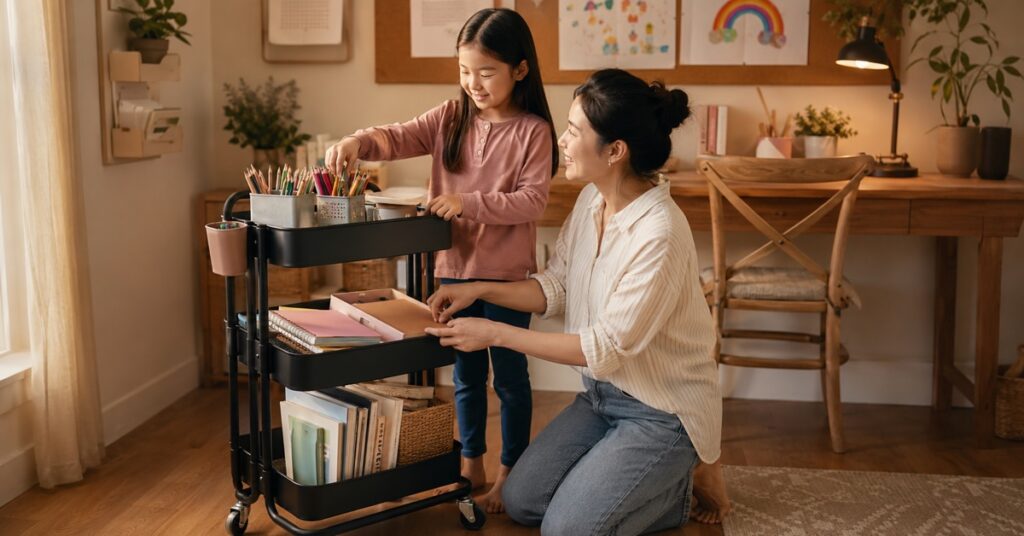
I like a three-tier cart for supplies that need to stay together but do not need permanent cabinet space. My daughter can bring a homework cart to the table, find what she needs, and return the whole station afterward. For younger children, the same idea works only when an adult controls the cart and keeps unsafe items out of reach.
The five picks below cover different family jobs. None is perfect. Some are smaller than their photos suggest, some are happiest on hard floors, and two make more sense as mostly stationary storage than as carts you push around all day.
Quick Picks
- Best overall: YASONIC 3 Tier Metal Rolling Cart. A compact metal cart with two side cups and three hooks that are genuinely useful for craft and homework supplies.
- Best budget cart for small items: Goovilla 3 Tier Rolling Utility Cart. The removable drawer helps contain little things, but the plastic frame is best kept to light loads.
- Best simple metal cart: Simple Houseware 3-Tier Metal Utility Rolling Cart. A wider, no-frills option for paper, school supplies, and craft bins.
- Best for taller, mostly stationary storage: Pipishell 3-Tier Rolling Utility Cart. The tallest pick here, with deeper baskets and a brand-confirmed limit of 22 pounds per shelf.
- Best for a clearly documented load limit: Amazon Basics 3-Tier Rolling Utility Cart. Its official manual states a maximum of 44.1 pounds per tier, with important limits on how and where it should be used.
At a Glance
| Rolling cart | Best for | Approx. overall size (W × D × H) | Material | Load information | Main trade-off |
|---|---|---|---|---|---|
| YASONIC | Craft and homework supplies | 11.45 × 15.35 × 29.79 in. | Metal | No clear per-tier limit available | More compact than many product photos make it look |
| Goovilla | Makeup, cables, diaper creams, and other small items | About 14.9 × 10.6 × 30.6 in. | Plastic | No clear per-tier limit available | Light-duty feel; narrow wheels struggle on carpet |
| Simple Houseware | Paper, school supplies, and craft bins | 17 × 12.5 × 31.5 in. | Metal | No clear per-tier limit available | Occasional missing hardware and uneven-wheel reports |
| Pipishell | Taller storage that usually stays parked | 16.5 × 13 × 33.8 in. | Metal | 22 lb. maximum per shelf; 66 lb. total | Repeated complaints about casters sticking or not sitting level |
| Amazon Basics | Supplies that need a documented static weight limit | 18.4 × 13.9 × 31 in. | Metal | 44.1 lb. maximum per tier; 132.2 lb. total | Not a cart to push across thresholds while heavily loaded |
What Matters in a Family Rolling Cart
Start with the job. A cart for markers, glue sticks, and workbooks needs different strengths from one holding pantry cans or stacks of paper. Lightweight accessories can make a small cart more convenient. They cannot turn a plastic frame into a heavy-duty one.
Then measure the parking spot and the basket interior. Overall dimensions include the frame, handles, and sometimes the casters. A 12-inch-deep cart does not necessarily accept a 12-inch storage bin. Leave room for the wheels to pivot, especially beside a desk or inside a narrow pantry.
Your floor matters too. Small casters are usually easiest on smooth, level hard flooring. Thick rugs, door thresholds, cords, and uneven transitions can make a tall loaded cart stop suddenly or tip. If the cart will move between rooms every day, wheel complaints deserve more weight than an extra cup or hook.
Finally, read load numbers carefully. A seller claim, a brand product page, and an exact-model instruction manual are not the same level of documentation. Even an official maximum normally describes a cart standing on firm, level ground. It is not permission to fill every tier to the limit and let a child race it down the hallway.
If your real goal is a calmer study area, connect the cart to a simple family command-center routine. The routine keeps the cart useful; the cart only keeps the supplies together.
The 5 Best 3-Tier Rolling Carts for Family Organization
1. YASONIC 3 Tier Metal Rolling Cart — Best Overall
YASONIC is my first choice for the family job that makes the most sense for a small rolling cart: keeping craft and homework supplies together.
The three mesh baskets hold the larger pieces, while two hanging cups give pencils, scissors, rulers, and paintbrushes a place where children can see them. Three hooks can handle tape, headphones, or a small pouch. That layout is more useful than a plain set of baskets when the cart needs to support an activity rather than store a single type of item.
It is metal, weighs about eight pounds empty, and uses four two-inch casters, including two that lock. The cart is compact at 29.79 inches high, 15.35 inches deep, and 11.45 inches wide. That can be an advantage beside a child’s desk, but it is also the main reason to measure before ordering. The size has surprised buyers who expected something closer to a full-size kitchen cart.
The other complaints are less common but worth knowing before assembly day: missing nuts, wheels that loosen, and casters that become less secure over time. Count the hardware before you begin, tighten the wheels evenly, and recheck them after the first few weeks.
I would use this one for notebooks, coloring books, craft paper, and lightweight activity bins. The advertised maximum does not tell you how the cart behaves while moving, so keep the load modest if you plan to roll it often.
Best for: A compact craft, homework, or family command cart where the side cups and hooks will have clear jobs. Skip it if: You want a wide kitchen cart or expect children to push a heavy load.
2. Goovilla 3 Tier Rolling Utility Cart — Best Budget Cart for Small Items
Goovilla makes sense when your problem is a crowd of small, lightweight things—not a shelf of books pretending to be lightweight things.
The cart is plastic and comes with a removable drawer, two cups, and four hooks. The drawer is the useful difference. Charging cords, hair ties, nail clippers, and tubes of cream do not stay neat in an open mesh basket; a shallow closed space gives them a home without adding another box.
The assembled cart is roughly 30.6 inches high, 14.9 inches wide, and 10.6 inches deep. Amazon’s current dimensions field appears to show packaging rather than a usable assembled height, so treat those model-specific assembled measurements as approximate and measure with a little extra room.
This is the light-duty pick. The plastic frame can feel flexible, the drawer may slide or stick if the cart is not level, and the narrow wheels are a poor match for carpet. A full cart can wobble during a quick turn. Those limits matter more than the very high load claim on the product page, which I would not use as a planning number.
Choose Goovilla for makeup, charging supplies, spare washcloths, diaper creams, or small bedside items. Skip it for canned food, textbooks, tools, or a cart that needs to cross a rug several times a day. In a baby-care setup, medicines, vitamins, creams, cords, and small parts still need to stay beyond a child’s reach; putting them in a cart does not make them child-safe.
Best for: A small bathroom, bedroom, or adult-controlled care station holding light items. Skip it if: You need metal construction, carpet-friendly wheels, or dependable heavy storage.
3. Simple Houseware 3-Tier Metal Utility Rolling Cart — Best Simple Metal Cart
If cups, hooks, and drawers sound like more pieces to manage, the Simple Houseware cart keeps the design uncomplicated.
Its metal frame supports three mesh baskets and four two-inch casters, two of which lock. At 17 inches wide, 12.5 inches deep, and 31.5 inches high, it gives paper and medium craft bins a little more elbow room than the narrower YASONIC.
The simplicity works well for school supplies. One tier can hold current workbooks, one can hold paper and folders, and the bottom can take heavier refill supplies. It is also easy to assign one basket to each child, although shared scissors and sharp tools still belong in an adult-controlled place. Our mixed-age playroom safety plan can help decide what should be accessible and what should not.
Measure the containers you plan to use against the basket’s actual inside space, not only the cart’s overall depth. Buyers have found the usable basket width smaller than expected. Other complaints include missing screws or washers, a light mesh bottom, and wheels that do not all sit evenly after assembly. Lay out every part first and assemble loosely before tightening the frame square.
One more detail may matter to some families: several buyers report a California Proposition 65 warning on the packaging that is not obvious on the product page. A warning does not tell us that normal use will cause harm, but I would want to know it before choosing a nursery cart. For that reason, this is a school-and-craft pick here, not a newborn-care recommendation.
Do not let “heavy duty” in the product name decide the job. The listing does not break the limit down by tier, so I would not plan a heavy load around that number. Its better case is a straightforward metal organizer for ordinary family supplies.
Best for: Paper, craft materials, and school supplies in a wider, simple metal cart. Skip it if: You need a documented shelf limit or are specifically shopping for a nursery station.
4. Pipishell 3-Tier Rolling Utility Cart — Best for Taller, Mostly Stationary Storage
Pipishell is the tallest cart in this group, and its deeper baskets are useful when you want storage that feels closer to a narrow open shelf.
It measures 33.8 inches high, 16.5 inches wide, and 13 inches deep. The brand states a maximum of 22 pounds per shelf and 66 pounds total. That is a sensible ceiling for paper, folded linens, craft refills, or bedside supplies, with the heaviest things on the bottom.
The important phrase is mostly stationary. This model has repeated complaints about wheels sticking, dragging, falling off, or failing to touch the floor evenly. A few buyers also report missing caster bolts or holes that make assembly difficult. The official instructions show rivet nuts inside the legs, so the caster connection depends on the parts being present and seated correctly.
I would consider it for a craft corner, beside a desk, or in a laundry area where it can park with the wheels locked and move only for cleaning. I would not choose it for a classroom-style cart, a route across wood flooring and rugs, or a setup that children will push. Locks help keep a parked cart from rolling; they do not prevent a tall cart from tipping.
During assembly, keep the screws slightly loose until the frame is square, confirm all four casters sit flat, then tighten everything. If a caster drags, leaves a mark, or begins to pull away from the leg, stop using the cart rather than hoping the load will settle it.
Best for: Families who want the tallest option here and will leave it parked most of the time. Skip it if: Smooth, frequent room-to-room rolling is the reason you are buying a cart.
5. Amazon Basics 3-Tier Rolling Utility Cart — Best for a Clearly Documented Load Limit
Amazon Basics is the pick for a reader who wants the load limit in an exact-model instruction manual instead of relying only on a number in a sales listing.
The official manual states a maximum of 44.1 pounds per tier and 132.2 pounds total. It also says to have an adult assemble the cart, use it on firm and level ground, put the heaviest load on the bottom, and inspect it regularly. Those are static maximums, not a challenge to load every basket to the edge.
The metal cart is about 31 inches high, 18.4 inches wide, and 13.9 inches deep, with four pivoting rubber casters and lockable wheels. The broader baskets suit books, printer paper, canned pantry goods, or bulk craft materials better than the little plastic Goovilla. Leave extra room for the wheels to turn; the real footprint can feel wider than the frame measurement in a narrow pantry.
Assembly is the first watch-out. Short bolts, missing instructions, and pieces that need careful alignment appear in owner feedback. The more serious, less common complaint is a caster or its internal fixing coming loose after weeks or months. Check every wheel before loading the cart and add it to your regular household tightening routine.
This is not my recommendation for a child-pushed book cart or for crossing thresholds while full. A clearly documented limit makes the choice easier to plan; it does not erase the physics of a tall load on small wheels. If a caster, weld, bolt, or inner fixing loosens, unload the cart and stop using it until the connection is secure.
Best for: Books, pantry goods, paper, or other supplies that benefit from a clear official static load limit. Skip it if: Children need to move it or it will cross rugs and thresholds every day.
Give Each Tier One Job
A cart stays organized longer when the tiers are assigned by frequency and weight, not by whatever fits on the day it arrives.
- Top tier: today’s task. Keep the current homework folder, active craft tray, or daily care items here. Clear it at the end of the day.
- Middle tier: regular supplies. Use small open bins for pencils, paper, tape, washcloths, or charging accessories. Labels should describe the item, not simply say “miscellaneous.”
- Bottom tier: heavy refills. Paper, books, and unopened supplies belong low. This lowers the center of gravity and keeps the top from becoming the heaviest part.
For a homework cart, I would add one “return to room” basket. My daughter can drop stray pencils, library books, and hair clips there without derailing cleanup; the basket gets emptied after homework, not allowed to become a permanent fourth category.
A care cart needs a different rule. Keep only safe, everyday items within reach and move medicines, vitamins, nail scissors, cords, creams, and choking hazards to locked or otherwise inaccessible storage. Our newborn-station guide can help separate convenient supplies from items that should never live on an open cart.
When a Rolling Cart Is Not the Right Organizer
Choose a fixed shelf or cabinet when the contents are heavy, breakable, hot, or unsafe for children. A rolling cart is not a good stand for a television, countertop appliance, fish tank, or hot drink station. It is also a poor answer to medications and cleaning products in a home with young children.
If the cart never needs to move, a low bookcase may offer a wider base and better use of wall space. If it needs to carry supplies over thick carpet or several thresholds every day, a purpose-built utility cart with larger wheels may be more stable than any of these slim three-tier models.
For toys that children should reach and return independently, low anchored storage is often easier than a tall cart. Start with the reset in our toy-clutter guide, then decide whether mobility adds anything useful.
Rolling Cart Safety for Families
A wheel lock is a parking brake, not tip-over protection. Keep the cart on firm, level ground, put the heaviest items on the bottom, and have an adult move it when loaded.
Do not let a child climb, ride, hang from, or push a full cart. Keep hot drinks, heavy appliances, medicines, vitamins, cleaning products, scissors, small parts, and loose cords out of reach.
Check the casters, bolts, welds, frame, and any internal wheel fittings regularly. Unload and stop using the cart if a wheel wobbles, a connection loosens, the frame leans, or a basket begins to separate.
Frequently Asked Questions
What is the best 3-tier rolling cart for craft supplies?
YASONIC is the best all-around craft pick here because the two side cups and three hooks keep long tools and little accessories out of the baskets. Simple Houseware is a better fit if you want wider baskets and a plain metal layout without extra attachments.
Can a 3-tier cart work as a diaper cart?
Yes, if an adult controls it and the contents are chosen carefully. Diapers, wipes, burp cloths, and clean clothing can work well. Medicines, vitamins, nail tools, creams, plastic bags, cords, and choking hazards need inaccessible storage. Locking the wheels does not make the cart childproof.
Which rolling cart is best for carpet?
None of these is an ideal thick-carpet cart. Small casters work best on smooth, level hard floors. YASONIC’s two-inch wheels may handle a low-pile transition better than Goovilla’s narrow casters, but measure the threshold and keep the load light. For daily carpet travel, look for a purpose-built cart with larger wheels.
How much weight can a 3-tier rolling cart hold?
It depends on the exact model and how the number is documented. Pipishell states 22 pounds per shelf. The exact Amazon Basics manual states a maximum of 44.1 pounds per tier on firm, level ground. The other picks have sales-page claims but no accessible exact-model manual that clearly supports a per-tier planning limit. Never assume a static maximum is safe for frequent loaded movement.
Should the heaviest items go on the top or bottom?
Put them on the bottom. A low center of gravity makes a cart less likely to tip when it starts, stops, or catches on something. Keep the top tier for lighter, frequently used supplies.
Do locking wheels make a rolling cart safe for toddlers?
No. Wheel locks reduce rolling while the cart is parked. They do not anchor it to the floor, stop climbing, or keep unsafe contents out of reach. A toddler can still pull on a basket or use the frame to stand.
How do I keep a rolling cart from becoming cluttered?
Give the whole cart one purpose and each tier one job. Use only a few small containers, label them clearly, and remove anything that does not support the cart’s purpose during a weekly five-minute reset.
The Bottom Line
YASONIC is the most useful all-around choice for a compact craft or homework cart. Goovilla works for light little items, Simple Houseware gives you a wider plain metal layout, Pipishell is best left mostly parked, and Amazon Basics has the clearest official static load information.
Measure the parking spot and the bins you want to use. Check every rug or threshold in the cart’s path. Most important, decide whether an adult or a child will be moving it.
The best rolling cart is not the one that holds the most on delivery day. It is the one your family can still use safely—and reset without a sigh—a month later.