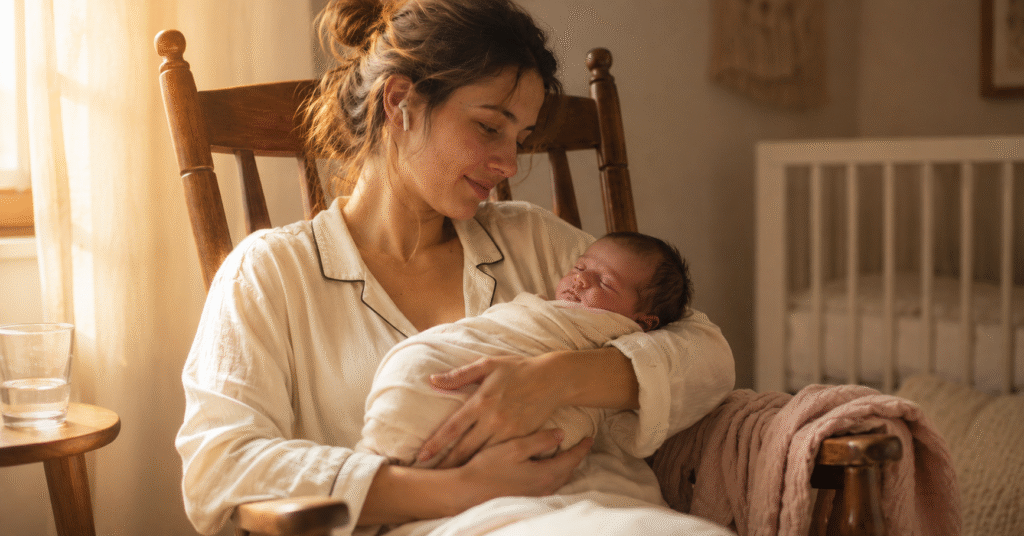
It’s 3:47am and I’m in the rocking chair with my daughter on my chest, again. She’s three weeks old, finally fell asleep after the second cluster feed of the night, and now I have a problem I didn’t expect: I’m wide awake, and I have nothing to do that my hands and brain can both manage.
I can’t reach the lamp without waking her. I can’t read the paperback I’d hopefully placed on the side table—my hand is pinned, the angle is impossible, my eyes are too tired to track text. I can’t scroll my phone without the bright light bouncing off her face. I can’t even change position to ease the cramp blooming in my left shoulder.
So I sit. And the minutes pass like wet cement.
My daughter is almost six now, but I remember those nights with a clarity that surprises me. The boredom underneath the love. The way time stretched and folded. The specific shape of being trapped under a tiny body you’d do anything for.
If you’re in that season right now—three weeks postpartum, six weeks postpartum, twelve weeks and still not sleeping—I want to tell you about something nobody mentioned to me until my second baby: audiobooks. Not for productivity. Not for self-improvement. Just for the company of a voice that isn’t asking anything from you. (If you’re still figuring out the rhythm of those early days, my hour-by-hour newborn guide walks through what the first 24 hours actually look like.)
Here are seven that postpartum moms keep coming back to, and three I’d skip if you’re newly postpartum.
The hands-busy moments nobody warns you about
Postpartum is, mechanically, the hands-busiest job most women have ever done. Which doesn’t sound like a big deal until you realize that almost every form of mental rest available to adults requires at least one free hand. Reading. Scrolling. Cooking the food you actually want to eat. Folding laundry to a podcast you have to manually unpause every time someone cries.
Audiobooks are the only consumable mental input I know of that asks for zero hands.
Here are the moments where I’d have lost my mind without them—first time around with my daughter, and again with both my sons:
- The 3am cluster feed. Forty-five minutes of nursing, then forty-five minutes of trying to put her down without waking her. Repeat. An audiobook in one earbud (the other ear listening for breathing changes) makes this survivable.
- Contact naps. My daughter, for her first three months, would nap exactly seven minutes if I put her down and ninety minutes if I didn’t. I “read” more in those three months than in the entire year before, because I had no other choice. (If you’re still hunting for a sleep setup that actually works, our 2026 bassinet picks compare the SNOO with budget options under $150.)
- The stroller walk to nowhere. Some babies sleep in strollers. Some only sleep in moving strollers. If yours is the second kind, you are about to walk approximately 600 miles in the next twelve weeks. Bring a voice with you.
- Pumping. Twenty minutes, hands occupied, brain bored, anxious about the ounces. A novel narrated by a great voice actor is the difference between dreading this and almost looking forward to it. (For the gear side of this season, our breastfeeding essentials guide covers the 10 things that actually matter.)
- The 6pm dishwasher unload with a baby strapped to your chest. This is the moment when whatever you do not get done becomes tomorrow’s problem. The audiobook playing through the kitchen speaker is what stops it from feeling like punishment.
If your phone-reading time used to happen at the gym, on commutes, or in the bath, postpartum has stolen all of it from you. Audiobooks give it back.
(I should also confess: more than once I rocked an already-asleep baby for an extra ten minutes because I wanted to finish a chapter. The chapter always won.)
Why audiobooks beat paperbacks (and Kindles, and podcasts) in the fourth trimester
I tried all four in those early months. Here’s what actually worked.
Paperbacks assume two free hands, a working overhead light, and the cognitive bandwidth to track text. Postpartum gives you exactly zero of these reliably. I gave up on a novel I’d been excited about for a month and didn’t pick up a physical book again until my daughter was nearly a year old.
Kindles are better—one-handed, backlit so you don’t disturb the baby—but you still need eyes-on-page focus. At 3am, my eyes were closed half the time. Words on a screen need active translation. A voice in your ear doesn’t.
Podcasts sound like the right answer and aren’t, for one specific reason: most podcasts are conversational, with multiple voices, ad breaks, and unpredictable emotional pacing. When you’re sleep-deprived, conversational unpredictability is exhausting. You don’t realize this until you’ve cried at a particularly cheerful host promoting mattresses while your baby refuses to latch.
Audiobooks are the sweet spot. One voice. Steady pace. No ads breaking the dream. You can lose ten minutes here, twenty there, and the book waits.
There’s something more subtle I didn’t expect, too: a good narrator becomes company. The same voice across ten or fifteen hours becomes a presence in your house during a stretch of life that is otherwise painfully lonely. I’ve talked to enough moms now to know I’m not the only one who teared up the first time a particular narrator’s voice came back after switching books.
What postpartum moms are actually listening to (and why these seven)
I spent the past few weeks digging into what new moms are recommending each other right now—r/BabyBumps and r/Mommit threads, Peanut app discussions, the comment sections of every postpartum audiobook list I could find, and Audible’s bestseller positions in the parenting category.
Seven titles kept surfacing, and they fell pretty cleanly into three buckets that map onto what you’ll actually need at different hours of the day:
- Group A is for the moments when you need to feel less alone. Validation, not advice.
- Group B is for the rare windows when you do want practical wisdom—but lightly, without overwhelm.
- Group C is for when you cannot hear another word about babies and need to be a person who isn’t a mother for ninety minutes.
You don’t need all seven. Pick one from each bucket and you have your first month covered.
Group A: When you need to feel less alone
Good Inside by Dr. Becky Kennedy
Narrated by the author. ~10 hours. One of Audible’s most consistently recommended parenting audiobooks in recent years.
Dr. Becky has become a household name among new American moms in the past three years, partly because she’s all over Instagram, but mostly because her core message lands hard for postpartum brains: you are a good parent having a hard moment, not a bad parent. That single reframe is worth the listen even if you absorb nothing else.
Many postpartum moms recommend it specifically for the first six months, when the gap between “the parent I thought I’d be” and “the parent I am at 4am” is the widest. Hearing Dr. Becky herself read the book—calm, warm, deliberately not-rushed—is part of the experience; the audiobook is reportedly closer to a session with her than the print version is.
Skip it if you’re allergic to gentle parenting language, or if your partner finds the framing eye-rolling and you’d rather not start that argument.
How Not to Hate Your Husband After Kids by Jancee Dunn
Narrated by the author. ~7.5 hours.
Nobody tells you that one of the hardest parts of having a baby is what it does to your relationship in the first year. Resentment about who’s getting up, who’s doing the night feeds, who remembers the pediatrician appointment, who gets to shower—it builds fast and quietly. (The physical recovery is its own story—our postpartum underwear roundup covers what real moms wear in those first weeks.)
Dunn, a longtime journalist, is open about her own marital crash after her daughter was born and brings in research, therapists, and FBI hostage negotiators (genuinely) to figure out how to fix it. It’s funny, it’s specific, and—based on consistent recommendations from postpartum moms across forums—it’s the book most people wish they’d read in the second trimester rather than at the breaking point.
Some couples find it easier to listen separately first, then talk through the parts that hit hardest. Others report finishing it on shared road trips and using it as a structured way to bring up things they couldn’t otherwise.
If one of these sounds like exactly what you need at 3am tonight, you can start a 30-day free trial here → and listen to one for free.
Group B: When you need practical wisdom (without overwhelm)
Bringing Up Bébé by Pamela Druckerman
~10 hours. Long-running bestseller (4.6 stars, 6,000+ Audible ratings).
Druckerman is an American journalist who had her first baby in Paris and noticed something strange: French families seemed to approach infant sleep, eating, and restaurant behavior differently than American families did, and often reported longer nighttime stretches and calmer mealtimes earlier than her American friends expected. The book is her attempt to figure out why.
It works as postpartum listening because it’s narrative—a memoir wrapped around a parenting investigation, not a parenting manual. You’re not being told what to do. You’re listening to a smart woman process a confusing time, which is exactly what postpartum brains can handle. Many new moms describe it as the first parenting book they didn’t feel attacked by.
The actual takeaways are practical. The “pause” before responding to a fussing baby. The single-flavor first-food approach. The structured eating times. None of it is dogmatic, all of it is testable.
Hunt, Gather, Parent by Michaeleen Doucleff
Narrated by the author. ~9 hours. NPR science correspondent.
Doucleff took her toddler to live with Maya, Inuit, and Hadzabe families to study cultures that often approach toddler behavior very differently from mainstream American parenting norms. The book that came out of it has been widely cited as a perspective-resetter for new parents drowning in conflicting Western advice.
It belongs in postpartum listening (rather than waiting until your toddler stage) because the framework it gives you—around autonomy, mood-matching, and not entertaining your child constantly—is most useful when you’re forming your default habits, not trying to undo them at year three.
One note: Doucleff narrates the audiobook herself, and her radio-journalism background shows. Reviewers consistently describe the listening experience as feeling like she’s in your kitchen, swapping stories. This is the rare nonfiction audiobook where author narration is widely cited as a reason to choose audio over print.
Group C: When you cannot hear another word about babies
Year of Yes by Shonda Rhimes
Narrated by the author. ~7 hours. 2017 Audie Award Finalist for Audiobook of the Year.
Shonda Rhimes—creator of Grey’s Anatomy and Scandal, and executive producer of Bridgerton—decided to spend a year saying yes to everything that scared her. The book is her account of that year, and what saying yes did to her body, work, and sense of herself as a single mother of three.
It’s on this list specifically because she narrates it herself, and her voice—dry, funny, exasperated, occasionally devastated—is the audiobook equivalent of having a successful older friend tell you the truth about her life. It is not a parenting book, which is why it works. After the eighth night feed of the day, you do not need another parenting book.
Do Less by Kate Northrup
~5.5 hours. Short, by design.
Northrup wrote this specifically for moms who are exhausted and resentful about being exhausted. The premise—that women have been sold a version of productivity that doesn’t account for the cyclical, energy-variable reality of mothering—is one most postpartum women have already silently figured out.
What this book does is give them permission to act on it. Cut the to-do list. Stop performing. Lie down when you can. It’s short enough to finish in a week of stroller walks, which itself is its argument.
Caveat: this one tends to divide listeners. Some moms find it deeply validating; others bounce off the softer self-help framing immediately. If you bristle at energy-management language, skip this one and go straight to Year of Yes.
I’m Glad My Mom Died by Jennette McCurdy
Narrated by the author. ~6.5 hours. One of the most-listened audiobooks of the past three years.
This one comes with a real warning. It’s brilliant, it’s funny in places that surprise you, and McCurdy reading her own memoir about her abusive mother and her recovery from eating disorders is one of the most-listened audiobooks of recent years. It is also genuinely not safe listening for the very early postpartum weeks—when your hormones are remaking your nervous system, your relationship to your own mother is being re-examined whether you wanted to do that or not, and your emotional resilience is at its lowest of the year. (If you’re noticing signs that go beyond normal exhaustion, the ACOG postpartum depression resource is a good place to read about what’s normal and what isn’t.)
If you’re in the first six weeks postpartum and feeling emotionally fragile—especially if your own relationship with your mother feels complicated in new ways since giving birth—this is not the right season for it. Please save it for later. If you’re past the most tender part of the postpartum window and you’re someone who finds heavy stories cathartic rather than destabilizing, it’s worth every hour. If you’re not sure which one you are right now, save it for six months from now.
Any of these three work especially well during stroller walks and late-night feeds—grab a free month of Audible here → and you can listen to one (or part of two) before deciding anything.
Three I considered and left off (on purpose)
A note in the spirit of being useful: there are three highly-recommended books I deliberately did not put on this list, because I don’t think they’re right for the season you’re in.
Cribsheet by Emily Oster—the data-driven pregnancy and infancy book economist parents adore—is excellent, but it asks for cognitive bandwidth you don’t have at six weeks postpartum. Save it for the second half of the first year, when your brain comes back online. Her earlier book Expecting Better is a better fit during pregnancy.
The Anxious Generation by Jonathan Haidt, currently dominating parenting bestseller lists, is about smartphones and adolescent mental health. It’s important. It is also almost guaranteed to crank up postpartum anxiety about decisions you don’t have to make for a decade. Read it when your kid is seven, not when she’s seven weeks.
The Happiest Baby on the Block by Dr. Harvey Karp—the 5 S’s classic—is the one new-parent book I’d put as required listening during pregnancy or in the very first week. By week six, you’ve either internalized swaddling and shushing, or your baby has aged out of the most responsive window (the newborn calming reflex fades around three months, and many babies become less responsive to the classic 5 S techniques shortly after). If you’re already past the newborn stage and entering the next phase, our 4 month sleep regression guide covers what comes next.
How to listen for free (genuinely free, not free-with-strings)
Most of the books on this list are available through Audible Standard, which has a 30-day free trial. The mechanics are simpler than Amazon usually makes things:
- You sign up. Card on file, but no charge yet.
- You pick one audiobook—it’s yours to keep forever, even if you cancel.
- You also get unlimited podcasts during the trial (Audible has a deep podcast library beyond audiobooks).
- If you don’t want to continue, you cancel before day 30. No charge. The book you picked is still yours.
- If you do want to continue, it auto-renews at $8.99/month after the trial, with one new audiobook credit each month plus unlimited podcasts.
This is the rare offer where I can recommend it without feeling like I’m pushing anything: listen to one book, decide, cancel if you want. That’s literally the design. A surprising number of new moms use the trial, finish one book during contact naps, cancel, and then re-subscribe later when their kid is older and they’re driving to soccer practice.
Quick disclosure: if you sign up through the link below, I earn a small commission—but you pay nothing during the trial, and your $0 is the same whether the link is mine or anyone else’s. I’d rather you actually try it and decide for yourself than feel pressured to keep paying.
One more thing, before you go
If you’re reading this on your phone in the dark, with a baby on your chest, with no idea how you’re going to make it to morning—you will. For most new parents, the first twelve weeks are among the hardest weeks of the entire first year. Most of what you’re feeling is biology, not failure. (The Mayo Clinic’s overview of postpartum depression is worth bookmarking if you ever want to check what’s normal versus what deserves a call to your doctor.)
A voice in your ear is a small thing. But it’s not nothing. It’s company that doesn’t need anything back from you, and in a time of life when everyone needs something from you, that quiet exchange is its own kind of rest.
Pick one book. Press play. Get through the next feed.
The first weeks are the hardest ones. You’re closer to the other side of them than you think.