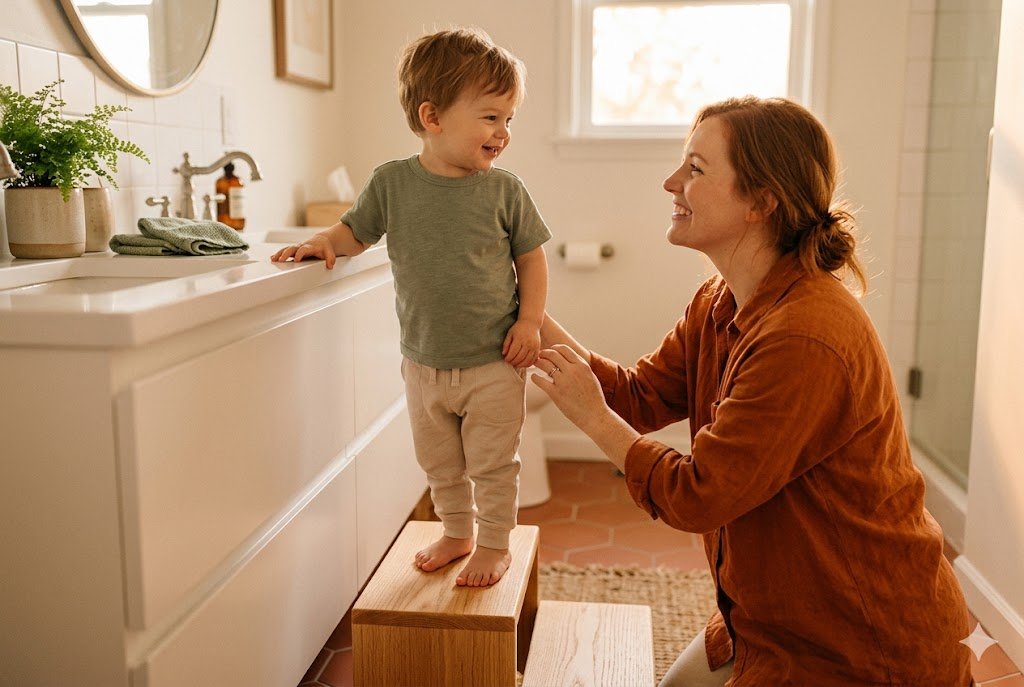
The first time my older son climbed onto a step stool by himself, washed his hands, and looked back at me with that I-did-it-without-you grin, I nearly cried into the laundry I was folding. He was right in the thick of potty training, and that one little plastic stool did more for his confidence in a week than any sticker chart I’d tried. A good step stool is one of those unglamorous toddler items nobody puts on a registry, and then you end up wishing you’d bought two.
So I went deep on this one. I’ve potty-trained three kids now, which means I’ve watched a lot of small humans negotiate a lot of bathrooms, and I’ve gotten picky about what actually earns a spot by the sink. I dug through current bestsellers, compared specs, read through what parents flag in reviews, and (this part surprised me) checked the recall record, too. That last step changed my list. There’s a whole popular category of toddler stool I now steer clear of, and I’ll explain exactly why further down.
Here are the five I’d actually point a friend toward, organized by what you need most.
The best toddler step stools at a glance
Best overall
Forbena Two-Step Stool
If you want one stool that just works for the messy middle of the toddler years, this is the one I’d reach for first. It’s a fixed two-step design with grab handles on the sides, a wide footprint, and rubber feet underneath so it doesn’t go skating across the tile when an excited two-year-old launches at it. It wears a Best Seller badge in the nursery step stool category and has a deep bench of positive reviews, which tells you it’s holding up in a lot of real bathrooms.
The two-step height is the quiet hero here. Toddlers can use the lower step to climb up to the toilet during potty training, then graduate to the top step to reach the sink for handwashing and teeth-brushing. It snaps together without tools in a couple of minutes — I appreciate anything that doesn’t need an Allen key and a YouTube tutorial. Expect to pay somewhere in the low-to-mid $20s.
Check the current price on Amazon →
Best value (two-pack)
Mangohood Two-Step Stool, 2-Pack
One truth nobody warns you about: you will want a step stool in more than one room. The bathroom sink, the kitchen counter, the second bathroom for when grandma visits — they migrate, they disappear, and someone is always carrying one off to use as a “stage.” Having more than one from the start saves a lot of bickering, so a two-pack is the smart move.
This Mangohood set is two simple, sturdy two-step stools that hold up to 220 pounds (yes, you can stand on one to reach a top shelf without a second thought). They’re polypropylene, lightweight enough for a toddler to lug around, and — importantly — they’re a stack-and-separate design rather than a folding one, so there’s no hinge mechanism to fail. It’s an Amazon’s Choice pick and runs around $30 for the pair, which is genuinely hard to beat.
Check the current price on Amazon →
Best budget & trusted brand
Fisher-Price Toddler Step Stool
Sometimes you just want a name you recognize without overthinking it. This single-step Fisher-Price stool is about as no-fuss as it gets: a textured, non-slip top, a wide stable base, light enough to move room to room, and a price that usually lands under fifteen dollars. It’s a newer release but already sitting near the top of the bestseller list.
I’d reach for this one for a younger toddler who’s just starting out — my youngest is nineteen months and a low single step is far less intimidating to him than a taller two-step. It’s also a smart “starter” stool to pair with a potty seat. The trade-off is height: a single step won’t get a smaller kiddo all the way up to a tall sink, so think of it as the gateway stool rather than the forever one.
Check the current price on Amazon →
Best wooden pick
AMBIRD Wooden Two-Step Stool
If plastic-in-primary-colors isn’t your bathroom’s vibe, a wooden stool blends in a lot more gracefully. This AMBIRD two-step is made of wood with a fun printed design (the dinosaur version is the kind of thing that gets a reluctant tooth-brusher genuinely excited to climb up), non-slip pads underneath, and handles for steadying little hands. It’s the priciest pick here, generally in the low $40s, and reviewers say it feels it: solid, heavier, the kind of thing that survives a second kid.
One honest heads-up: the cuter printed versions sell out and restock unpredictably, so if you’ve got your heart set on a specific design, grab it when you see it. AMBIRD makes a plainer natural-bamboo version too if the themed one is gone.
Check the current price on Amazon →
Best for making it fun
UNCLE WU Two-Step Stool with Ducks
Potty training runs on motivation, and there is no shame in a little bribery-by-rubber-duck. This UNCLE WU two-step comes with a couple of bonus ducks, a dual-height design that doubles as a single stool or even a toddler chair, and easy-grip handles. It’s lightweight, wipes clean in seconds, and — the detail I cared about most — the brand notes it’s third-party lab tested to U.S. CPSIA safety standards with a Children’s Product Certificate on file.
That compliance piece matters more in this category than you’d think (more on that in a second). For a stool that lives in the around-$20 range, getting documented safety testing is reassuring. It’s a US-based seller, too, which usually means smoother returns if anything’s off.
Check the current price on Amazon →
Why I skip the foldable “toddler towers”
You’ve seen them: the tall, foldable, height-adjustable platforms marketed as kitchen helpers or “learning towers” so your kid can stand at counter height beside you. They look brilliant in the photos. The safety record is another story.
Over roughly the past year, the U.S. Consumer Product Safety Commission has issued a steady stream of recalls and warnings on these tower-style stools — multiple brands, tens of thousands of units, all for the same failure modes: the stool collapsing or tipping over, the platform detaching, or a child’s torso slipping through the side openings. The CPSC has flagged risks of serious injury and even death from tip-over, fall, and entrapment. You can browse one of those recall notices on CPSC.gov to see the language for yourself.
It’s not just one bad apple, either. When Consumer Reports tested a batch of toddler towers, nearly all of them raised safety concerns in stability and entrapment testing — and they pointed out there’s currently no mandatory federal safety standard written specifically for these towers. That combination — high failure rate plus no governing standard — is exactly the kind of thing that makes me close the tab.
I’m not saying every tower on the market is dangerous, and plenty of families use them without incident. But for my own kids, I’d rather use a low stool where a fall is a short fall, and skip the hinge-and-platform engineering that keeps showing up in recall headlines. A simple two-step does 95% of what we actually need it for anyway.
How to choose a step stool that’s worth the cabinet space
After three kids, here’s the short list I run through before anything goes in the cart:
- Wide, stable base. The wider the footprint relative to the height, the harder it is to tip. This is the single most important thing.
- Non-slip everywhere. You want grippy feet on the bottom and a textured top surface. Bathroom floors get wet; bare feet get soapy.
- A height that matches the job. Single step for younger toddlers and toilet-side use; two-step to reach a standard sink. Measure your sink if you’re unsure.
- Handles. Side handles help a wobbly new climber steady themselves, and they make the stool easy for a kid to carry without dragging it by one leg.
- Easy to clean. Smooth, sealed surfaces with no deep crevices. Potty training is, ah, a damp business.
- Material that fits your life. Plastic is lighter, cheaper, and shrugs off water; wood looks nicer and tends to feel sturdier but costs more and likes to stay dry.
One thing I’d not stress about: a stool that “grows with them” through three convertible heights. In practice, the simplest fixed designs were the ones my kids actually used, and the fewer moving parts, the fewer things to break.
A few safety habits that matter more than the stool itself
No stool replaces an adult. The American Academy of Pediatrics notes that most kids show signs of toilet-training readiness somewhere between 18 and 30 months, and generally don’t recommend pushing it before age two — and a lot of that early bathroom time still needs you within arm’s reach. If you want a readiness gut-check, the AAP’s guide on how to tell when your child is ready is a calm, useful read.
- Supervise new climbers, especially on wet floors. The early weeks are when the spills happen.
- Keep the stool on a flat, dry surface — not on top of a bath mat that can bunch and slide.
- Teach the “hold the handles” rule from day one so it becomes automatic.
- Check the weight capacity and stick to it, and look for a brand that mentions CPSIA testing or a CPC.
- Re-tighten anything that loosens over time, and retire a stool the moment it gets wobbly.
Starting potty training soon?
A step stool is one piece of the puzzle. If you’re just gearing up, my no-pressure potty training guide walks through readiness signs, the gear that’s actually worth it, and how to keep the whole thing low-drama for everyone.
So which one should you buy?
If you want me to just pick: get the Forbena two-step for an only-child bathroom, or the Mangohood two-pack if you’ve got more than one sink to cover. Going budget or buying for a younger toddler? The Fisher-Price single step is the easy yes. Want it to look nice or last through siblings, grab the AMBIRD wooden stool; want to bribe a reluctant trainee, the UNCLE WU duck set earns its keep.
Whatever you choose, keep it low and keep it simple. The flashiest stool isn’t the one your kid will love — it’s the one that feels safe enough for them to climb without you, which is the entire point.