Updated July 27, 2026
A thin swim shoe can make sense for the short walk between a changing room and a pool. The same shoe may collect sand at the beach or feel too flimsy on a rocky shoreline. A rugged water sandal can handle more walking, but it may be heavier than a toddler needs for swim class.
Before comparing brands, look at the surface your child will walk on, how long the shoes will stay on and whether the fit will remain secure once wet.
Water shoes can add a layer of protection between a toddler’s feet and hot, rough or shared surfaces. They cannot make a wet surface slip-proof, and they do not replace close adult supervision around water.
The Quick Answer
For pools, splash pads and everyday wet play, I would start with the Nike Sunray Protect 4. It is the lighter, more flexible option, with a closed toe and heel plus an adjustable strap.
For rocky shorelines, gravel, boardwalks or a day with more walking, I would choose the KEEN Newport H2. It costs more and feels more structured, but it offers a protective toe, a secured heel and a more substantial outsole.
Neither shoe is automatically right for every toddler. The Nike tends to fit roomy, while the KEEN can press across a higher instep. Measure both feet and keep the first try-on indoors.
Does Your Toddler Need Water Shoes?
Toddlers who are walking outdoors need shoes when their feet need protection. Water shoes may be useful when a child will walk across a rough pool deck, a public changing area, hot sand or a beach where small shells and stones are present.
They are not automatically necessary for every water activity. Before buying a pair, ask:
- What will be underfoot? Smooth pool tile, wet concrete, sand and river rocks create different needs.
- Will my child walk outside the water? A toddler being carried into a parent-and-child swim class has a different use case from one moving between a splash pad and a playground.
- What does the facility allow? Some pools permit water shoes on deck but have separate rules for footwear in the water.
If the surface is comfortable and safe, the activity is brief and the venue does not require footwear, another purchase may not solve a real problem.
For children who have only recently started walking, shoes are primarily for protection outside. They are not a tool for teaching balance or correcting gait. Our first walking shoes guide explains when bare feet, socks or protective shoes make sense.
Choose the Shoe for the Surface
Product names are inconsistent. Compare the actual sole, upper and closure instead of relying on “water sock” or “water shoe.”
Indoor pool or swim class
A light, close-fitting swim shoe can be enough when walking time is short. Look for a secure opening, a sole with a visible tread pattern and an interior that does not bunch under the toes. Ask the facility whether shoes can be worn in the pool.
Splash pad
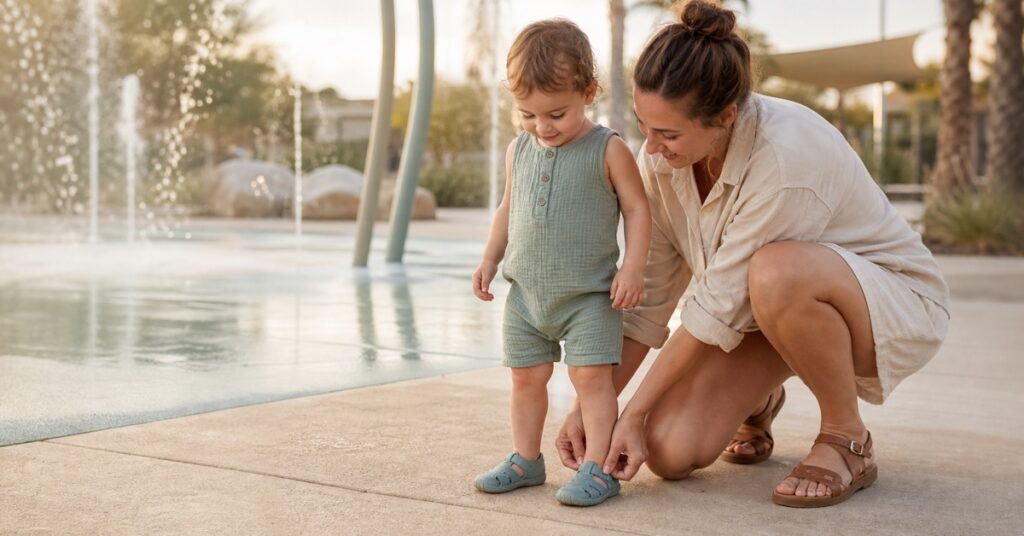
Splash pads combine moving toddlers with wet, often smooth surfaces. Prioritize a heel that stays in place, an adjustable closure and a sole that does not feel excessively bulky.
No tread pattern guarantees traction on every wet surface. The U.S. Consumer Product Safety Commission has previously recalled specific children’s water shoes and toddler aqua socks because they had inadequate traction on wet, smooth flooring. Treat “non-slip” as a claim to examine, not a promise that a toddler cannot fall.
Sandy beach
A closed toe can reduce direct contact with hot sand, shells and other surface debris, but no water shoe protects against every sharp object. Check the area before letting a toddler explore.
Pay attention to openings. Large drainage holes can let sand enter repeatedly, while a tightly enclosed shoe may hold water and grit against the skin. Look for drainage that does not make it easy for sand to collect inside.
For the rest of the packing list, see our complete beach-day checklist.
Lake, riverbank or rocky shoreline
Uneven ground calls for more toe coverage, a firmly secured heel and a more substantial outsole. That extra structure usually makes a shoe heavier and slower to dry.
If the day includes a trail, a long walk or repeated climbing over rocks, a water-friendly sandal may be more appropriate than a soft swim shoe. Our toddler sandals guide covers that more rugged use case.
Backyard water play
For a water table or sprinkler on safe grass, a toddler may not need specialized footwear. If the play area includes hot paving, rough decking or slippery transitions between surfaces, use the same fit and construction checks you would use for a splash pad.
My Two Toddler Water-Shoe Picks
These two shoes solve different problems. The Nike is the simpler choice for pool days and splash pads. The KEEN earns its higher price when the route includes rougher ground or more walking.
| Pick | Best for | Price range checked July 27, 2026 | Main watch-out |
|---|---|---|---|
| Nike Sunray Protect 4 | Pools, splash pads and lighter everyday use | $30–$40 | Roomy fit; do not add extra growing room |
| KEEN Newport H2 | Gravel, boardwalks, rocky shores and more walking | $50–$60 | More structured across the instep |
1. Nike Sunray Protect 4 — Best for Pools and Splash Pads
The Nike is the lighter of these two picks. It suits families who want more coverage than a sock-style swim shoe without putting a bulky outsole on a toddler for a short pool or splash-pad outing.
Nike specifies an enclosed toe and heel, a reinforced hook-and-loop strap, a thin flexible outsole, a quick-drying upper and rubber in the outsole. Its roomy footbed and low-profile construction have also earned the American Podiatric Medical Association Seal of Acceptance. That seal is not a no-slip guarantee, but the combination of coverage, flexibility and adjustability fits pool decks, splash pads and shorter wet-play outings.
The main sizing pattern is a roomy fit rather than a narrow one. Do not add extra growing room by default. Measure first, use Nike’s current chart and try the shoes on indoors. Check that the heel does not lift, the toe does not catch the floor and the pair arrives new with neatly bonded sole edges.
Best for: pools, splash pads, swim-class transitions and ordinary wet play.
Skip it if: your toddler needs a thicker outsole for sharp gravel or rough trails, or already slips out of roomy shoes.
2. KEEN Newport H2 — Best for Rougher Ground and More Walking
The KEEN is the more substantial choice. It makes sense when the day combines water play with boardwalks, gravel, rocky shorelines or more walking.
KEEN specifies quick-dry webbing, a closed protective toe, no-tie bungee lacing, an adjustable hook-and-loop closure and a rubber outsole with a multi-directional lug pattern. The toddler version has a generous forefoot and is machine-washable on a cold, gentle cycle followed by air-drying. It is more structured than the Nike, which makes it the more sensible of these two for extra toe and underfoot protection.
The tradeoff is the fit and price. The KEEN costs more and sits more firmly across the foot. Some owners reported early strap wear, sole damage, used-looking deliveries or pressure across a high instep. Inspect the strap anchors, sole edge and interior seams when the pair arrives. A child with a high instep should take several dry indoor steps before the shoes are worn outside.
Best for: rougher shorelines, gravel, boardwalks and water days with more walking.
Skip it if: you only need a light shoe for a short swim class, or your child dislikes pressure across the top of the foot.
Which One Should You Choose?
- Mostly pools, swim class, splash pads or ordinary wet play: start with the Nike Sunray Protect 4.
- More walking, gravel, boardwalks or a rough shoreline: start with the KEEN Newport H2.
- A high instep, narrow heel or measurements between sizes: do not choose by brand reputation alone. Measure both feet, use the model-specific chart and preserve the option to return the shoes after an indoor fit check.
A Quick Fit Check
Toddler feet grow quickly, and the size printed on the shoe is only a starting point. The American Academy of Pediatrics’ parent guidance recommends checking shoe fit about once a month. The American Podiatric Medical Association also advises measuring both feet, choosing for the larger foot and buying shoes that feel comfortable without a break-in period.
1. Measure both feet
Follow the brand’s current size chart rather than assuming the size from another shoe will transfer. Measure both feet while your child is standing if they can stand comfortably, then use the larger measurement. If the child will wear socks with the shoes, measure and try them on with that type of sock.
2. Check the space in front
HealthyChildren recommends about a finger’s width between the end of the big toe and the inside edge of a toddler’s shoe. Confirm that the longest toe has room and is not pressed against the front.
A shoe bought much too long “to grow into” can catch the ground or let the foot slide.
3. Watch the heel
Have your toddler take a few steps on a dry indoor floor. The heel should not repeatedly lift out of the shoe, and the opening should not gape widely with each step.
A pull-on shoe still needs to hold the heel. Stretchy fabric alone is not proof that it will stay secure after it gets wet.
4. Check the top and sides
Look for pressure across the instep and around the little-toe side of the foot. The toes should be able to rest naturally rather than being squeezed together. An adjustable strap should close securely while leaving some useful adjustment in both directions.
“Wide toe box” or “barefoot” does not prove that a particular size fits your child.
5. Watch a few dry steps
Before using the shoes outside, watch your child walk across a safe, dry floor. Look for toe catching, dragging, kicking the shoes off or a new reluctance to walk. The goal is not to diagnose gait. It is to notice whether the shoes immediately change how comfortably the child moves.
Do not create a wet-tile “slip test” at home. Wet traction varies by surface, and deliberately making a smooth floor slippery adds risk rather than providing a reliable test.
What Matters Beyond “Quick-Dry”
“Quick-dry” appears on almost every water-shoe description. It is useful, but it does not tell you whether the shoe will stay on or feel comfortable.
- A secure heel: the shoe should stay with the foot through normal walking, lifting and squatting.
- An adjustable closure: a hook-and-loop strap or another usable adjustment can help with a narrow heel or higher instep.
- A clearly patterned outsole: look for tread rather than a nearly smooth sheet of rubber, while remembering that tread is not a no-slip guarantee.
- Protection suited to the surface: a soft swim shoe and a closed-toe water sandal solve different problems.
- An interior that stays flat: seams, labels and removable insoles should not curl or bunch under wet feet.
- Drainage without internal sliding: water needs a way out, but the child’s foot should not slide around inside the shoe.
- Care instructions you can follow: if a pair is difficult to rinse or takes days to dry, it may not work for frequent swim lessons.
Flexibility needs context. Rocky ground may call for more underfoot protection than a pool deck.
Check Again After the First Short Outing
A shoe can feel fine while dry and behave differently once the fabric, insole and child’s skin are wet. Make the first outing short enough that you can stop and check the fit.
After a short first wear, move to a safe, dry spot and look for:
- persistent red marks at the heel, instep or sides of the toes;
- a liner or insole that has folded, slid forward or come loose;
- sand, small stones or debris trapped against the skin;
- a heel that has become loose after the upper got wet;
- the foot sliding noticeably inside the shoe;
- separation beginning between the upper and sole; or
- pain, limping or a sudden refusal to walk.
Pain, broken skin or pressure marks that persist are reasons to stop using the shoes and reassess the fit. If a toddler is limping and you cannot identify and remove a simple cause such as a small stone, HealthyChildren advises contacting the child’s pediatrician.
Do not keep using an uncomfortable pair in the hope that it will “break in.” Wet skin and repeated friction are not a useful fitting process.
How to Rinse and Dry Toddler Water Shoes
Start with the manufacturer’s care label. Materials and adhesives differ, so a method that is fine for one shoe may damage another.
- Rinse away sand, salt and visible pool residue.
- Remove the insole only if the manufacturer says it is removable.
- Open straps and pull tabs so air can reach the interior.
- Air-dry the shoes in a ventilated place.
- Avoid a clothes dryer, high-heat shoe dryer or direct heater unless the care instructions specifically allow it.
The CDC notes that fungi associated with athlete’s foot thrive in warm, dark and moist environments. Keeping feet and toes clean and dry, changing shoes and socks regularly and wearing protective footwear in shared showers or locker rooms are sensible hygiene habits. These steps reduce avoidable moisture and exposure; they do not guarantee that a child will never develop a rash or infection.
Water Safety Still Comes First
Water shoes protect feet; they are not drowning-prevention equipment.
At a beach or lake, check the bottom and water conditions before a child enters. Use an appropriate life jacket when the activity, setting or child’s swimming ability calls for one, and follow local rules. Swimming lessons, inflatable toys and water shoes do not make a child drown-proof.
Frequently Asked Questions
Should toddler water shoes be tight?
They should be secure, not tight. The heel should stay in place and the shoe should not gape, but the toes need room and the upper should not leave persistent pressure marks. A shoe that depends on squeezing the foot to stay on is not a good fit.
Should I size up?
Use the brand’s current chart and the larger of your child’s two foot measurements. Allow reasonable toe room, but do not automatically buy a full size larger for growth. Too much length can let the foot slide or make the front of the shoe catch the ground.
Can toddlers wear water shoes in a pool?
Often they can wear them on the deck, but rules for footwear in the pool vary. Check with the swim school, public pool or resort. A shoe allowed on deck may not be allowed in the water.
Are water socks enough for a splash pad?
It depends on the sole, fit and surface. A thin sock-style upper can stay close to the foot, but some designs have little structure or a light outsole. For an active toddler on wet concrete, look closely at heel security and tread rather than choosing by the word “sock.”
Are clogs the same as water shoes?
Not necessarily. Many clogs tolerate water and are easy to rinse, but a loose heel or open-backed fit may not stay secure during active play. Judge the actual fit and closure instead of treating every washable shoe as interchangeable.
What should a new walker wear?
Outside, a new walker needs footwear when the environment calls for protection. Choose a comfortable, well-fitting shoe with a nonskid sole and enough toe room. Water shoes should not be marketed as a way to teach walking or correct a child’s gait.
Can a toddler wear water shoes all day?
If a wet shoe holds grit or rubs, take it off. Change into dry walking shoes when most of the day will be spent away from water.
How often should I check the fit?
Check at least monthly during the toddler years, and sooner if your child has a growth spurt, starts resisting the shoes or develops red marks. Also check the outsole and interior for wear even when the length still seems adequate.
The Short Version
For pools and splash pads, start with the Nike Sunray Protect 4. For longer walking or rougher ground, start with the KEEN Newport H2. Whichever pair you choose, look for a heel that stays put, enough toe room, useful tread and an interior that remains flat after it gets wet. Recheck the shoes after the first short outing and about once a month as your child grows.
Keep the roles separate: water shoes protect feet; an attentive adult within arm’s reach manages water safety.