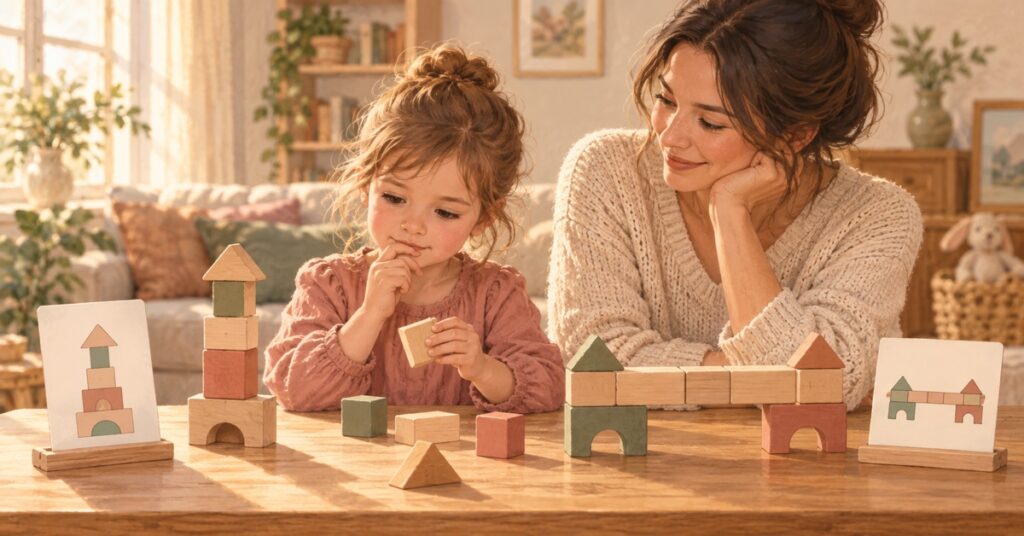
Try building a small tower beside your child. Do they reach for the blocks to make one like yours, or pull it apart and start something entirely different? That is the kind of preference I would look for before choosing a puzzle game.
Castle Logix and Camelot Jr. both have wooden building pieces, a challenge booklet, and 48 puzzles for one player. The useful difference is what your child has to do with those pieces. Castle Logix asks them to recreate a pictured structure. Camelot Jr. asks them to build a route between two characters while following the puzzle’s restrictions.
| If this sounds like your child | Where I’d start |
|---|---|
| Age 3+ and enjoys building from a picture | Castle Logix |
| Age 4+ and likes connecting places with bridges, while following rules about the pieces | Camelot Jr. |
| Wants to build freely and keeps putting the challenge booklet aside | The blocks already at home |
Treat the age labels as minimums. A willing adult beside a younger child doesn’t change them. Once your child is old enough for both, choose by the kind of puzzle they want to solve. A fourth birthday doesn’t make Castle the wrong choice.
Castle Logix: when matching the picture is part of the fun
Castle is the one I’d consider when your child likes comparing a little construction with a picture and adjusting it until the two match. There are four wooden blocks and three tower pieces. It is a small collection, so the reason to buy it is the puzzles those pieces can make, rather than a big addition to the block basket.
You might see the shape you need straight away and still have to work out how to build it. The holes sit in different places in the blocks. Turn one around, and a tower may fit differently; choose another arrangement, and the structure may no longer stand by itself. The castle has to match the challenge and support itself.
The later outline challenges give away less of the construction. That is why I wouldn’t dismiss Castle as a copying toy for three-year-olds, or assume that an older preschooler should automatically move on. Recreating a shape can involve more thought than its handful of pieces suggests.
Watch what happens when the picture and the construction don’t match. Does your child want to turn a block and try again? That interest would make me more inclined to choose Castle. If the booklet keeps interrupting a story they would rather invent, I’d leave the puzzle purchase for later.
You can play freely with the pieces, but the set offers only a small number of building parts. For a child who wants a sprawling castle with extra rooms and towers, I would keep using the blocks already at home. There is no need to make that play more structured before they want it to be.
Camelot Jr.: a path to build, with rules to follow
With Camelot, I’d look for interest in making a route work, along with a willingness to follow the challenge’s rules. The knight and princess start in the positions shown on the page. Some towers are placed before solving begins. Your child then has to use the specified pieces to connect the two figures.
The building set has four towers, three stairways, and a bridge, plus a base and two figures. Only the pieces allowed by the particular challenge belong in that solution. Pulling another block from the toy basket would miss the point of the puzzle, even if it produced a perfectly nice bridge.
The figures must be able to follow a continuous route. They can use stairs and walk along the tops of walls, but they cannot jump down or climb a wall to get around a gap. That gives you something concrete to discuss at the table: where would the figure get stuck, and which piece could help it get farther?
I’d explain that before expecting independent play. A child can be a keen builder and still want to move the starting towers or carry the knight across in their hand. Those are reasonable choices during pretend play; they just don’t solve this particular challenge. If reminding your child of the rules keeps spoiling the fun, put the booklet aside and try another day.
A child who likes figuring out where a little bridge should go may enjoy this goal. For a child who mainly wants to act out a story with the figures, the fixed starting positions may be an unwelcome interruption. Camelot also carries a small-parts warning: keep its pieces away from younger siblings, including when the older child has left the table.
How much help will your child need?
Whichever box you choose, I would plan to sit down for the first few puzzles. One player tells you how many people the game is designed for. It doesn’t tell you whether your child can arrange the starting pieces, remember the rules, and solve a challenge without help.
In her family account of Camelot Jr., Michelle at ResearchParent describes a child who enjoyed the early puzzles but became frustrated at later ones, with the game put away and revisited. Her account is a reminder to leave room for a pause, even when your child enjoyed the early pages.
Before a stuck puzzle becomes an argument, check the page together. With Camelot, make sure the starting towers and available pieces match the challenge. With Castle, compare the outline of the construction with the picture. Then suggest turning one piece and let your child try the next move.
You can also look at the solution together and work backwards. The official guidance allows this for both games. I would give a useful hint rather than insist that every puzzle be solved without help. Leave your child something to try next. If your child wants to stop, close the booklet.
Those 48 challenges also tell you very little about how many afternoons either box will fill. Children may revisit favorites, rush through early pages, or lose interest before finishing. I wouldn’t buy both for a bigger total, or choose either on a promise of half an hour alone while you get something done. Keep both sets away from younger siblings; being able to solve a puzzle alone is a separate question from whether a child needs supervision.
Here, the activity centers on one person solving a puzzle, even when a parent sits alongside.
Check the edition before you order
Before ordering Castle, check the particular version and seller terms. The Castle Logix linked here is SG 030, an international-packaging listing. Check the packaging and instruction language, delivery estimate, and return conditions, especially if it is a gift. The link is for that edition; check its details instead of choosing by the box picture alone.
For Camelot Jr., the linked model is SG 031US. The building pieces are wooden, but the figures vary by edition. Designer Raf Peeters records a change to plastic figures in 2018 and a planned return to wood in 2024. Plastic figures alone do not establish that a set is counterfeit, and the same listing does not guarantee which edition will arrive.
If wooden figures are important to you, confirm the version before ordering rather than relying on an older review photo. I wouldn’t pay extra on an unconfirmed all-wood assumption. For either game, count the pieces and find the booklet as soon as the box arrives. Missing parts can prevent affected challenges from working; damaged pieces or splinters are reasons to contact the seller before play.
If Castle’s total cost or delivery terms don’t suit you, waiting is reasonable. Buying Camelot for a three-year-old is not the workaround. There is no deadline for adding a challenge booklet to a child’s block play.
Start with one box—or the blocks you own
Still unsure? With blocks your child already uses safely, build a simple shape and invite them to make another like it. Notice whether following that invitation appeals to them. This is a small glimpse of their interest, not a test of ability or a guarantee that a boxed puzzle will be a hit.
If a similar puzzle game is already sitting unused on the shelf, bring that one down first. Otherwise, choose one box, open the first challenge together, and see whether your child wants another. You can leave the second game on the wish list.