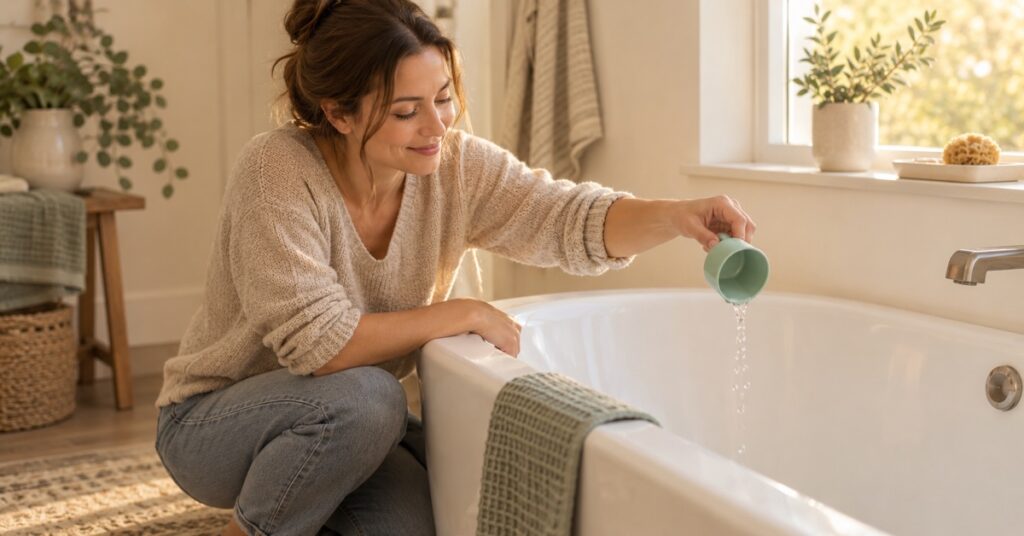
At the end of a bath, an open cup lets you see the water left inside. A closed toy can leave you tilting and shaking it, still wondering what's in there. The part I'd pay attention to is the one you'll repeat tomorrow: getting that water out and reaching the surfaces to clean.
If your child is happy filling a cup and tipping it out, I'd check what you already own first. An intact, age-appropriate children's cup or stacking cup that is suitable for bath use may already do the job. If you need something new for pouring, I'd start with Boon Fleet. The other two options here earn their place through a different kind of play: vehicles to pretend with, or cups to stick on and pull off.
These picks start at 10 months for Boon Fleet and Mushie Vehicles, and 12 months for Fat Brain Toys Suction Kupz. They are not recommendations for younger babies. Check the age and care directions on the particular set you buy.
| How your child plays | Option and labeled age | What you can reach | Allowed care | Main tradeoff |
|---|---|---|---|---|
| Scooping, pouring and making “rain” | Boon Fleet, 10 months+ | Five open boats; no parts to separate | Top rack of dishwasher | Can fill and sink; stacking may need help |
| Pretending with vehicles | Mushie Vehicles, 10 months+ | Four toys open into eight halves | Warm water and mild soap, or top rack of dishwasher | More pieces to wash and dry; mold is still possible |
| Sticking on and pulling off | Suction Kupz Classic, 12 months+ | Six open cups and their suction bases | Dishwasher-safe; follow the set’s directions | Suction can be unreliable, even on smooth surfaces |
What “easy to clean” actually tells you
When a child lifts an open boat out of the water, you can look into the same space the water occupied. You can reach it to clean it and tip out what is left. That is a useful kind of simplicity, although an open boat can fill with water and sink. A hole that drains an open deck is also different from a small opening into a closed, hollow body. Counting holes alone will not tell you how accessible a toy is.
A toy that separates into two halves lets you inspect an interior that would otherwise be hidden. The extra step matters: you need to open it, wash the surfaces, let them dry and put it back together. If that is the part of the evening you tend to rush, choose with that in mind.
A sealed toy is designed to keep water outside while it remains intact. A no-hole label does not tell you whether there are seams, whether those seams can eventually leak, or whether you could inspect the inside if they did. A no-hole label is not a promise that a toy will never grow mold.
Dishwasher-safe answers a separate question about the cleaning method. It does not tell you whether the toy opens or which parts you can reach. Permission also belongs to the particular product: silicone alone does not mean every rack, cycle or cleaning method is suitable.
Boon Fleet for scooping, pouring and little rain showers
Boon Fleet makes the most sense for a child who keeps scooping water and pouring it back. Its five open boats offer a wide space to fill and drain holes that turn a lift out of the bath into a little rain shower. The labeled age is 10 months and up, and the boats are polypropylene plastic.
The practical attraction is what happens afterward. You can see into the boats, and there are no halves to take apart before reaching the inside. Boon allows the top rack of the dishwasher and says to drain the boats fully after use and store them dry. That is a specific care permission, not something to assume about every similar-looking boat.
Choose Fleet for filling and emptying; a game that depends on a boat staying afloat is a poorer fit. Water can collect in the open boats, and a parent account describes them floating until filled. The stack may need your help too; BabyGearLab flagged stacking difficulty in its hands-on comparison. A child can still enjoy pouring even if building the boat stack is frustrating.
Fleet is an easy starting choice if you want new bath toys without adding a disassembly routine. If an existing cup already holds your child's interest, though, the boat shape and rain effect need to be the reason to add it. Easy to wash does not make an unused set worth buying.
Mushie Vehicles if your child wants vehicles in the bath
For a child who wants little vehicles in the water, I'd consider Mushie Vehicles if you're willing to open them after each bath. The four silicone toys are labeled for 10 months and up. Each separates into two parts, so you can see and reach the inside.
Picture all four vehicles coming out of the bath. Once you've opened them, there are eight pieces to wash and leave apart to dry before putting them back together. Being able to reach inside is useful; having eight wet pieces spread out afterward is the part to weigh before ordering.
Mushie's directions allow warm water with mild soap or the top rack of the dishwasher. The brand says to avoid harsh or scented cleaners, rinse after each use and let the toys dry completely before storage. Keep the halves apart until they're dry, so you can check the inside before reassembling.
Being able to open the toys is useful, but the brand's Mold Free name is not a guarantee. A parent reviewing this Vehicles set reported mold after about a year despite separating the toys to dry after every use. The reviewer said the mold could be washed off. This is one owner's account, not a prediction of how long your set will last, but it is a reason to keep inspecting the inside even when you follow the routine.
There is more cleanup here than with an open pouring toy. If little vehicles are what keep your child interested, the work may be a trade you are happy to make. If you're mainly trying to reduce the number of things spread out to dry, I'd pass.
Suction Kupz for sticking on and pulling off
Fat Brain Toys Suction Kupz Classic is for a child who wants to press something onto a surface, pull it off and do it again. That press-and-pull action needs to be the reason to buy it. Six more cups are hard to justify when ordinary pouring is all your child wants.
The set contains six open silicone cups and is labeled for 12 months and up. You can reach the cup interiors and the suction bases without splitting a hollow toy. The product details allow dishwasher cleaning; follow the instructions supplied with your set for how to load and wash it.
The catch is the feature you would be buying it for: suction. Smooth surfaces give the cups the intended place to attach, but that does not guarantee they will stay put. Owner reports include weak adhesion on cleaned glass and suction that stopped holding after an initial period of use. One parent describes a toddler pulling the cups off during play. The cups may be fun to pull off, but keeping them attached can become your job.
Think about the next minute of the bath. If a cup falls and your child happily tries again, there may still be a game there. If every fall means you need to press the cups back onto the wall, it may be a frustrating way to add play. Keep any attachment point within your seated child's reach so the game does not invite standing or climbing.
Skip Kupz if you're picturing a row of cups that stays fixed to the bath wall. Open interiors help with cleaning; they cannot make the suction more dependable.
When the cup you already have is enough
Before buying any set, watch the play you already have for the next few baths. If your child is content moving water between a suitable cup and the tub, there's no missing toy you need to rush out and buy. You can keep using the cup and wait until there is a clear reason for something different.
This applies to an intact child's cup or stacking toy that is age-appropriate and suitable for water play. It is not an invitation to hand over any kitchen container: avoid glass, damaged edges and small loose parts, and check the item's material and care instructions. You do not need to buy an entire new set to have a complete bath setup. For the wider setup, see our baby bath essentials guide.
Keep the after-bath routine manageable
For cleaning, start with the directions for the toy in your hand. Open the parts meant to separate, clean the reachable surfaces as directed, drain them and allow them to dry before storage. Do not assume that dishwasher permission also permits boiling, a sterilizer or any cleaning solution you happen to have. A toy's shape can make the job more manageable; it cannot remove the need to look at its condition.
Cleveland Clinic recommends throwing away toys that are particularly moldy or have a foul smell. You do not need to turn this into a frightening bath-time ritual: keep the care routine practical, and replace a toy you cannot get properly clean. If the missing piece is somewhere for toys to drain and dry, our bath toy organizer guide can help with that choice.
Throughout the bath, stay within arm's reach. Keep a hand on your baby, and take your child with you if you need to leave. A floating toy or a cup stuck to the wall does not change the supervision your child needs.
For the next bath, put out just the cup or toys your child actually reaches for. The rest of a set can stay dry in the cupboard. Fewer wet pieces mean fewer pieces waiting for you afterward.