(Montessori-Inspired)
As parents, we often celebrate the big milestones—the first step, the first jump, the first “I did it!” But there’s a quieter kind of magic happening in those tiny fingertips. Fine motor skills are the behind-the-scenes heroes of everyday independence.
Below are five low-prep, play-based activities you can set up in minutes. They’re Montessori-inspired: simple materials, real-life practice, and plenty of room for exploration.
Some activities use small parts. Always provide active adult supervision. For children under 3, swap small items for larger alternatives (e.g., jumbo cereal or large pasta).
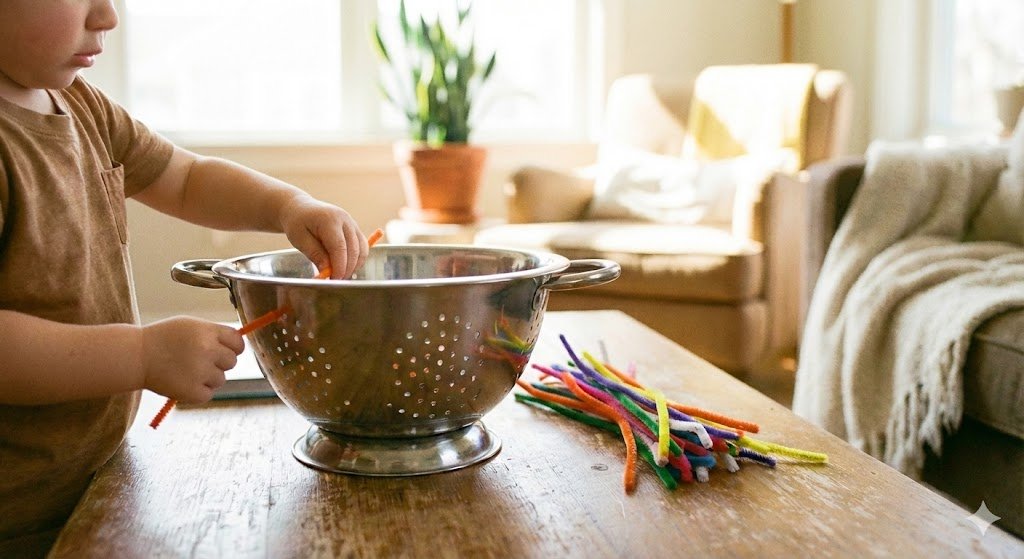
1) Colander & Pipe Cleaners
How to do it
- Grab a kitchen colander and pipe cleaners.
- Demonstrate slowly: poke through, then pull.
- Let your toddler try. Hold the colander steady if needed.
Why it matters
This task develops bilateral integration—using both sides of the brain and body together.
💡 Minimalist swap: Use dry spaghetti (with supervision).
2) Pincer Grasp Sticker Challenge
How to do it
- • Offer a sheet of stickers and blank paper.
- • Help them “start” by peeling up one edge.
Strengthening the pincer grasp is a critical precursor to holding a pencil and self-feeding.
💡 Swap: Use painter’s tape or washi tape on a table.
3) Kitchen Tongs Transfer
Mom tip: Start with larger tongs (easier to squeeze). Move to tweezers as they grow stronger.
Process
Set out two bowls and a pair of tongs. Moving items (pom-poms, rolled socks) develops essential hand-eye coordination.
Minimalist swap
Dry cereal (like O-shaped cereal) works great—just supervise closely.
4) Playdough “Hidden Treasure” Rescue
Pushing and pulling against playdough provides valuable sensory feedback, helping kids develop proprioceptive awareness.
Instructions
Press “treasures” (large beads, coins, or buttons) into dough. Ask your toddler to “rescue” them by pinching and pulling.
5) Magic Dropper Art
Using a medicine dropper requires high-level control and teaches the principle of cause and effect.
Mess-averse tip: Skip food coloring. Plain water on colored construction paper creates satisfying “magic” dark spots.
Frequently Asked Questions
How often should we do fine motor activities?
A few times a week is plenty. Remember, daily life (feeding, dressing, coloring) provides constant practice!
What if my toddler uses their whole fist to hold crayons?
According to the AAP, this is a normal developmental stage. Grip matures as their hand strength grows.