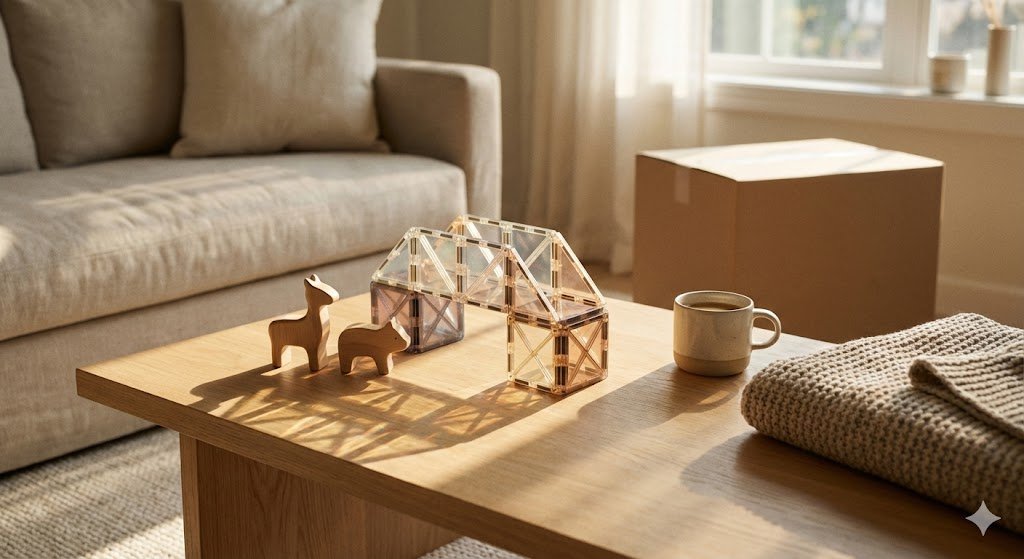
…without a single minute of screen time.
Why is it that your child is “bored” in a room overflowing with toys? The answer is simple: Most modern toys are Performers. They do the work; the child just watches. If you want real focus, you need to stop entertaining your kids and provide them with Tools.
The Dopamine Trap
We’ve all been there. You spend $40 on a plastic gadget that sings and promises to teach phonics. It’s a one-trick pony. Once the buttons are pushed, the novelty wears off in six minutes, and they are back tugging at your sleeve for an iPad.
Passive stimulation makes the brain lazy. According to the American Academy of Pediatrics, excessive screen use can alter how children process rewards. Real growth happens when they are forced to create their own entertainment.
My 3-Point Checklist Before Hitting “Buy”
Stop trusting the “Educational” labels. Use these filters instead:
- ✔ No Batteries Required: If it needs a battery to be “fun,” it’s probably a performer. Passive toys are powered 100% by the child’s imagination.
- ✔ The “100 Uses” Test: Can this be a bridge, a phone, a hat, and a dinosaur’s bed? Open-ended tools are the key to long-term engagement.
- ✔ The “Resale Value”: High-quality tools like Connetix or Holztiger hold 70% of their value. You aren’t just buying a toy; you’re renting brain development.
Specific Moves: How to Actually Use These Tools
1. Magnetic Tiles: Get Off the Floor
Take your tiles to the dishwasher, fridge, or any metal door. Challenge your child to build a vertical “gravity track.” This builds Visual-Spatial Processing and Structural Engineering skills. When the track falls, don’t rush in to fix it. Let them figure out why—that is where the grit is built.
2. Cardboard & Tape: The Zero-Dollar Lab
A box is just garbage until you add Masking Tape. Give them a roll of tape and a few boxes. Don’t tell them what to build. Just give them a prompt: “The dinosaurs need a castle with an elevator.” This builds Divergent Thinking.
3. Neutral Figures: Processing Big Feelings
Use figures with neutral expressions. Because the toy isn’t permanently “smiling,” the child can project their own anger, sadness, or fear onto it. This is a crucial step in emotional development and social role-playing.
The Morning Invitation Strategy
Independent play often fails because of Choice Paralysis. A messy toy box feels like a chore, not an invitation.
Tonight, clear a table and set up a “Starter Scene”:
- Half-build a bridge with blocks.
- Place two animals near it, facing the gap.
- Leave the extra blocks nearby.
When they wake up, they see a story waiting for a hero. They pick up right where you left off.
The Golden Rule: Be Invisible
The second you hear that beautiful silence, stay away. Praise is a distraction. If you walk in and say “Good job!”, you break what psychologists call The Flow. You pull them out of their imaginative world and back into yours.
Now go. Drink that coffee while it’s actually hot for once.