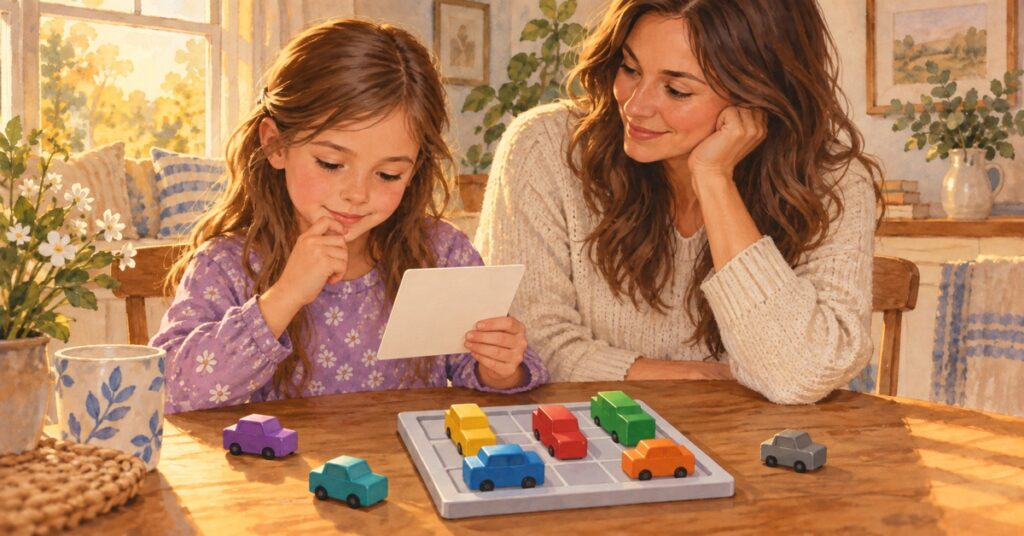
Picture your child at the table, holding a challenge card beside a little traffic jam. She places a truck on the board, looks back at the picture, and asks you to check where it goes. You’re helping before the first move.
That moment matters if you’re buying Rush Hour as something your child can get out and play alone. The age on the box is the first thing to check. After that, think about whether you’ll be arranging the cars each time a new card comes out.
Which version would I buy first?
For a first box at ages five to seven, I’d start with Junior. For an eight-year-old or older child who enjoys working through a puzzle alone, I’d lean toward standard Rush Hour. ThinkFun lists Junior for ages 5+ and standard Rush Hour for ages 8+. Both are single-player games.
| Your child right now | Where I’d start | What to expect |
|---|---|---|
| Ages 5–7, interested in a first traffic puzzle | Rush Hour Junior | You may still help arrange cars or explain moves. |
| Age 8+, enjoys trying different moves alone | Standard Rush Hour | Be available to explain the first puzzle. |
| Age 8+, new to this kind of puzzle and prefers a gentler introduction | Junior can still be an option | It may not hold every older child’s interest. |
| Under age 5 | Wait on both | Adult help doesn’t change the labeled ages. |
I wouldn’t buy standard Rush Hour early just to avoid buying Junior. If your younger child wants to follow the picture and slide cars out of the way, Junior is the age-appropriate starting point in this pair.
For an older child who keeps moving pieces around to try another idea, the standard game would be my pick. Even at eight or older, your child may want you beside the board for the first few puzzles. Don’t expect every challenge to be easy just because your child meets the age recommendation.
Both current versions come with 40 challenge cards. That gives your child a set of puzzles to work through; it doesn’t tell you how long the box will stay interesting. The same card count doesn’t make the two games equally difficult, and I wouldn’t turn it into a promise of months or years of play.
If this is a gift for someone else’s child, ask whether they enjoy puzzles on their own. A love of toy cars is a useful clue, but it doesn’t tell you whether they’ll like solving a traffic jam. For a child who would rather play another way, consider a different kind of gift.
Can your child set it up—and keep going?
The part I’d watch most closely is what happens when a new card comes out. Can your child match the cars to the picture and notice which way each one faces? If you’re placing every vehicle, you’re still needed at the beginning of every new puzzle, even if your child can solve it once you’ve finished.
That’s a perfectly reasonable way to play together. It just needs to be time you’re happy to give. If you’re hoping to finish making dinner while your child handles the game, remember to include the help needed between puzzles, not only the sliding that happens after you’ve arranged the board.
The rules matter, too. You arrange the vehicles as shown on the card, then slide them forward or backward along their orientation to make a route for the red car to leave. You can’t lift a blocking truck out or turn a car sideways to make room.
For a child who mainly wants to drive cars around, those limits may take away the part they enjoy. I’d be cautious about buying either game just because the pieces look like favorite toys. The appeal here is finding a route within the rules. A child can love cars and have no interest in that particular puzzle.
Then there’s the point when the obvious move doesn’t work. Notice whether your child wants another attempt, a small hint, or for you to finish it. There isn’t a required number of minutes to persist. I wouldn’t make this purchase a test of patience, and a frustrating puzzle doesn’t need to become homework.
In The Family Gamers’ parent-and-child review of an earlier standard edition, the child found the game harder than expected; the reviewers recommended it for people who enjoy puzzles. I wouldn’t assume an eight-plus label means an easy first sitting.
At the beginning, I’d check the starting arrangement together and demonstrate how the cars may move. If a puzzle seems impossible, compare the board with the card before trying to solve it for your child. A misplaced vehicle changes the puzzle. After that, offer a hint if it’s wanted, choose another challenge, or put the game away for later.
If you have a chance to borrow either version, watch the whole sequence from taking out the card to starting another puzzle. That lets you see where your help is wanted. You don’t need to count mistakes or turn the visit into a readiness test.
Check the edition before you order
This comparison covers the current U.S. Rush Hour Junior 76583 and Rush Hour 76582. Check the product name and model number together before ordering.
The current Junior has a red Fire Chief hero car. Older reviews often show an ice-cream truck, so a red car doesn’t automatically mean you’re looking at standard Rush Hour. The current Junior product page is the version reference to use here.
The official contents lists for both boxes include 16 vehicles, a grid with a drawer, 40 challenge cards, and two instruction cards. A travel bag isn’t listed, so don’t order expecting the bag shown in an older review. Check the contents of the version you’ve selected before buying.
When the box arrives, check its contents before putting the first challenge in front of your child. Missing cards or a required vehicle can prevent you from using the set as intended; contact the seller about an incomplete or damaged set.
Keep the pieces away from younger siblings who still mouth objects, and put them away where those children can’t reach them. In a shared playroom, make a separate place for small pieces so the older child can use the game without scattering them among a younger sibling’s toys.
When I’d wait—or keep the game you already own
I’d skip this pair for a family looking for a game everyone plays at once. You can take turns or discuss a puzzle together, but the boxes are designed for one player. If two children both want to make the next move, a single board may not give you the shared activity you were hoping for.
I’d also wait if the main goal is an activity needing very little help and your child currently wants you to arrange and finish every puzzle. Playing together can be enjoyable; it also means you’ll need to stay involved. Before buying, decide whether that’s how you want to spend that time.
If you already own Junior, keep it while your child still wants to play. An eighth birthday doesn’t create a need to replace a favorite game. I’d consider standard Rush Hour once your child is at least eight and wants a new challenge. Finishing Junior before then doesn’t change the standard game’s age label.
One well-chosen box is enough to start. Think back to the last time your child sat down with a puzzle and how much she wanted you beside her. Choose with that afternoon in mind, including the time you’re happy to spend helping.