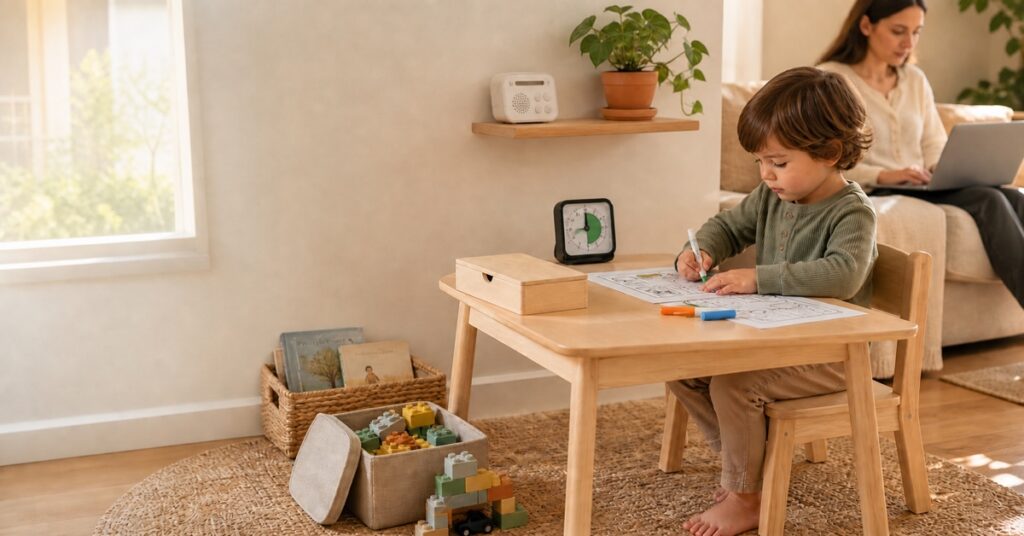
By 12:47, lunch is over but the last cup is still beside the sink. Until recently, this was the easy part of the day: curtains closed, one more book, then a nap. Now your toddler is back in the hallway before you have put away the plates.
First they need water. Then the blue book. The third time, they just want to know whether quiet time is over.
This is the moment when a very full shopping cart can look like a plan. I would make the first version much smaller. Give your child a place to be, an ending they can see, and one thing they already know how to start. Stay close. Try seven minutes.
The missing nap leaves much more than seven minutes to fill. Snack, books, outside time, and ordinary play still carry the rest of the afternoon. Seven minutes is simply where quiet time begins: long enough to practice the rhythm without asking a newly nap-free child to replace an hour of sleep with an hour alone.
If you want the short shopping answer, I would only consider two things at first: a visual timer and a low-mess activity. Choose either a small puzzle or large-piece bricks later, not both. Test an ordinary speaker before buying a card player, and leave the child-size table until your dining table is genuinely getting in the way.
Seven minutes is enough for the first afternoon
After lunch, do the bathroom trip and get the drink of water out of the way. Draw two quick pictures on an index card—quiet time, then snack or outside—and clear one corner of a table. It does not need to look like a playroom.
The TIME TIMER Home MOD makes “a little while” visible. Its colored disk gets smaller as the minutes pass, so a child who cannot read a clock can still see that you are coming back. It does not tick, and the ending alert can be switched off.
Set it for seven minutes, even though the dial goes to 60. Put it where your child can see it but cannot pick at the battery compartment. Then say something simple: “You play here. I’m nearby. I’ll come back when the color is gone.”
The Home MOD is usually around $15–$25. When the trouble happens in the morning or at bedtime, compare okay-to-wake clocks for toddlers instead.
Beside the timer, put down two or three pages and a few Crayola Color Wonder markers. The ink appears on the special paper rather than skin, clothes, or furniture. Your child can make the first mark without waiting for you to spread out a mat, open paint, or find a wet cloth.
Color Wonder is labeled for ages 3 and up and generally costs $10–$20. The paper is a refill you will keep buying.
Already have a timer your child understands and crayons they use without help? Start there. The point is not to replace familiar things that are already doing the work.
For the first few afternoons, stay in sight. Fold laundry. Put away lunch. Do something reassuringly dull. When the disk disappears, come back—even when your child has stopped watching it. That small promise is more important than reaching half an hour.
The timer ends at 1:04. Return before adding extra minutes because the room happens to be quiet. Show your child that the picture card was true: now comes the snack, the hug, or the trip outside.
Repeat the same short afternoon several times. Once seven minutes feels ordinary, try ten. If everything unravels at minute 18, tomorrow can end at 15. Tiredness, hunger, and a nap that has not quite disappeared are not problems another package can solve.
Later that week, the picture is finished. The afternoon is not.
On the fourth or fifth day, the page may be full while two minutes are still left on the timer. Your child slides it toward you, proud and completely finished. This is the first time I would add something to the basket.
If finishing the picture was the satisfying part, set out one image from the Melissa & Doug 4-in-1 Wooden Farm Puzzle Set (ages 3+, usually $10–$20). Its four small pictures are easier to finish than one sprawling puzzle. Do them together before putting one in the quiet-time basket; when every piece still comes with a call for help, keep this one in family play for now.
Another afternoon, the markers may become two people having a conversation. Follow that thread instead. Put out half of the LEGO DUPLO Classic Brick Box 10913 (65 pieces, ages 18 months+, usually $20–$30), build a garage without a roof, and stop. A half-built idea is easier to continue than a loose pile is to begin.
For either route, familiarity beats novelty. A chunky puzzle or large-piece bricks your child already knows may be all the basket needs.
By now the activity may be going fine, yet “Mom?” still comes from the room every couple of minutes. Play a familiar story on an ordinary speaker first. If the voice helps for several afternoons, the Yoto Mini 2024 Edition lets a preschooler start physical story and music cards with simple knobs, without a camera, microphone, or ads. It does have a small pixel display and costs about $70–$90 before extra cards (ages 3–12). Choose the card before quiet time begins; the point is company, not another device that needs you standing beside it. Our Yoto alternatives guide compares lower-tech and figurine-based options.
The edition matters here. Yoto Minis made from 2021 through 2023 were recalled because the lithium-ion battery could overheat. The link above is for the 2024 Edition. Check any used or hand-me-down player against the CPSC recall notice and Yoto’s recall page, charge it outside quiet time, and put the cable away afterward.
There is one more thing I would resist buying from the photograph alone: the little table. Try the dining table, coffee table, a lap tray, or a clear piece of floor for a week. If you are moving a laptop and lunch plates every afternoon—or floor play always becomes a lap around the house—the Delta Children MySize Table and 2 Chairs gives coloring and puzzles a place that can stay ready (GREENGUARD Gold certified, ages 3+, usually $55–$75). It still takes up floor space. Assemble it as directed, check the hardware, and keep it away from windows or furniture that invites climbing. These small-space Montessori playroom ideas offer lower-footprint alternatives.
A quiet room still needs you nearby
Before you step out of sight, keep the door unlocked and stay close enough to hear and respond. Leave food, water beads, strong magnets, beads, marbles, scissors, liquid paint, loose sensory fillers, and charging cords out of the room. Anchor climbable furniture, use cordless window coverings, keep the play spot away from windows, and remove cracked puzzle or building pieces. The CPSC childproofing guide has more detail.
And if your child curls up beside the puzzle and falls asleep, let sleep win. Quiet time can hold the old place in the day; it cannot replace rest the body still needs. The American Academy of Sleep Medicine recommends 11–14 total hours a day for ages 1–2 and 10–13 hours for ages 3–5, including naps.
Tomorrow may still give you only seven minutes. But perhaps the last lunch cup makes it into the cupboard before you hear those bare feet in the hallway again. That is enough for a beginning.