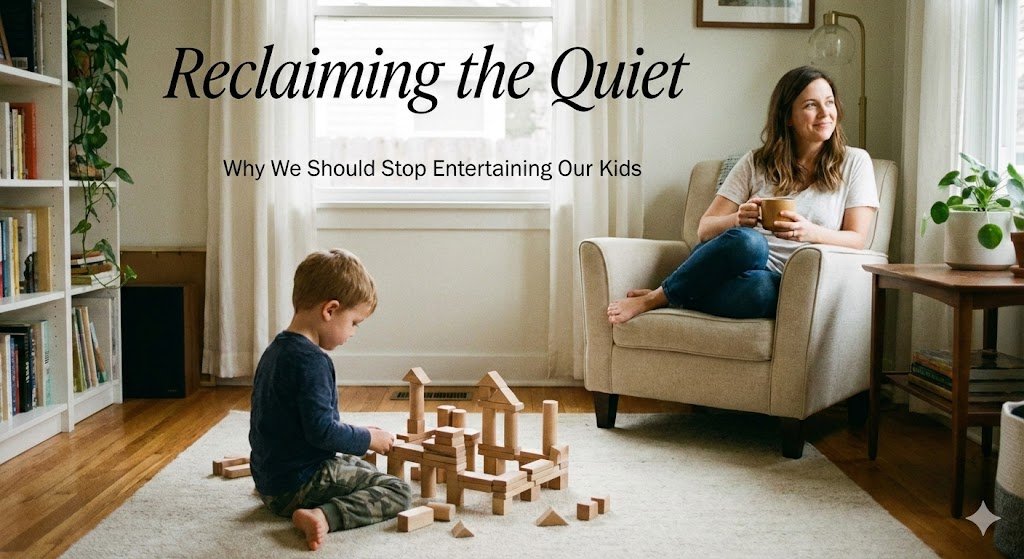
I thought entertaining my kids was love. In fact, I didn’t realize it was actually exhausting their independence while burning myself to a crisp. Eventually, I realized my days were a blur of “Look at this!” and “Play with me!” and by 7 PM, I was nothing more than a shell of a human being. Therefore, I’ve learned that I must stop entertaining my kids to help them find their own inner engine.
But then it clicked: by acting as my child’s “Cruise Director,” I was actually robbing them of their most vital work—learning how to be the master of their own time.
Teaching a child to play alone isn’t a “trick” to buy yourself some space. It’s about building their “inner engine.” Here is how I’ve been navigating that shift—slowly, imperfectly, and with a lot more hot coffee.
1. Stop Entertaining Your Kids to Fill the “Full Tank”
It’s the great parenting paradox: to get them to leave you alone, you have to lean in first. Specifically, think of your child’s attachment as an emotional battery. Whenever they feel disconnected, they don’t just ask for attention—they cling like a barnacle.
Before I need to get things done, I give them 10 minutes of “Deep Connection.” No phone, no distractions—just me on their level. When that battery is topped off, they have the security they need to venture off into their own world.
2. Boredom is the Waiting Room for Brilliance
We’ve been conditioned to fear boredom, rushing in with an iPad the moment a child looks restless. Yet, boredom is the psychological “blank space” where the brain does its best work.
— Reference: Harvard Center on the Developing Child
I’ve learned to sit with the discomfort of their boredom. Eventually, that “I’m bored” morphs into a rocket ship made of pillows or an hour-long “experiment” with a bowl of water.
3. The “Ghost Mom” Technique
The hardest part was learning how to be near without being involved. To achieve this, I started sitting in the same room, but I brought my own work—a book or a basket of laundry. In this scenario, I’m the “Anchor.”
To be clear: this isn’t about checking out emotionally; it’s about availability without interference. You are their safety net, not their scriptwriter. If they ask me to join, I use “Sportscasting”: “I see you’re building a very tall tower with the red blocks.” It validates them without me seizing the steering wheel.
4. Foster Independent Play by Simplifying Choices
When a playroom looks like a toy store exploded, kids don’t see opportunity; they see noise. Consequently, they end up paralyzed by “decision fatigue.” Therefore, I’ve started rotating toys—keeping only a few open-ended items out. When there are fewer “things,” there is more room for imagination to breathe.
5. Protecting the Flow
This is the golden rule: If they are playing quietly, fade into the wallpaper. First, avoid offering an unnecessary snack. Next, resist the urge to say “Good job!” Finally, don’t even make eye contact. Because of this, that quiet focus is protected, and their brain can continue the hard work of re-wiring itself.