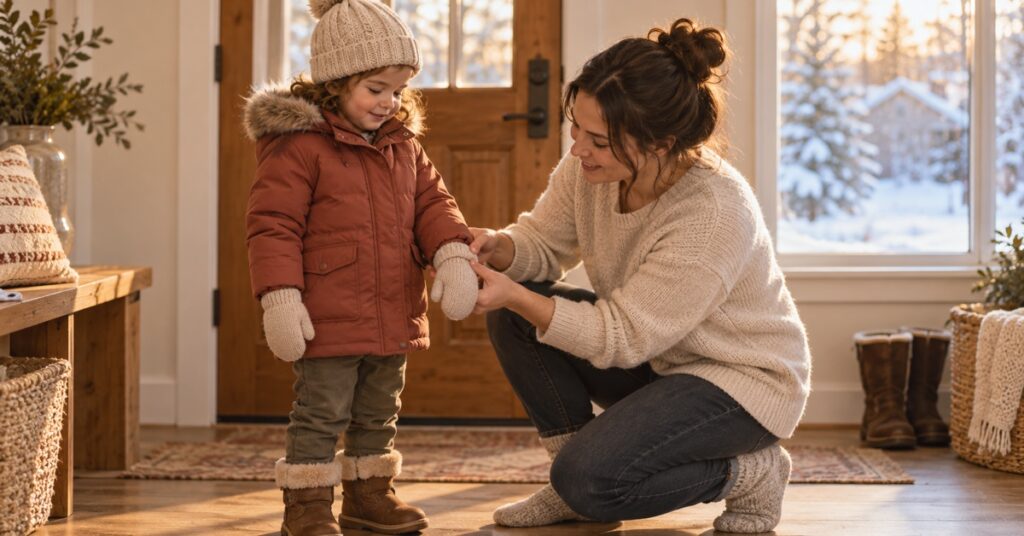
You're holding a mitten open at the door, your toddler's thumb is still tucked against their palm, and the coat sleeve is bunched around their wrist. You pull the sleeve back, open the mitten again, and try to guide the thumb into place.
I'd start with the pair you already have. If it fits, stays dry during your child's outings, and has no tears or damaged seams, keep using it. If you need a replacement, choose one style that suits the hand, coat, and weather; you don't need all three below.
If you do need new toddler winter mittens, these choices cover different sizes within roughly ages 1–4. I'd use them for ordinary daytime outings with an adult and somewhere nearby to warm up indoors. Extreme cold, remote trips, and specialist ski equipment fall outside these recommendations.
Start with the hand and the coat sleeve
Put the brand's size chart beside your ruler or measuring tape and measure as that chart directs. Check what its measurements describe: a child's hand, the space inside a mitten, or the mitten's outside dimensions. Those aren't interchangeable. If the chart only gives an age, you'll still need a try-on. Buying a bigger size won't help if the thumb can't reach its place.
Try the mitten with the coat your child will actually wear. The thumb should settle into its pocket without pulling the palm sideways, and the fingers should have room to move. Fasten it without squeezing the hand or wrist. Then let your child reach forward and bend their arms. Look at where the two cuffs meet and whether the coat pushes the mitten out of position.
Long cuffs go on differently. A knitted cuff that belongs under the sleeve changes the order of getting dressed; a cuff that covers the coat needs room around the outside of that sleeve. Choosing the order you can manage at the door matters more than simply buying the longest cuff.
| If this matches your routine | Consider | Main tradeoff |
|---|---|---|
| You can put mittens on before the coat | SnowStoppers Original, Small | Adult help; more rearranging if a mitten comes off |
| You need a wider opening to guide the thumb | Hestra Baby Zip Long, size 2 | A choice for drier outings; warmth feedback varies |
| You want separate wrist and forearm adjustments over the coat | JAN & JUL Toasty-Dry Snow, S with thumb | Two closures for an adult to check |
Three ways to handle the cuff
SnowStoppers Original would be my pick for a family happy to put mittens on before the coat. Its long knitted cuff sits under the sleeve. You help the thumb into place, pull the cuff up, and then bring the coat sleeve over it. That extra overlap is the reason to consider it, but an adult still needs to help with dressing. Skip it if your child needs to manage mittens alone or you want to avoid rearranging the coat when a mitten comes off.
The Black Small discussed here is labeled for ages 1–3. Feedback on this size and color includes wet mittens and fabric tearing; other sizes also have seam complaints. A long cuff doesn't remove the need to check for dampness or damage. I wouldn't choose this pair for repeated soaking or sustained wet play.
If finding the thumb is the part that keeps going wrong, I'd look first at Hestra Baby Zip Long for drier outings. The long side zipper opens up the hand area so an adult can see where the thumb needs to go. Put the coat on first, open the mitten, help the thumb into place, and fit the long cuff over the sleeve. The Black/Black pair linked here is model 36421 in size 2. The brand's chart suggests about ages 2–3, so check the fit even if the age sounds right.
Baby Zip Long has no waterproof membrane. Warmth feedback varies, and a 2015 review of another size describes cold hands and red, swollen fingers. Check your child's hands during use and keep indoor warming breaks easy to reach. Skip it for persistent wet snow or rain.
JAN & JUL Toasty-Dry Snow is the one I'd consider when you want to adjust the wrist and forearm separately over a coat sleeve. Pull the long cuff over the sleeve, leaving room for the coat, then adjust both closures without squeezing. The extra adjustment also gives an adult another fastening to check. Choose Navy Forest, model WMT-NVF, in S for ages 2–4 with a thumb. Check those details before ordering: the XS has no thumb, and the Rain mittens are a different product. I wouldn't choose this S expecting guaranteed dryness in persistent wet snow or a particular lifespan.
What waterproof labels leave out
A water-repellent outer finish helps the surface shed water. A waterproof liner or membrane sits underneath. Those are different layers, and neither label tells you how long the whole mitten will keep your child's hand dry during play.
SnowStoppers describes a Drypel waterproof liner; JAN & JUL lists a PU waterproof membrane and a water-repellent outer finish. SnowStoppers owners still report wet mittens. For JAN & JUL, reports of water getting through in rain and holes developing concern the same Navy Forest snow mittens in M, not this S. I wouldn't buy either range expecting all-day dryness or a guaranteed season of wear.
Hestra's Amazon title has used “waterproof,” while the brand identifies Baby Zip Long as having no waterproof membrane. Follow the brand's description when deciding whether it suits your outing. If you're also choosing a coat and boots for wetter days, see the toddler rain gear guide.
Fit checks before the next outing
Before the next outing, repeat the thumb-and-coat check and look over the palm, seams, and cuffs for holes or wear. Check inside for dampness, too. A pair that is still wet from the last outing needs to dry before it goes back on.
Follow the care label on the pair you receive. For SnowStoppers and Hestra, plan on hand washing; don't choose Hestra because a page says it can go in the washing machine. JAN & JUL's snow-mitten instructions allow spot cleaning or a cold gentle wash, followed by hanging to dry, with no tumble drying. Give the inside time to dry fully.
During play, check hands and listen when your child says they feel cold. If your child's hands feel cold or the mittens are wet inside, stop that outing, go indoors, and change wet items. Build in indoor warming breaks. If you notice pain, numbness, or unusual skin color, stop promptly and bring your child indoors. Follow the American Academy of Pediatrics' winter safety guidance for when to seek medical care.
Before you order anything, put the coat and mittens on together at home. That small rehearsal may be all you need to get out the door with the pair you already own.