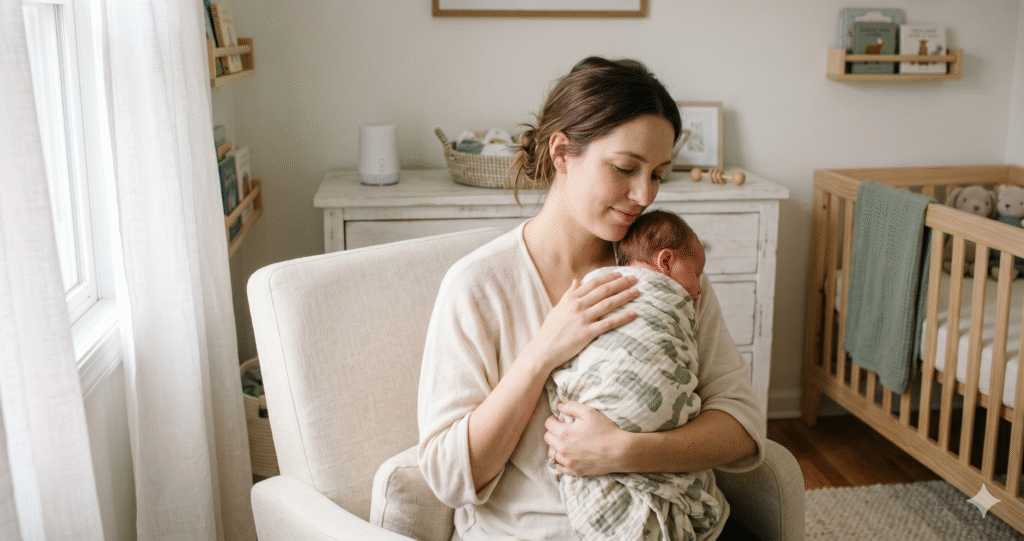
The night my daughter was two weeks old, I stood in the hallway at 3 a.m. making the loudest “shhhhh” sound I could sustain with a sleeping baby pressed against my chest, terrified that putting her down would end everything. My husband had already googled “is it possible to shush too much.” Reader, we needed a machine.
A white noise machine turned out to be one of those baby items I wish someone had handed me at the hospital along with the diapers and the swaddle tutorial. It didn’t fix sleep overnight — nothing does — but it made everything quieter, calmer, and a lot more survivable. My daughter went from waking at every creak of the floorboard to sleeping through garbage truck day, and I stopped treating our living room like a library at a church.
If you’re here because you’re exhausted and looking for something that actually helps, you’re in the right place. Below are the six best white noise machines for babies in 2026 — researched from official product specs, pediatric safety guidelines, and real parent feedback — with real pros and cons for every budget. Let’s get into it.
Why White Noise Actually Works for Babies
Here’s something most people don’t realize: the womb is loud. Blood flow, your heartbeat, the muffled roar of everyday life — babies in utero are surrounded by sound that can reach around 85 decibels. The sudden quiet of the outside world can feel genuinely disorienting to a newborn.
White noise works by recreating that familiar sonic environment. It also creates a consistent sound backdrop that masks the random disruptions — a doorbell, a sibling, a delivery truck — that jolt a light-sleeping baby awake mid-nap.
Research backs this up. A small but widely cited 2005 study published in Archives of Disease in Childhood found that white noise helped newborns fall asleep significantly faster than silence. The American Academy of Pediatrics (AAP) acknowledges white noise machines as useful sleep tools, with one important caveat: keep the volume below 50 decibels and place the machine at least 7 feet from your baby’s sleep space. More on that in the safety section below.
What to Look for in a Baby White Noise Machine
Not all sound machines are created equal, especially when you’re shopping for a newborn. Here’s what actually matters:
- Volume safety: Look for a machine with incremental volume control so you can stay well under the AAP’s 50 dB recommendation. Avoid machines that blast at maximum from the start.
- Continuous play vs. timer: Timers that cut off after 30 minutes are useless if your little one wakes every time the sound stops. For young babies especially, look for an “all night” or continuous play option.
- Portability: If you’re planning any travel, a rechargeable clip-on is a game changer. On-the-go sleep is already hard enough without hunting for an outlet at your in-laws’ house.
- Sound variety: White noise is the gold standard, but brown noise (deeper, rumbly) and fan sounds work well for many babies. More options means more chances to find what clicks for your kiddo.
- Night light: Handy for middle-of-the-night feeds when you need just enough glow to see what you’re doing without waking the whole room.
- App dependency: Some smart machines require Wi-Fi and apps to function fully. Totally fine if you like that — but if the idea of a frozen app at 2 a.m. makes you nervous, opt for a physical-button machine.
The 6 Best White Noise Machines for Baby in 2026
1. Dreamegg D11 Max — ~$20–25
| Sounds | 21 (white noise, ocean, brook, lullabies, shushing, fetal tone, fan, cricket, and more) |
| Battery | 1800mAh — up to 30 hours on low/medium |
| Night light | Yes — dimmable warm glow, breathing mode |
| Portable | Yes — lanyard + loop, clips to stroller or car seat |
| Child lock | Yes |
| App required | No |
| Charging | USB-C (cable included, no adapter) |
- 30-hour battery means your partner can grab it and go without charging it first
- 21 sounds means you can find one that actually works for your baby
- Lightweight enough to toss in a diaper bag without thinking about it
- No app, no Wi-Fi, no subscriptions — just works
- No power adapter in the box — you’ll need your own USB plug
- At max volume it can hit 90 dB (use low to mid — that’s all you need anyway)
Best for: Parents who want one machine that does everything — nursery, travel, stroller naps — without spending a lot. My daughter had one clipped to her bassinet and one in the car seat bag. That’s how much I trust this thing.
2. Magicteam SN-A1 — ~$22–25
| Sounds | 20 non-looping (white, brown, pink, blue noise, fan, rain, ocean, brook, birds, bonfire) |
| Battery | None — AC or USB plug-in only |
| Night light | No |
| Portable | Limited — cord required |
| Volume levels | 32 levels of fine-tuned control |
| Timer options | 1 / 2 / 3 / 4 hours or continuous |
| App required | No |
- 32 volume increments make it easy to dial in safely under 50 dB
- Brown and pink noise options — great if white noise is too “hissy” for your baby
- Memory function saves your settings between uses
- Tiny footprint, easy to tuck behind the dresser in a nursery
- No battery — must be plugged in, so it’s nursery-only
- Speaker is less powerful than pricier machines — may not mask heavy household noise
- No night light
Best for: Parents who want a solid dedicated nursery machine and don’t need portability. If you’re on a tight budget and the crib is in a fixed spot, this delivers real value without fuss.
3. Yogasleep Hushh 2 — ~$30–35
| Sounds | 6 (Dohm signature sound, fan, nature sounds, calming melodies) |
| Battery | Rechargeable — up to 33 hours |
| Night light | Yes — adjustable amber LED |
| Portable | Yes — reinforced one-hand clip, ultra-wide opening |
| Child lock | Yes — toddler lock |
| Buttons | Backlit — visible in the dark |
| App required | No |
- The backlit buttons are a thoughtful detail — no more fumbling blind at 4 a.m.
- Yogasleep’s signature Dohm sound is beloved by generations of parents for good reason
- 33-hour battery life is excellent for travel
- The reinforced clip actually stays put on a stroller canopy
- Only 6 sounds — if your baby needs more variety to settle, this may not be enough
- Must charge with the included USB cable only (not a standard cable)
Best for: Parents who want a polished, well-built portable machine from a brand with decades of white noise credibility. Perfect for stroller naps, daycare drop-offs, and weekend trips to grandma’s.
4. LectroFan EVO — ~$45–50
| Sounds | 22 non-looping (10 fan, 10 white/pink/brown noise, 2 ocean) |
| Battery | None — USB plug-in only |
| Night light | No |
| Volume control | Precision (stepless) |
| Timer | 1–8 hours (gradual fade) or continuous |
| Memory function | Yes |
| App required | No |
| Warranty | 1 year + 1,000-day satisfaction guarantee |
- Best-in-class sound quality — non-looping fan sounds are realistic and calming
- 22 sound options with seriously precise volume control
- Gradual fade timer means no jarring cutoff that wakes your baby
- Clean, compact design — it doesn’t look like an afterthought next to the changing table
- Must be plugged in — not portable
- No night light, no app features, no “smart” extras
- Pricier than the Dreamegg for similar sound variety (you’re paying for audio quality)
Best for: Parents who want the most realistic, highest-quality white noise for the nursery and don’t need portability. If your baby is a sensitive sleeper and you want a machine that will still be running strong in three years, this is your pick.
5. Hatch Rest 2nd Gen — $70
| Sounds | 15 free (white noise, rain, ocean, heartbeat, fan, dryer, wind, thunderstorm, lullabies + more via Hatch+ subscription) |
| Battery | No battery on base model — plug-in only; Rest+ model adds 8–12hr battery, costs $90 |
| Night light | Yes — infinite color wheel, brightness adjustable |
| App control | Yes — Wi-Fi, set schedules and adjust remotely |
| Time-to-Rise | Yes — light changes color to signal wake time |
| App required | Yes for full features; basic touch control works without app |
- Grows with your child — from newborn white noise to toddler OK-to-wake training
- App-controlled scheduling means bedtime becomes almost hands-off
- Remote volume and light adjustment from your phone without entering the room
- Beautiful design that looks intentional in a nursery
- Most useful features require the Hatch+ subscription (sold separately in app)
- Wi-Fi setup can be finicky; some parents report app glitches
- Base model has no battery — power outage = no sound
- More machine than you need if you just want simple white noise
Best for: Parents who want an all-in-one system they’ll use from the newborn stage through age 5+. If you’re already into baby sleep training and want everything in one device — sound, light, routine, wake clock — the investment makes sense.
6. Baby Shusher Firefly — ~$30–35
| Sound | 1 — rhythmic human “shhh” sound |
| Battery | Rechargeable — USB-C (cable included) |
| Night light | Yes — dimmable sunset glow |
| Timer options | 30 / 60 / 90 minutes or continuous |
| Portable | Yes — carabiner clip, compact cone shape |
| Sound type | Real human voice shushing — not synthetic white noise |
| App required | No |
- That rhythmic human shush is different from digital white noise — many newborns respond to it faster
- Used in NICUs and recommended by pediatricians worldwide
- Firefly model adds continuous play and USB-C charging (huge upgrade over original)
- Super compact — fits in one hand, clips to a stroller hood
- Only one sound — if your baby doesn’t respond to shushing, you’re stuck
- Not every baby reacts the same way; some find it unsettling
- Once your baby is past the newborn stage, you may want more sound variety
Best for: The first 3–4 months especially. If you’ve read “Happiest Baby on the Block” and you’re already using the 5 S’s, this is the machine version of that shush. It can be weirdly magical on a crying newborn.
Quick Comparison: All 6 at a Glance
| Machine | Price | Sounds | Battery | Night Light | App |
|---|---|---|---|---|---|
| Dreamegg D11 Max | ~$20–25 | 21 | 30 hrs | ✅ | ❌ |
| Magicteam SN-A1 | ~$22–25 | 20 | Plug-in | ❌ | ❌ |
| Yogasleep Hushh 2 | ~$30–35 | 6 | 33 hrs | ✅ | ❌ |
| LectroFan EVO | ~$45–50 | 22 | Plug-in | ❌ | ❌ |
| Hatch Rest 2nd Gen | $70 | 15+ | Plug-in* | ✅ | ✅ |
| Baby Shusher Firefly | ~$30–35 | 1 | Rechargeable | ✅ | ❌ |
*Rest+ 2nd Gen ($90) adds an 8–12hr backup battery.
How to Use a White Noise Machine Safely
White noise machines are incredibly helpful — but like anything in the nursery, they come with a few simple guidelines to keep your baby’s hearing protected. For the full picture on building a safe sleep space (crib setup, room temperature, and more), our Baby Sleep Essentials guide covers everything.
- Volume: Keep it at or below 50 decibels — roughly the sound of a quiet conversation. Most machines have a safe range on their low-to-medium settings.
- Distance: Place the machine at least 7 feet (about 2 meters) away from your baby’s crib or sleep surface. Never put it inside the crib or right next to their head.
- Duration: Using it all night is common and generally fine, but if you can turn it off once your baby is in deep sleep, that’s ideal. The goal is to help them fall asleep — not to run forever at high volume.
The research on hearing damage is specifically about machines placed too close to babies at high volume — a scenario that’s easy to avoid. Used sensibly, white noise is a safe and well-supported sleep tool. The AAP endorses it for exactly this reason.
Frequently Asked Questions
Is white noise safe for newborns?
Yes, when used following the AAP’s guidelines — below 50 dB and at least 7 feet away. The concern with white noise is not the sound itself but the volume and distance. A machine blasting at max right next to a baby’s ear is a problem. One humming quietly across the room is not.
How loud should white noise be for a baby?
Aim for 50 decibels or less at your baby’s sleep position. That’s roughly the sound level of a quiet conversation or a gentle rainfall. Most sound machines stay well within this range on their low-to-medium setting. If you want to check, you can download a free decibel meter app on your phone and measure at the crib.
White noise vs. brown noise — which is better for babies?
White noise contains all sound frequencies at equal intensity — that classic “static” sound. Brown noise is lower-pitched and rumbly, like a distant thunderstorm or a strong shower. Some babies respond better to brown noise, especially if they’re very sensitive to sharp high-frequency sounds. If white noise doesn’t seem to work for your kiddo, try brown or pink noise before giving up on sound machines altogether.
Can white noise become a sleep crutch?
This comes up a lot, and the honest answer is: sort of, but probably less than you think. Some babies do become accustomed to falling asleep with white noise, and may need it more consistently as time goes on. Most sleep consultants don’t consider this a problem — it’s a sleep association, similar to a favorite swaddle or a pacifier, and can be faded gradually later if you choose to. Frankly, if it means everyone is sleeping, it’s a tool worth using.
Will white noise interfere with my baby monitor?
Not if you set things up correctly. The key is making sure your monitor’s microphone is close enough to your baby to pick up their sounds, while the white noise machine is placed farther away — across the room, not right next to the monitor. A good video monitor helps here too, since you’re watching movement and breathing rather than relying solely on sound. Most parents find that alert cries cut right through white noise on a monitor at normal volume.
🎁 Free Download: Newborn First Week Guide
Everything you actually need to know for the first seven days home with a newborn — feeding cues, sleep basics, when to call the doctor, and more. No fluff, no overwhelm.