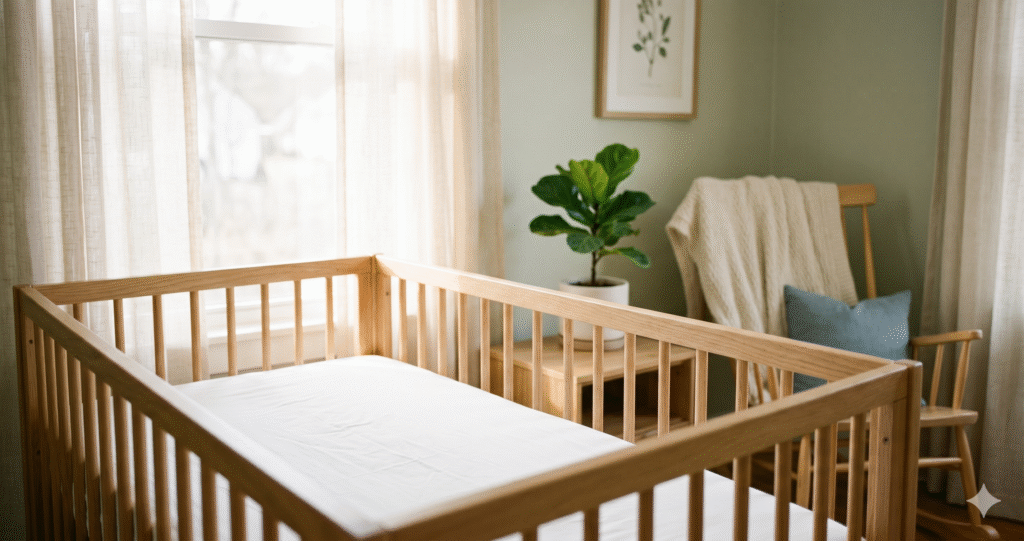
The first time I brought my daughter home from the hospital, I stood in her nursery at 2 a.m. staring at the crib mattress we’d registered for. It looked fine. It felt fine. My husband was half-asleep in the doorway, and I remember thinking, how do I actually know if this is safe for her to sleep on? That question, flat out, no marketing noise, is what this guide is built to answer.
The American Academy of Pediatrics is pretty unambiguous: babies should sleep on a firm, flat, non-inclined surface, with a fitted sheet and nothing else in the crib. But within those rules, the crib mattress market is genuinely confusing. You’ve got $60 foam pads, $400 organic hybrids, “breathable” marketing claims with no proof they reduce SIDS, fiberglass scandals, and a dozen different certifications that sound alike but mean different things.
I’ve narrowed this down to five mattresses I’d actually consider. Each one has a specific family it’s the right fit for, plus what I think each one gets wrong. No padding, no “best of” filler. Let’s get into it.
The 5 best crib mattresses at a glance
| Pick | Best For | Certifications | Price |
|---|---|---|---|
| Newton Baby Original | Best overall, breathability | GREENGUARD Gold | $300-350 |
| Naturepedic Breathable 2-Stage | Best organic | GOTS, GREENGUARD Gold, MADE SAFE, EWG Verified | $330-360 |
| Moonlight Slumber Little Dreamer | Best dual-firmness | GREENGUARD Gold, CertiPUR-US | $200-300 |
| Sealy Soybean 2-Stage | Best budget | GREENGUARD Gold, CertiPUR-US | $120-150 |
| Newton Baby Mini | Best for mini cribs | GREENGUARD Gold | $150-200 |
How to choose a crib mattress (without getting overwhelmed)
Before any specific product, here’s the mental model I use when I’m looking at a crib mattress. Six things to check, in order of importance.
1. Firmness — this is the one that’s actually life-or-death
Press your hand into the surface. If it leaves any real indentation, it’s too soft. A safe infant mattress should feel nothing like the mattress you sleep on as an adult. It should feel borderline uncomfortable to a grown person. That’s the point. Soft sleep surfaces are one of the few factors with strong evidence tying them to sleep-related infant deaths, per CDC data on safe sleep environments. If a mattress promises “plush comfort for baby” on the infant side, walk away.
2. Fit — the two-finger test
Put the mattress in the crib. If you can fit more than two fingers between the mattress edge and the crib slat, the mattress is too small. Gaps are where babies get stuck. Standard crib mattresses in the US measure roughly 27¼” × 51⅝”, but variation exists, so check your actual crib. Most 2024 to 2026 CPSC recalls on crib mattresses come down to this single problem: off-brand mattresses that don’t fit standard cribs properly.
3. Certifications that actually mean something
Three certifications carry real testing weight:
- GREENGUARD Gold: tests for low chemical emissions (VOCs). This is the minimum bar I’d set. Tested against 360+ volatile organic compounds, stricter than regular GREENGUARD because it’s built for environments with children.
- GOTS (Global Organic Textile Standard): certifies the finished product, not just one material. If a mattress says “organic cotton cover” but doesn’t hold GOTS finished-product certification, the organic claim is unverified.
- CertiPUR-US: certifies foam for emissions and content (no phthalates, heavy metals, or harmful flame retardants). Only relevant if the mattress contains polyurethane foam.
Certifications that sound official but aren’t third-party tested? “Hypoallergenic,” “natural,” “eco-friendly,” “made with soy.” These words on their own mean nothing.
4. Breathability is a comfort feature, not a safety guarantee
Breathable mattresses have become a whole category, and they do offer real comfort benefits (cooler sleep, easier on stomach-sleeping babies). But there’s no peer-reviewed evidence that breathable mattresses reduce SIDS risk. The AAP’s evidence-backed interventions are firm, flat, and no soft bedding. Treat breathability as a nice-to-have, not a must-have.
5. Dual-stage vs. single-stage
A dual-stage mattress has a firmer infant side and a medium-firm toddler side. You flip it around 12 months, or whenever your little one can pull to stand. Here’s the math that changed my mind on paying the premium: we used our Newton for my daughter through age 2.5, then flipped nothing (it’s one-sided) but kept using it for my youngest son. At the $300-350 range spread over roughly four years of use across two kids, it cost us less per month than a single meal-delivery subscription. If you plan to keep the crib through toddlerhood, 2-stage is worth the money.
6. Waterproofing — what kind matters
Every parent learns fast that babies leak. But how a mattress waterproofs varies a lot:
- Vinyl/PVC cover: cheap and effective but contains phthalates in most formulations. Less ideal for indoor air quality.
- Food-grade polyethylene: non-toxic plastic. This is what Naturepedic uses, derived from sugarcane.
- Waterproof barrier + removable washable cover: what Newton uses for its waterproof version. Arguably the cleanest approach.
- Water-resistant only: Moonlight Slumber’s default cover resists, doesn’t waterproof. You’ll want a separate pad.
1. Best Overall: Newton Baby Original Crib Mattress
Why it’s my top pick
The Newton uses something called a Wovenaire core. Basically a patented food-grade polymer material that’s 90% air and 10% plastic (the same food-contact-grade plastic as yogurt containers). The result is a mattress you can literally hose down in the shower. That’s not marketing. You can unzip the cover, take the core to the bathtub, rinse it, and let it air-dry. The first time my husband and I tried this (after a particularly memorable middle-of-the-night diaper blowout), we both just stood there impressed that this was actually a thing.
Independent CPSC-accredited lab testing showed 97% more airflow through a Newton than a conventional waterproof mattress. That doesn’t translate to “prevents SIDS” (see my earlier point), but it does mean when my youngest son rolled onto his stomach at four months old, I felt reasonably okay about it in a way I wouldn’t have with a traditional foam-and-vinyl mattress.
What I like
- Wovenaire core is genuinely washable from top to bottom, unique in the category
- GREENGUARD Gold certified + meets Australian Firmness Standard AS/NZS 8811.1:2013
- Works from newborn through toddler bed without flipping
- 100-night risk-free trial
- Lead and phthalate free, no vinyl or PVC
What to watch for
- Not organic. Newton is openly honest about this on their own site. If GOTS certification is non-negotiable for you, consider the Naturepedic pick below instead.
- Premium price point. The Original isn’t cheap.
- The Original isn’t waterproof (there’s a Waterproof version at a slightly higher price if you want that). For the Original, you’ll want a separate waterproof pad.
- Doesn’t ship to Alaska or Hawaii.
2. Best Organic: Naturepedic Organic Breathable 2-Stage
Why it’s the organic pick
If you want the deepest possible stack of third-party certifications, this is it. Naturepedic’s Breathable 2-Stage carries six independent certifications: GOTS (organic), GREENGUARD Gold (emissions), MADE SAFE (ingredient screening), EWG Verified (non-toxic transparency), U/L Formaldehyde Free, and PETA-Approved Vegan. It’s won the Good Housekeeping Parenting Award for Best Eco-Conscious Crib Mattress two years running.
What’s genuinely clever about it: the waterproof surface is a food-grade polyethylene coating made from non-GMO sugarcane, which means you get real waterproofing (wipes clean with soap and water) without vinyl or PVC. On top of that sits a 3D-structured breathable cover that’s removable and machine-washable. So you get both waterproofing and breathability, which is rare. Most “breathable” mattresses sacrifice waterproofing; most waterproof mattresses aren’t breathable.
What I like
- Six third-party certifications, including GOTS finished-product (not just “organic cotton cover” marketing)
- Lightweight 10 to 12 lb core makes sheet changes at 2 a.m. much less rage-inducing
- Lifetime warranty, one of the longest in the category
- 100-night trial, free returns
- Handcrafted in Ohio by Amish craftsmen, if that matters to you (it matters to me)
What to watch for
- Breathable cover requires occasional hand or machine washing, which adds a maintenance step some parents won’t love
- Price is in the premium tier, in the $330-360 range
- Some reviewers mention the sugarcane waterproof layer can show mild discoloration after a couple years of heavy use. Doesn’t affect function, but worth knowing.
3. Best Dual-Firmness: Moonlight Slumber Little Dreamer
Why it’s on the list
The Little Dreamer is the crib mattress version of a well-tailored reliable sedan. Not flashy, not organic, but it does its one job (supporting an infant firmly and then transitioning to a softer toddler side) better than most. It’s been picked by NYT Wirecutter as a top crib mattress, won a Mom’s Choice Gold Award, and carries an A rating from Baby Bargains. The construction is CertiPUR-US certified polyurethane foam, GREENGUARD Gold certified for low emissions, and made in Illinois with a lifetime product warranty.
What genuinely stands out is the side-stitched construction. The seam runs around the middle of the mattress instead of the top edge. It’s a small detail, and it means there are no crevices on the sleeping surface for spills or mold to hide in.
What I like
- True dual-firmness: genuinely firm infant side with a distinctly softer (but still safe) toddler side
- Only 8 pounds, the lightest dual-stage mattress I’ve come across
- Lifetime warranty, made in USA
- No spray-on flame retardants; uses a woven fire barrier instead
- Real editorial credibility (Wirecutter, Mom’s Choice, Baby Bargains)
What to watch for
- Important brand note: Moonlight Slumber has received scrutiny in the past for using broad terms like “organic” and “VOC-free” in their marketing without sufficient substantiation. The company subsequently removed those claims. Their current certifications (GREENGUARD Gold, CertiPUR-US) are both third-party verified, but if the history bothers you, it’s worth factoring in.
- The core is polyurethane foam, not organic, not breathable
- New mattresses often have a noticeable off-gassing smell for the first few days. Let it air out in the nursery before putting baby in.
- The standard cover is water-resistant, not truly waterproof. I’d pair it with a separate waterproof pad.
4. Best Budget: Sealy Soybean Foam-Core 2-Stage
Why it’s the budget pick
If the premium mattresses above aren’t in your budget right now, the Sealy Soybean is what I’d recommend without reservation (with eyes open about what it is and isn’t). Wirecutter named it Best Budget Crib Mattress. It’s GREENGUARD Gold certified for low emissions and uses CertiPUR-US certified foam. It weighs 8.3 pounds, fits standard cribs, and Sealy claims “more babies sleep on a Sealy than any other brand in the USA,” which, given Sealy has been making baby mattresses for decades, is probably true.
You get a 2-stage dual-firmness design, a lifetime warranty, and it’s made in the USA. For under $150, that’s a legitimately strong package.
What I like
- The most affordable crib mattress I’d actually put under my own kid
- GREENGUARD Gold + CertiPUR-US (real certifications, not marketing fluff)
- Lifetime warranty is rare at this price point
- Lightweight, square-corner design for snug fit
- No phthalates, lead, mercury, formaldehyde, or PBDE flame retardants
What to watch for
- The “soybean” marketing is fuzzy. Sealy describes the foam as “soy-enhanced,” but they don’t disclose what percentage of the polyols come from soybean oil versus petroleum. It could be 1% soy, it could be more; you can’t tell from the product page. For some families this is fine, for others it’s a dealbreaker.
- The waterproof cover is vinyl-based, which is less ideal for indoor air quality than food-grade polyethylene alternatives
- Not breathable, polyurethane foam core
- Not dual-firmness on the original Foam-Core model. If dual-firmness matters, make sure you’re buying the 2-Stage specifically (ASIN B001N4LE5M).
- The Sealy baby website itself currently lists this model as out of stock (April 2026). Amazon remains the more reliable buying channel.
5. Best for Mini Cribs: Newton Baby Mini
Why it’s the mini pick
If you have a mini crib (common in small apartments, for secondary sleep spaces, or for families doing bed-sharing-adjacent setups), the Newton Mini is the same Wovenaire technology from my #1 pick, scaled down. It fits standard mini cribs at 37¾” × 23¾” × 3″ thick, weighs just 9 pounds, and carries the same GREENGUARD Gold certification as the full-size Newton.
The mini crib mattress category is generally a wasteland. Most mini crib mattresses in the $60 to $100 range are basic foam pads that can fail the two-finger fit test. The Newton Mini is one of a handful of options built to the same quality bar as a standard crib mattress.
What I like
- Same washable Wovenaire breathability as the full-size Newton
- GREENGUARD Gold certified
- Dual-purpose: works as a toddler bed mattress when transitioning out of the mini crib
- No flame retardant chemicals (uses natural viscose fire barrier instead)
What to watch for
- Only 3″ thick, some parents find it thinner than expected compared to the 5.5″ Original
- $150-200 is expensive for a mini crib mattress (most in this category cost $60 to $100)
- Only fits mini cribs (38″ × 24″). If you upgrade to a standard crib later, you’ll need to buy new.
Safe sleep beyond the mattress
The mattress is one piece. When I brought up sleep setups with my kids’ pediatrician at various checkups, she kept coming back to the same four or five things. Here’s what the AAP’s 2022 safe sleep update says matters most, in actual order of evidence:
- Back to sleep, every time. Even for naps, even when they hate it. This is the single most evidence-backed intervention for reducing SIDS.
- Firm, flat surface with a tight-fitting fitted sheet. No extras. No bumpers, no blankets, no pillows, no stuffed animals, no sleep positioners for the first 12 months.
- Room-sharing without bed-sharing. AAP recommends at least the first six months in the same room but on a separate surface.
- Avoid overheating. Dress your little one in one layer more than you’re comfortable wearing. No hats indoors once home from the hospital.
- No inclined sleepers. Rock ‘n Plays, inclined bassinets, and similar products were pulled from the market after being linked to infant deaths. “Inclined” is never safe for infant sleep.
Brush up on the full updated recommendations at AAP’s 2022 policy statement on sleep-related infant deaths. Some of what’s in there might surprise you, and it’s worth bringing up anything you’re uncertain about at your next pediatrician visit.
FAQ
What about Saatva’s crib mattress? Or Avocado Eco Organic?
Both are excellent products I considered and didn’t feature. Saatva makes a beautifully designed dual-sided crib mattress at ~$299 with GREENGUARD Gold and organic wool flame barrier (no fiberglass). The only reason it’s not on my main list: Saatva sells direct-to-consumer only, not through Amazon or major retailers. If you’re comfortable ordering from their website, it’s genuinely competitive with anything above.
Avocado Eco Organic Crib Mattress is priced at $199 direct from avocadogreenmattress.com and carries five finished-product certifications (GOTS, OEKO-TEX Class I, MADE SAFE, EWG Verified, GREENGUARD Gold). It’s a serious competitor to Naturepedic on paper. Avocado doesn’t currently sell the Eco Organic directly on Amazon, which is why I went with Naturepedic for the organic slot. If you’re shopping on Avocado’s own site anyway, the Eco Organic is worth a very close look.
Do breathable crib mattresses actually reduce SIDS risk?
Not according to currently published research. The CPSC-accredited airflow testing cited by Newton and others measures how much air passes through the mattress, but that’s not the same as evidence that this reduces sleep-related death. The AAP hasn’t endorsed breathable mattresses as a SIDS-prevention tool. That said, breathability does help with heat regulation and may offer some peace of mind for stomach-sleeping babies. Treat it as a comfort feature, not a safety guarantee.
When do I flip a dual-stage mattress?
Most manufacturers recommend around 12 months, or when your child can pull to stand on their own. There’s no hard cutoff. Check your specific mattress’s instructions. The infant side is firmer by design, and using the toddler side too early removes the support an infant actually needs.
Do I need a waterproof mattress pad on top of a waterproof mattress?
If the mattress itself is truly waterproof (like the Naturepedic sugarcane-coated surface or the Newton Waterproof version), a separate pad is redundant for leak protection but can extend the life of the cover. If the mattress is only water-resistant (like the standard Moonlight Slumber), a waterproof pad is basically mandatory.
Is fiberglass in crib mattresses something I should worry about?
Yes, but probably not from the mattresses on this list. Fiberglass is used in some cheaper mattresses as a flame barrier. When the cover tears or is washed with abrasive cleaners, fiberglass fibers can escape and contaminate the home. Some households have reported needing professional remediation. None of the mattresses I recommend above contain fiberglass: Newton uses natural viscose, Naturepedic uses organic PLA/wool, Moonlight Slumber uses a woven fire barrier, and Sealy passes flame standards without it. Always check the label before buying unfamiliar brands. If it doesn’t specify, assume fiberglass until proven otherwise.
How long does a crib mattress actually last?
Realistically, 3 to 5 years of use before you’d want to replace for durability reasons. Most of the mattresses above have lifetime or 10-year warranties, but for hygiene, many parents choose to buy fresh for a second child rather than reuse. The Newton is an exception. Because the whole thing is washable, it reuses cleanly between kids.
Final thought
The truthful version of “which crib mattress should I buy” goes like this: pick one that’s firm, fits your crib snugly, and carries at least GREENGUARD Gold certification. Everything past that (breathability, organic certifications, dual-firmness, washability) is optimization, not safety fundamentals. Don’t let the premium mattresses make you feel guilty about the budget one, and don’t let the budget one make you skimp on the fit test. Your little one doesn’t know the price tag. They just need a firm, flat, safe place to sleep.