If you’ve ever stood in the toy aisle (or scrolled Amazon at midnight) trying to decide between Magna-Tiles, Connetix, and PicassoTiles, you already know the problem: every brand swears it’s the best, and the price difference between them is enormous. We’re not talking about $5 either—we’re talking about a three-times price gap for sets that, from the outside, look almost identical.
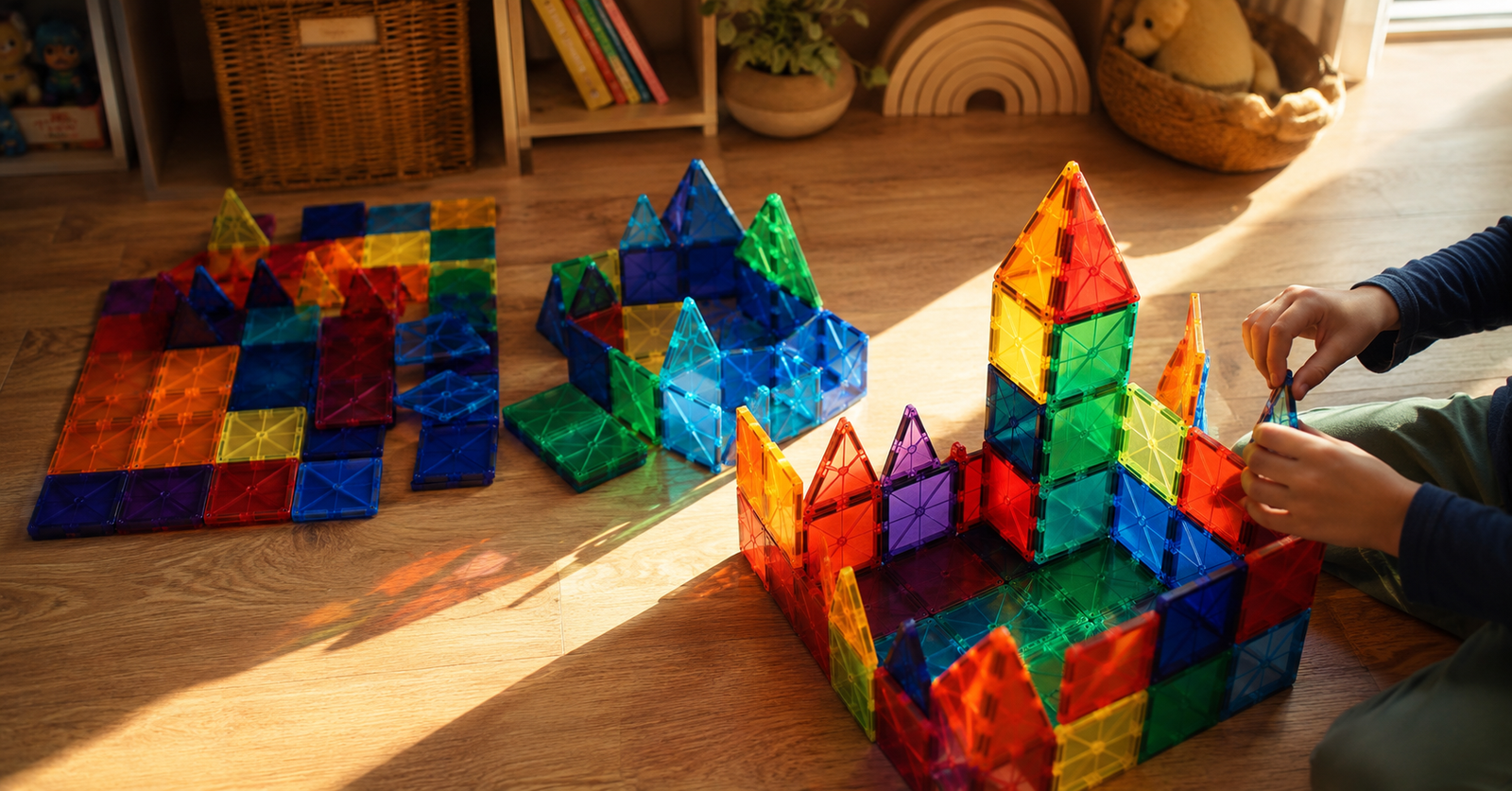
I’ve been a magnetic tile mom for years. Three kids, three different developmental stages, and a play corner that’s seen plenty of magnetic tile use. My almost-six-year-old daughter started building with magnetic tiles when she was around two. My middle son, who’s three, plays with them every single day—they’re easily one of his most-loved picks from my best toys for 2-3 year olds shortlist. My youngest, just past eighteen months, has recently started joining in too. That’s a lot of hours of real-world testing happening on my living room floor.
In this guide, I’m comparing the three brands at their most popular size: the 100-piece sets. This matters because most “vs” articles online compare different piece counts (a 32-piece against a 100-piece), which isn’t a fair fight. Here, you’ll see what each brand actually offers when you’re spending real money on a real starter set—and I’ll tell you which one is right for your family based on the ages of your kids, your budget, and how rough your household is on toys.
Quick Verdict — Which Set Should You Buy?
If you only have ninety seconds, here’s the short version:
- Magna-Tiles Clear Colors 100-Piece Set is the industry gold standard. Best for families with toddlers under three, light-table play, and parents who want the safest, most durable construction. Premium pricing.
- Connetix Rainbow Creative Pack (102 pieces) is the premium builder’s choice. Best for kids ages three and up who want to build houses, castles, and elaborate structures—it’s the only set that includes windows, doors, and fences.
- PicassoTiles 100-Piece Set is the value champion. Best for first-time buyers, larger families, classrooms, or anyone who wants to fill a play space without spending premium money.
If you want to know why each pick is what it is—and which scenario fits your home—keep reading.
How I Compared These Three Sets
Before I recommend anything to my readers, I run it through five layers of fact-checking:
- Manufacturer specifications straight from each brand’s official website (not Amazon listings, which can be inaccurate)
- CPSC recall database checks, because magnetic toys are one of the most-watched product categories in children’s safety
- Independent reviewers, including hands-on testers and parenting blogs that have physically taken these tiles apart to compare construction
- Amazon review patterns, looking specifically at one-to-three-star reviews for repeating complaints
- Parent communities on Reddit and Facebook groups to surface issues that don’t show up in official listings
Three kids, ten-plus years of parenting magnetic-tile builders, and this layered fact-checking process is what’s behind every recommendation below. None of these brands paid for placement here.
A note on personal experience: I’ve used Magna-Tiles and Connetix in my own home for years. PicassoTiles is the one major brand I haven’t personally bought yet—but I’ve spent extensive time researching it through manufacturer specifications, hands-on independent reviews, the CPSC database, and Amazon review patterns. Where I draw on personal experience below, I’ll say so. Where I draw on research, I’ll be clear about that too. I’d rather be transparent than pretend.
Magna-Tiles Clear Colors 100-Piece Set — The Industry Gold Standard
Best for: Families with very young children, light-table play, anyone who wants the safest construction quality in the category.
Check the current price on Amazon →
Magna-Tiles invented this category. The brand has been making magnetic building tiles since 1997, and the company is quick (and accurate) to point out that they’ve had no product recalls in their entire history. That’s a meaningful credential in a toy segment where competitors regularly get pulled from shelves.
The Clear Colors 100-Piece Set comes with squares and triangles in five shapes, all translucent so they catch sunlight or light-table light beautifully. The tiles are made from food-grade modified ABS plastic, which is BPA-, phthalate-, and latex-free, and the construction includes three engineering features I haven’t seen replicated elsewhere: a signature criss-cross lattice that resists cracking even when stepped on, nickel-plated metal rivets that secure the magnets inside, and a V-Lock edge design that prevents chipping. They meet US, EU, ASTM, and CPSIA safety testing standards. They also come with a one-year limited warranty—one of the best in the industry.
What I love about Magna-Tiles, especially as a mom whose youngest is only eighteen months: the magnets are intentionally calibrated to be easy to pull apart. This sounds like a weakness until you’ve watched a frustrated toddler give up on a toy because they can’t separate the pieces. Magna-Tiles strike the balance perfectly—strong enough to hold a structure together, gentle enough for tiny hands.
What’s the downside? Two things. First, they’re the most expensive of the three brands by a meaningful margin. You’re paying premium pricing for that twenty-five-plus years of refinement. Second, because the magnets are deliberately softer, very tall or wide builds can sag and collapse more easily than with Connetix. If your kids are older and want to construct ambitious castles, you’ll either need more Magna-Tiles to add structural stability—or you’ll want to look at Connetix.
There are no windows, doors, or fence pieces in this set. You get clean geometric shapes for open-ended play, which is by design, not an oversight. Magna-Tiles believes in fewer “themed” pieces and more imagination work.
Connetix Rainbow Creative Pack 102 Pieces — The Premium Builder’s Choice
Best for: Kids ages three and up who want to build houses, castles, and elaborate small-world structures.
Check the current price on Amazon →
Connetix is the Australian newcomer that’s earned a devoted following among serious magnetic-tile families. The brand launched in 2019, designed by two families of parents and educators, and entered the US market with three distinct selling points: stronger magnets, beveled edges instead of flat surfaces, and—most importantly for households like mine—a wider variety of shapes than any competitor.
The Rainbow Creative Pack includes the standard squares and triangles, but then adds something I’ve never seen elsewhere: six window pieces, six door pieces, six rectangles, and six fence pieces. If your child has ever tried to build a “house” out of plain triangles and squares and ended up frustrated, you’ll understand instantly why this matters. With Connetix, my three-year-old can build something that actually looks like a house in his head: there’s a door he can open, a window his toy animals look through, and a fence around the yard. That changes the entire play experience.
Connetix has the strongest magnets among the three brands. In every independent reviewer’s hands-on testing I’ve read, Connetix held one more tile in a vertical chain than Magna-Tiles before the structure collapsed. The bevel-edged tiles are also surprisingly sturdy despite being thinner than the lattice-reinforced Magna-Tiles, and they create gorgeous light refractions when sun hits them through a window.
Safety credentials are impressive. Connetix lists compliance with ASTM F963-17, CPSIA Section 101, California Proposition 65, Canada SOR/2011-17 surface coatings regulation, and REACH (the European Union chemical safety standard). Like Magna-Tiles, they use ultrasonic welding plus metal rivets to keep magnets safely sealed inside.
The downsides are real and worth knowing. The strong magnets that make Connetix great for big builds may pinch tiny fingers—I’ve seen this firsthand with my youngest, and one of the most common Amazon reviews mentions a toddler getting their finger caught between two pieces snapping together. If your child is under two, Connetix is probably not your first set. Second, US inventory can be unpredictable. As an Australian brand, Connetix sometimes goes out of stock during peak shopping seasons. Third, while they’re more affordable than Magna-Tiles on a per-tile basis, they’re still in premium pricing territory.
PicassoTiles 100 Piece Set — The Value Champion
Best for: First-time magnetic tile buyers, larger families, classrooms, school-age kids, or anyone who wants more tiles without the premium price.
Check the current price on Amazon →
PicassoTiles’ 100-Piece Set is one of the best-selling magnetic tile sets on Amazon, and the reason is simple math: you get the same piece count as a premium Magna-Tiles set for roughly one-third the price. The 100-Piece Set is Amazon’s Choice in its category, has earned tens of thousands of positive reviews, and consistently ranks among the top toys in the broader Toys & Games category.
What makes this set distinctive is what you get for the money. PicassoTiles includes eight extra-large squares (six inches by six inches) in the 100-piece set—neither Magna-Tiles nor Connetix include large squares of this size in their standard 100-piece offerings. Those big base tiles are absolute gold for building wide foundations, stable garages, or platforms that hold up large constructions—and they’re one of the most consistently praised features in long-term customer reviews.
So what’s the catch? Here’s where I want to be honest with you, because most affiliate articles online aren’t.
PicassoTiles does not use metal rivets. The tiles are sealed using high-strength ultrasonic welding and adhesive, not the rivet-plus-lattice double-sealing system that Magna-Tiles and Connetix use. This isn’t disclosed on PicassoTiles’ official marketing, but every independent reviewer who has physically taken the tiles apart confirms it. What does this mean for you in practice? In normal everyday play, it means very little. The tiles are sturdy, and independent reviewers and long-term customer feedback consistently report they hold up well through years of normal use. But if a tile is thrown hard against concrete or repeatedly stepped on in extreme ways, there’s a slightly higher chance it could split open and expose the magnets inside. This is why I always tell parents: regardless of brand, check magnetic tiles regularly and immediately discard any that show cracks or damage.
PicassoTiles’ official safety disclosures are also less comprehensive than the other two brands. Their packaging confirms the tiles are BPA-free and non-toxic, and the brand is sold on the Amazon US marketplace by an FBA seller with consistent ratings—but I couldn’t find the same detailed list of ASTM, CPSIA, EN71, or REACH certifications that Magna-Tiles and Connetix publish on their websites. That doesn’t mean they’re unsafe (the CPSC has never recalled PicassoTiles products), but the transparency gap is worth noting.
The other limitation: PicassoTiles’ surface scratches slightly more easily than the premium brands over time. Multiple long-term reviewers note that after heavy daily use, PicassoTiles develop visible surface wear sooner than Magna-Tiles or Connetix. Kids don’t care. Some parents do.
Head-to-Head Comparison
Here’s the at-a-glance summary of how the three sets stack up:
| Feature | Magna-Tiles | Connetix | PicassoTiles |
|---|---|---|---|
| Piece count | 100 | 102 | 100 |
| Price tier | Premium ($$$) | Premium ($$) | Value ($) |
| Shape variety | 5 shapes (squares + triangles) | 9 shapes (incl. windows, doors, fences) | 5 shapes (incl. XL squares) |
| Construction | Lattice + metal rivets + V-Lock | Beveled + metal rivets | Ultrasonic welding (no rivets) |
| Magnet strength | Moderate (designed for easy pull-apart) | Strongest | Moderate-to-strong |
| Safety certifications listed | ASTM, CPSIA, EN71 (full disclosure) | ASTM, CPSIA, Prop 65, REACH, Canada SOR | BPA-free, non-toxic (limited disclosure) |
| Recall history | Zero (25+ years) | Zero | Zero |
| Translucent / light-table friendly | Yes (excellent) | Yes (with bevel refractions) | Yes |
| Includes XL pieces | No | No | Yes (eight 6″ squares) |
| Includes architectural pieces | No | Yes (windows, doors, fences) | No |
| Warranty | 1-year limited | Not specified | Not specified |
| Best for ages | 1–8 (especially under 3) | 3+ | 3+ |
| Cross-brand compatible | Yes | Yes | Yes |
All three brands are compatible with one another—you can mix sets together and they snap into the same structures.
Which One Should YOU Buy? A Real-Family Scenario Guide
Here’s where most comparison articles fall short. They tell you the features but leave you to figure out which set fits your life. Let me try to actually answer that—using my own household and the families I know as reference points.
Scenario 1: You have a baby or toddler under two
Buy Magna-Tiles. The deliberately softer magnet strength is the single most important feature at this age. Strong magnets are a finger-pinch hazard for tiny fingers, and toddlers also struggle to pull strong magnets apart, which leads to frustration and abandoned play. Magna-Tiles’ lattice and rivet construction also gives the maximum safety margin if a tile ever does get damaged. This is what my youngest plays with under supervision—and they’re one of the few toys that reliably trigger true independent play in our home.
Scenario 2: You have only one child, ages three to six, who loves building houses and small-world play
Buy Connetix. This is the scenario where Connetix absolutely shines. The windows, doors, fences, and rectangles transform what your child can build. A castle stops being a triangular stack and becomes a real castle with a drawbridge entrance. A barn has a door for the toy animals. A house has windows you can see through. If your child gravitates toward pretend play and storytelling rather than abstract construction, the architectural pieces are worth every extra dollar.
Scenario 3: You’re a first-time magnetic tile buyer, or you’re not sure your child will love them
Buy PicassoTiles. No question. Magnetic tiles are an investment, and if you’re not sure your child will be into them, spending a hundred-twenty dollars to find out is a heavy gamble. PicassoTiles gives you the same piece count and the same play experience for far less. If your child falls in love with them, you’ve got room in your budget to add a premium set later as their builds get more ambitious. If they don’t, you’ve saved meaningful money.
Scenario 4: You have school-age kids (five and up) who want huge, ambitious builds
Buy PicassoTiles, and lots of them. At this age, the lighter safety margin matters far less because your kids aren’t putting things in their mouths or stepping on tiles barefoot. What matters is volume. School-age kids want to build cities, multi-story buildings, marble runs, and Instagram-worthy creations—and that takes a LOT of tiles. PicassoTiles gives you the most pieces per dollar, and the included XL squares are perfect for big base structures.
Scenario 5: You have a mixed-age household (like mine)
This is the strategy I recommend to most parents in my situation: start with a Magna-Tiles set for the safety credentials and build the bulk of your collection with PicassoTiles. The two brands are compatible, so they snap together seamlessly. You get the rivet-secured safety margin for the youngest child, the volume for your bigger kids, and the cost savings that matter when you’re shopping for a family of three or more children.
If you can stretch the budget, adding a Connetix Rainbow Creative Pack as your second or third set is what unlocks the architectural play. The window and door pieces are the single best add-on you can buy for a magnetic tile collection.
Scenario 6: You’re shopping for a classroom or daycare
Buy PicassoTiles in bulk, and supplement with Magna-Tiles. Educational settings need volume and durability without the premium price tag, which puts PicassoTiles in pole position. Add a smaller Magna-Tiles set for the rivet-secured safety margin during supervised play with younger groups.
A Quick Safety Conversation Every Magnetic Tile Parent Should Have
Magnetic tile toys have come up in conversations about the broader category of magnetic toy hazards, and it’s worth being clear-eyed about the actual risks.
The serious recalls and injuries you may have read about over the past decade almost always involve small, high-powered magnets in ball-and-stick construction sets or rare-earth desk toys—not magnetic tiles. In late 2022, the US Consumer Product Safety Commission tightened safety standards in a way that effectively banned the sale of high-powered loose magnet sets. Compliant magnetic tiles, by contrast, use lower-strength magnets sealed inside large plastic pieces that are too big for children to swallow.
The real practical risk with magnetic tiles is what happens if a tile breaks. A cracked or shattered tile can release the small magnets inside, and if a child swallows two or more, the magnets can attract through tissue and cause serious internal injury.
This means three habits matter, regardless of which brand you buy:
- Inspect tiles regularly—weekly is a good cadence—and immediately discard any that show cracks, dents, or loose magnets.
- Always supervise children under three with magnetic tiles, even brands marketed as ages 3+.
- Never let children play with magnetic tiles outdoors on hard surfaces (concrete patios) where impact damage is more likely.
Magna-Tiles’ rivet-and-lattice construction and Connetix’s rivet-and-bevel construction both add an extra layer of safety here—the rivets keep tiles intact even when damaged. PicassoTiles’ weld-only construction has a slightly higher theoretical risk, which is part of why I recommend it more confidently for older children. If you’re building out a broader rotation of low-risk, hands-on activities, my guide to screen-free activities for toddlers pairs naturally with magnetic tile play.
Are Magna-Tiles, Connetix, and PicassoTiles Compatible With Each Other?
Yes—completely. All three brands use the standard three-inch base measurement for squares, and the magnet polarity is consistent across all three. You can mix tiles from any of these brands and they’ll snap together into the same structure.
This is important strategic news for budget-conscious parents. Instead of choosing one brand and committing to expensive expansion packs forever, you can build a hybrid collection: a premium starter set from one brand, with bulk pieces from another. The most common combination I see in online parent groups is a Magna-Tiles or Connetix base set with PicassoTiles bulk fills.
Frequently Asked Questions
Are PicassoTiles safe for toddlers?
PicassoTiles meet basic toy safety standards (BPA-free, non-toxic), are sealed with ultrasonic welding, and have no recall history. They’re labeled for ages 3+, like all major magnetic tile brands. That said, they lack the metal rivets used by Magna-Tiles and Connetix, which is why I recommend them more confidently for children over three.
Why are Magna-Tiles so expensive?
Premium pricing reflects three things: twenty-five-plus years of brand history with zero product recalls, more rigorous construction (lattice + rivets + V-Lock edge), and the cost of being designed in the US (just outside Chicago). You’re paying for safety engineering and brand reputation, not just plastic.
What age are magnetic tiles appropriate for?
All three brands officially recommend ages 3 and up. That said, with supervised play, many children begin enjoying magnetic tiles as early as 18 months. Magna-Tiles’ softer magnets make them the most toddler-friendly choice in that supervised-play window.
Where are these brands manufactured?
Magna-Tiles is designed in the US (Chicago area) and manufactured through a global network of partners. Connetix is an Australian brand manufactured in China. PicassoTiles is manufactured in China.
Do magnetic tiles come with a warranty?
Magna-Tiles offers a one-year limited warranty—one of the only brands in the category to do so. Connetix and PicassoTiles don’t publish explicit warranty terms; you’ll rely on Amazon’s return policy for those.
Can I mix Magna-Tiles, Connetix, and PicassoTiles together?
Yes. All three brands use compatible sizing and magnet polarity. Many families build hybrid collections to balance safety, features, and budget.
Final Verdict
There’s no universal “best” magnetic tile brand—there’s the best brand for your family.
If you have very young children or you only want to buy one premium set and never think about it again, Magna-Tiles is the gold standard for good reason. If your child loves building houses, castles, and architectural play, Connetix is the most exciting set on the market right now. And if you want to maximize what you get for your budget—or if you’re not sure whether your child will love magnetic tiles at all—PicassoTiles is the smartest first purchase you can make.
In my own house? My youngest plays with our Magna-Tiles under supervision. My three-year-old gets the Connetix architectural pieces for his elaborate barn builds. Watching my kids spend hours building, knocking down, and rebuilding has been one of the quiet joys of my last five years of motherhood. Magnetic tiles are one of the few toys I’ve watched all three of my kids come back to year after year—and the fact that the major brands snap together means you’re never locked into a single ecosystem. Whatever brand you start with, your collection can grow alongside your family.
Whatever you pick, you’re choosing a toy your child will likely play with every single day for years. That’s a rare thing in a toy aisle full of disposable plastic. Choose the brand that fits your family, and don’t overthink it.