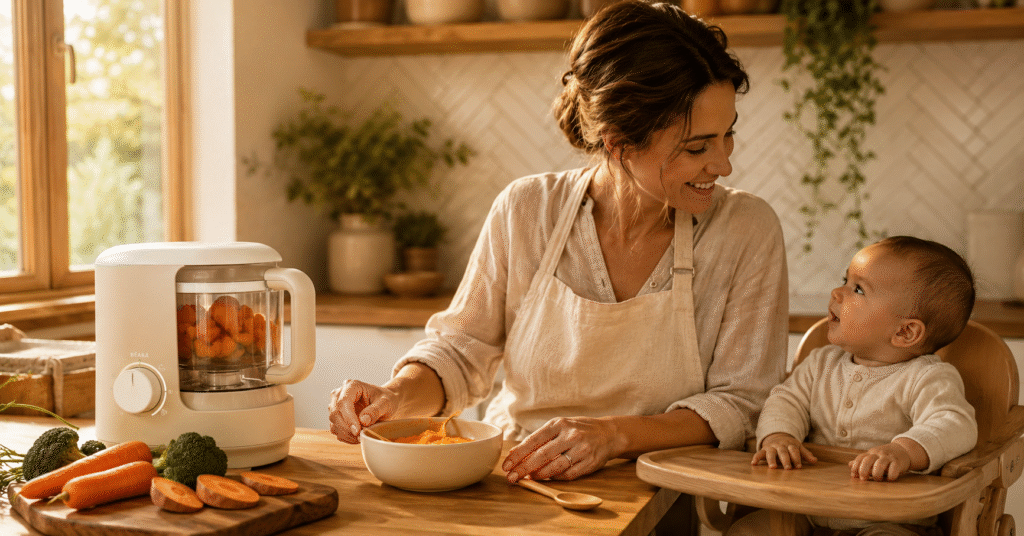
If you’ve ever had dinner to cook, a baby needing attention and three pots to wash before bedtime, you already know why baby food makers appeal to busy parents. The promise is simple: one appliance, one bowl, real food made in under twenty minutes. The reality is more complicated, because there are now dozens of these machines competing for your counter space, and they are not all the same.
I have three kids, and my youngest just recently moved past the purée stage. Those months left me with strong opinions about which features actually matter and which are marketing fluff. Over the last few weeks I went back through the current market, cross-referenced four leading review outlets (Mommyhood101, Babylist, The Bump, and What to Expect), pulled current sales data and customer review patterns, and verified safety records against the CPSC database. Then I narrowed the field to five.
This is not a list of every baby food maker on Amazon. It’s a list of five steam-and-blend combos that hold up to scrutiny, across different price points, family situations, and trade-offs. Whichever one you’re considering, I’ll tell you what I’d look for before clicking buy.
Quick comparison: who’s this for?
| Model | Best for | Capacity | Standout feature |
|---|---|---|---|
| Grownsy One Step | Most parents starting out | Single-serve to medium batches | Best balance of price, build, and reviews |
| Baby Brezza Deluxe | Truly hands-off cooking | 3.5 cups | The only one that auto-transitions from steam to blend with zero touch |
| BEABA Babycook Solo | Buy-it-for-life parents | 4.5 cups (27 servings) | Thirty-five-year French pedigree with FDA, Health Canada, and EU food-safety compliance |
| Babymoov Duo Meal Station | Multiples or batch cookers | 9.25 cups (25 servings) | Steam two foods + blend a third simultaneously; lifetime warranty |
| EVLA’s Touch Screen | Tight budgets, pouch users | 600 ml (smaller batches) | Self-clean cycle, six reusable pouches included |
Do you actually need a baby food maker?
Maybe not, if you already own a decent steamer basket, a blender, and a freezer ice-cube tray. The American Academy of Pediatrics doesn’t recommend any specific equipment for starting solids. They just want the food to be soft, mashable, and offered around six months when your baby shows readiness signs.
So what changes with a dedicated machine? Three things.
First, you save dishes. A pot, a colander, a blender, a spatula, and the lid you dropped on the floor, compared to one bowl that steams and blends in the same container. For me, this was the single biggest reason I kept reaching for the machine instead of the stovetop, especially in the early-evening witching hour.
Second, you preserve more nutrients. Steaming food above the water, rather than boiling it in water, keeps more water-soluble vitamins like B and C in the food itself. The CDC’s guidance on infant nutrition emphasizes nutrient-dense first foods, and steam cooking is genuinely better than boiling for retention. Most of these machines also let you save the condensed steam water as the liquid you blend with, which adds the dissolved nutrients right back in.
Third, you remove a friction point. Tired parents skip steps. If making fresh purée takes fifteen minutes instead of forty, you’ll do it more often. That matters more than any feature list.
If you batch-cook every Sunday and freeze a month at a time, a $20 silicone freezer tray and your existing blender will get you there. If you’re cooking from scratch most days, or if you’re the parent who’ll happily skip homemade food when it feels like too much work (no judgment — I have been that parent), a dedicated machine earns its space.
How I evaluated these five machines
I’m not testing twelve different baby food makers in my kitchen. My kids are past the purée stage now, and I’m not pretending to be a lab. What I can do is something more useful: layer multiple independent sources and check whether the marketing matches the reality.
For each machine on this list, I cross-referenced:
- Four leading review outlets (Mommyhood101, Babylist, The Bump, and What to Expect) for hands-on testing notes.
- The CPSC recall database for the last five years, plus brand-direct recall pages.
- Current Amazon listing bullets and the brand’s own product page, since these sometimes disagree on capacity or function count, which is a red flag worth noting.
- Negative review patterns from one- and two-star reviews, looking for durability complaints that repeat across many users.
- Parent communities on Reddit and Facebook groups to surface issues that don’t show up in formal reviews.
The five that follow each survived all five layers. Where a machine has a known weakness, I’ll tell you what it is.
The five baby food makers worth considering in 2026
Grownsy One Step Baby Food Maker
Roughly $100 · 4-in-1: steam, blend, grind, sterilize · Tritan bowl, elevated steam basket
If you’d asked me three years ago which baby food maker dominated Amazon, I would have said BEABA. Today the answer is Grownsy — and not by a small margin. Their One Step model currently holds the #1 Best Seller badge in Amazon’s Baby Food Mills category, with thousands of reviews and an Amazon’s Choice mark to back it up.
Beyond all that marketing language, what you actually get is a compact countertop machine that steams food in an elevated basket, then blends it in the same bowl with two mixing modes (auto and manual) and three time settings. The blending cup is Tritan, a BPA-free copolyester that’s heat-resistant and safer for baby food contact than older polycarbonates. There’s a built-in sterilize mode for pacifiers and bottle nipples, which is nice but probably not the reason you’d buy it.
The detail that won me over reading the spec sheet: when you open the lid mid-cycle, the machine automatically pauses. That’s a small thing until you have a curious toddler trying to “help” you cook.
Pros
- Strongest sales and review velocity in its category right now
- Tritan bowl is safer than older plastic bowls and more shatter-resistant than glass
- True steam cooking (not boiling) to preserve B and C vitamins
- Lid-open auto-pause is a genuine safety feature
- Around six color options to match your kitchen
- Sterilize mode is a useful side function
Cons
- Single-layer basket means smaller per-batch capacity than the Babymoov or BEABA Duo
- Brand is newer to the U.S. market than BEABA or Baby Brezza, so long-term durability data is shorter
- Customer service is by email rather than phone, which is slower
Bottom line: If you’re starting solids in the next month and want the best-validated choice without overspending, this is the one I’d put on my registry.
Baby Brezza One Step Food Maker Deluxe
Around $150 · 3 modes: auto steam+blend, steam only, blend only · 3.5-cup capacity, 10-minute cycle · Includes 3 reusable pouches + 3 funnels
This is the only machine in the lineup that genuinely lets you walk away. You load your ingredients, press one button, and ten minutes later there is finished purée sitting in the bowl. Every other machine on this list requires you to either transfer food between containers (BEABA Solo) or manually trigger the blend after steaming (Grownsy, Babymoov). The Brezza Deluxe does both steps automatically.
The four stainless-steel blades handle steaming and blending in the same bowl without you touching anything after the initial setup. The LCD panel lets you select the function and timing; the water tank is removable for easy filling. The bundle includes three reusable food pouches and three filling funnels, which is genuinely useful if you want to send portions to daycare or take them to the grandparents’ house.
Four major review outlets, Babylist, The Bump, What to Expect, and Mommyhood101, have named it among their top picks. That’s an unusually high level of consensus in this category.
Pros
- Genuinely one-touch operation, no food transfer mid-cycle
- Strong endorsement from four major review labs
- Includes pouches and funnels, fewer extras to buy separately
- Removable water tank and dishwasher-safe bowl and blade
- U.S.-based customer service available seven days a week
Cons
- Smaller capacity (3.5 cups) than the BEABA or Babymoov
- “Blend only” mode requires holding the button down, no walk-away short of the full auto cycle
- Some early-batch units had quality-control issues; the current revision appears improved
- Price runs $50 higher than the Grownsy for similar core functions
My take: Automated steam-and-blend cycles can reduce the number of separate steps, but hands-free does not mean safe to cook while holding or wearing a baby. Keep your child away from hot appliances, food and steam, and follow the machine’s instructions.
BEABA Babycook Solo (4-in-1)
Around $130 · 4-in-1: steam, blend, defrost, reheat · 4.5-cup bowl (1.1 L) makes 27 servings in 20 min · Tritan bowl, stainless-steel water reservoir, one-handed operation
BEABA is the French brand that invented the modern baby food maker. They’ve been at it for over thirty-five years, and their flagship Babycook line is sold in dozens of countries worldwide. Several review outlets, including The Bump, have called it the machine that set the standard for the category.
The Solo is their entry-level Babycook. You get a 4.5-cup Tritan cooking bowl, an elevated stainless-steel steam basket, and a single-knob control that handles all four functions. The design is intentional in a way the budget machines aren’t: the steam basket sits high enough that food never touches the boiling water, and the unique cyclone-effect blade lets you control texture by how long you pulse. One-handed controls are a convenience feature, not permission to hold a baby while cooking. Do not hold or wear your baby while operating a hot steamer or handling hot food; follow the exact model’s instructions.
What you pay for, besides the heritage: the cooking bowl, basket, and blade are made from food-grade materials that meet U.S. FDA, Health Canada, and EU food-contact safety standards, and are certified BPA-, lead-, and phthalate-free. It’s the kind of regulatory paperwork that a thirty-five-year-old brand has the resources to maintain. A newer brand often doesn’t.
Pros
- Thirty-five years of brand expertise; the original baby food maker
- Meets FDA, Health Canada, and EU food-contact safety standards; BPA-, lead-, and phthalate-free
- Tritan bowl and stainless-steel steam basket (not the glass model that was recalled)
- Designed for true one-handed operation
- Uses the condensed steam water as your purée liquid, adding nutrients back in
- Seven color options, including some genuinely elegant ones
Cons
- Single dial control feels dated compared to the LCD on the Brezza or Babymoov
- Smaller capacity than the Babymoov for big-batch cooking
- Deep narrow bowl means getting food out from under the blade takes a spatula
- Premium price for what is, functionally, a four-in-one
Worth it if: you want the gear equivalent of an heirloom and you’ll use it for multiple children. Save the difference if this is your first baby and you’re feeling overwhelmed by gear costs, and pick up the Grownsy instead.
Babymoov Duo Meal Station (6-in-1)
Roughly $180-190 · 6-in-1: steam, blend, warm, defrost, sterilize bottles, reheat · 9.25-cup capacity (about 25 baby-sized servings) · LCD panel with 10 presets · Lifetime warranty
If the Brezza is the hands-off pick and the BEABA is the heritage pick, the Babymoov is the kitchen-counter-saver pick. One machine replaces six: a steamer, a blender, a bottle warmer, a bottle sterilizer, a defroster, and a reheater. For families with twins, two close-in-age siblings, or anyone who batch-cooks a week of food at a time, it’s the most efficient appliance in this lineup.
Two separate steam baskets are the killer feature. You can steam sweet potato in one basket and pears in the other without cross-flavoring, then blend them separately. Mommyhood101’s 2026 hands-on review highlights what makes it unique: in their tested lineup, this was the only machine that could steam and blend at the same time. While one batch finishes in the blender, the next batch is already cooking in the steamer. For batch days, that is a real time-saver.
It also runs the longest warranty in this lineup: Babymoov backs it for life. That’s the kind of confidence you only see from a brand that’s been selling the same line for over twenty years.
Pros
- Six functions in one; replaces multiple appliances
- Two separate steam baskets to cook two different foods without cross-flavoring
- Can steam and blend simultaneously, a rare feature in this category
- Largest capacity here at about 25 servings per cycle
- Lifetime warranty
- LCD with 10 presets and a companion recipe app
Cons
- Largest footprint at about 15 inches wide
- The most expensive option on this list
- Steeper learning curve, since six functions means more buttons and presets to learn
- Some users report long-term issues with the heating coil after several months of weekly use
Best fit: cooking for twins, two kids under three, or anyone who genuinely wants to consolidate appliances. Probably overkill if you’ll only ever make small batches.
EVLA’s Baby Food Maker (Touch Screen)
Around $70 · 6 functions: steam, blend, reheat, defrost, sterilize, self-clean · 600 ml capacity · Touch-screen control · Includes 6 reusable food pouches
If your budget is under $80 and you also want to use reusable food pouches, EVLA’s is the only machine on this list that pairs those two priorities. The bundle includes six reusable pouches (more than any other machine in this roundup), and the self-clean function is a quietly useful feature most premium machines skip. You add water and a drop of detergent, hit the clean button, and the machine runs a 45-second cycle that handles most of the cleanup.
It’s a smaller machine in every dimension. The 600 ml capacity means you’re making two to three servings per cycle rather than a full week’s worth, which is fine if you’re cooking fresh every few days. The touch-screen control is more modern than the budget category usually offers, and the water tank has a wide opening, a small design detail that prevents the mold buildup that plagues some narrow-tank competitors.
EVLA’s has won both a NAPPA award and a Mom’s Choice award. It’s the budget pick I’d actually buy.
Pros
- Lowest price in this lineup
- Six reusable food pouches included; biggest pouch bundle here
- Self-clean cycle (45 seconds) is a real differentiator
- Touch-screen control rather than buttons
- Wide water-tank opening helps prevent mold
- Backed by NAPPA and Mom’s Choice awards
Cons
- Smallest capacity at 600 ml means two to three servings, not a full batch
- Some users report uneven purée texture on tougher foods
- Touch screen occasionally finicky with wet or greasy fingers
- Reusable pouches will need replacing over time
Smart pick for: making fresh food every few days, sending portions to daycare in reusable pouches, and keeping your total spend under $100. Skip it if you batch-cook on weekends; the capacity will frustrate you.
How to choose between them
Five solid machines, five different families they’re built for. Here’s how I’d think about it.
Start with how you’ll actually use it. Think about this honestly. Are you the parent who’ll batch-cook on Sunday and freeze cubes for the week? Then go big with the Babymoov or BEABA Solo. Are you the parent who’ll make a fresh bowl most evenings and never freeze anything? A smaller machine like the EVLA’s or Brezza is plenty. There’s no shame in either approach. The wrong-sized machine becomes a counter-occupying decoration.
Next consider how hands-off you need this to be. If you’ve got a baby who screams the moment you put them down, the Baby Brezza’s one-touch auto cycle becomes invaluable. If your baby naps long enough for you to manage a multi-step process, the other machines are fine.
Heritage and longevity matter if you’re planning to use the machine across two or three kids over many years. That’s where BEABA’s regulatory paperwork and build quality justify the price. If this is a phase you’ll be done with in nine months, paying the premium makes less sense.
Finally, measure your counter space before you order anything. The Babymoov is about fifteen inches wide. The EVLA’s is closer to eight. That difference matters in a small kitchen.
Using your baby food maker safely
The machine handles cooking; you handle everything around it. A few non-negotiables.
Wait for the AAP-recommended readiness signs. Around six months, not before. Your baby should be able to sit with support, hold their head steady, open their mouth when food approaches, and turn their head away when full. Starting earlier increases the risk of choking and allergy sensitization. (A supportive seat helps, too. See my picks for the best high chairs for baby-led weaning if you’re still shopping.)
Start single-ingredient. One new food at a time, three to five days apart, so you can identify any allergic reaction. Pediatricians now recommend introducing common allergens early, including peanut, egg, and dairy, rather than delaying them. Steamed and blended into a thin purée, these foods are safe even for early eaters.
Watch the temperature. Food that comes out of any of these machines is hot. Always stir and test on the inside of your wrist before serving. The CDC recommends body temperature, warm but not hot.
Don’t store leftover formula or breastmilk in the machine’s bowl. Use proper storage containers, and never re-steam previously served food.
Descale monthly. All five machines build mineral deposits over time, especially if you’re on hard water. White vinegar plus distilled water, run through a steam-only cycle, handles it. Skipping descaling shortens the life of the heating element on every machine here.
Frequently asked questions
At what age can I start using a baby food maker?
Around six months, in line with current AAP guidance, and only after your pediatrician confirms your baby is developmentally ready for solids. The machine itself doesn’t determine the timing; your baby’s readiness does.
Are these machines safe? Any concerns about plastic and food?
All five machines on this list use BPA-free materials. The Tritan plastic used in the Grownsy, BEABA Solo, and Brezza bowls is a copolyester certified for food contact and considered safer than older polycarbonates. The Babymoov uses a mix of Tritan, polypropylene, and SAN, all BPA-, lead-, and phthalate-free. If you want zero plastic in contact with hot food, look at the BEABA Duo (a sister model to the Solo with a glass bowl, not on this list) or use a stovetop steamer with a glass blender.
How long do these machines actually last?
With monthly descaling, most users report three to five years of regular use across all five brands. The most common failure point is the heating element, which is why descaling matters. The BEABA and Babymoov have the strongest reputations for longevity; the Grownsy is too new to have long-term data, though early signs are good. The Babymoov’s lifetime warranty offers the best protection if longevity is your top concern.
Can I use these machines for older toddlers?
Yes. All five double well as small steamers for finger foods, soft pasta, and cooked vegetables long after purée season ends. My youngest used our food maker as a soft-vegetable steamer well into his second year. The blade can come out for steam-only use. (If you’re planning ahead for that stage, I have a separate guide on the best toddler plates, bowls, and utensils for self-feeding.)
Should I get a glass-bowl version instead?
Glass eliminates plastic-on-hot-food contact, which appeals to some parents. The trade-off is breakage risk. BEABA’s 2019 Neo recall (covered above) happened because their original glass bowl could shatter. The redesigned current bowl is reportedly much stronger, but glass remains heavier and more fragile than Tritan. If glass is non-negotiable for you, look at BEABA’s Babycook Neo (current generation) or Babymoov’s Duo Meal Glass. For most families, modern Tritan is a reasonable middle ground.
Do I need to sterilize the machine before first use?
Yes. Every machine in this lineup recommends running two or three full steam cycles with water only before the first time you make food. This removes any residual manufacturing smells and confirms the machine is working correctly. Don’t skip it.
Quick checklist before you buy
A short pre-purchase gut-check, especially if you’re tempted by Amazon Prime Day or registry deals:
- Counter space: Measure the spot where the machine will live, height included if you store it under a cabinet.
- How you’ll really use it: Daily fresh batches or weekly meal prep? That answer changes which capacity is right.
- Your baby’s readiness: Your pediatrician has cleared solids, and you’re seeing the readiness signs above.
- Registry vs. self-purchase: Adding it to a registry? Pick one under $150 so friends actually buy it.
- Warranty: Note the length; manufacturers honor it more readily if you register the product on their site within thirty days.
- Return window: Check the seller’s return policy before opening the box. If something arrives damaged or smells off after the initial steam cycles, you’ll want to return rather than try to fix it.
Want more help with starting solids?
I’ve put together a free, printable First-Foods Tracker that walks you through introducing the AAP’s recommended order of foods, including the common allergens, over your baby’s first three months on solids. It’s the same tracker I wish I’d had when we started solids with our youngest.
Sign up below to download it free.
A final thought
If you’re shopping with a baby registry in mind, the Grownsy and the Baby Brezza are the two I’d star first. Both sit at price points friends and family actually buy from registries (under $150), and both ship reliably through Amazon, which is where most registry gifters check off items. The BEABA Solo is the gift to ask for if a generous family member offers to splurge. The Babymoov is the one to add to your registry only if you’re expecting twins or you already know you batch-cook; otherwise you’ll get a bigger machine than you need. The EVLA’s is a smart self-purchase, not a typical registry pick.
None of these machines will make your baby eat better. Babies eat (or refuse to eat) on their own schedule, and the fanciest food maker on earth can’t change a tongue-thrust reflex or a sudden veggie strike. What a good machine does do is lower the activation energy. When making purée takes ten minutes instead of forty, you do it more often. When you do it more often, you offer more variety. When you offer more variety, you build a less picky eater — even if it doesn’t feel that way at month nine when everything is being rejected.
That’s the real return on this purchase: not the appliance itself, but the habits it makes possible. Pick the one that fits your kitchen, your budget, and your tolerance for cleanup. Then forget about it and feed your baby.