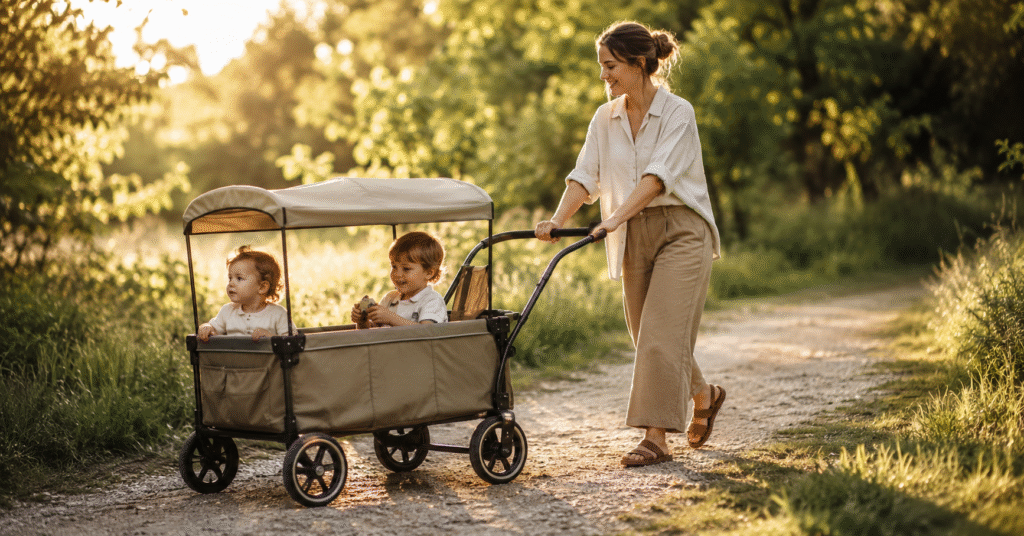
The first time I seriously considered a stroller wagon was the summer my older son turned three and my youngest hit 18 months. We were two blocks into a neighborhood farmers’ market when the double stroller stopped being the answer. My older son wanted out so he could walk. Five minutes later, he wanted back in. My youngest decided the cup holder was a teething toy. I was carrying a tote bag, a half-eaten muffin, and what felt like the last shreds of my patience.
That’s the wagon moment. Once your kids are old enough to climb in and out on their own but still too little to last a full day on their feet, a stroller wagon stops being a luxury and starts looking like sanity insurance. After cross-referencing dozens of parent reviews across mom groups and combing through every major brand’s spec sheets, here are the five best stroller wagons for 2026, plus the one thing about Disney that nobody told me before I started shopping.
The 5 Best Stroller Wagons for 2026 at a Glance
| Pick | Best For | Seats | Approx. Price |
|---|---|---|---|
| Wonderfold W4 Elite Pro | Best overall for big families | 4 | $650–700 range |
| Wonderfold W2 Original | Best for two kids day-to-day | 2 | $375–425 range |
| Veer Cruiser XL | Best all-terrain for beach & trails | 4 | $750–825 range |
| Radio Flyer Trav’ler | Best budget travel wagon | 2 | $275–325 range |
| Radio Flyer 3-in-1 EZ Fold | Best compact budget pick | 2 | $160–200 range |
How We Picked These Five
I’m cautious about gear that costs more than most people’s monthly grocery budget. Before any wagon made the shortlist, it had to clear a five-layer check.
- Safety certifications. Every model on this list is third-party tested to current safety standards (ASTM F833-21 for most, JPMA certification for Veer). I confirmed each on the manufacturer’s official safety page.
- CPSC recall scan. I checked the U.S. Consumer Product Safety Commission database for active recalls and recent warnings on each model and brand. None of the five had any open recall as of this update.
- Rating floor. Every pick has a 4.4+ star rating with at least fifty verified reviews on its primary Amazon listing, and most have thousands.
- 1-3 star pattern analysis. I read negative reviews looking for repeat complaints, not one-off shipping gripes. Where a pattern emerged (heavy fold, brake feel, harness adjustment), I noted it in the “What to know” section of each pick.
- Real-parent reports. Mom-group threads, Reddit r/Mommit and r/beyondthebump posts, and long-term parent reviews on independent gear sites confirmed (or pushed back on) the manufacturer’s marketing.
1. Wonderfold W4 Elite Pro — Best Overall for Big Families
If you’ve spent any time scrolling Instagram in the last two years, you’ve seen this wagon. The Wonderfold W4 Elite Pro is the four-seater that mom groups recommend by reflex, and after digging through its specs and the thousands of reviews behind it, that reflex is mostly right. It’s the current best-seller in Amazon’s Tandem Strollers category, which tells you something about how completely it dominates the four-kid segment.
What makes it worth it
- An aluminum frame keeps the empty weight lower than the steel Luxe model, which matters every single time you wrestle it into a trunk.
- Reclining, removable seats face forward or backward, so siblings who don’t want to look at each other don’t have to.
- The front zipper door lets a toddler climb in without you having to lift them. A small thing until you’re solo-parenting and pregnant or recovering.
- It is third-party tested to the ASTM F833-21 safety standard with a five-point harness on each seat and a total weight capacity that comfortably accommodates four kids plus a diaper bag’s worth of gear.
What to know before buying
- Even at the lighter aluminum spec, this wagon is heavy. The recurring 1-3 star pattern is “great wagon, awful to lift into an SUV.” If you drive a smaller sedan or hatchback, measure your trunk before you order.
- Folded, it stays bulky. Parents with garage space love it; parents with apartment closets don’t.
- Most accessories (snack tray, parent console, all-weather mat) are sold separately, and they add up.
👉 Check current price on Amazon
2. Wonderfold W2 Original — Best for Two Kids Day-to-Day
The W2 Original is what I’d buy if I were doing it over and didn’t have a third on the way. It’s the two-seat sibling to the W4, sharing the same brand DNA, the same testing standard, and the same general design language, but at roughly half the wallet pain and a much friendlier footprint for narrow doorways and crowded sidewalks.
What makes it worth it
- Two raised seats with five-point harnesses give each kid their own space and a clear view, which dramatically reduces the “she’s looking at me” complaints on long walks.
- The steel frame is heavier than the Elite Pro’s aluminum but feels reassuringly solid; parents who prioritize durability over weight savings tend to prefer it.
- All-terrain wheels handle grass, gravel, and average sidewalk seams without drama.
- Front zipper door, mesh side panels for ventilation, and a one-step foot brake are standard.
What to know before buying
- The steel frame adds noticeable weight versus the higher-end Wonderfold models. Reviewers who upgraded to the Luxe or Elite Pro later usually cite the weight difference, not anything wrong with the W2 itself.
- No included car seat adapter. If you want to use it with a newborn in an infant carrier, you’ll need to buy the adapter separately.
- Canopy is smaller than the four-seater models; in peak summer sun your kids may need hats too.
👉 Check current price on Amazon
3. Veer Cruiser XL — Best All-Terrain for Beach Days and Trails
The Veer Cruiser XL is the wagon that gets pushed at you on TikTok every June when beach season starts. There is a real reason for that. Veer designed the Cruiser as a true all-terrain piece. Aircraft-grade aluminum frame, knobby off-road tires, and a steering system that lets you push it, pull it like a wagon, or push it along beside you like luggage. Of all the four-seaters I researched, it is the lightest empty by a significant margin, which translates directly to how easily one parent can manage it on uneven ground.
What makes it worth it
- JPMA certified to current ASTM stroller safety standards. (For families coming from the stroller world: JPMA is the same certification body whose seal you’ve seen on UPPAbaby and Nuna.)
- The aluminum frame keeps the empty weight remarkably low for a four-seater, meaningfully lighter than comparable Wonderfold models per side-by-side comparisons from independent gear testers.
- Push, pull, or push-along steering is genuinely useful on sand and gravel where pushing alone doesn’t work.
- Compatible with a single infant car seat using the brand’s adapter (sold separately), extending its useful life back into the newborn months.
What to know before buying
- This is the priciest pick on the list, and a lot of what you’d expect at this price isn’t included. The canopy, the cup holders beyond the basics, the storage basket, the car seat adapter. Most of these are accessories you’ll add to your cart. Plan for that before sticker shock hits.
- The Cruiser philosophy is “premium stroller experience, not a giant toy box on wheels.” Storage out of the box is minimal compared to a Wonderfold.
- Independent reviewers have noted the standard restraint is more streamlined than the padded five-point setups on competing wagons; some parents upgrade to the brand’s comfort seat for that reason.
- One thing worth flagging because it’s been circulating: a viral budget-tier wagon sold at Costco was recalled in October 2025 after parents started using it as a Veer dupe. The recalled item is the Olympia Tools “Pack-N-Stroll,” not anything from Veer. The Veer Cruiser line itself has no active recall.
👉 Check current price on Amazon
4. Radio Flyer Trav’ler Stroll ‘N Wagon — Best Budget Travel Wagon
This is the pick I’d hand to a friend who said “I want a wagon but the premium models are genuinely not in our budget.” Radio Flyer has been making kid-haulers since 1917, and the Trav’ler Stroll ‘N Wagon is their answer to families who liked the wagon idea but didn’t want to spend Wonderfold money to test the theory. It folds with one hand into an included travel cover, it weighs less than most double strollers, and it has more verified reviews than any of the premium wagons on this list.
What makes it worth it
- One-hand flat fold actually fits in airport overheads, sedan trunks, and small closets. The included travel cover with a zippered accessory pouch makes airport gate-check far less stressful.
- Five-point safety harnesses on both seats, a rear foot brake, and a removable UV-protection canopy with a peek-a-boo mesh window. All standard, not add-on.
- Push or pull steering with a fold-away push handle gives you genuine wagon flexibility.
- The price-to-feature ratio is hard to beat at this tier. It is consistently a best-seller in its category.
What to know before buying
- Designed for ages 1+, not newborns. If you need a wagon to use with a baby under twelve months, this isn’t the pick.
- Total weight capacity is lower than the premium four-seaters, so two preschoolers are about its limit.
- It’s a Radio Flyer, not a Wonderfold, and the materials and seat padding are a real step below the premium tier. Set expectations accordingly.
👉 Check current price on Amazon
5. Radio Flyer 3-in-1 EZ Fold Wagon with Canopy — Best Compact Budget Pick
This is the wagon you buy when you’re not sure if you’ll actually use a wagon. Sitting comfortably under the $200 mark, with well over ten thousand verified reviews averaging a strong star rating, and a three-way convertible design that lets it serve as a kid wagon, a bench-style ride, or a flat cargo hauler depending on what your day calls for. It is consistently one of the most-reviewed wagons in its entire category, and that’s not by accident.
What makes it worth it
- Three configurations from a single wagon: two seats with seat belts, a flat bench for older kids who don’t need restraints, or a flat cargo bed for hauling beach gear, market hauls, or sports equipment.
- One-hand flat fold, rubber tires with bearings (not cheap plastic), and a UV-protective canopy that rolls up when you don’t need it.
- The DuraClean fabric is honestly the most realistic call-out in the listing copy: sand, juice, and toddler-grade mess clean up far better than the cream-colored seats on some premium models.
What to know before buying
- Designed for ages 1.5+. Not appropriate for younger babies or any setup where you need an infant car seat adapter.
- Two-seat capacity, with a lower total weight limit than the premium picks. If your two kids together weigh more than 150 pounds, you’ve outgrown this wagon.
- It is genuinely budget-tier in feel. The handle bar isn’t as cushioned, the seats aren’t elevated, and you’ll feel every bump on rougher terrain. For sidewalk and park use it’s perfect; for trails, look at the Veer.
👉 Check current price on Amazon
Wonderfold vs Veer: Which One Should You Actually Buy?
This is the comparison the internet won’t stop arguing about, so let’s settle it. Wonderfold and Veer are both excellent. They are also designed for genuinely different families, and the right answer depends almost entirely on where you’ll use it.
Choose Wonderfold (W4 Elite Pro or W2 Original) if:
- You’ll mostly use it on sidewalks, in parks, around the neighborhood, at zoos, and in shopping areas with paved paths.
- You want lots of built-in storage (pockets, basket, organizer) without buying every accessory separately.
- Your kids will spend time playing or napping inside it, not just being transported.
- You like the elevated, raised-seat design that keeps kids visible and at adult eye level.
Choose Veer Cruiser XL if:
- You actually leave pavement regularly: beach, trails, snow, gravel parks, music festival lawns.
- You prioritize a lower empty weight and a more compact fold for travel.
- You don’t mind paying separately for accessories to customize the experience.
- You’re willing to trade some out-of-the-box storage for genuinely better all-terrain maneuverability.
If you can’t decide because you do a little of both, look at which environment you’ll be in for at least 70% of your wagon trips and pick accordingly. The “perfect for everything” wagon is a marketing fantasy.
The Disney Wagon Rule Nobody Tells You About
Okay, here is the section that almost made me title this whole post differently.
If you are buying a stroller wagon partly because you’re planning a Disney trip, please read this carefully: Disney World and Disneyland do not allow stroller wagons of any kind inside the theme parks.
This is not new. It’s not a rumor. It is the official park policy, and it has been since May 1, 2019. Straight from the Walt Disney World Resort Property Rules page:
“Stroller wagons are also prohibited. Wagons are prohibited at any theme park or water park.”
It does not matter how compact your wagon is. It does not matter that it has a push handle and looks like a stroller. It does not matter that the brand calls it a “stroller wagon.” If it’s a wagon, you cannot bring it into Magic Kingdom, EPCOT, Hollywood Studios, Animal Kingdom, Disneyland, California Adventure, Typhoon Lagoon, or Blizzard Beach. Multiple families have been turned away at security checkpoints in 2025 and 2026 because they didn’t know.
The 31-inch by 52-inch size limit you may have read about applies to strollers, not wagons. There is no compliant wagon size at Disney. You either rent a stroller from the parks, bring a compliant double stroller, or use one of the family stroller alternatives we’ve covered in our best travel strollers guide.
Where a stroller wagon still helps on a Disney trip: resort hotel grounds, Disney Springs (the shopping and dining area), the airport, the drive between parks, and your kids’ actual day-to-day life back home. Don’t return the wagon because of this rule. Just don’t make Disney’s main parks the deciding factor in your purchase.
What to Look For in a Stroller Wagon: A Buyer’s Checklist
If none of these five is quite right for your family, here’s what to evaluate when you compare anything else you’re considering. These are the criteria that separate a wagon worth keeping from one you’ll regret in six months.
Safety certifications
Look for ASTM F833 certification (the U.S. standard for carriages and strollers) and ideally JPMA certification, which involves third-party laboratory testing. The CPSC recall database is also a quick free check before any purchase: search the model name before you buy.
Frame material
Aluminum frames are lighter and easier to handle solo; steel frames are typically more durable and feel more solid but add noticeable weight. Neither is “better” — they’re different tradeoffs.
Harness type
Five-point harnesses (over both shoulders and between the legs) are the gold standard for younger kids and squirmy toddlers. Three-point harnesses are acceptable for older, more cooperative children but offer less containment.
Weight capacity
Total capacity matters as much as per-seat capacity. Two preschoolers plus a diaper bag, snacks, and a beach blanket can easily hit 150+ pounds.
Wheels
All-terrain wheels with real treads handle grass, gravel, and packed sand. Smaller plastic wheels are fine for sidewalks and not much else.
Folded size
Measure your trunk before you buy. The most heartbreaking returns happen here.
Canopy and accessories
Some brands include them; others sell each piece separately. Build the real total cost before comparing prices across brands.
Age range
Most stroller wagons start at 6 months with a car seat adapter or 1 year independently. A few only support 18+ months. Read the manufacturer’s age guidance, not just the marketing copy.
Frequently Asked Questions
Can a newborn use a stroller wagon?
Not directly. Most wagons start at 6 months with a compatible infant car seat adapter, or 12+ months for independent seating. The Wonderfold W4 line and Veer Cruiser both have car seat adapters available separately. If you need newborn-from-day-one capability, a traditional travel system is a better starting point.
Is a stroller wagon better than a double stroller for two kids?
It depends on your kids’ ages and your routine. Wagons shine when kids are old enough to climb in independently and want to play, snack, or nap inside it. Double strollers are still better for newborn-plus-toddler combos and tighter urban spaces. Many families end up owning both.
Are stroller wagons worth the money?
If you’ll use it more than once a week for at least two years, the cost per outing drops below what you’d pay for a decent dinner out. The wagons in the budget tier almost always work out to a yes. The premium models make most sense for families with three or more kids or heavy outdoor use.
Can you check a stroller wagon at the airport?
Most wagons gate-check the same way a stroller does, but always confirm with your airline since the rules vary by carrier. The Radio Flyer Trav’ler and Veer Cruiser both fold compactly enough for stress-free travel; the four-seater Wonderfold models are bulkier and worth checking dimensions on for international flights.
Are stroller wagons safe on hills?
The good ones have rear foot brakes and parking brakes designed for moderate slopes — not skateboard parks. On any real hill, slow down and use the push-along mode if available, especially with kids inside. The 1-3 star reviews I read most often mentioned brake feel on inclines as a watch-out.
Our Pick by Scenario
- Best overall, big family: Wonderfold W4 Elite Pro
- Best for exactly two kids: Wonderfold W2 Original
- Best for beach, trails, and rough ground: Veer Cruiser XL
- Best for budget travel and air travel: Radio Flyer Trav’ler
- Best under-$200 starter pick: Radio Flyer 3-in-1 EZ Fold
Whichever one you choose, remember the actual point: more time outside with your kids, fewer logistics meltdowns, and a couple of years of weekends where you don’t have to negotiate who’s walking versus who’s being carried. That’s worth a lot more than the price tag.