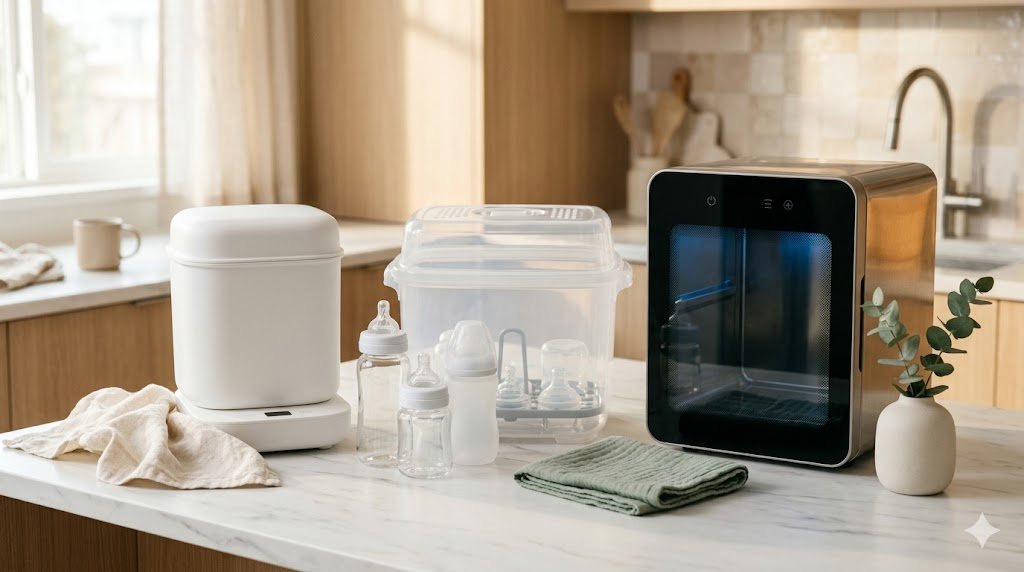
When my daughter was a newborn, I didn’t own a bottle sterilizer. We breastfed mostly, and on the rare nights my husband took over a feed, I washed her bottle in hot soapy water with a dedicated brush, air-dried it on the rack, and called it done. The CDC guidance was clear: for a healthy full-term baby, that’s enough. I felt vindicated saving the eighty bucks.
Then my youngest son arrived four years later, and by week five he had thrush. White patches on his tongue, fussing at the breast, cracked nipples on my side. Our pediatrician’s instructions were specific: sterilize everything that touches his mouth — pacifiers, bottle nipples, breast pump parts — once a day until it clears. That was the week I sat up at 2am with a nursing baby and read every bottle sterilizer review on the internet.
So this guide is not a “every parent needs one” pitch. It’s almost the opposite. Most healthy full-term babies don’t need a sterilizer at all. But if you’re one of the families who do — preemie, recurring thrush, mostly bottle-feeding, daycare with multiple bottles a day, or living out of a hotel — picking the right machine for your situation saves real money and counter space. Here are the seven I’d recommend in 2026, sorted by who they’re for.
- Best Overall:Philips Avent Premium SCF293/00 with Dryer — the brand pediatricians know, full sterilize-plus-dry cycle, frequent promo pricing.
- Best Value:Papablic Sterilizer & Dryer Pro — 10-bottle capacity for under $70, ideal for exclusive pumpers and twin parents.
- Best Travel / Tightest Budget:Philips Avent Microwave SCF281/05 — twenty bucks, two minutes, fits in any kitchen with a microwave.
Do You Actually Need a Bottle Sterilizer?
This is the question I wish someone had answered honestly for me before I started shopping. The short version: probably not, unless you fit one of the five scenarios below.
The CDC’s official guidance is that for a healthy baby over three months old, washing bottles thoroughly with hot soapy water and a bottle brush, then air-drying on a clean surface, is enough. Sanitizing daily is recommended for babies under three months, born premature, or with a weakened immune system — but for everyone else, sanitizing once a week or less is generally enough. The American Academy of Pediatrics echoes this: routine sterilization isn’t required if your tap water is treated and your dishwasher hits high heat.
That said, a sterilizer genuinely earns its place on the counter if you’re in one of these situations:
- Your baby was born premature or has a weakened immune system. Preemies and immunocompromised babies are at higher risk for the same germs that wouldn’t faze a full-term newborn. Daily sterilization is the pediatric default until your doctor says otherwise.
- Your baby has had thrush or another recurring oral infection. Thrush (oral candida) loves warm, moist, milk-coated nipples and pacifiers. Daily sterilization while you treat it — and for a week or two after — is what most pediatricians will tell you. This is the situation that finally pushed me to buy one.
- Your baby is under three months old and bottle-fed. The CDC singles this group out specifically. If you’re exclusively bottle-feeding (formula or pumped milk) before three months, daily sanitizing reduces the chance of foodborne illness.
- You’re mostly bottle-feeding or exclusively pumping, juggling 6+ bottles and pump parts a day. At that volume, hand-washing and air-drying becomes its own part-time job. A sterilizer that doubles as a dryer takes the bottleneck off your kitchen counter.
- Daycare or travel means bottles cycle through unfamiliar environments. If three different caregivers handle your bottles each day, or if you spend weeknights in hotels and Airbnbs, a daily sterilize gives you control over hygiene you wouldn’t otherwise have.
If you’re a mostly-breastfeeding parent with a healthy full-term baby and you wash bottles in a normal dishwasher, you can probably skip this entire category. Save the money for diapers, a wrap carrier, or honestly, takeout. For a full list of newborn purchases worth skipping, see our newborn must-haves and skips guide.
Steam vs UV vs Microwave: Which Method Should You Pick?
Three options cover most of what you’ll see, and they’re not equally good at the same job. Here’s the short comparison most reviews skip.
| Method | Speed | Price Range | Capacity | Best For |
|---|---|---|---|---|
| Electric Steam | 6–12 min sterilize + 30–60 min dry |
$60–$300 | 4–10 bottles + pump parts | Daily home use, the mainstream choice |
| Microwave Steam | 2–8 min | $20–$40 | 4–5 bottles | Travel, tight budgets, anyone with a microwave |
| UV-C LED Cabinet | 15–30 min (no water) |
$180–$400 | 5–6 bottles | Avoiding heat on nipples, dry cycle, longer protected storage |
Steam is the workhorse. It uses heated water vapor to kill 99.9% of bacteria, mold, and the yeast that causes thrush. It’s the method most pediatricians are familiar with, and the one with the longest track record. Drawback: it’s wet. Without a dryer cycle, you’ll be shaking water out of bottles or laying them on a rack to finish.
Microwave sterilizers are basically a steam sterilizer in a plastic bin you put in your microwave oven. They’re the cheapest option by far and the most portable — but you do need a microwave on hand, and they don’t dry.
UV-C LED uses ultraviolet light to destroy bacterial DNA. The big upside is no heat and no water, which is gentler on silicone nipples that can degrade with repeated steam exposure. The downsides are the price (usually four to ten times a comparable steam unit) and a hidden technical limitation: UV-C only works on surfaces that the light can directly reach. Anything in shadow, on the bottom of an opaque bottle, or wedged behind another item won’t get sterilized. Reputable UV cabinets work around this with reflective interiors and recommendations to position items “opening up” — but it’s a real constraint that cheap UV wands and pocket sanitizers ignore entirely.
The 7 Best Bottle Sterilizers for 2026 (Quick Comparison)
| Product | Best For | Method | Price | Capacity |
|---|---|---|---|---|
| Philips Avent Premium SCF293/00 | Best Overall | Steam + HEPA Dryer | ~$110 | 6 bottles |
| Papablic Sterilizer & Dryer Pro | Best Value, Large Capacity | Steam + Dryer | ~$65 | 10 bottles |
| GROWNSY SteriDry Pro Compact | Best Budget Steam | Steam + Dryer | ~$60 | 6 bottles |
| Baby Brezza Sterilizer & Dryer Advanced | Best Mid-Range (HEPA + 48h storage) | Steam + HEPA Dryer | ~$125 | 8 bottles + pump parts |
| Philips Avent Microwave SCF281/05 | Best Microwave / Tightest Budget | Microwave Steam | ~$21 | 4 bottles |
| Ubbi 3-in-1 Collapsible Microwave Bin | Best Travel / Reusable Silicone | Microwave Steam | ~$40 | 5 bottles |
| Wabi UVC LED Sanitizer & Dryer Ultra | Best UV (FDA + EPA + ETL certified) | UV-C LED + Dryer | ~$350 | ~5 bottles |
The 7 Best Bottle Sterilizers, Reviewed
2. Papablic Baby Bottle Sterilizer and Dryer Pro — Best Value, Large Capacity
Why it earned a spot: If you’re exclusively pumping, feeding twins, or running daycare bottles plus home bottles through the same machine, capacity matters more than brand cachet. Papablic gives you ten tall bottles or six wide-neck bottles in a single load, with a top tray deep enough to hold breast pump parts from Medela, Spectra, Momcozy, and Eufy. The price tag is roughly half what Avent charges. The compromise is brand polish and resale value — but for daily working-parent use, the math is hard to argue with, and the brand has been quietly building a reputation in pumping-mom communities for years.
Cycle time: ~8 minutes sterilize (drying time adjustable)
Capacity: 10 tall bottles or 6 wide-neck bottles
Pump-part tray: 2.5 inch depth on the upper tier
Compatibility: Dr. Brown’s, Avent, Medela, Spectra, Momcozy, Eufy pump parts
Controls: Single rotary knob (no digital menus)
- Largest capacity in its price range — built for twins or exclusive pumpers
- Top tray geometry actually fits pump parts (most “8-bottle” units don’t)
- Single-dial controls — no learning curve at 3am
- Includes a deodorize function that removes the lingering milk smell
- Brand has been on Amazon since 2017 — track record of replacement parts and customer service
- Don’t confuse the “Pro” (10 bottles, ~$65) with the “Pro Max” (13 bottles, ~$120) — the Pro is enough for most families
- Tall unit (14+ inches) won’t fit under all upper cabinets — measure clearance first
- A few reviewers report mineral residue if you use hard tap water — vinegar descale every few weeks fixes it
- Brand visibility is lower than Avent or Baby Brezza if that matters to you
3. GROWNSY SteriDry Pro Compact — Best Budget Steam Sterilizer
Why it earned a spot: The cheapest electric sterilizer in this guide that I’d actually feel comfortable recommending. GROWNSY isn’t a heritage brand, but the SteriDry Pro pulls off an eight-minute sterilize cycle — the fastest steam unit on this list — and includes a built-in filter to keep the drying air clean. It’s noticeably smaller than the Avent and Papablic units (around 20% less footprint), which matters if your kitchen counter is already crowded with a bottle warmer, formula maker, and Instant Pot.
Cycle time: 8 minutes sterilize (drying ~30% faster than competitors, per brand)
Capacity: ~6 bottles, compact form factor
Functions: Sterilize only / dry only / sterilize+dry / storage
Footprint: Compact (8.1 × 7.5 × 14.9 inches)
- Fastest sterilize cycle in the steam category at this price
- Built-in filter prevents secondary contamination during drying
- Smaller footprint than other 6-bottle units
- Four operating modes, including storage-only
- Strong overall rating in customer reviews
- GROWNSY is a relatively new brand — fewer independent expert reviews than Avent or Baby Brezza
- Customer service responsiveness is mixed in reviews (most issues resolved, but slower than Avent)
- Capacity is real for 6 standard bottles, but wide-neck bottles fit fewer
- The compact width can crowd accessories if you’re sterilizing pump parts alongside bottles
4. Baby Brezza Sterilizer and Dryer Advanced — Best Mid-Range (HEPA + 48h Storage)
Why it earned a spot: Two specs justify the price jump from Papablic. First, items stay sterile for up to 48 hours when left in the closed unit — twice as long as Avent or Papablic claim. Second, the drying cycle pushes air through a HEPA filter to remove 95% of airborne particles before they touch your bottles. If you’re sterilizing because your pediatrician told you to (post-thrush, post-illness, immunocompromised baby), those are the specs that actually matter — not the marketing buzzwords. This is the unit I see recommended most often in support groups for parents dealing with recurring thrush.
Cycle time: 10 minutes sterilize / 30 minutes dry (33% faster than the original)
Capacity: 8 bottles + 2 full pump part sets (wearable pumps included)
Sterile storage: Up to 48 hours (industry-leading)
Heating plate: Stainless steel — resists rust and hard water buildup
Controls: Digital LCD with countdown timer
Warranty: 1 year limited
- HEPA-filtered drying air (95% germ-free) — rare at this price
- 48-hour sterile storage is genuinely useful for night-shift parents
- Stainless steel heating plate avoids the mineral crud that kills cheaper units
- Holds wearable pump parts (Willow, Elvie) most others can’t accommodate
- Brand is widely available — replacement filters and parts easy to find
- The HEPA filter is a consumable — budget for replacements every 6 months
- One-year warranty is shorter than Avent’s two-year
- Tallest unit on this list (16 inches) — measure cabinet clearance
- Roughly twice the price of Papablic for two more bottles of capacity, so the value math depends on how much you weight the HEPA spec
5. Philips Avent Microwave Steam Sterilizer (SCF281/05) — Best Microwave / Tightest Budget
Why it earned a spot: Twenty bucks. Two minutes. Fits any home microwave. If you only need to sterilize occasionally — for pacifiers between uses, after a stomach bug runs through the house, or when you’re staying in a rental for a week — this does the job for less than the cost of two restaurant meals. It’s also the sterilizer most pediatricians grew up recommending, and it’s been on the market for over a decade with the same basic design, which is its own kind of vote of confidence.
Cycle time: 2 minutes
Capacity: 4 Philips Avent bottles (standard or wide-neck)
Dimensions: 6.5 × 11 inches — fits most home microwaves
Sterile storage: 24 hours if lid stays closed
Safety features: Lid clips + cool-touch side grips
- Cheapest sterilizer in this guide by a wide margin
- Fastest cycle of any method — two minutes
- Compact and lightweight — fits in a diaper bag or carry-on
- No moving parts to break
- Sustainability certification (carbon offset on lifecycle emissions)
- No drying function — bottles come out wet and need to air-dry on a rack
- Four-bottle capacity is the smallest in this guide
- Requires a microwave — useless in a microwave-free kitchen or hotel
- Hot to handle even with the cool grips — let it cool before opening
A note on bottle warmers vs sterilizers
A lot of products marketed as “all-in-one” combine bottle warming with sterilization — most of them are warmers first that happen to do a quick steam cycle. If you’re shopping for warming as the primary function, the Dr. Brown’s Insta-Feed, Baby Brezza Smart, and a handful of others are covered in detail in our best baby bottle warmer guide. The sterilizers in this article are dedicated sterilizers — better at sanitizing, not designed to warm milk.
6. Ubbi 3-in-1 Collapsible Microwave Wash Bin & Sterilizer — Best Travel / Reusable Silicone
Why it earned a spot: This is the piece of gear I wish I’d known about when my daughter was small. It’s a food-grade silicone basin that does three things in sequence: wash basin for cleaning bottles in the sink, microwave steam sterilizer for sanitizing them, and steamer basket for cooking solids when feeding transitions around six months. It collapses from 5.5 inches tall down to under 2 inches, which means it actually fits in a diaper bag or carry-on. Ubbi is the same brand behind the diaper pail a lot of parents already trust, and the silicone here is the same food-grade material their other products use.
Capacity: 5 baby bottles (5–8 oz)
Material: 100% food-grade silicone (BPA-free, no PVC, no phthalates)
Collapsed height: 1.88 inches (fits diaper bag)
Triple use: Wash basin → microwave sterilizer → veggie steamer
Cleaning: Dishwasher safe
- Three legitimate uses, not just marketing — actually works as a wash basin and veggie steamer
- Collapsible design fits any diaper bag
- No single-use plastic bags to throw away (unlike disposable steam bags)
- Silicone won’t crack like the hard-plastic microwave sterilizers
- Built-in cool-touch handles make it safe to pour off the hot water
- No dryer function — bottles come out wet
- Single-layer design means pump parts and bottles compete for space
- Released in late 2025 — long-term durability data is still building
- Needs a microwave to work
7. Wabi UVC LED Sanitizer & Dryer Ultra — Best UV LED Cabinet
Why it earned a spot: The UV bottle sterilizer market is, frankly, full of garbage. Pocket wands, palm-sized boxes, and Amazon-only brands selling “UV-C sterilizers” that have never been independently tested and may not even emit enough UV-C to be effective. Wabi is the exception. The Ultra is an FDA-registered medical device (classified under General Hospital devices), an EPA-registered germicidal UV-C product, and ETL-certified for electrical and UV safety — a level of regulatory paperwork that pretty much no other UV bottle sterilizer can match. It uses nine UV-C LEDs at 275nm with a 20,000-hour lifespan, dries at a plastic-safe 104°F, and is made in Korea. Yes, it’s $350. But it’s the only UV option I’d actually trust for a medical-reason use case.
UV source: 9 UV-C LEDs, 20,000-hour lifespan, mercury-free
Cycle time: ~30 minutes (sanitize + dry)
Drying temperature: 104°F (40°C) — plastic-safe
Capacity: Approximately 5 Dr. Brown’s bottles + accessories
Certifications: FDA-registered, EPA-registered (Est. No. 93317-KOR-001), ETL-certified
Made in: Korea
- The only UV bottle sterilizer with FDA + EPA + ETL certifications in this category
- No heat exposure to silicone nipples (gentler over time)
- Mercury-free LED technology (most cheap UV uses mercury lamps)
- Maintains active UV protection during storage, refreshing every 3 hours
- Plastic-safe 104°F dry cycle — won’t degrade BPA-free plastic bottles
- Sixteen times the price of the Avent Microwave for the same end result
- Real limitation: single top-mounted UV source means items in shadow or facing the wrong direction get less exposure — works best for bottles positioned opening-up
- Stainless steel reflective interior is functional, not optimal for non-bottle items like car keys or phones (despite marketing claims)
- Customer service responsiveness has been mixed in reviews
- Smaller user community than Avent or Baby Brezza, so less peer support online
What to Watch Out For (Three Sterilizer Categories I’d Skip)
Most “best sterilizer” lists are sponsored content that doesn’t tell you what to avoid. Here are three categories I’d steer away from:
Portable UV-C wands and pocket sanitizers
You’ll see palm-sized “UV-C sterilizer” wands and pocket boxes sold all over Amazon for $15 to $40. Most of them are not independently certified to emit enough UV-C at the right wavelength to actually kill anything. When the reviewers at Mommyhood101 tested a popular portable UV-C wand from a major baby brand using lab-grade Quantadose UV-C detection strips, the strips registered no detectable UV-C output. The wand may have been emitting something in the UV-A or UV-B range, but for actual sanitization you need UV-C at 254–280nm, and you need enough of it for long enough. Pocket-size devices almost never deliver that. If you want UV, you want a cabinet with FDA and EPA registration. Otherwise you’re paying for theater.
Disposable single-use sterilizer bags (as a primary solution)
Brands sell zip-top steam sterilizer bags marketed for travel — you put bottles inside, add water, microwave, done. As an emergency option for a hotel weekend, they’re fine. As your everyday system, the math gets ugly fast: at one to two dollars per bag and roughly 20 uses per bag, daily sterilizing puts you at $20 to $30 a month plus the trash. A $40 reusable silicone option like the Ubbi pays for itself in two months and produces zero packaging waste. Use disposables only when you genuinely have no other option.
The all-in-one combo of warmer + sterilizer (if sterilizing is your priority)
Several products combine bottle warming with sterilization in one machine. If warming is your main need and sterilizing is occasional, they make sense — and we cover them in the best bottle warmer guide. But if you’re sterilizing daily for medical reasons, a dedicated sterilizer like the Avent Premium or Baby Brezza will handle the volume and sanitization standards more reliably than a small combo unit designed primarily for warming a single 4oz bottle.
How to Use a Bottle Sterilizer Correctly
Do I need to wash bottles before sterilizing them?
Yes, always. Sterilizing doesn’t replace washing — it follows it. Wash bottles, nipples, rings, caps, and pump parts in hot soapy water with a bottle brush, rinse thoroughly, and only then load them into the sterilizer. Steam and UV don’t remove milk residue, and dried milk can shield bacteria from the sanitizing process.
How long do bottles stay sterile after a cycle?
Most steam sterilizers keep contents sterile for 24 hours if the lid stays closed. The Baby Brezza Advanced extends that to 48 hours. UV cabinets like the Wabi refresh sanitization automatically every few hours during storage. The clock starts the moment you open the lid — once air gets in, sterility is gone, so plan to use bottles within 24 hours of opening regardless of unit.
How often should I actually sterilize?
For preemies and babies under three months, the CDC recommends sanitizing at least once daily. For healthy babies over three months, sanitizing weekly (or less) is sufficient if your dishwasher hits high heat. During an illness — yours, baby’s, or anyone in the household — bump it back up to daily until everyone clears.
Does steam sterilization damage bottle nipples?
Silicone nipples have a lifespan regardless of how you clean them — most manufacturers suggest checking them every few months, and replacing whenever you see cracks, discoloration, or stickiness. Repeated high-heat steam can accelerate that timeline slightly, but the real cause of nipple degradation is normal chewing and use. UV sterilization is gentler on silicone if you’re particularly worried, but for most parents the difference is academic.
Will UV light damage plastic bottles?
Cheap, uncertified UV lamps that emit broad-spectrum UV (including UV-A and UV-B) can degrade plastic over time. FDA-registered UV-C LED devices like the Wabi emit a narrow band at 275nm at controlled intensity — the wavelength designed to disrupt bacterial DNA without significant impact on BPA-free plastics. The bigger risk isn’t damage to the bottle, it’s UV exposure to skin and eyes, which is why these units are designed to shut off the moment you open the door.
Can I sterilize glass bottles in any of these?
Yes, every steam and UV sterilizer in this guide handles glass bottles. In fact, glass bottles tolerate repeated sterilization better than plastic and don’t degrade with heat. If you’re already using glass bottles (the Chicco Duo or Avent Natural Glass, for example), any of these picks will work.
Bottom Line: Which Sterilizer Should You Buy?
If you’ve read this far and still aren’t sure you need one, that’s probably your answer. Re-read the five scenarios at the top and check whether any apply to your family. If not, save the money.
If you do need one:
- Most parents: The Philips Avent Premium SCF293/00 with the dryer. Brand name, two-year warranty, the cycle most pediatricians recognize.
- Pumping or feeding twins: The Papablic Sterilizer & Dryer Pro. Ten bottles plus pump parts at the price of a small Avent.
- Medical-reason sterilizing (thrush, preemie, immunocompromised): The Baby Brezza Sterilizer & Dryer Advanced. HEPA-filtered drying and 48-hour sterile storage actually matter when you’re sanitizing for a real medical reason.
- Travel or tight budget: The Philips Avent Microwave SCF281/05. Twenty bucks, two minutes, works anywhere there’s a microwave.
- Anti-heat / certified UV: The Wabi UVC LED Sanitizer Ultra. The only UV bottle sterilizer with the regulatory paperwork to back up its marketing claims.