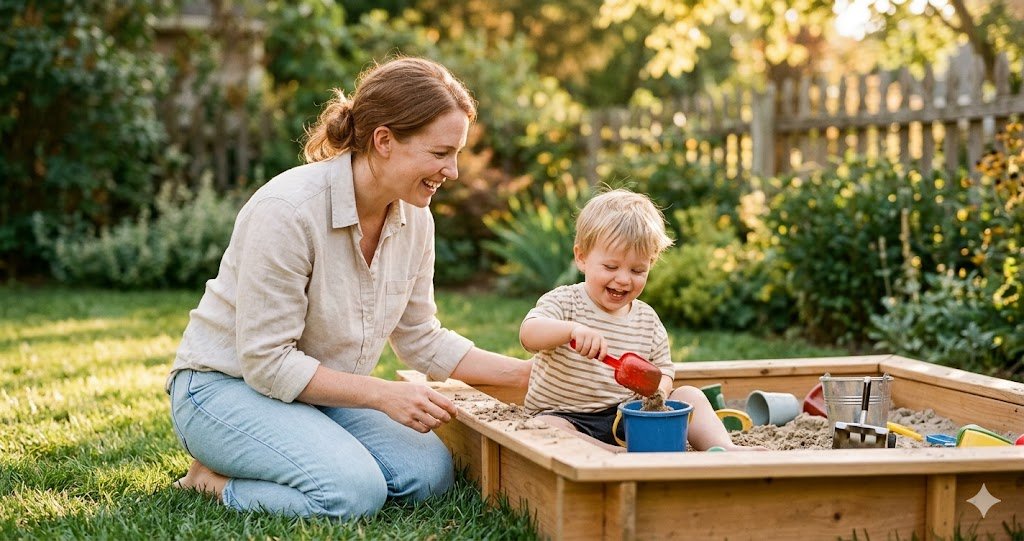
Here’s a confession: of all the big outdoor toys we’ve cycled through over the years, the sandbox is the one I’d defend in court. Swings get outgrown. Trampolines make me nervous. But a box of sand? My daughter spent entire summers of her toddler years “baking” sand muffins, and now my older son is deep in his excavator phase and would happily relocate his bedroom out there if I let him. The youngest, at a year and a half, mostly just eats it. We’re working on that.
Sand play is one of those rare activities that’s genuinely good for kids. It builds fine motor skills, it invites the kind of open-ended pretend play the American Academy of Pediatrics keeps telling us kids need more of, and it buys you twenty quiet minutes on the patio. The catch is that the sandbox market is genuinely confusing right now: classic plastic shells, giant wooden octagons, canopy versions, and tiny folding kits that are technically “sandboxes” but live on your kitchen table.
So I did what I always do: went deep on the category, compared dozens of options against parent reviews, current safety guidance, and the boring practical stuff like covers and drainage, and narrowed it down to six that I’d actually put in my own backyard. One famous name got cut, and I’ll explain exactly why further down, because I know some of you came here specifically to ask about the turtle.
The short list
- Best classic sandbox: Step2 Naturally Playful Sandbox II, the one that still looks good in your yard years later
- Best for truck-obsessed kids: Little Tikes Dirt Diggers Excavator Sandbox, whose lid doubles as a truck ramp (frankly genius)
- Best wooden sandbox: Best Choice Products Octagon Wooden Sandbox, with room for the whole playdate
- Best extra-large: SoliWood Octagon Sandbox, for when your yard is the neighborhood hangout
- Best with shade: Gowoodhut Wooden Sandbox with Canopy, sun protection built in
- Best for apartments & rainy days: Kinetic Sand Construction Site Folding Sandbox, the indoor escape hatch
Before we dig in (sorry), one note on how I pick: every product here had to clear a high bar on ratings, review volume, and current availability, and then pass my personal test. Would I buy this for my own kids? Would I recommend it to my best friend without a disclaimer? If the answer wobbled, it got cut. You can see the same vetting process at work in my backyard toddler slides guide.
1. Step2 Naturally Playful Sandbox II — the classic that earns its spot
If you close your eyes and picture “a nice backyard sandbox,” you’re probably picturing this one. Step2 has been making versions of it for as long as I’ve been a mother, and the design has quietly solved most of the problems that plague cheaper plastic boxes: it’s double-walled so it doesn’t flex and crack, the corners are molded into little seats so kids aren’t sitting in the sand the whole time, and the lid is a proper fitted lid with tie-downs — not a tarp you chase across the lawn in March.
Reading through years of parent reviews, the pattern that stands out is longevity. People hand these down to second and third kids. The neutral stone-and-sun styling is part of that; it doesn’t scream “plastic toy” from across the yard, and more than a few families confess to converting theirs into a garden bed or a little pond once the sandbox years end. I respect a toy with a retirement plan.
The honest downsides: it costs more than you’d expect for a plastic box, sand is not included (it never is, more on that below), and while the box itself is fine for young toddlers, the included scoop-and-mold accessories have small parts meant for the three-and-up crowd. If your sandboxer is closer to my youngest son’s age, just stash the little pieces for a year and hand him a measuring cup. He will not feel deprived.
2. Little Tikes Dirt Diggers Excavator Sandbox — for the construction-site kid
There is a particular stage (my older son is squarely in it) where every flat surface becomes a construction site and every conversation circles back to diggers. This sandbox was clearly designed by someone who lives with one of those children. It has an actual working excavator arm built into the rim, so kids can scoop, swing, and dump real sand instead of just pretending. The lid flips over to become a ramp for driving trucks up and down, and that trick deserves more credit than it gets: most sandbox lids are dead weight leaning against the fence, while this one is part of the toy. A handful of sand tools and a chunky digger truck come in the box too.
Where it gives ground to the Step2: it’s a bit smaller inside, so it’s really a one-or-two-kid box rather than a whole-playdate box. And it leans hard into the construction theme, bright yellow and very “job site,” which is either a feature or a bug depending on your backyard aesthetic. For a digger kid, though, this is the one that gets played with daily instead of weekly.
3. Best Choice Products Octagon Wooden Sandbox — the playdate magnet
At some point, many families graduate from “a sandbox” to “the sandbox,” the big wooden one that becomes a fixture of the yard. This octagon from Best Choice Products is the strongest value I found in that category. It’s genuinely spacious, the eight-sided shape means several kids can each claim a corner without turf wars, and the bench rails around the rim are reinforced enough that adults can sit on them too. That last detail matters more than it sounds: sandbox supervision is a lot more pleasant when you’re not squatting.
It also gets the unglamorous fundamentals right. There’s a proper cover to keep out rain, leaves, and the neighborhood cats, which is exactly what the AAP’s sandbox safety guidance recommends. The ground liner underneath is a practical bonus on top of that: it lets rainwater drain while keeping weeds from staging an invasion up through your sand. Plenty of wooden boxes at this price skip one or both.
Know going in: this is a weekend project, not an unboxing. It ships flat, assembly falls to whichever adult in your house claims to be good with an Allen key, and then you need to source a serious quantity of play sand before anyone digs anything. There’s also no shade, so placement matters; under a tree or on the shady side of the house if you can manage it.
4. SoliWood Octagon Sandbox — the extra-large neighborhood hub
And then there’s the next size up. The SoliWood octagon is the sandbox you build when you’ve accepted that your yard is where the cousins, the neighbors, and that one kid who’s always just around are going to congregate every summer afternoon. It’s dramatically bigger than the standard wooden boxes, big enough that a small crowd of elementary-schoolers can dig simultaneously without anyone flinging sand in self-defense.
The construction reflects the scale: thick solid-wood panels joined with metal corner posts rather than just screws into end grain, which is what you want when the box is holding a small dune’s worth of sand and being climbed on daily. The rain cover and fabric ground liner come in the box, and the one-piece panel design is built to go together faster than its size suggests.
The honest math: a box this large swallows an enormous amount of sand, and sand is heavy, cheap-per-bag, and annoying-per-trip. Budget for the sand run (or delivery) as part of the purchase, and measure your yard twice, because this thing claims real square footage. For a family with one toddler, it’s overkill; for a multi-kid household or the designated hangout house, it’s the best kind of overkill.
5. Gowoodhut Wooden Sandbox with Canopy — shade included
Sandboxes sit in full sun. So do the children in them. Nobody mentions this until July. If your yard has no natural shade, a canopy model solves a real problem, and this Gowoodhut is the only canopy sandbox I found whose reviews held up under scrutiny. (Several better-known canopy models got cut for recurring complaints about flimsy roofs and warping lids. This category is rougher than it looks.)
The design is clever in a quietly Scandinavian way: the lid panels fold open into two bench seats with backrests, and the canopy adjusts in height and rotates, so you can angle it against the afternoon sun and then drop it down low over the box when playtime’s over, where it doubles as a dust cover. Open-bottom construction means rainwater drains instead of turning your sand into a swamp, and the wood edges are rounded off, which toddler shins appreciate.
Two things to know before you click: it ships from a smaller seller, so check the delivery cost at checkout since it can add meaningfully to the total, and it’s a standard-size box — lovely for one or two kids, snug for a birthday party. A canopy also isn’t a substitute for sunscreen or a good sun hat; the AAP’s backyard safety tips are worth a skim before the season starts in earnest.
6. Kinetic Sand Construction Site Folding Sandbox — the rainy-day escape hatch
Let’s be clear about what this is: not a backyard sandbox, but a fold-out construction site that lives indoors and contains its own sand. I’m including it anyway, for three groups of people — apartment families, anyone surviving a rainy week, and parents whose kids ask to play in the sandbox at seven a.m. in February.
The whole thing opens into a walled play tray and packs back up with everything inside, which is the feature that separates it from the loose-bin chaos of regular kinetic sand. Inside you get a crane with a swap-able digging bucket and wrecking ball, a dump truck that molds bricks in its bed, and the sand itself, the squeezy, mesmerizing kind that sticks to itself instead of to your rug. Kids build brick walls, then demolish them with the wrecking ball, then build them again. It’s a complete dramatic arc in toy form.
It earns the most reviews of anything on this list by a wide margin, and the affection is real. Just calibrate expectations: the included sand is a modest amount (you can buy more), the case is lightweight plastic, and it will not scratch the itch of a kid who wants to dig a hole to the earth’s core. Think of it as the sandbox’s portable little cousin, and a very good gift.
Okay, but where’s the turtle?
If you’ve spent any time researching sandboxes, you’ve met the Little Tikes turtle: the green shell with the lid that’s been in American backyards since before some of us were in American backyards. It’s iconic. It’s also not on this list, and I want to be straight with you about why.
When I dug into recent reviews of the current version, the rating has slipped well below where I draw my line, with recurring complaints about lid fit and overall build quality compared to the turtle people remember from their own childhoods. Nostalgia is powerful, and I felt it too, but I’m not going to recommend something on the strength of how good it was twenty years ago. If you want that classic toddler-shell experience, the Step2 at the top of this list is the better-built version of the same idea. And if Little Tikes restores the turtle to its former glory, I’ll happily update this page; I check back on these picks each season.
How much sand do you actually need?
Nobody tells you this part: the sandbox is the cheap half of the purchase. Sand is sold in bags that feel heavy in the cart and look comically small in the box. A few rules of thumb from someone who has underestimated this repeatedly:
- Small plastic boxes (the Step2 and Little Tikes size): a handful of bags of play sand will do it. One car trip, manageable.
- Standard wooden boxes (the Gowoodhut size): plan for a stack of bags. This is where delivery starts making sense.
- The big octagons: honestly, consider having a landscape supply company deliver in bulk. It’s often cheaper per pound than bagged sand, and your back will thank you.
Whatever the size, buy sand labeled as play sand, which is washed and screened for exactly this use. The AAP has raised questions about some sand products over the years, so this is one place not to improvise with whatever the hardware store has on the contractor aisle. Fill the box only partway, too: kids dig down, and a half-filled box means less sand launched overboard.
The unglamorous safety stuff (that actually matters)
A few more habits worth building from the AAP’s sandbox guidance: rake the sand every so often to fish out leaves, clumps, and mystery objects; keep the family pets out of the box entirely (they cannot tell it apart from a litter box, and they will not try); and if you’re ever building a DIY frame, skip old railroad ties, which can splinter and may be treated with chemicals you don’t want near small hands.
And the toddler classic: sand eating. My youngest son treats every sandbox like a buffet, and if yours does too, take comfort. A mouthful of clean play sand is unpleasant but not dangerous, and most kids self-correct after a taste or two. Supervision, a covered box, and fresh sand are your safety net. For the rest of the warm-weather toolkit, our baby sunscreen guide covers the picks that hold up to long sandbox afternoons.
FAQ
What age can a baby start playing in a sandbox?
Most kids are ready for supervised sand play somewhere around their first birthday, once they’re sitting confidently. That’s about when my daughter started, and she was instantly hooked. The real gate isn’t age, it’s the mouthing stage: until your child stops taste-testing everything, stay close and keep sessions short. Boxes like the Step2 are designed with young toddlers in mind; just hold back any small accessories until age three.
Is a plastic or wooden sandbox better?
Plastic wins for younger toddlers and smaller yards: it’s lighter, has no splinter risk, comes with a fitted lid, and you can move it when you re-landscape. Wood wins on space, looks, and lifespan, and a good wooden box can carry a family from toddlerhood through elementary school. A lot of families do what we’d suggest: start plastic, graduate to wood around preschool age.
How do I keep bugs and cats out of the sandbox?
A real, fitted cover used consistently solves most of it. That’s the AAP’s top recommendation, and it’s why a cover was a non-negotiable for every outdoor pick here. Beyond that, let wet sand dry before covering, rake regularly, and refresh the sand entirely every season or two. If a cat does get in despite your defenses, replace the affected sand rather than scooping; it’s not worth the gamble.
Can I leave a sandbox out all winter?
The boxes themselves are built for weather — that’s their whole job. The smarter move is to fasten the cover securely, let the sand fully dry first, and check the box over in spring for warping, splinters, or hardware that’s worked loose. Wooden boxes appreciate being on a liner or slightly elevated spot so they’re not sitting in standing water for months.