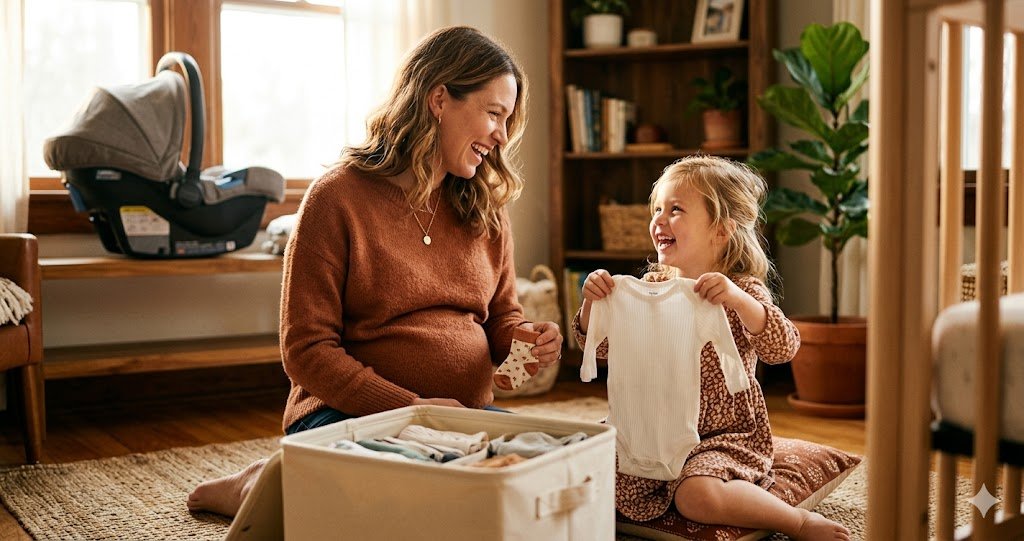
Somewhere between the positive test and your first prenatal appointment, the internet will try to convince you that baby number two needs a registry as long as baby number one’s. It doesn’t. Figuring out what to reuse for your second baby takes one honest afternoon, not a spreadsheet. I’ve done this twice now: my daughter was barely out of toddlerhood when my older son arrived, and by the time my youngest son showed up, I had the whole “what stays, what goes” routine down cold.
Here’s the honest math: most of what you can reuse for a second baby is already sitting in your storage bins. The real prep work isn’t shopping. It’s a quick safety audit, a little detective work on what survived storage, and three hard rules about what never gets a second life.
If this is your first baby and you landed here by accident, start with our Baby Registry Reality Check instead. This one’s for the veterans.
Start With the Car Seat: A 10-Minute Safety Audit
Before a single onesie comes out of the attic, deal with the car seat. It’s the one piece of baby gear where “still looks fine” tells you absolutely nothing, and it’s also the most expensive thing on this list to get wrong. If you can rope in your partner, divide and conquer: one of you on car seat duty, one excavating the storage bins.
Step 1: Find the expiration date
Yes, car seats expire, and no, it’s not a conspiracy to make you buy more plastic. There’s no federal law that forces an expiration date onto car seats, but manufacturers set one based on how long the materials can be trusted to perform in a crash, and the National Highway Traffic Safety Administration (NHTSA) supports the practice. Plastic shells, foam, and harness webbing all degrade with heat, cold, and ordinary use, even when the seat looks showroom-fresh on the outside.
Look for the sticker on the side or bottom of the seat (some brands stamp it into the shell). You’re looking for two things: the date of manufacture and either a printed expiration date or a “useful life” window. Most seats are good for roughly six to ten years from the date of manufacture. Note that the clock starts when the seat was made, not when you bought it. A seat purchased in 2021 may have been manufactured in 2020, and if it could sit on a shelf for a year before you bought it, do that math now rather than discovering it mid-pregnancy with baby number two.
The practical question isn’t just “is it expired today?” It’s “can I reuse this car seat for my second baby until they outgrow it?” If your infant seat has two years left and your newborn will need it for one, you’re fine. If it expires next spring, replace it now and skip the midnight scramble. If you do end up replacing, you don’t need a flagship: a lightweight, well-reviewed basic like the Graco SnugRide Lite LX covers the infant stage without the luxury price tag, and as a bonus it’s a current-generation seat with a fresh expiration clock. We compared the wider field in our best baby car seats guide if you want options.
Step 2: Check the crash history
A car seat is engineered to absorb one serious impact. If yours has been in a moderate or severe crash, it’s done, even if you can’t see a single scratch. NHTSA’s guidance is that seats don’t automatically need replacing after a minor crash, but “minor” has a strict definition.
- The vehicle could be driven away from the crash site
- The door nearest the car seat wasn’t damaged
- No one in the vehicle was injured
- The airbags didn’t deploy
- The car seat has no visible damage
Miss even one, and the seat gets replaced. And some manufacturers require replacement after any crash at all, so check your manual. When in doubt, the manual wins.
One more thing on this: if you’re inheriting a seat from a friend or relative, you’re also inheriting their memory of its crash history. Unless you’d trust them with your banking password, treat an unknown history as a disqualifier.
Step 3: Run the recall check
Take two minutes and run the model number through NHTSA’s recall lookup. While you’re at it, register the seat with the manufacturer if you never got around to it the first time. Registered owners get notified directly when something’s wrong, which beats finding out from a news headline.
Worth knowing as you weigh “keep vs. replace”: federal side-impact testing requirements (FMVSS 213a) are currently being phased in, which means newly manufactured seats are being tested to stricter standards than seats made just a few years ago. It’s not a reason to panic-replace a perfectly valid seat, but if yours is near expiration anyway, it’s a decent nudge toward the newer generation.
What to Reuse for Your Second Baby: The Keep Pile
Now for the good news, which is most of the news. Most of what you already own can be reused, but a few items still need a real inspection—and a short list should be replaced.
The crib frame. Start with the permanent label. A crib manufactured on or after June 28, 2011 is the simplest way to verify that it was made under the current federal crib standard (the American Academy of Pediatrics has a useful plain-English summary); for an older crib, I would need written proof of current compliance. Check recalls, find the instructions, confirm every original hardware piece, and inspect the frame, slats, supports, and locks for cracks, repairs, looseness, or modification. A drop-side crib, an unidentified crib, or one with missing or substitute hardware is a no.
Clothes, with two checks. Newborn clothes barely get worn long enough to wear out, so the wardrobe is mostly free. First do the season math: sort by size and by the month your new baby will actually be that size. Then inspect seams, fabric, zippers, snaps, buttons, decorations, and drawstrings; skip damaged pieces, recalled garments, weighted sleepwear, and anything altered from its labeled use.
The baby bathtub. Give it a once-over for cracks and mildew in the seams, but plastic tubs are about as close to immortal as baby gear gets.
Carriers and wraps. Check the buckles, stitching, and any velcro for wear. Fabric carriers that held up through one baby generally have several more in them.
The baby monitor. Power and battery life are only the start. Identify the exact model and check recalls; for WiFi monitors, confirm the maker still supports security updates, factory-reset it, install current firmware, remove the previous account, and set it up under your own credentials. If support has ended or ownership cannot be cleared, pass. (Whether it now needs a coworker is a different question. More on that below.)
Swaddles, sleep sacks, burp cloths, bibs. Wash according to the label and check fabric, seams, zippers, snaps, and sizing. Keep sleepwear unweighted and use it only within its labeled fit and developmental limits. You will be shocked how many burp cloths you own. You will still want more.
High chair, bouncer, play gym, toys, books. Identify each durable item’s exact model, find its instructions, check recalls, and inspect every original restraint, lock, fastener, surface, battery door, magnet, and small part that applies. Follow the maker’s current use and stop limits; cleaning does not clear a missing part or structural defect.
Reuse, But Inspect First
This middle category is where storage conditions decide what you can actually reuse for your second baby. Three items earn a real inspection, not a glance.
The crib mattress
First, draw a hard line around what “reuse” means here. This section applies only to a mattress you originally bought new for your own older child and whose entire use and storage history you know. A mattress from another home—or one with an uncertain history—belongs in the buy-new category.
The AAP’s safe sleep guidance calls for a firm, flat, noninclined sleep surface, and the CPSC says a crib mattress must fit tightly. Before reusing yours, confirm that its permanent label and model are still readable, it has not been recalled, and it is the correct mattress for the crib with no gaps. Then inspect the whole surface and every edge: it must be firm and completely flat, with no lasting indentation or sagging; the waterproof cover must be fully intact; and there can be no rips, cracks, stains, odors, water damage, mold, or questionable storage history. A hand press is a useful screen, but it is not enough by itself.
Reuse it only if every check passes. If one fails—or you are not completely sure—replace just the mattress. That is deliberately stricter than “it looks fine,” and it keeps this advice consistent with the rule not to buy a crib mattress secondhand from another home. If you’re shopping for a replacement, parent reviews consistently point to firm, waterproof-cover basics like the Graco Premium Crib & Toddler Mattress, a GREENGUARD Gold certified workhorse that fits standard cribs and later converts to toddler-bed duty. Our full crib mattress roundup compares more options if you want to dig deeper.
The stroller
Start with the stroller’s permanent label, instructions, and recall status. Then check the frame and attachment points for cracks, corrosion, bends, or homemade repairs; inspect the wheels and harness; and test the brakes and folding locks exactly as the manufacturer directs. Use only manufacturer-approved replacement parts—if a safety-critical lock, strap, frame joint, or required part is missing or unreliable, do not improvise a repair.
The breast pump
Here’s the one almost nobody tells you, and it’s the best money-saver on this list: under the Affordable Care Act, most health insurance plans cover a breast pump for each pregnancy, usually with no out-of-pocket cost. You’ll typically need a prescription from your OB or midwife and an order through an approved supplier, and plans vary in what they’ll cover, so one call to your insurer settles it. Many moms keep the old pump as a backup (one upstairs, one downstairs is a genuinely life-improving setup) and let insurance fund the new one.
If you do reuse your old pump, the motor can stay, but everything that touches milk gets replaced: tubing, flanges, valves, membranes. Those parts are designed as consumables, they lose suction as they wear, and they’re nearly impossible to fully sanitize after months of storage. Manufacturers sell them as replacement kits for exactly this reason.
The Never-Reuse List: Three Hard Rules
Everything above is a judgment call with a checklist. These three are not.
- An expired car seat, or one with a moderate-to-severe crash in its past. No exceptions, no “just for short trips.” Cut the straps before you toss it so nobody else fishes it out and reuses it.
- Bottle nipples and pacifiers. The bottles themselves, especially glass, are fine after a proper sterilizing. But nipple material degrades, develops micro-cracks, and hangs onto bacteria in ways a dishwasher can’t undo. Bottle manufacturers recommend replacing nipples between babies, and at a few dollars a set, this is the cheapest peace of mind in the entire nursery. Bonus: your new baby may have opinions about flow levels anyway, and newborns need slower nipples than the ones your first child graduated to.
- Pump parts that touch milk. Covered above, but it bears repeating because the pump motor working perfectly tricks people into reusing the whole kit. Motor yes, milk-path parts no.
Do You Actually Need a Double Stroller?
This is the big-ticket question of second-baby prep, and the honest answer is: it depends almost entirely on your age gap, not on what the stroller industry would prefer you believe.
Gap under 2 years: A double is probably worth it. You’ll have two non-walkers (or one walker with the stamina of a houseplant) for at least a year, and physically carrying one while pushing the other gets old by week two.
Gap of 2 to 3 years: This is the gray zone, and it’s where I lived. Consider a sit-and-stand model or a ride-along board that attaches to your existing stroller. Your older child mostly walks, occasionally collapses into dramatic exhaustion half a mile from home, and needs a perch for exactly those moments. A full double is a lot of hardware for a part-time problem.
Gap over 3 years: Skip it. By the time the baby arrives, your eldest is a pedestrian with strong opinions about being seen in a stroller. Put the money toward literally anything else.
One honest caveat: think about your actual routine, not the average one. If you do daily mile-long walks, daycare runs on foot, or live somewhere a car isn’t the default, the math shifts toward the double even with a bigger gap. If you’re weighing formats, our stroller decision guide breaks down which type fits which lifestyle.
What Second-Time Moms Actually Add
The short list of things that genuinely earn their place the second time around:
A second sound machine. Your newborn can sleep through anything for about six weeks. After that, your toddler’s interpretive-dance phase happening one thin wall away becomes the enemy of every nap. One machine per kid’s sleep space keeps them from waking each other at 5 a.m., which is a hill I will die on. And it doesn’t need to be the fancy app-controlled kind: a no-frills workhorse like the Magicteam sound machine is one of the most-reviewed budget picks on Amazon for exactly this second-room job.
A “big sibling” gift. Not gear, but it belongs on the list. A small present that arrives “from the baby” buys an astonishing amount of goodwill during week one. Veteran move: make it something that occupies hands and attention during feeding times.
A second changing setup. Nothing fancy. A basket with diapers, wipes, and a fold-up mat on whichever floor of your home the official changing table isn’t. With one kid, you walk to the changing table. With two, the changing table comes to you, or it doesn’t happen.
What to Reuse for a Second Baby: Quick Answers
Do car seats really expire, or is that a marketing gimmick?
They really do. There’s no federal law mandating expiration dates, but manufacturers set them based on material lifespan, and NHTSA supports the practice. Plastics and webbing degrade with time and temperature swings in ways you can’t see. Check the sticker for the date of manufacture; most seats are rated for six to ten years from that date.
Can I reuse the crib mattress for my second baby?
Only in the narrow known-history case: you bought it new for your own older child, the label and model are traceable, it has not been recalled, it fits the crib with no gaps, and it is still firm, flat, dry, odor-free, undamaged, and protected by an intact waterproof cover. A mattress from another home or with any uncertainty should be replaced. The AAP’s standard for every infant sleep surface is firm, flat, and noninclined.
Will insurance really give me a new breast pump?
In most cases, yes. The ACA requires most plans to cover a breast pump per pregnancy, typically at no cost, through an approved supplier with a prescription. Coverage details vary by plan, so call your insurer early in your pregnancy and ask what’s included.
Do I need to rebuy bottles?
The bottles themselves can be reused after sterilizing, as long as they’re not cracked, warped, or cloudy. Replace all the nipples, both for hygiene and because your newborn needs slow-flow nipples regardless of what your first baby ended up using.
The bottom line on what to reuse for your second baby: the list of what you truly must buy is short, the list of what you must check is manageable, and the rest is already yours. Spend the savings on a really good postpartum meal train. You’ve earned the veteran discount.