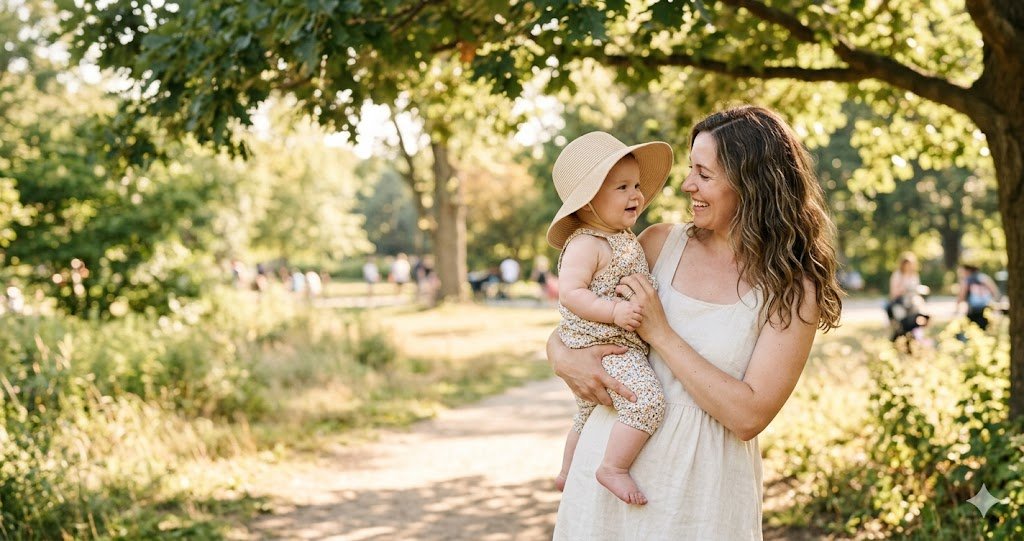
Every June, the same question starts popping up in my mom group chats: “Is it too hot to take the baby out?” And every June, somebody answers with a number they half-remember, somebody else disagrees, and a third mom announces she’s just staying inside until September.
After three kids and a lot of sweaty stroller walks, I’ve learned the real answer is more useful than a single magic number, but it’s not complicated either. There is a threshold pediatricians use. There are early warning signs babies give you before things get dicey. And there’s a short list of gear that genuinely helps, plus a couple of popular “hacks” (looking at you, blanket-over-the-stroller trick) that make things worse.
This is the guide I wish someone had handed me when my daughter was a newborn and I was googling “baby sweating normal??” at 2 a.m. Let’s get into it.
So… How Hot Is Too Hot?
The number to know is 90. The American Academy of Pediatrics points to a heat index at or above 90°F as the point where heat poses a significant health risk to children. Above that line, kids can get sick fast: dehydration, heat cramps, heat exhaustion, and in the worst case heat stroke.
Notice that’s the heat index, not the air temperature. The heat index folds humidity into the math, which matters because sweat is your body’s cooling system, and sweat can’t evaporate well into air that’s already soggy. On a muggy day, an air temperature in the low-to-mid 80s can push the heat index past 90. Your weather app already does this calculation for you. It’s the “feels like” number. In summer, that’s the one I check, not the big number at the top.
Why are babies the canaries here? A few unfair facts of baby physiology: little ones heat up faster than adults, they sweat less efficiently, and they can’t exactly announce “I’m overheating, please relocate me.” A one-year-old in constant motion is also a tiny furnace generating his own heat on top of whatever the sun is doing.
My working rules, refined over a decade of summers:
- Feels-like under 80s: normal outdoor life, with shade and water breaks.
- Feels-like in the 80s: shorter outings, shade-first, and I keep an eye on the early signs below.
- Feels-like 90 or above: we go out early morning or after dinner, keep it brief, or find somewhere air-conditioned to burn energy. Midday is for indoor forts and popsicles.
One more timing rule that does double duty for heat and sun: the AAP recommends keeping babies out of the sun between 10 a.m. and 4 p.m., when UV rays are strongest. Conveniently, that’s also when the heat peaks. Morning park trips and evening walks aren’t just nicer; they’re the medically smart window.
Overheating Signs: What to Actually Look For
Babies don’t go from fine to emergency in one step. They give you a ramp, and the earlier you catch it, the more boring the story stays. Boring is the goal.
Early signs (act now, no drama needed)
- A damp, sweaty neck or back. Here’s the thing most parents don’t realize: if your baby is sweating, they’re already too warm. With my daughter, I got into the habit of slipping two fingers under the back of her collar; it told me more than her hands or feet ever did (those run cold even when the core is toasty).
- Flushed, red cheeks that don’t match the activity level.
- Fussiness that doesn’t match the moment, or the opposite: a baby who suddenly goes unusually quiet and droopy.
- Fewer wet diapers, or darker urine. Concentrated urine is one of the first measurable dehydration flags in a baby.
The fix at this stage is simple: get into shade or AC, strip them down to a diaper or one light layer, offer a feed (more on hydration in the FAQ), and put a cool, damp washcloth on the back of the neck. Most of the time, that’s the whole event.
Heat exhaustion (cool them down, watch closely)
- Skin that feels cool and clammy even though it’s hot out, often with heavy sweating
- Rapid breathing or a fast heartbeat
- Unusual tiredness, weakness, or dizziness in a child old enough to show it
- Nausea or vomiting
- A raised temperature, though typically not extreme
Move them somewhere cool immediately, undress them, apply cool wet cloths to the skin, and offer fluids in small, frequent sips: breast milk or formula for babies, water for older kids. If symptoms aren’t clearly improving, or the vomiting continues, call your pediatrician or head in to be seen.
And the one I have to say even though you already know it: never leave a child in a parked car, not for a quick errand, not with the windows cracked. Car interiors climb to dangerous temperatures shockingly fast, and hot-car tragedies happen to loving, sleep-deprived, distracted parents every single summer. Make a back-seat check part of locking the car, every time, and ask your partner to build the same habit.
The 6-Month Line: Sun Rules for Babies Are Different
Sun protection advice splits cleanly at six months of age, and knowing which side of the line you’re on simplifies everything.
Under 6 months: shade is the strategy
The AAP’s guidance for young babies is blunt: keep infants under 6 months out of direct sunlight. Park them in the shade of a tree, an umbrella, or the stroller canopy, and dress them in lightweight clothing that covers arms and legs, plus a brimmed hat that shades the neck.
Why not just slather on sunscreen? Newborn skin is thinner and more absorbent than ours, and young babies are also worse at shedding heat, so the default is physical protection first. Sunscreen isn’t forbidden, though. When shade and clothing genuinely aren’t enough, it’s okay to apply a small amount of broad-spectrum sunscreen (SPF 15 or higher) to little exposed areas like the face and the backs of the hands. When my daughter was tiny, that usually meant a dab on her cheeks for the unavoidable walk from the car to wherever the shade was.
6 months and up: sunscreen joins the team
Once your baby passes the six-month mark, regular sunscreen on exposed skin becomes part of the routine. What to look for, per the AAP:
- “Broad-spectrum” on the label, meaning it blocks both UVA and UVB rays
- SPF 15 at minimum; many pediatric dermatologists steer families toward 30 or higher
- Mineral formulas (zinc oxide and/or titanium dioxide) for babies, since they sit on top of the skin instead of absorbing into it and are gentler on sensitive skin
- Water-resistant, reapplied every two hours, and sooner after swimming or heavy sweating. There’s no such thing as waterproof sunscreen, whatever the marketing fonts imply.
My pick: Blue Lizard Baby Mineral Sunscreen SPF 50+. When I cross-referenced pediatric recommendations against thousands of parent reviews, this one kept landing at the top of the pile. It’s a fully mineral zinc-and-titanium formula, fragrance-free, and water-resistant, and the cap changes color in UV light, which sounds like a gimmick until you realize it’s basically a built-in “time to reapply” nudge for the parent whose brain is juggling snacks, swim diapers, and a toddler sprinting toward the water. Fair warning that comes up in nearly every honest review: like all mineral sunscreens, it goes on white and takes some rubbing. That’s the trade for the gentle formula. If you want the full comparison, I broke down my favorite baby sunscreens in this guide.
Shade First: The Most Underrated Sun “Product” Is a Shadow
Parents tend to treat sunscreen as the main event, but the AAP’s actual hierarchy puts physical protection first: shade and clothing, then sunscreen on whatever’s still exposed. A few things that surprised me when I first dug into the research:
- UV rays cut through clouds. An overcast beach day can still burn a baby.
- Sand and water bounce UV back up, so a baby sitting “in the shade” at the beach is still catching reflected rays. Shade helps a lot; it doesn’t make anyone invincible.
- Wet clothing loses much of its sun-blocking power, which is why a soaked cotton tee is not the swim protection it appears to be. Dedicated UPF swim shirts hold their rating wet.
The hat: look for a brim that shades the neck
The AAP’s hat language is specific: a brim that shades the neck, not just a cute cap. That’s exactly why, when I researched sun hats, I kept gravitating toward legionnaire-style designs. The FURTALK Baby Sun Hat with Neck Flap checks every box on the AAP’s list: UPF 50+ fabric, a wide brim for the face, a fabric flap covering the neck and ears, and an adjustable chin strap, which parents in reviews consistently call the difference between a hat that stays on and a hat that gets flung from the stroller like a tiny frisbee. It comes in infant through preschool sizes, so you can match it to each kid. My full sun hat roundup is here if you want more options, including a wide-brim style with serious mom-brand credentials.
The beach tent: portable, controllable shade
Trees don’t always grow where you vacation. For beach and park days with a baby, a pop-up shelter solves the “there is no shade for half a mile” problem. The Monobeach Baby Beach Tent is the one that dominates this category, and reading through parent reviews it’s easy to see why: it pops open in seconds, the fabric carries a UPF 50+ rating, and the base doubles as a shallow splash basin so a baby can play in an inch of water while staying under cover. Two notes from the common-complaints pile: it’s sized for the baby, not for you (you’ll be sitting beside it, not in it), and on a breezy beach you genuinely need to fill the sand pockets and use the stakes, or it will attempt flight. Remember the reflected-UV point above, too: a baby in a beach tent still wears a hat and sunscreen. More beach shade options live in my beach gear guide. And once you know the rules, here’s exactly what to pack for a beach day with a baby, from shade to swim diapers to the wet-and-sandy exit.
Don’t Forget the Eyes
This one gets skipped constantly, and I get it: sunglasses on a baby feel like a photo op, not a medical device. But UV damage to eyes accumulates starting in childhood, and the AAP recommends children’s sunglasses that block at least 99% of UV rays.
One label-reading tip worth tucking away: “polarized” is not the same thing as UV protection. Polarization cuts glare, which is lovely, but the spec you’re checking for is “UV400” or “99–100% UVA/UVB protection.” A cheap pair of dark, non-UV lenses can actually be worse than nothing, because the dark tint makes pupils dilate and let more light in.
My pick: COASION Flexible Baby Sunglasses. These hit the spec that matters (UV400 lenses, with polarization on top), and the design acknowledges reality: the frames are bendable rubber that survives being twisted, sat on, and chewed, and the adjustable head strap is what keeps them on a baby who has strong opinions about accessories. Every baby I’ve raised has treated sunglasses primarily as a removable snack, so I consider the strap non-negotiable. More options by age in my kids’ sunglasses guide.
The Stroller Heat Trap (Please Stop Draping Blankets)
Here’s the most dangerous summer habit I see at every park, done with the best intentions: draping a blanket, even a thin muslin one, over the stroller to “shade” a sleeping baby.
A cover over the stroller opening blocks the airflow that lets heat escape. Instead of a shaded breeze, your baby is now napping in a still, stuffy pocket of trapped air that heats up fast, and the cover hides them from view, so you can’t see the flushed cheeks that would normally tip you off. Shade should come from the canopy, a clip-on parasol, or where you park the stroller, never from sealing the opening.
What does help: airflow. A clip-on stroller fan moves air across your baby’s skin, which is exactly how evaporative cooling is supposed to work. Two safety rules make the difference between helpful and hazardous:
- Clip it to the handlebar or frame, out of arm’s reach, not dangling from the canopy directly over your baby’s head, and make sure the blade guard’s gaps are too small for little fingers.
- Aim it across the stroller, not blasting straight into a tiny face. And know the fan’s limit: the AAP notes that once air temperature climbs past about 90°F, directing hot air at a person can speed up dehydration rather than cooling anyone off. In a true heat wave, the fan retires and the AC mall walk begins.
My pick: the Gaiatop Mini Stroller Fan. Comparing spec sheets across the bestsellers, this one stands out for getting the safety details right: the protective cover uses narrow gaps designed to keep infant fingers out, the flexible silicone tripod wraps securely around a handlebar, and the fan head pops off for charging so you’re not re-rigging the whole thing every night. Reviewers’ main grumble is that the highest speed drains the battery in a few hours, so pack a power bank for all-day outings.
Cooling Play: Make the Water Do the Work
On hot-but-not-dangerous days, the smartest move isn’t avoiding outside; it’s choosing activities where the cooling is built in. Water play pulls heat off little bodies while they’re having so much fun they forget to complain, which is more than I can say for any other parenting tool I own.
A backyard water table is the lowest-effort version of this: no pool setup, no swim diapers required, refill with the hose. The Step2 Rain Showers Splash Pond Water Table is the runaway favorite in this category, rated for kids from 18 months, which happens to be exactly the stage my youngest son is in: old enough to stand and scoop, young enough that cause-and-effect (pour water up top, watch it rain down through the spinners) is the greatest show on earth. Tens of thousands of parent reviews back up the durability, and the open design fits two or three kids around it, which matters enormously when you have siblings negotiating water rights.
Two safety notes that apply to any water play, straight from the standard pediatric playbook: a young child can drown in just a couple of inches of water, so water tables mean active supervision and get emptied when playtime ends. And water play doesn’t pause sun exposure; the sunscreen and hat stay on.
Summer Sleep: The Overheating Risk Nobody Sees
Daytime heat gets all the attention, but overheating during sleep deserves its own paragraph, because it’s a known risk factor for SIDS in babies under one.
- Room temperature: the commonly cited pediatric sweet spot for a baby’s room is 68–72°F. If your AC struggles in a heat wave, block direct sun with curtains during the day and use a fan to circulate air (not pointed directly at the crib).
- Dress for the room, not the season aisle: in summer that’s usually a single light layer, like a short-sleeve onesie, with a lightweight sleep sack if anything. No hats indoors for sleep; babies dump excess heat through their heads.
- Do the neck check: hands and feet run cool and will lie to you. A sweaty neck or damp hair means strip a layer.
If you’re second-guessing what to put your baby in tonight, my TOG and room temperature dressing chart breaks down exactly what they should wear to sleep at every temperature.
Quick FAQ
Should I give my baby extra water in the heat?
Under 6 months: no plain water; their kidneys aren’t ready for it, and water can displace the nutrition they need. Instead, offer breast milk or formula more often than usual. Over 6 months: small sips of water between feeds are fine and helpful. For any age, the dashboard to watch is diapers: fewer wet ones, or darker urine, means push fluids and find some AC.
My baby broke out in tiny bumps. Heat rash?
Probably, if it’s clusters of small red bumps in sweaty zones like the neck folds, chest, and diaper area. The treatment is refreshingly low-tech: cool the skin and let it breathe. Skip powders and ointments, which can trap heat and clog pores; the rash typically fades on its own once your kiddo cools down. If it doesn’t, or it looks angry or blistered, that’s a pediatrician call.
What if my baby gets sunburned despite everything?
For a baby under one, a sunburn warrants a call to your pediatrician. For older kids with mild redness, cool compresses and keeping the area out of the sun while it heals usually do it; blistering, fever, or significant pain means get them seen.
Does daycare handle sunscreen, or do I?
If your little one is in daycare or preschool, don’t assume: most US centers require a signed sunscreen permission form before staff can apply anything, and many ask you to send in a labeled bottle just for your child. Two practical moves: apply the first coat yourself at drop-off so the morning playground block is covered no matter what, and read the form closely to see whether it covers reapplication or only one application per day. (Navigating that first daycare month? My starting daycare survival guide covers the rest of the paperwork maze.)
Anything special about car seats in summer?
Two things. First, metal buckles and dark fabric get scorching in a parked car; touch-test the buckle and the seat surface before loading in your little one, or toss a light-colored cloth over the seat (the seat, not the child) while parked. Second, repeat after me and tape it to the dashboard if needed: back-seat check, every exit, every time.
The Bottom Line
Watch the feels-like number and respect 90. Own the 10-to-4 window by going out early or late. Learn the early signs (sweaty neck, flushed cheeks, quiet droopiness, fewer wet diapers) so you can act while it’s still no big deal. Shade and clothing first, mineral sunscreen on what’s left, eyes covered, stroller uncovered, and water doing the cooling work whenever possible.
Summer with babies isn’t something to white-knuckle through from an air-conditioned bunker. With a feels-like check and a little gear, it’s the best season of the year. Go make some sweaty, sunscreen-smudged memories.
Want my one-page Summer Safety Cheat Sheet?
I condensed this whole guide (the 90° rule, the warning signs ramp, and the packing list) into a printable one-pager you can stick on the fridge or save to your phone. Join the Little Loving Life newsletter below and it’s yours.