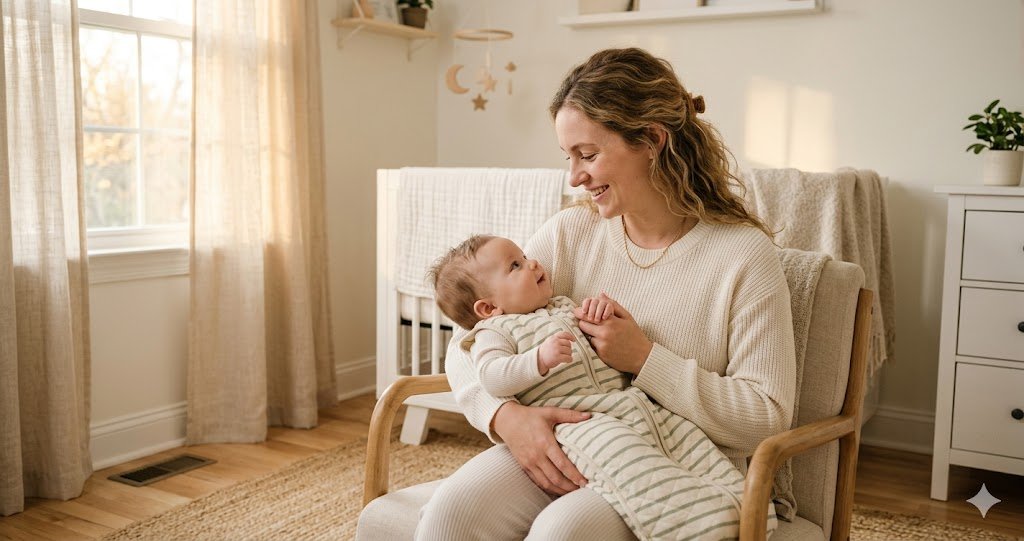
TOG + Room Temperature Dressing Chart: What Should Baby Wear to Sleep?
There’s a particular flavor of 2 a.m. worry that every new parent knows: you’re standing over the crib in the dark, hand hovering over the baby’s chest, trying to decide. Too hot? Too cold? Just right? When my daughter was a newborn, I lost count of the nights I did exactly that, then Googled “what should baby wear to sleep” on my phone with one thumb.
What I figured out fast: almost every tidy little temperature chart you find is sitting on a page that’s also trying to sell you a $40 sleep sack. That doesn’t make the charts wrong, but it does mean nobody’s incentivized to tell you which numbers are actual medical guidance and which are just industry convention. So that’s what this page is: a brand-neutral TOG and room-temperature dressing chart, plus an honest breakdown of what the pediatric guidelines really say (and don’t say).
The TOG + room temperature dressing chart
Find your room temperature, match it to a TOG-rated sleep sack, then layer underneath. Treat it as a starting point; your baby’s own comfort cues always win.
| Room temperature | Sleep sack TOG | What to wear underneath | Feels like |
|---|---|---|---|
| 75°F & up24°C & up | 0.2–0.5 | Diaper only, or a short-sleeve bodysuit | Hot summer |
| 72–74°F22–23°C | 0.5–1.0 | Short-sleeve bodysuit | Warm |
| 69–71°F20–21°C | 1.0 | Long-sleeve bodysuit or lightweight footed pajamasmost common | Mild |
| 64–68°F18–19°C | 2.0–2.5 | Long-sleeve bodysuit + footed pajamas | Cool |
| 61–63°F16–17°C | 2.5 | Long-sleeve bodysuit + warmer footed pajamas | Cold |
| 60°F & below15°C & below | 3.5 | Warm base layer + footed pajamas | Very cold |
Save this one or screenshot it (you’ll want it at 2 a.m., trust me). But before you take any chart as gospel, this one included, it helps to understand where these numbers actually come from.
What “TOG” actually means
TOG stands for Thermal Overall Grade. It’s a measurement of how much warmth a fabric traps, tested in a lab on a thermal mannequin. The rule is simple: the lower the number, the lighter and more breathable the garment; the higher the number, the more insulating it is. Baby sleepwear usually runs from about 0.2 TOG (barely-there, hot-summer weight) up to 3.5 TOG (thick, deep-winter weight).
A useful mental model: one TOG is roughly one light layer of cotton. So a 1.0 TOG sack is doing about the same job as a single thin blanket, except it can’t slip up over a sleeping face. One more thing worth knowing: testing labs flag that no baby should be in a sack or swaddle rated above 4.0 TOG. If you ever feel like you need more warmth than a 3.5 provides, the answer is to warm the room a little, not to keep stacking insulation.
The honest part: what the AAP actually says (and doesn’t)
If you’ve read more than one of these guides, you’ve seen “68–72°F” repeated like scripture, usually credited to the American Academy of Pediatrics. What surprised me when I went digging: the AAP doesn’t actually name a temperature. Its published guidance says it’s hard to set a specific room-temperature threshold, so instead it recommends dressing your baby for the environment, in no more than one layer more than an adult would wear to be comfortable in that room.
That 68–72°F range is still a perfectly reasonable target. It’s widely cited by pediatric sleep experts, and it lines up with what most babies sleep comfortably in. It’s just not an official medical standard, and TOG ratings aren’t either. TOG is an industry measurement system, and brands like ergoPouch, Halo, and Kyte Baby each publish their own version of the chart, calibrated to their own products. That’s exactly why the numbers wander a little from one site to the next, and why the AAP doesn’t endorse any specific TOG figure.
Reading your actual baby (not just the thermostat)
The chart gets you in the right neighborhood. Your baby tells you the rest. A few things I wish someone had drilled into me earlier:
Do the touch test on the right spot
Cold hands and feet are not a reliable signal. Babies’ extremities run cool by design, so a chilly little foot doesn’t mean your baby is cold. My husband used to swear our daughter was freezing because her toes were cold; the touch test said otherwise every single time. Slip a hand onto the back of the neck or the center of the chest instead. It should feel warm and comfortable, not sweaty or clammy.
Know the overheating signals
Overheating is the direction to worry about most, because it’s tied to higher SIDS risk. The signs the AAP says to watch for are sweating, flushed skin, and a chest that feels hot to the touch. Spot those, and you peel off a layer and nudge the room cooler. One small rule that catches a lot of parents off guard: skip the hat indoors. After the first few hours of life, the AAP advises against indoor hats during sleep.
Don’t double up sacks
If one TOG isn’t keeping your little one warm enough, the fix is a warmer base layer or a slightly higher TOG, not layering one sleep sack over another. Stacking sacks can tip a baby into overheating, which defeats the entire point.
Swaddles, sleep sacks, and the transition you can’t skip
For newborns, a swaddle is often the magic that buys everyone a few more hours of sleep, and it pairs well with a predictable newborn sleep routine. It settles the startle reflex that keeps jolting them awake, and we leaned on it hard in my daughter’s first couple of months. But there’s one rule here that is truly non-negotiable, because it ties directly to SIDS risk.
The AAP guidance is to stop swaddling as soon as your baby shows any sign of trying to roll over. Not once they can roll, but at the first attempts. Some babies start working on it as early as 2 months (often alongside the kind of sleep upheaval that comes with the 4-month sleep regression), so it can sneak up on you. The reason is sobering and simple: a swaddled baby has their arms pinned, so if they roll onto their tummy, they can’t push up to clear their airway. That is why caregivers are advised to make the switch proactively instead of waiting.
The switch is to a wearable blanket, a sleep sack with the arms free. That’s the safe, blanket-free way to keep a baby warm at every age after the swaddle, and a non-swaddling sack that lets them move freely can be used as long as you like. (One caution: the AAP advises against weighted swaddles and weighted sleep sacks entirely.) We kept my youngest son in a roomy 1.0 TOG sack well past his first birthday. He ran hot as a toddler and kicked off anything heavier, which told us everything we needed to know about his layers.
If your home runs warm or cold
Not every house cooperates with a thermostat number, and that’s fine. If you live somewhere hot, or in an older home that never quite holds heat, adjusting what your baby wears is almost always easier and safer than fighting the room overnight. Drop to a lighter layer underneath in summer; add a warmer footed base layer in winter before you reach for a higher TOG. Keep the crib away from radiators, vents, and direct sun, and let the touch test settle any close calls.
If you’re shopping for sleepwear, the practical move is to own two TOG weights that cover most of the year, a 1.0 for mild months and a 2.5 for cold ones, rather than one of everything. Plenty of well-reviewed TOG-rated sleep sacks come with a printed dressing guide and a room thermometer tucked inside, which makes a handy starting reference (just remember each brand’s guide is calibrated to its own product).
This article is for general informational purposes and reflects research into current pediatric safe-sleep guidance. It isn’t medical advice and isn’t a substitute for your pediatrician. Every baby is different; if you have questions about your child’s sleep, temperature, or health, talk to your healthcare provider.