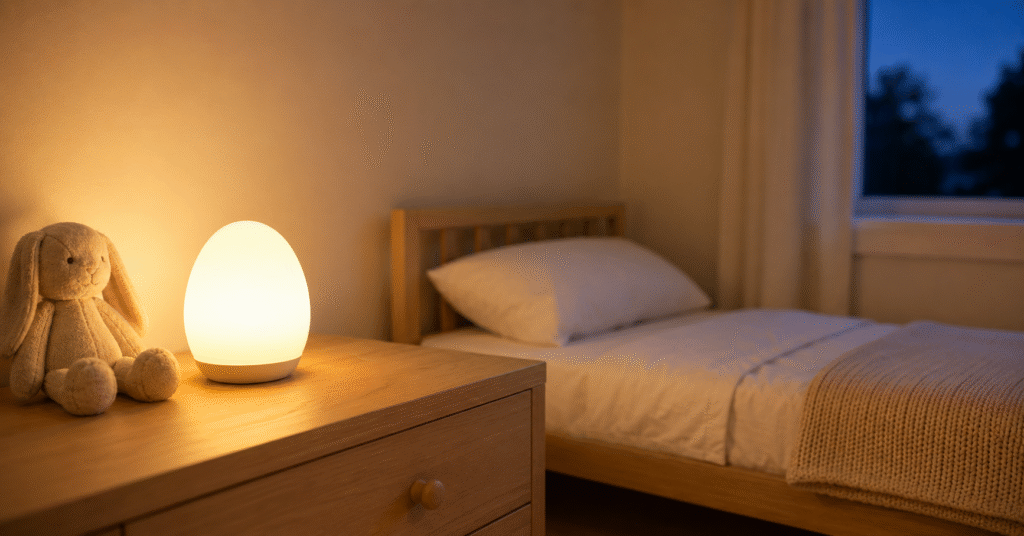
My older son started asking for “the music light” around age two. We were halfway through the toddler-bed transition, his little brother was night-waking down the hall, and the basic plug-in nursery light we’d used since infancy stopped cutting it. He wanted something that would do something when the door closed: make the room hum, glow a color he chose, and stay on until he was actually asleep.
If that sounds like your house too, read on. A toddler night light needs to do more than just glow. The good ones combine a dim, warm light with white noise (or lullabies, or rain), an auto-off timer so you’re not running a sound machine until 6 a.m., and for older toddlers, sometimes a wake clock that signals “okay, you can come find Mommy now.”
I went deep on this category over months of bedtime routines with my sons, reading through specs and listings carefully and weighing what actually matters at this age. Below are the five toddler night lights with sound and timer worth your attention in 2026, at five different price points and use cases. If you’re shopping for a younger sibling too, our companion roundup of the best white noise machines for babies covers that age range in detail.
Quick Picks: Best Toddler Night Lights with Sound and Timer
| Pick | Best For | Approx. Price |
|---|---|---|
| Dreamegg Sound Machine Baby (Nite 1) | Best overall — Ok-to-Wake + sleep trainer | $32 |
| Momcozy Baby Sound Machine | Best with full app control | $40 |
| Hushing Sound Machine | Best budget pick under $25 | $22 |
| Yogasleep Hushh 2 | Best for travel, daycare, grandparents’ | $30 |
| Dreamegg D1 | Best simple plug-in (no app needed) | $36 |
Here’s the detailed breakdown of each: what’s good, what isn’t, and which toddler it actually fits.
1. Dreamegg Sound Machine Baby — Best Overall
This one earned the top spot because it actually grows with your toddler. Out of the box it’s a sound machine and night light: 34 sounds split across nature, ambient, white noise, and lullabies, with three lighting modes (solid color, sunlight, and a dynamic mode that includes color-changing and breathing effects). That alone is enough for a two-year-old.
The feature that earns this the top spot is the Ok-to-Wake alarm clock. You set a wake time in the app, and the light turns a specific color when your child is “allowed” to leave the bedroom (yellow is a popular choice in our friend group). Toddlers can’t read a clock, but they can absolutely understand “yellow means come find Mommy and Daddy.” For families dealing with 5:30 a.m. early risers, this single feature is the entire reason to buy a smart sound machine over a simpler one.
Everything important (sounds, volume, light color and brightness, timer, child lock, Ok-to-Wake schedule) lives in the Dreamegg app. That is both the strength and the catch: setup is simple, but you need stable home Wi-Fi. A handful of reviews mention pairing issues on 5GHz networks; if that happens, switching to your router’s 2.4GHz band usually resolves it.
What I like: The Ok-to-Wake function is a legitimate quality-of-life upgrade for parents of early risers. App control means you don’t have to open the door at 6 a.m. to bump the volume down. Sunlight breathing mode is gentle enough for sensitive kids who don’t like color-changing lights.
What I don’t: Heavily app-dependent, so a phone battery dying mid-bedtime can be annoying. The display itself is minimal, with no big digital clock visible to your child; just the colored light cue.
Best for: Toddlers 18 months and up, especially if you’re working on early-morning boundaries or shifting from a crib to a toddler floor bed setup.
2. Momcozy Baby Sound Machine — Best with App Control
If your toddler still has a younger sibling at home, the Momcozy is the more flexible choice. It carries 34 soothing sounds and a seven-color adjustable night light, and the app lets you build a full personal sleep routine, meaning the machine can run different sounds and light colors at different times of night, automatically. That is gold if you have a baby who needs white noise at 11 p.m. and a kid who needs lullabies at 7 a.m.
The auto-off timer offers 30, 60, or 90 minutes, which is the right range for toddler bedtimes. You can also set a wake-up function that fades in light and sound, a gentler alarm than anything we used to use.
What I like: The app is well-designed. Routine builder is the standout feature: you set it once and forget about it. Seven actual color choices (not just RGB shifts) give you a usable amber for nighttime feeds, which matters for melatonin (more on this below).
What I don’t: Physical buttons are tiny and hard to feel in the dark, so once you set it up you really do need the app for adjustments. Battery life is on the shorter side if you use it unplugged, so most parents end up keeping it plugged in.
Best for: Households with both a baby and a toddler sharing routines, or parents who love smart-home integration. If you’re navigating the 4-month sleep regression with the younger sibling, the routine builder pulls double duty.
3. Hushing Sound Machine — Best Budget Pick
I almost didn’t include a third sound machine because three of these picks cover similar ground. The Hushing earns its spot because nothing else at this price gives you brown noise, 12 night light colors, and five timer settings. It is $22 and does the job.
You get 30 non-looping sounds: three noise types (brown, white, and pink), two fan sounds, 18 nature sounds, and seven calming melodies. The timer covers continuous play plus 1, 2, 3, and 4 hours, and the sound fades out gradually when the timer ends rather than cutting off abruptly. That is more thoughtful than most machines at twice the price.
The night light has 12 colors and 10 brightness levels, controlled by tapping the metal grill on top: double-tap to turn on or off, single-tap to cycle colors, hold to dim. Touch-controlled night lights are something older toddlers can absolutely figure out on their own around age three, which is either a feature or a bug depending on the day.
Where it wins: Brown noise at this price is rare and arguably better than white noise for blocking lower-frequency household sounds. The fade-out timer is a nice touch, and the touch-control night light is intuitive for older toddlers. Where it doesn’t: It needs to stay plugged in (not portable), there’s no app or child lock (a real downside if your kid is mid-button-pushing phase), and the aesthetic is generic plastic.
Best for: Families on a tight budget, or as a second machine for a sibling’s room.
4. Yogasleep Hushh 2 — Best for Travel
Yogasleep (formerly Marpac) has been making the iconic Dohm fan sound machine since the 1960s, and the Hushh 2 is their second-generation portable for babies and toddlers. It does fewer things than the others on this list, and that is the point.
You get six sounds (two white noise variants including the signature Dohm fan sound, two nature sounds, and two soothing melodies) plus a soft amber night light with four brightness levels and a timer that runs 30 minutes, 60 minutes, or two hours. Battery life is excellent: 12 to 34 hours per charge depending on volume. There’s a reinforced carabiner clip that hooks onto a stroller, car seat, crib rail, or diaper bag.
The feature that matters most for toddlers specifically is the toddler lock. Older toddlers love to push buttons; with the lock engaged, the controls stop responding entirely until you unlock them. The backlit buttons are the other nighttime win — you can find the off switch at 2 a.m. without turning on the overhead light.
What I like: Genuinely portable. Toddler lock works as advertised. Amber-only light won’t suppress melatonin. Drop-tested durability and a US brand with a 1-year warranty.
What I don’t: Only six sounds, which feels limiting if your kid has strong preferences. No color options on the night light. No app. The smaller speaker doesn’t fill a large room the way a corded unit does.
Best for: Travel, road trips, daycare drop-offs, and grandparents’ houses. If you only own one sound machine and you travel often, this is the one.
5. Dreamegg D1 — Best Simple Plug-In
This is the no-app pick for families who do not want another connected device in the house. The D1 is Dreamegg’s classic: a cylindrical sound machine with 24 high-fidelity, non-looping sounds (seven white noise variants, seven fan sounds, and ten nature sounds including birds, ocean waves, rain, thunderstorms, lullabies, and a fetal heartbeat tone), an optional warm white nightlight you can turn off independently, a sleep timer, and a memory feature that remembers your last sound, volume, and timer setting.
Every control is a physical button on the front. No app to download, no Wi-Fi to configure, no firmware updates: plug it in, press the sound you want, set the timer, and walk out. For grandparents watching the kids, or as a second sound machine for the playroom or a guest room, that simplicity is the entire selling point.
Where it wins: Truly plug-and-play. The independent night light switch lets you run sound without light or vice versa. The memory feature is more thoughtful than most because it remembers everything (sound, volume, timer), not just the last sound. Warm white light is gentle on melatonin. Where it doesn’t: Only 24 sounds versus the other Dreamegg’s 34. No color options on the light, just warm white. Needs to stay plugged in. No Ok-to-Wake function, so it is not a true sleep trainer.
Best for: Parents who don’t want yet another app, or as a reliable second unit for the playroom, grandparents’ house, or a sibling’s room.
What Actually Matters in a Toddler Night Light (Buying Guide)
The product page on Amazon for any of these will throw “34 soothing sounds!” and “12 colors!” at you, and most of that genuinely doesn’t matter. The three things below actually do, in roughly that order of importance for a toddler specifically.
White noise volume and your toddler’s hearing
This is the one I wish someone had told me earlier. A 2014 study in Pediatrics tested 14 popular infant sound machines at maximum volume and found that all 14 exceeded 50 decibels when measured at 30 centimeters (about a foot from the machine), and three of them exceeded 85 decibels — the threshold where prolonged exposure can damage hearing. Following that research, the American Academy of Pediatrics recommends keeping a sound machine below 50 decibels and at least seven feet from where your child sleeps.
Practical translation: don’t put the sound machine on the crib rail or the nightstand right next to your toddler’s bed. Put it across the room, on a dresser, and keep the volume at about half. If you can hold a normal conversation in the room over the noise, it’s roughly in the safe range. All five machines in this roundup can run well under 50 decibels; the warning here is about how you use them, not which one you buy.
Toddler night light needs are not the same as baby night light needs
A lot of “best baby night light” articles get reused for toddlers, and that’s a mistake. The differences matter:
- Color choice becomes part of bedtime. Toddlers want to pick their color. Machines with adjustable colors (Dreamegg, Momcozy, Hushing) let you turn this into a small ritual (“what color tonight?”) that gives a two-year-old a small piece of control at the exact moment they want to push back on bedtime. A single-amber light like the Yogasleep can’t do this.
- Light color affects sleep hormones, but not all colors do equally. Warm amber and red light have the least impact on melatonin, while blue and bright white light suppress it. For the actual sleep portion of the night, dim warm amber or red is what pediatric sleep specialists recommend. The colorful display modes are for the wind-down period, not for running all night.
- Toddlers will press every button. A child lock is much more important than at the infant stage. Yogasleep’s toddler lock is explicit; Dreamegg’s app lets you lock the device remotely; the Hushing has no lock, which is its biggest weakness.
- Portability becomes useful, not just nice-to-have. Toddlers go to daycare, sleep at grandparents’, and refuse to nap on vacation. A machine that travels with them carries their sleep routine with it, and a toddler who recognizes “their” sound at an unfamiliar house falls asleep faster.
If your kid is between 12 and 24 months and still in a crib, the differences are smaller. If they’re 2+ and in a toddler bed, the four points above matter a lot. (Already there? Our toddler pillow guide covers the other half of that sleep setup.)
Ok-to-Wake: what it actually does and when it helps
An Ok-to-Wake feature uses a colored light to tell your child whether it’s an acceptable time to get out of bed. You set a wake time in the app (say, 6:30 a.m.), the light glows a designated “stay in bed” color overnight, and at 6:30 it switches to the “okay, come out” color.
It only works if two things are true: your child is at least roughly two years old (younger toddlers don’t reliably grasp the concept), and you’re consistent for the first two weeks of teaching them what the colors mean. The way most sleep coaches recommend introducing it is as a daytime game first (“what does yellow mean? what does red mean?”) for about a week before relying on it overnight. My partner and I did this with our older son, and the daytime rehearsal made a real difference once we started using it at night.
The best-known Ok-to-Wake sound machine on the US market is the Hatch Rest, which retails closer to $70. Of the five picks in this roundup, the Dreamegg Sound Machine Baby (Nite 1) is the only one with a true Ok-to-Wake function with app-set schedules, at roughly half the price. If this is the feature you want most, that’s the one. For the broader wind-down side of bedtime, our gentle 5-step bedtime routine pairs well with whichever night light you choose.
Frequently Asked Questions
Should a toddler night light stay on all night, or shut off?
For most toddlers, a dim warm or amber light all night is fine and often comforting, especially if they’re in a toddler bed and might get up to use the bathroom. What you don’t want is a bright or color-changing light running for hours, because that can disrupt deeper sleep. The timer feature on these machines exists for this reason. We run color mode during the wind-down (about 20 minutes), then it auto-fades to dim warm amber for the rest of the night.
Is white noise safe for toddlers all night?
Volume matters more than duration. Kept below 50 decibels and at least seven feet from your child, white noise is generally considered safe and can genuinely help block household sounds like dishwashers, older siblings, and the dog. The concern in older pediatric research has been about machines at maximum volume placed inches from a sleeping infant, which is a use pattern, not a flaw in the product.
At what age do you stop using a night light with sound?
There’s no fixed age. Some kids drop the night light around 5 or 6 when they’re confident in the dark; others use it well into elementary school. Sound machines often stay in use longer than the light, since many adults use white noise to sleep too. You’ll know it is time to phase out the light when your child stops asking for it or starts sleeping just as well when it doesn’t get turned on.
Do toddlers need a different sound machine than babies?
Not strictly, but the feature priorities shift. Babies benefit most from constant, low white noise that mimics the womb. Toddlers benefit from variety, light color choice, a child lock, and (in older toddlers) Ok-to-Wake training. If you’re buying your first machine and your kid is past their first birthday, get one with the toddler features built in. You’ll grow into them, and a basic machine will need to be replaced.
Does the timer setting matter that much?
More than I expected before having kids. A 60- or 90-minute timer covers the falling-asleep window and frees you from having a machine humming until morning if you don’t want one. If your kid is a deep sleeper, use the shorter setting; if they wake easily, run continuous. The five picks above all give you both options.
The Bottom Line
For most families with a toddler, the Dreamegg Sound Machine Baby is the strongest all-rounder; the Ok-to-Wake feature is the kind of thing you don’t realize you need until you have it. If you have a baby and a toddler under the same roof, the Momcozy with its routine builder is more flexible. For travel and daycare drop-offs, the Yogasleep Hushh 2 is worth every dollar. And if app fatigue is real in your household, the Dreamegg D1 or budget Hushing still get the job done without a single notification.
Whichever you choose, the most important variables are the ones above: keep the volume low, the machine at least seven feet from your child, the night light dim and warm, and the routine consistent. The device matters less than the volume knob and the bedtime routine around it.