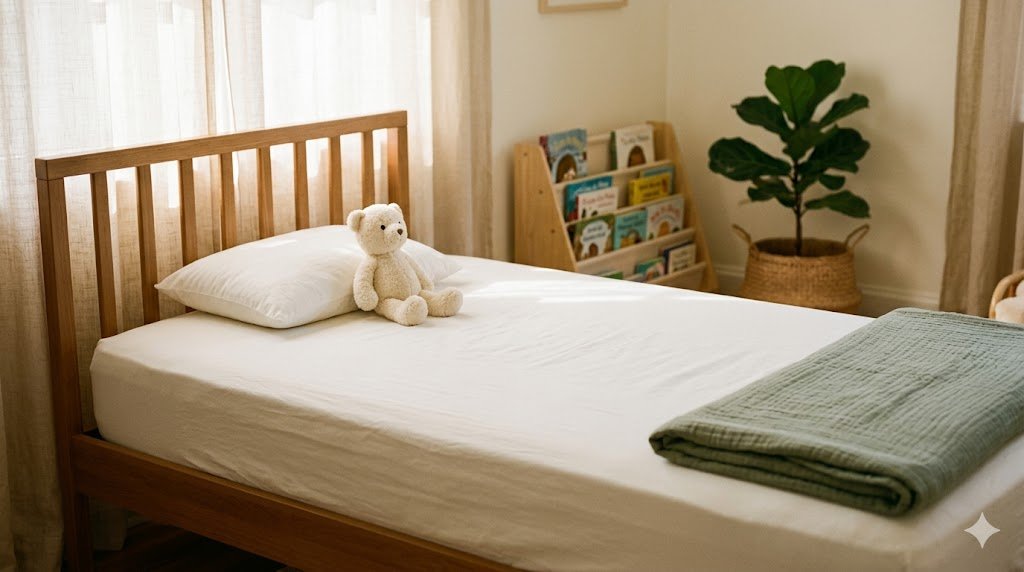
When my older son was around two and a half, we moved his crib rail down and turned his crib into a toddler bed. Within a week he was reaching for a pillow at bedtime: the throw pillow off the reading-nook chair, a bunched-up sleep sack, anything. The signal was unmistakable: he wanted one. I wasn’t sure he was ready, I wasn’t sure what size to get him, and the first two pillows I tried were either too thick or so thin he kept folding them in half to prop his head higher.
My youngest is 18 months now, still in his crib, still happily flat-headed on the mattress. He isn’t ready. But the older one’s transition taught me that when the moment comes, it comes fast, and I’d rather know what we’ll need before the bedtime meltdown than during it. So once both kids were down one night, I sat down with the American Academy of Pediatrics (AAP) safe-sleep guidance, the CPSC’s toddler-product safety alerts, the testing notes from Babylist, The Bump, and Sleep Foundation, and a long evening reading the 1- to 3-star Amazon reviews on every pillow that came up more than once. This is what I’d buy now, by age and by use case.
When is your toddler actually ready for a pillow?
Age alone isn’t the right test. A 24-month-old who still sleeps face-down with his arm folded under his head probably doesn’t need one yet. A 20-month-old who keeps stealing yours off the couch and tucking it under her cheek probably does. Pediatric occupational therapists who specialize in toddler sleep consistently point to developmental readiness over the calendar.
The five signs I’d watch for:
- They can push objects away from their face. This is the single most important safety signal: it’s the muscle control that lets them clear their own airway if a pillow shifts during the night.
- They’ve already transitioned to a toddler bed. The CPSC is explicit on this one: a pillow inside a crib is not just a soft-object hazard, it’s a climbing aid. A determined 18-month-old will use it to leverage themselves over the rail. Pillow comes after the bed switch, never before.
- They’re showing interest. Stealing yours, propping their head on stuffed animals, asking for “one too” at bedtime. Kids tell you when they’re ready, if you watch.
- They’re at least 18 months, ideally past 2. The CPSC accepts 18 months as the floor for small toddler-specific pillows. The AAP prefers 24. Most pediatricians I cross-referenced will land somewhere in that window depending on the child.
- They’ve stopped swaddling and rolling tightly. Kids who still burrow face-first into soft surfaces during sleep aren’t ready, even if they’re chronologically old enough.
If your child meets fewer than three of these, wait. There’s nothing magical about being the kid in daycare with the cutest dinosaur pillowcase if she’s not actually sleeping better with it.
What size pillow does a toddler need?
Toddler pillows are deliberately smaller and thinner, and the reason is geometric: your little one’s head-to-shoulder gap is much shorter than yours, so a pillow with adult loft tips their chin toward their chest and partially closes the airway.
The three sizes that exist, and roughly when each one fits:
- Mini toddler (around 9×13 inches): The smallest commercially available size. Best for 18 months to about 3, especially as a first pillow when your child has just moved out of the crib and the standard 13×18 still looks visibly oversized on a toddler bed.
- Standard toddler (around 13×18 inches): The workhorse size for ages 2 to 4-ish. Most major brands center their main product on this dimension. If you only buy one, this is it.
- Jumbo toddler / pre-youth (around 14×20 inches): The step-up between standard toddler and full youth (16×22). Useful around ages 4 to 5 when the 13×18 starts looking small but the youth size still looks too big.
One thing testers from The Bump and Sleep Foundation both note: the loft (how thick the pillow is when uncompressed) matters more than the width. For most toddlers, a pillow that compresses to about 2 to 3.5 inches under the weight of a small head is the right zone. Anything thicker pushes the head forward; anything thinner is the equivalent of sleeping on a folded sheet.
What to look for — and what to skip
After comparing roughly fifteen options across the four major review sites and the toddler-pillow category leaders on Amazon, the criteria that matter the most:
- Firmness in the Goldilocks zone. Push down on the pillow. It should compress, then bounce back within a couple of seconds. If it stays compressed, it’s too soft (suffocation risk). If it doesn’t budge, it’s too firm (uncomfortable, your kiddo won’t use it).
- Fill material with real certifications. Look for OEKO-TEX Standard 100 (limits harmful substances), GOTS (organic cotton verified to the seed), or Woolmark (wool authenticity). These aren’t marketing badges. They’re independently audited.
- Machine washable, with a removable pillowcase. Toddlers leak. The pillow and the case should both survive the washer.
- Hypoallergenic fill, if your child has any sensitivity. Polyester cluster fiber and natural wool are both reliable; some kids react to feathers and down, which is why neither shows up in toddler-pillow design.
And what to skip, which is just as important:
- An adult mini pillow or a decorative throw pillow. These look the right size but the fill is wrong (often polyester clusters with no firmness control, or shredded foam that emits an off-gassing smell from a sealed package). The cover usually isn’t toddler-skin-safe.
- Memory foam with a strong chemical smell out of the box. Some memory foam toddler pillows arrive smelling like a new car interior. That’s volatile organic compound off-gassing, and it doesn’t belong six inches from your child’s nose for the next eight hours.
- Any “self-feeding pillow” or “anti-flat-head pillow.” The CPSC has issued multiple warnings on both categories. They’re not safe sleep products.
The 6 best toddler pillows for the crib-to-bed transition
Six picks, organized by what each one is genuinely best for, not by which brand sponsored what list. Prices reflect current Amazon ranges.
1. KeaBabies My Little Dreamy 13×18 — Best Overall
This is the one I’d recommend first because it gets the boring fundamentals right. The kind of pillow our older son sleeps on is a 13×18 polyester-fill with an organic cotton case, a category that KeaBabies’s My Little Dreamy fits squarely into alongside a handful of similar competitors. The fill is polyester cluster fiber that holds its shape after a wash; the case is OEKO-TEX Standard 100 and GOTS-certified organic cotton; the loft compresses to right around 2.5 inches, which is the sweet spot for most toddlers. It carries Amazon’s Best Seller and Amazon’s Choice badges in the toddler pillow category and has been highly rated by thousands of parents.
KeaBabies consulted a pediatric chiropractor on the loft and shape, which is the kind of design detail you can feel when a toddler pillow actually stays on the bed past 2 a.m. instead of getting kicked off by midnight. The included envelope-style pillowcase comes in a long list of prints, which matters more than you’d think. Letting your kiddo “pick” the dinosaur or the butterfly print is half the battle in getting them to actually use the pillow you bought.
What to know: A small minority of reviewers report it shrinking slightly on the first machine wash, even when following the care label. KeaBabies’ customer service has replaced it for parents who flagged this. A few parents of 18-month-olds also note it’s a bit stuffed for the younger end of the recommended range, which is exactly why the Mini version below exists.
2. Utopia Bedding Toddler Pillow 2-Pack — Best Budget
If you need a pillow for the bed at home and a backup for daycare, or you have two toddlers in adjacent stages, this pack is hard to beat. Two pillows for under fifteen dollars works out to roughly the price of a single coffee per pillow. It carries an Amazon Best Seller badge in the nursery pillows category and has thousands of positive reviews.
The build is honest: a 250-thread-count cotton-blend cover, polyester fill, a 13×18 dimension that matches the major brands. It’s not as plush as the KeaBabies, and the manufacturer recommends spot-cleaning rather than the full machine wash, but for a daycare cubby or a guest-room toddler bed, the value math is unbeatable.
What to know: At this price, fill consistency varies between batches. Some parents describe their pair as “perfect,” others say one of the two arrived noticeably flatter than the other. After several washes some reviewers also note minor lumpiness. These are the trade-offs of paying budget-tier prices in a category where premium pillows run three times as much. No pillowcase is included; you’ll want to buy a 13×18 case (or two) separately.
3. KeaBabies Mini 9×13 — Best First Pillow (18–24 months)
This is the size I wish I’d known about when our older son first moved to his toddler bed. A standard 13×18 looks comically large on an 18-month-old’s freshly-graduated toddler bed, and most “mini” pillows on Amazon are actually travel pillows with the wrong loft. The KeaBabies Mini is a true scaled-down version of their main pillow, with the same OEKO-TEX and GOTS certifications, just sized for the very smallest end of the toddler-pillow window.
If your child has just transitioned out of the crib and the bed feels enormous around them, this is the pillow to start with. They’ll likely outgrow it sometime between ages 3 and 4 and graduate to the standard 13×18, which is a reasonable two-year runway for the cost.
What to know: The Amazon star average sits slightly below the brand’s flagship pillow. I read through the lower-star reviews, and the pattern is almost entirely “too small for my 4-year-old,” which is genuinely the point of the product, not a defect. If your child is past their fourth birthday, skip this one and go to the standard 13×18 or the Jumbo 14×20.
4. Woolino Premium Wool Toddler Pillow — Best Natural Fill
If you’ve stocked your nursery with organic crib sheets, wool sleep sacks, and the chemical-free everything, this is the toddler pillow that fits that universe. Woolino fills it with Woolmark-certified Australian wool (not synthetic, not foam, not memory anything) and wraps it in a 300-thread-count GOTS-certified organic cotton sateen shell. It carries OEKO-TEX Standard 100 certification on the finished product.
What wool does that polyester can’t: it regulates temperature. My older son sleeps hot, and the synthetic-fill pillows we tried had a way of going from “warm” to “sweaty” by 4 a.m. Wool wicks moisture and breathes, which is why The Bump highlights this pillow as a “best first pillow” option for sweaty sleepers and warm-climate bedrooms.
What to know: It’s the most expensive option on this list at around $45, roughly twice the price of the standard KeaBabies. It only comes in one size (14×19), with no jumbo or youth version, so your child will eventually outgrow it. Some new pillows have a faint natural wool scent for the first week or so, which fades. If your child has a confirmed wool allergy, skip it.
5. Little Sleepy Head Toddler Pillow — Best for Customization
The thing that makes this pillow genuinely different from everything else on the list: Little Sleepy Head sells the same 13×18 pillow in three different fill thicknesses — Less (around 3.5 inches before compression), Classic (around 4 inches), and More (around 4.5 inches). I haven’t found another toddler-pillow brand that does this. If your child is a stomach sleeper and keeps flattening their pillow, you order the Less version. If your child is older and sleeps on their side, you order the More version. The Classic suits the majority of back-sleeping toddlers.
It’s polyester cluster fiber in a 100% cotton shell, OEKO-TEX Standard 100, CPSC compliant, and machine washable. The brand has been making this same pillow since 2014, which is unusual longevity in a category where brands appear and disappear yearly.
What to know: The default Classic fill runs slightly fluffier than the KeaBabies; some parents of very young toddlers prefer to order Less. Multiple reviewers note exceptional customer service. The brand will sometimes send a custom-fill replacement at no charge if your child doesn’t take to the version you ordered. The product is labeled as US-designed, but a small number of reviewers have noted the manufacturing tag says China. That’s not unusual for the category, but worth knowing if “Made in USA” is a deal-breaker for you.
6. KeaBabies Jumbo 14×20 — Best for Older Toddlers (ages 4–5)
My daughter outgrew her 13×18 around her fourth birthday. The pillow started looking small under her head, but a full youth-size 16×22 looked too big on her toddler bed. The Jumbo 14×20 is the in-between size that fills that gap. Same KeaBabies fill, same organic cotton pillowcase, same OEKO-TEX and GOTS certifications, just an inch wider and two inches longer than the standard.
If your little one is on the older end of the toddler-pillow window and starting to ask for “a bigger one like mommy’s,” this is the gentle upgrade before they’re truly ready for adult bedding. It’s also a good fit if you bought the standard 13×18 around age 2 and want to replace it as your child grows rather than re-buying the same size.
One thing worth knowing: the Jumbo’s loft is comparable to the standard 13×18, so if your child is asking for something fluffier rather than wider, this is the wrong upgrade path. Consider the Little Sleepy Head More-fill option instead.
How to actually introduce the pillow (the part most guides skip)
When my older son moved to his toddler bed, I made the mistake of putting the pillow in his bed the same night. He was suspicious of it, pushed it onto the floor, and slept fine without one for another two weeks. The second time around — after some quiet research I should have done first — I tried a different sequence.
Here’s what worked the second time around:
- Introduce the pillow during the day first. Put it on the bed during reading time, naptime stories, or pretend play. Let your child associate it with comfort before they’re asked to actually sleep on it.
- Let them pick the pillowcase. A 4-year-old with strong opinions about princesses or rocket ships will use a pillow they chose. Same kid handed a generic white case might never look at it.
- Don’t take away the comfort object. If they sleep with a lovey or stuffed animal, the pillow joins the team; it doesn’t replace anything.
- Give it a full two weeks before deciding it doesn’t work. Toddler routines stabilize slowly. The first three nights are not a representative sample.
And one thing to not do: don’t transfer your own pillow as a temporary measure. Adult pillows are too thick, too soft, and too wide. Once your kiddo associates a pillow with the wrong shape, retraining them to the right one is harder.
Frequently asked questions
Can my toddler use a pillow inside the crib?
No. The CPSC is explicit on this: even after age 1, a pillow inside a crib creates two risks. The first is the soft-object suffocation hazard that’s been documented in sleep-related infant deaths. The second is mechanical: a determined toddler will use the pillow as a step to climb over the crib rail. Both the AAP and the CPSC recommend a pillow only after your child has transitioned to a toddler bed, regardless of age. (For mattress safety during this same window, see our best crib mattress 2026 guide.)
When should we upgrade to a youth-size pillow?
Roughly age 5, or when the standard 13×18 starts visibly shrinking under their head. The youth size is 16×22, with a loft around 3 inches, designed for ages 5 to 8. Don’t rush it. Kids “outgrow” toddler pillows much later than they outgrow toddler beds.
Is memory foam safe for toddlers?
Generally yes, if the foam is CertiPUR-US certified (meaning it’s been tested for off-gassing and harmful chemicals) and the pillow has the right toddler loft. Avoid any memory foam pillow that arrives with a strong chemical odor, and avoid adjustable-fill memory foam pillows where small foam pieces can escape through a torn seam.
My toddler refuses to use the pillow. Should I push?
No. Some kids sleep just fine flat on the mattress until age 4 or 5. Forcing a pillow because the parenting books say “by age 2” rarely works, and a child who actively rejects the pillow is more likely to bunch it into something unsafe. Wait a few weeks, try again, or skip it entirely until they ask. The bedding hill is not the one to die on.
How long does a toddler pillow last?
About 1 to 2 years of nightly use before the fill starts to clump irreversibly. If the pillow no longer bounces back when pressed, or has developed permanent lumps, it’s time to replace it, which is conveniently around the same time your child probably needs a bigger size anyway.