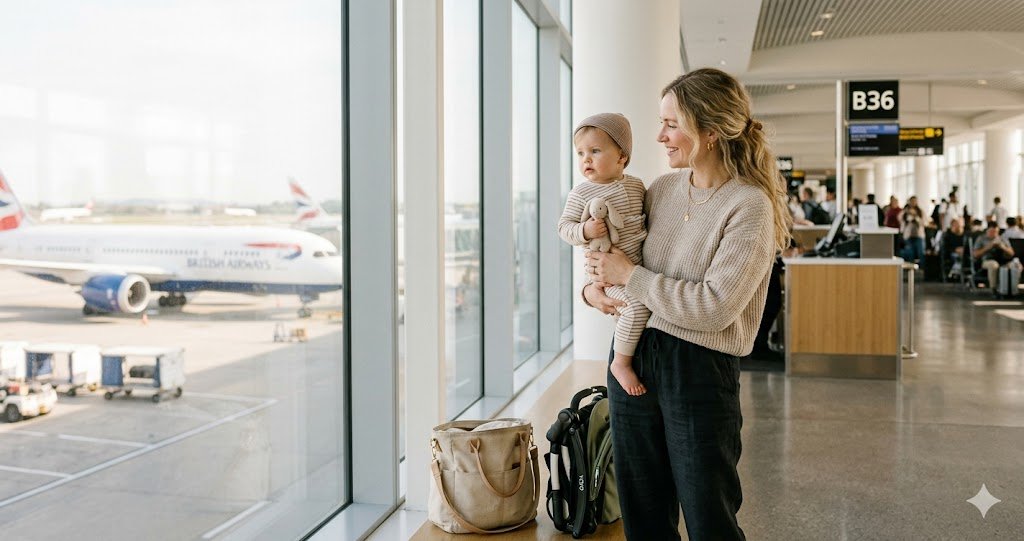
The first time I flew with a baby, I packed like we were relocating to a research station in Antarctica. Three outfit changes that never left the bag. A white noise machine I was too embarrassed to turn on. Enough diapers to absorb the Pacific. And somehow, the one thing I actually needed at 30,000 feet, a spare shirt for me, was in the checked luggage.
Three kids and a lot of boarding passes later, I can tell you that flying with a baby or toddler is genuinely manageable. Not relaxing. Let’s not get carried away. But manageable, in the way that anything becomes manageable once you stop improvising and start running a system.
This guide is that system: what to decide before you book, the car seat question nobody gives you a straight answer on, how to get through security without unpacking your entire life, and a layered packing checklist you can run through, item by item, the night before your flight.
First, the Thing Nobody Tells You: a Lap Baby Isn’t the Safe Option
Most airlines let children under two fly free on a parent’s lap, and most of us assume that if it’s allowed, it must be fine. Here’s the uncomfortable truth: the people who regulate flying don’t think it’s fine. The FAA itself says the safest place for a child under two is in an approved child restraint system in their own seat, not in your arms, because your arms simply cannot hold a baby through unexpected turbulence. The NTSB has been asking for a lap-child rule change since 1979.
So why is it still allowed? Partly economics: regulators worried that forcing families to buy an extra ticket would push them to drive instead, and driving is statistically far more dangerous than flying. Which is a fair point, and it’s also why I won’t tell you that flying with a lap infant makes you a bad parent. It doesn’t. Plenty of families do it, including families I love and respect.
But you deserve to make that call with the real information, not the airline’s cheerful “infants fly free!” framing. If the budget allows, buy the seat and bring the car seat. If it doesn’t, fly the lap infant with your eyes open: keep them attached to you, hold them low and snug during turbulence, and don’t let anyone make you feel silly for asking the gate agent whether there’s an empty seat next to you. There often is, and gate agents can work small miracles for polite parents.
Before You Book: Small Decisions That Save the Whole Trip
Timing beats everything. A flight that lines up with your kiddo’s longest nap is worth more than any toy in your bag. For babies who still nap on the move, I aim for a departure about an hour before usual nap time: enough runway to board, feed, and let the engine hum do its work. For toddlers, opinions split between “fly early before they’re tired enough to melt down” and “take the red-eye and pray.” Having tried both philosophies across three children, I’ll just say this: the red-eye gamble pays off beautifully or catastrophically, and you won’t know which until you’re airborne.
There is a golden age, and it’s earlier than you think. Babies between roughly four and seven months are the secret easy mode of air travel: portable, nap-happy, not yet mobile, charmed by ceiling vents. The hardest passengers are newly walking toddlers who have discovered freedom and have zero interest in giving it back for a five-hour flight. If you have any flexibility in planning a big trip, that’s worth knowing.
Seat strategy. On a two-adult trip, booking the window and aisle and leaving the middle empty is a classic for a reason: middle seats fill last, and if the gamble fails, the person assigned there will trade for your window or aisle so fast it’ll make your head spin. Flying long-haul with a young baby? Ask about bulkhead bassinet rows when you book, not at the gate. They’re limited and they go early.
Quick reality check before any flight: if your little one has had a recent ear infection, cold, or fever, a pre-trip call to your pediatrician is worth ten of any tip in this article. The AAP also notes that while it’s generally considered safe for healthy babies to fly after the first week, waiting until two to three months is ideal, since airports are crowded germ factories and tiny immune systems are still warming up.
The Car Seat Question (and the Label That Settles It)
If you bring your child’s car seat on board, it needs to be certified for aircraft. The test is delightfully low-tech: flip the seat over and look for a label that says it’s certified for use in both motor vehicles and aircraft. Most US convertible seats and infant carriers have it. Booster seats don’t, because boosters need a shoulder belt that airplanes don’t have; a booster rides in the overhead bin, and a booster-age kid uses the plane’s lap belt in their own seat.
Installing a car seat on a plane is easier than in a car (no LATCH wrestling, just the lap belt through the belt path), but do it during family pre-boarding so you’re not the person blocking row 23 while a hundred strangers radiate patience at you. Your child rides rear-facing or forward-facing exactly as they would in the car, per the seat’s instructions.
For toddlers who’ve outgrown the bring-the-whole-seat phase but are too young for just a lap belt, there’s an FAA-approved harness device called CARES that wraps around the airplane seatback. It packs down to nothing, which is its entire charm.
And if you’re not bringing the seat into the cabin, protect it. Checked and gate-checked car seats get treated like every other piece of luggage, which is to say: badly.
For gate check or baggage check: a padded car seat travel bag
After comparing the car seat bags parents actually rebuy, the padded backpack style wins for one simple reason: your hands. The YOREPEK padded car seat travel bag straps onto your back like a giant turtle shell, leaving you free to push a stroller, drag a suitcase, and hold a small human’s hand all at once. It’s roomy enough for most convertible seats with space left over, and parents routinely report stuffing diapers and bulky jackets in around the seat, since checked car seats typically fly free and nobody weighs the padding. Two honest caveats from the fine print: the front panel isn’t padded like the back is, and it doesn’t fit a couple of the largest rotating seats, so double-check your model before you order.
Getting Through the Airport Without Losing Your Mind (or a Child)
Security with small children is an assembly line problem. One adult sends bags, shoes, and electronics through; the other handles children and explains to the three-year-old why the bins are not a ride. Solo parents: put everything possible into one bag before you reach the belt, wear slip-on shoes, and accept every offer of help from TSA officers, most of whom have seen ten thousand parents and genuinely want to move you through.
Here’s the rule that surprises almost every first-time flying parent: baby food and drink are exempt from the liquids rule. Formula, breast milk, toddler drinks, and baby food pouches can come through security in reasonable quantities well beyond the usual travel-size limit. Take them out of your bag, tell the officer what you’ve got, and expect a little extra screening. The full details are on the TSA’s traveling with children page, which is worth a skim the night before, if only so you can quote it calmly while your formula goes through additional screening.
Your wheels: the travel stroller question
Any stroller can survive a vacation. Airports are a different sport: you need something that folds with one hand while the other hand holds a child, slides through a security scanner without drama, and ideally comes back up off the jet bridge floor in working condition. Full-size everyday strollers are gate-check casualties waiting to happen. (For the complete field guide to this category, our travel stroller roundup goes nine picks deep; below are the two that matter most for flying.)
The do-it-all pick: MAMAZING Ultra Air
Cross-referencing the travel stroller field against what flying actually demands, this one keeps rising to the top of parent reports. It’s genuinely feather-light thanks to a carbon fiber frame, folds and unfolds with one hand, and collapses down to roughly the footprint of a carry-on suitcase. Many parents report it fits in the overhead bin once the bumper bar pops off, which is a real luxury, though overhead space varies by aircraft, so check your airline’s limits before you count on skipping the gate check. The canopy coverage is excellent for airport naps, and independent reviewers note the folded package stands up on its own, a small thing that matters enormously when you’re in a boarding line holding a baby. Two things to know going in: it’s not for newborns, since babies need to be around six months to ride, and the fold takes a few practice runs at home before it becomes muscle memory. Practice before the trip, not at the gate.
The budget pick: Dream On Me Aero umbrella stroller
If a premium travel stroller isn’t in the cards, or you simply refuse to gate-check anything you’d cry about losing, a classic umbrella stroller is the honest answer. The Aero is the one that keeps showing up in budget roundups for a reason: impressively light, quick one-hand fold, dual rear brakes, and a price low enough that an airline mangling it stings instead of devastates. Be clear-eyed about the trade-offs at this price: it uses a simpler three-point harness rather than five-point, and the seat doesn’t recline, so it’s an airport-errand workhorse rather than a napping suite. For a trip where the stroller mostly exists to ferry a tired toddler and a diaper bag between gates, that’s often exactly enough.
Your hands: the carrier
If I could bring only one piece of gear through an airport with a baby, it wouldn’t be the stroller. A soft carrier turns the entire terminal into a hands-free zone: through security (you’ll typically walk through with baby worn, though officers may swab your hands), down the jet bridge, up and down the aisle during the flight when walking is the only thing that works. One important fact most parents learn from a flight attendant mid-flight: for takeoff and landing, a carrier doesn’t count as a restraint, and you’ll be asked to hold your baby in your arms with the carrier loosened or off. Wear it for the airport; plan to unclip for the bookends of the flight.
The carrier: Infantino Flip 4-in-1
There are gorgeous carriers out there costing several times more, and if you already own one you love, bring that. But for a travel workhorse, the Flip 4-in-1 is the people’s champion: one of the most-reviewed carriers on the entire internet, with a rating that has survived an enormous crowd of opinionated parents. It converts between facing-in for babies and facing-out for nosy toddlers, adjusts quickly between differently sized parents, and machine washes after the inevitable flight where someone’s snack comes back up. The honest trade-off versus premium structured carriers is long-haul comfort: with a heavy toddler on a multi-hour wear, your shoulders will know. For airport distances, it’s more than enough.
One more airport-locomotion note for the toddler crowd: ride-on suitcases. Parent opinion is split right down the middle here. For every family that swears their Trunki saved a long layover, another reports the novelty wore off one gate into the journey and they towed both child and suitcase the rest of the way. Know your child. If they’re the type to commit to a bit, it’s a joy; if they’re the type to abandon a scooter in the driveway after four minutes, skip it.
Takeoff, Landing, and the Ear Pressure Problem
The crying you hear on descent is usually ears. Babies can’t pop their own ear pressure the way we do, and the fix is wonderfully simple: swallowing. Nurse, offer a bottle, or hand over a pacifier during takeoff and especially during descent. The timing matters more than the method. Descent starts well before the wing flaps come out, roughly half an hour before landing on many flights, so don’t burn your feed too early; when your ears first register the change, that’s your cue.
For toddlers, anything that makes them swallow works: a water cup with a straw, a chewy snack, the rare and sacred lollipop. And the oldest trick in the parenting book still applies: change the diaper right before boarding. A dry baby boards happier, and airplane changing tables are built for dolls.
The In-Flight Entertainment Plan (Realistic Edition)
Two principles carry the whole flight. First, novelty beats quality: a three-dollar toy your toddler has never seen outranks the beloved hundred-dollar toy from home. Second, ration ruthlessly. Everything comes out one item at a time, roughly one per hour, and goes back before the next appears. The bag itself stays out of sight, because a visible bag of wonders is a negotiation you will lose.
And yes: screens. On a flight, screens are not a parenting failure, they’re cabin crew. Download everything before you leave home, because in-flight wifi exists mostly as a concept. My only hard rule is pairing the screen with headphones that protect small ears, which we’ll get to in a second.
For babies (around 10 months and up): LiKee suction spinners
The genius of suction toys on a plane is that they solve the real problem, which is not boredom but gravity. Anything a baby holds, a baby drops, and there is no retrieving a toy from under seat 23C. These spinners stick to the tray table or the window and spin with a satisfying press, which buys you stretch after stretch of quiet fascination. They’re BPA-free, built past CPSC standards, and small enough to live in a sandwich bag. A consistent pattern in parent reviews: the suction is strong enough that the toy survives the flight, which is more than can be said for most of the cabin’s loose objects.
For ages 3 and up: Esjay busy board
A soft-sided busy board is the closest thing to a guaranteed quiet hour on a plane: zippers, buckles, laces, button practice, a little puzzle page, all sewn into a felt book with a carry handle that slides into a seat-back pocket. This one keeps topping the category because the pages offer a genuine range of difficulty, so it doesn’t get solved and abandoned in ten minutes. One thing I want to be unambiguous about, because plenty of travel-toy lists aren’t: the manufacturer rates this for ages three and up due to small parts. It’s a preschooler’s flight companion, not a baby toy, no matter how cute it looks in the photos.
The mess-free wildcard: Benresive reusable sticker book
Reusable stickers are the rare airplane toy that works on the airplane itself: the cling-style stickers go on the window, the tray table, the safety card, and then peel off and go again, with nothing adhesive left behind for the cleaning crew to resent. The whole book weighs about as much as a granola bar. The stickers are small, so this is one to do together with a younger toddler rather than hand over wholesale, and it pairs beautifully with the window seat you fought for.
For the screen: iClever BTH27 toddler headphones
Most kids’ headphones cap volume at a level designed for school-age children, and some have a “louder mode” that quietly defeats the entire purpose. What sets this pair apart is that it’s built specifically for the toddler end of the range: a lower volume cap tuned for the youngest ears, with a second slightly higher mode for when they’re older, in line with WHO safe-listening guidance. They fold flat, the battery comfortably outlasts a round trip and then some, and, crucially for flying, there’s a wired backup cable in the box, so they plug straight into a seat-back entertainment screen when Bluetooth isn’t an option. They’re sized for small heads, which also means a child much past the preschool years will eventually outgrow them; for the two-to-five window, they’re exactly right.
Diapers, Potty Emergencies, and Other In-Flight Glamour
Airplane lavatories have changing tables, technically. They fold down over the toilet and are roughly the size of a legal pad, so the strategy is speed: a slim wet bag with one diaper, a travel pack of wipes, and a fold-out changing pad goes with you to the lavatory, not the entire diaper bag. Pack each backup outfit inside its own zip-top bag; the soiled one goes into the same bag, sealed, and your carry-on stays civilized.
Now, the newly potty-trained toddler: a creature of profound conviction and a fifteen-second warning window. Everyone goes to the bathroom right before boarding, no exceptions, no negotiations, even “just to try.” Book the aisle seat for the potty-trained kid. And know that the seat belt sign is not a hostage situation: flight attendants understand toddler bladders, and a polite explanation goes a long way.
The public-toilet peace treaty: Frida Baby Fold-and-Go potty seat
The hardest part of traveling with a freshly potty-trained kid isn’t the airplane; it’s every cavernous, loud, automatic-flushing public toilet between your house and the destination. A folding potty seat turns an adult-sized airport toilet into something a toddler will actually agree to sit on. This one folds small enough to disappear into a diaper bag, has a non-slip base so the seat stays put, and silicone handles so little hands grip the seat instead of the germ situation around it. It comes with its own travel pouch, and it’s the kind of under-fifteen-dollar item that quietly saves a vacation. Note that it’s a seat topper, not a standalone potty, so it needs an actual toilet to sit on; for the no-bathroom-in-sight scenario, some families also pack a collapsible standalone travel potty in the checked bag.
The Layered Packing System (Your Pre-Flight Checklist)
Everything you pack for a flight belongs to one of three layers, and the layer determines where it lives. Mixing layers is how you end up excavating your bag at 35,000 feet looking for a pacifier that’s in the overhead bin.
Layer 1: The under-seat command center
This is the bag at your feet, and it holds anything you might need within ninety seconds: diapers and wipes (more than the math says, because delays exist), the slim changing kit, feeding gear and snacks in no-spill cups, the pacifier plus its understudy, one comfort item, the rationed toy rotation, headphones, and the loaded tablet. Plus the spare shirt for you. Learn from my Antarctica trip.
Layer 2: The overhead carry-on
Backup depth you’ll touch once, maybe: the extra outfits in their zip-top bags, the bigger stash of diapers, backup formula or milk, a light blanket, medications, and anything you cannot afford to have lost with checked luggage, like the birth certificate copy some airlines ask for to verify a lap infant’s age.
Layer 3: Gate check and checked
The stroller and car seat (bagged), the travel potty if you bring a standalone, the bulk supplies for the destination, and a travel crib if your destination does not provide a safe sleep space. Most US airlines check car seats and strollers for free, but policies and stroller size limits vary, so confirm with your airline before you fly rather than at the counter.
Run the three layers the night before, not the morning of, and finish with a “last hour before leaving the house” sweep for the things everyone forgets: chargers, the diaper change at the door, the passports. Future you, standing in the security line with everything exactly where it belongs, will be grateful.
The Age-by-Age Cheat Sheet
Under 6 months: the stealth-easy era, if feeding is going smoothly. When my daughter was a tiny baby, the engine noise did more soothing than I ever managed at home; flights were mostly a feed, a nap, and a parade of charmed seatmates. Protect the feed-on-takeoff-and-descent routine and bring twice the burp cloths.
6 to 18 months: the boss level. Mobile, opinionated, and immune to reason. This is my youngest son’s current era, and what works is honestly unglamorous: walking the aisle, the suction spinners, snacks deployed one cracker at a time like a slow-release sedative, and surrendering all dignity in service of peekaboo with the passengers behind you.
18 months to 3 years: negotiation season. My older son flies best when he’s been given a job: he carries his own tiny backpack, he hands the boarding passes over, he is the official pusher of buttons. Ownership buys cooperation. This is also peak sticker-book and snack-variety territory, and the age where the pre-boarding bathroom trip becomes law.
3 years and up: actual companionship begins. My daughter now treats a flight as an event, window seat as a birthright, and the busy board and headphones do real work. Kids this age also remember the trip, which means the airport stops being an obstacle and starts being part of the vacation. Talk through every step before the trip; preschoolers handle anything they’ve been briefed on.
FAQ: The Questions Every Flying Parent Googles at Midnight
What’s the best age to fly with a baby?
Pediatric guidance considers it generally safe for a healthy baby to fly after the first week of life, but waiting until the two-to-three-month mark is ideal, mostly because of germ exposure in crowded airports. Practically speaking, the four-to-seven-month window, after immunizations and before mobility, is the easiest flying you’ll ever do with a small child.
Do car seats and strollers fly free?
On most major US airlines, checked car seats and strollers don’t count against your baggage allowance, and gate-checking is typically free. Policies and size limits vary by airline, though, so confirm yours when you book.
Can I bring formula, breast milk, and baby food through security?
Yes. They’re exempt from the standard liquid limits in reasonable quantities for the trip. Declare them at the checkpoint and allow a few extra minutes for screening. Ice packs to keep milk cold are allowed too.
Does my child need their own seat after age 2?
Yes. The lap-child option ends at the second birthday; from two onward, every child needs a purchased seat. And as covered above, safety bodies recommend a seat with an appropriate restraint well before that.
Do I need ID for my baby on a domestic flight?
Adults need ID; babies don’t, but airlines can ask for proof of age for a lap infant, since the free-lap-child rule ends at two. A copy of the birth certificate in the carry-on settles it in seconds.
What about giving a baby medicine to sleep on a flight?
Pediatricians advise against it. Beyond the dosing concerns, the famous catch is that antihistamines make a meaningful share of children more alert and wired, and a flight is the worst possible place to discover your child is in that group. The boring tools, timing, feeding, motion, and patience, are the safe ones.
One last thing, from one trench parent to another: the flight you’re dreading will end. The passengers who matter will smile at you, the ones who sigh were going to sigh at something anyway, and your little one will not remember a single second of it. You, on the other hand, get a story. Safe travels.