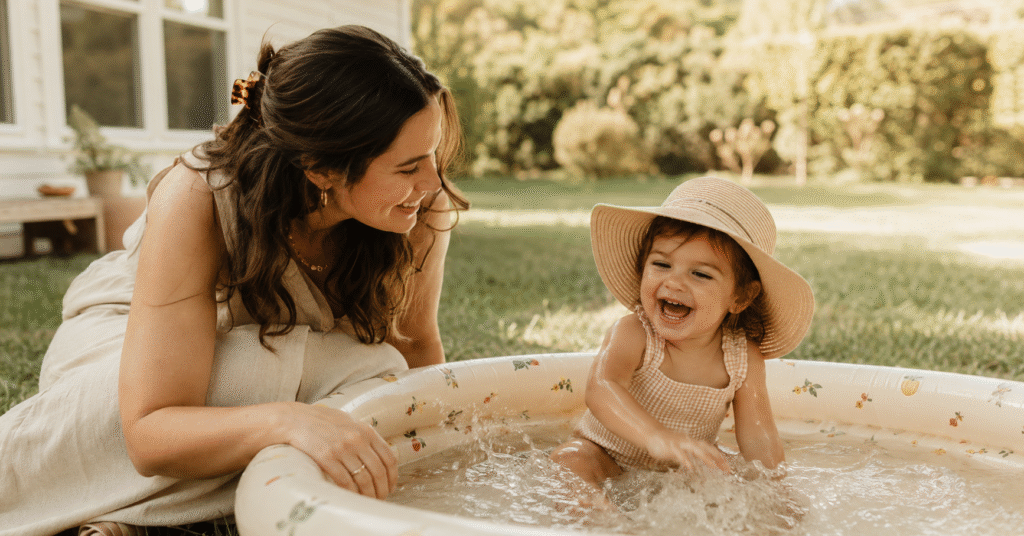
There’s a specific kind of summer afternoon that only a kiddie pool can fix. It’s 90 degrees out, the nap didn’t take, and someone is puddled on the kitchen floor in protest of, as far as I can tell, the concept of Tuesday. Fifteen minutes of splashing in six inches of water later, and everyone is a functioning member of the household again. After three kids and roughly a decade of backyard summers, I’ve come to think of the humble inflatable pool as one of the highest returns on investment in all of parenting.
But “inflatable kiddie pool” covers a lot of ground, from a $13 ring you blow up by mouth to a $50 dino-themed splash center with its own slide. For this guide I leaned on what I do best: a lot of cross-referencing. I worked through current Amazon listings, sorted by real ratings and sales rather than sponsored placement, pulled manufacturer specs straight from the source, and read independent parent reviews and CPSC and AAP water-safety guidance to separate the little pools worth owning from the ones that spring a leak by the Fourth of July.
Below are the five that earned a spot, each matched to the kind of kid and yard it actually suits. (A quick, important note before we splash in: none of these pools is a substitute for your eyes. More on that below, because with water it really, really matters.)
At a glance: the 5 best inflatable kiddie pools
| Pool | Best for | Size & ages | Ballpark price |
|---|---|---|---|
| Intex Sunset Glow Baby Pool | Overall pick / first pool | 34″×10″, ages 1–3 | ~$13 |
| Grip A Pool 48″×12″ | Roomier soft-floor pool & ball pit | 48″×12″, ages 2–5 | ~$22 |
| Sloosh Crab Splash Pool | Sun protection / shade | ~34″×39.5″, ages 3+ | ~$26 |
| Intex Dino Park Play Center | Bigger kids who want a slide | 79″×62″×27″, ages 3+ | ~$53 |
| Sloosh Whale 3-Ring Pool | Budget / grab-and-go | 34″×10″, toddlers | ~$15 |
What matters when you’re choosing one
A few things separate a pool you’ll re-buy next year from one you’ll quietly retire to the garage:
Depth and a soft floor. For babies and new sitters, a cushioned inflatable bottom is the whole game — it gives a wobbly little one something forgiving to land on and takes the chill off the ground. Hard-plastic pools are sturdier, but for the under-3 set I’ll take a padded inflatable floor every time.
Drainage. A built-in drain plug sounds like a small thing until you’re flipping a full pool over your head trying to empty it before dinner. Get the plug.
Shade. Pale little shoulders plus midday sun is a fast road to a miserable evening. Either buy a pool with a canopy or commit to setting up in shade and reapplying sunscreen.
Age fit. A 34-inch ring is perfect for a one-year-old and boring by four. A slide-and-sprayer center is a blast for a four-year-old and way too much pool for a baby. Buy for the kid you have this summer.
And one unglamorous tip: buy a cheap electric pump. Inflating these by mouth is a workout nobody signed up for, and the pump is the one summer chore my husband and I happily trade off.
One quick reality check from the pediatric side: the inflatable ring itself, and any floaties that go in it, are toys, not safety devices. They can deflate, and the AAP is explicit that they don’t prevent drowning. The pool keeps your kiddo happy; you keep your kiddo safe.
The 5 best inflatable kiddie pools
Best Overall
1. Intex Sunset Glow Baby Pool
If you want one pool that just works and costs about the same as a fancy coffee, this is the one I’d point a new parent toward. It’s the classic three-ring shape with a soft inflatable floor, and it has the kind of track record you can’t fake — tens of thousands of reviews and a steady 4.6-star average, which is rare air in a category full of one-summer wonders.
It’s small on purpose: roughly 34 inches across with about six inches of water, which is exactly the cozy, contained puddle a one- or two-year-old wants. A couple of honest caveats from the review pile: the air valves can be a bit stubborn to inflate, and a few parents feel it runs small (it does — that’s the point, but go in knowing). A repair patch is included for the inevitable driveway encounter with a stray rock.
Best Roomier Soft-Floor Pool
2. Grip A Pool 48″×12″ Cushioned Kiddie Pool
When my youngest graduated from “sits in a puddle” to “needs room to actually splash,” the 34-inch pools started feeling like a kitchen sink. This one is the sweet spot up from there: at 48 inches wide and 12 inches deep, it’s noticeably bigger and deeper than the standard baby pools, but still shallow enough to feel safe for a two- or three-year-old. It’s built on a sturdy three-ring design with a cushioned, anti-slip inflatable floor and an easy drain plug, and the sea-creature print is a hit.
Across reviews the recurring note is comfort — the padded bottom earns its keep for families without grass — and it doubles neatly as an indoor ball pit when the weather turns. Just set expectations on capacity: it’s roomy for one toddler, cozy for two. If you’re hoping to fit a backyard’s worth of cousins, you want the Dino Park further down.
Best for Sun Protection
3. Sloosh Crab Splash Pool with Canopy
If your shade situation is “the one tree, until 1 p.m.,” a pool with its own roof solves a real problem. This crab-shaped splash pool pairs a shallow wading base with a removable canopy that takes the worst of the midday sun off little heads, plus a built-in crab sprinkler you connect to a garden hose for the squealing-with-delight factor. The canopy has a back window, which sounds gimmicky until you realize it lets you keep eyes on your kid from behind. Heavy-duty PVC and a UV-fade-resistant top mean it should hold up across a couple of summers, and the whole thing folds down for storage.
This one skews younger and more “splash” than “swim” — it’s a shallow play setup, not a deep soak — so think babies and younger toddlers cooling off rather than older kids who want to fully sit in water. A canopy is a helpful layer, not a substitute for sunscreen and supervision.
Best for Bigger Kids
4. Intex Dino Park Inflatable Play Center
This is the one my older boys would lobby for. The Dino Park is a full play center rather than a simple pool: a wading area, a small water slide with a soft landing mat, a dinosaur sprayer that hooks to your hose, a ring-toss hoop, and a ball wall with six balls included. It’s the closest thing to a backyard water park you can deflate and stuff in a closet by September, and it has the Intex name behind it, which counts for something on durability.
It’s a different animal from the baby pools above — bigger footprint (you’ll want about 7 feet of clear yard), a real setup, and best enjoyed by the three-and-up crowd who can use the slide. For a houseful of preschoolers on a hot afternoon, it’s worth every penny. For a single one-year-old, it’s a lot of pool. A drain plug keeps cleanup sane.
Best Budget Pick
5. Sloosh Whale 3-Ring Kiddie Pool
If you want a second pool for the front yard, a spare for grandma’s house, or just the lowest-stakes way to test whether your kid is even into this whole water thing, the Sloosh whale is hard to beat. It’s the familiar 34-inch three-ring design with a cheerful ocean print, a solid 4.6-star average across hundreds of reviews, and a price that won’t sting if it lives a hard life. Sloosh notes it’s non-toxic and BPA-free and meets U.S. toy standards.
The one thing to know going in: no pump is included, so factor in a cheap manual or electric one unless you have lungs of steel. Like all these small rings, it pulls double duty as a ball pit or even a dog cool-down station on the hottest days.
The part I’d never skip: kiddie pool water safety
I know, I know — you came for pool recommendations, not a lecture. But this is the section I’d beg you to read, because the statistics on small children and water are genuinely sobering, and a kiddie pool is exactly the kind of “harmless” water that gets underestimated.
Drowning is the leading cause of injury-related death for children ages 1 to 4, and the children at highest risk are roughly 12 to 36 months old — prime kiddie-pool age. The hardest part to wrap your head around is how it happens: drowning is usually silent and takes less than a minute, with no splashing or shouting to alert you. And it doesn’t take a deep pool — a child can drown in one to two inches of water. The American Academy of Pediatrics has found that most drownings in kids under four happen during non-swim times, when no one expected the child to be near water at all.
What that means for a backyard pool, in plain terms:
Supervise within arm’s reach, always. While there’s water in the pool, an adult who can swim should be close enough to touch your child — phone down, conversation paused. Don’t rely on an older sibling to “watch” the baby.
Empty it after every single use. This is the big one for kiddie pools specifically. The AAP and CDC both call out emptying wading pools (and buckets, and bathtubs) immediately after use, then flipping the pool over so it can’t collect rainwater. A forgotten half-full pool is one of the exact hazards that catches families off guard.
Put it away so it doesn’t lure them back. Store the empty pool out of sight, and keep water toys out of the yard when not in use — they’re magnets that draw curious toddlers back to where the water was.
Treat floaties as toys, not safety gear. Inflatable rings, water wings, and the pool itself can deflate and do not prevent drowning. Real layers of protection are barriers, supervision, and (for pools that warrant it) swim skills.
For the full, authoritative picture, these are the two resources I keep bookmarked: the AAP’s water safety guide for young children on HealthyChildren.org, and the CDC’s drowning prevention page. Five minutes there is the best thing you’ll do for your kid’s summer. (If you want short, shareable explainers for a partner or sitter, the AAP’s drowning-prevention toolkit has good ones.)
Keeping the water clean (and your sanity)
Standing water gets gross faster than you’d think — warm, shallow, and sitting in the sun is basically a science-fair invitation. A few habits that keep a kiddie pool pleasant:
Empty and rinse it daily (which, conveniently, is also the safety move). Wipe it down before it dries so you’re not scrubbing a film off later. Fill fresh each session rather than topping off yesterday’s water, and if you’re filling straight from a cold hose, give it some time in the sun to take the edge off before a baby gets in. A good reusable swim diaper keeps the water more sanitary than you’d expect, too. When summer’s over, dry it completely before folding — packing away a damp pool is how you discover mildew next May.
Pair the pool with a good wide-brim hat and broad-spectrum sunscreen and you’ve got the whole kit. (If you’re still sorting out sun gear, our picks for kids’ sun hats with chin straps and UPF 50+ toddler rash guards cover the basics.) And if your little one is more into scooping and pouring than full-on swimming, a toddler water table scratches the same itch with even less water to keep an eye on.
Frequently asked questions
What’s the best age for an inflatable kiddie pool?
The small 34-inch ring pools (picks 1 and 5) are ideal from about age one through three. Roomier soft-floor pools (pick 2) stretch to about five, and the slide-style play center (pick 4) is built for the three-and-up crowd. There’s no pool that’s safe to use without an adult present, at any age.
How much water does a kiddie pool need?
Less than you’d guess — a few inches is plenty for a baby or toddler, and more isn’t better here. The Intex Sunset Glow, for example, holds about 15 gallons at full fill, but you’ll often want even less for the littlest ones. Shallower is both safer and faster to empty and refill.
Inflatable or hard plastic — which is better?
For babies and new sitters, inflatable wins on comfort: the cushioned floor and soft sides are gentler on tumbles. Hard-plastic pools are more durable and don’t need inflating, so they’re a fine choice once your kid is steadier on their feet and you’re tired of the pump. Plenty of families end up owning one of each.
How do I keep the water from getting dirty?
Empty it after every use, rinse and dry it, and fill fresh next time. Don’t let water sit overnight — it’s both a hygiene and a safety issue. For a kiddie pool this size, daily dumping is simpler (and cheaper) than any treatment.