Last month my older son had a meltdown because his banana broke in half. Not broke as in fell on the floor — broke as in I peeled it and it snapped, which apparently was a betrayal of everything he holds dear. He’s three. This is his job right now.
After ten years of parenting three kids, I’ve made peace with the fact that big feelings are not a problem to fix. Toddlers melt down because they genuinely don’t have the skills yet to handle emotions that big: the wanting, the frustration, the tiredness all arrive at once and their little systems get overwhelmed. What has changed in our house is that we now have a small toolkit of things that help my kids find their way back to calm faster. Not magic wands. Tools.
One honest thing before we start: no object replaces you. Young kids calm down by borrowing our calm first. The experts call it co-regulation, and I call it “sitting on the kitchen floor breathing slowly while someone screams about a banana.” The tools below work best alongside a calm grown-up, not instead of one. My husband and I both keep a couple of these in rotation, and honestly he’s better at the breathing ball than I am.
How I picked these
I went down a deep research rabbit hole for this one — digging through manufacturer specs, safety labels, and a few hundred parent and teacher reviews — and I filtered everything through four rules:
- Quiet. A calming tool that beeps or sings is not a calming tool. It’s a new problem.
- Screen-free. Screens can distract a child out of a meltdown, but they don’t teach the settling part.
- Toddler-proof-ish. Everything here can survive being thrown at least once, because it will be.
- Age-checked. I cross-checked every manufacturer’s age label against how these actually get used at 2, 3, and 6 years old — and I’ll flag the fine print as we go, because some of it surprised me.
I’ve grouped the eight picks into five buckets, because different kids (and different moods) need different kinds of input. My three each gravitate to a completely different bucket, which tells you everything.
1. For kids who chew everything: ARK’s Grabber
If your kiddo chews shirt collars, sleeves, or their own knuckles when they’re stressed, they’re not being weird — chewing gives the jaw deep, steady input that many kids find genuinely grounding. The trick is redirecting it to something safe.
The ARK Grabber is the one tool in this roundup that comes straight from the therapy world: it was invented by a speech-language pathologist, and it’s made in ARK’s own factory in South Carolina from medical-grade material (no lead, phthalates, PVC, BPA, or latex). The P-shape has a loop that’s easy for small hands to hold and a long stem that reaches all the way back to the molars, where kids actually do their serious chewing.
Here’s the detail that sold me during my research: it comes in three color-coded toughness levels: Standard (soft), XT (medium), and XXT (very firm). ARK themselves recommend starting with the softest level and only moving up if your child chews through it. That’s exactly the kind of graded system I wish more kid products had.
Keep in mind: it’s sold as a single piece and isn’t the cheapest chew out there, and heavy chewers can work through the soft level in a few weeks. Also, it looks like a therapy tool rather than a toy — some kids couldn’t care less, some need you to introduce it playfully.
2. For busy hands: two quiet fidgets that earn their keep
Tangle Jr. Classic
My daughter is six, and waiting is her personal mountain to climb. Doctor’s offices, restaurants, her brothers’ everything. Her hands need a job or her patience evaporates. The Tangle Jr. is what lives in my bag for exactly those moments.
It’s eighteen little curved segments that twist endlessly in any direction — no beginning, no end, and crucially, no sound. This thing has been around for over forty years and teachers still hand them out, which is about the strongest endorsement a fidget can get. It’s palm-sized (about 2 inches coiled, 7 inches stretched out), fits in any coat pocket, and gives restless fingers something smooth and repetitive to do while the rest of the kid settles.
Keep in mind: the segments snap apart — that’s part of the design — which makes it a choking hazard under 3 and means a determined kid can disassemble it and lose a piece under the couch. Ask me how I know. Colors in the multi-packs are also random, so if your child has Opinions about pink, brace yourself.
IMPRESA Monkey Noodles
Some kids don’t need something delicate to twiddle — they need to pull. When my sons are wound up, their whole bodies are in it, and a stretchy Monkey Noodle gives all that arm energy somewhere to go. These stretch from about 12 inches to a frankly ridiculous 8 feet and snap back to shape, and the pack of five means there’s one in the car, one in the diaper bag, and three temporarily missing.
They’re made of a soft, hypoallergenic material that’s free of BPA, phthalates, and latex, and they hit a nice price point for something that works this hard. Pulling something with real resistance is weirdly satisfying (I’ve caught my husband with one during work calls).
Keep in mind: they’re lint and pet-hair magnets, and after months of enthusiastic stretching they do slowly lose their bounce. At this price, I consider them semi-consumable.
3. For wiggly bodies at the table: Harkla Weighted Lap Pad
Gentle, steady weight on the lap is one of those things that sounds like it shouldn’t work until you watch it work. Many kids find that a bit of weight helps them feel settled and anchored when they have to sit — think dinner, long car rides, or listening to a story when their body would rather be doing laps around the sofa.
The Harkla weighted lap pad is the one I’d pick out of the dozens on Amazon, for boring-but-important reasons: it’s a two-piece duvet design, so the soft minky dotted cover comes off and goes in the washing machine (glass-bead-weighted things and washing machines are otherwise not friends). The weight is distributed in an inner insert with ties so it doesn’t all slump to one corner. It’s 18 by 21 inches, sized to lie flat across a lap without sliding off, and Harkla is a small US company with a lifetime guarantee they actually honor, according to a long trail of reviews.
The dotted minky texture is a quiet bonus: little fingers trace the bumps while the weight does its thing, so fidgety hands and wiggly body get handled in one go.
Keep in mind: this is the priciest thing in the roundup, and it’s a lap tool, not a blanket — if your child tries to nap under it, it goes back on the shelf. Harkla also makes the same idea in a 5-lb puppy shape if your kid is more likely to accept a “heavy dog friend” than a “special mat.”
4. For the snuggle-it-out kids: Warmies 13″ Plush
Not every big-feelings moment needs a clever gadget. Sometimes a kid just needs something warm and heavy-ish to hold against their chest while they put themselves back together. That’s the entire job description of a Warmies, and it does that job absurdly well.
It looks like a regular 13-inch stuffed animal, but it’s filled with flaxseed grain and real dried French lavender, which gives it a gentle heft (around 2 lbs) and a soft scent. The party trick: you warm it in the microwave for up to 90 seconds and it holds cozy warmth for a long stretch, or you can chill it in a freezer bag for a cool version in summer. Warmies has been making heatable plush for over 30 years, so this isn’t some untested novelty with a heating element; it’s grain in a toy, done carefully.
In our house the Warmies comes out after the meltdown peak. It’s the recovery tool, the thing that turns the last ten minutes of sniffles into quiet couch time. The weight is modest enough for even younger toddlers to carry around themselves, which is exactly why I picked it over the heavier weighted plushies in this category.
Keep in mind: grain filling means no washing machine, ever. Surface cleaning only, so maybe don’t bring it to spaghetti night. And lavender is polarizing: most kids love it, a few wrinkle their noses.
5. For eyes and lungs: three visual calm-down tools
This last bucket works on a simple idea: give an overwhelmed kid one slow, predictable thing to look at (or breathe with), and their body often follows it down. These are the backbone of our calm-down corner. And if the meltdowns themselves are what’s wearing you down, our gentle guide to handling toddler tantrums calmly pairs perfectly with this toolkit.
Hoberman Mini Sphere — the breathing ball
Telling a furious three-year-old to “take a deep breath” works approximately never. Showing them a colorful ball that grows when you breathe in and shrinks when you breathe out? That works often enough to feel like cheating.
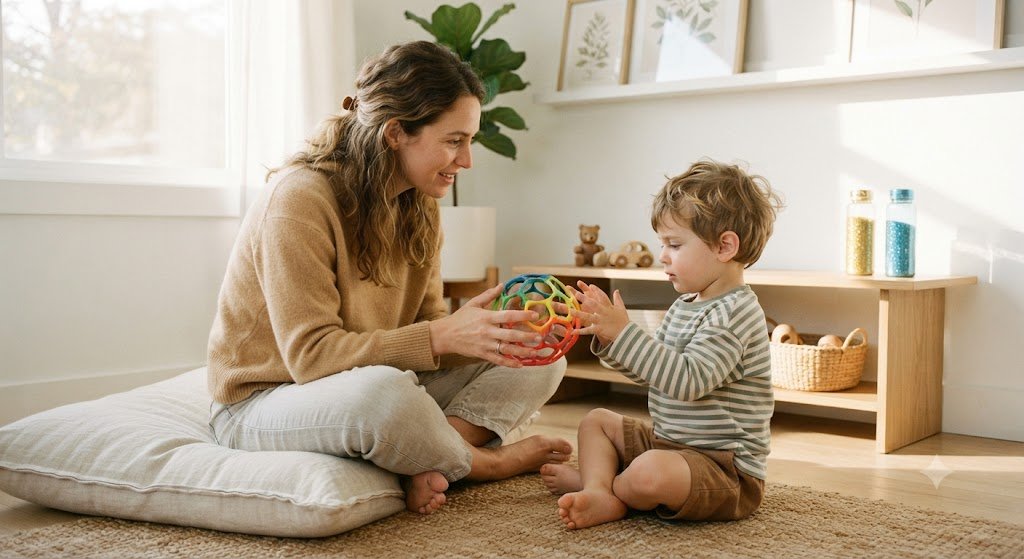
The Hoberman Mini Sphere is a lattice of colorful linked struts that expands from about 5.5 inches to a full 12 inches and folds back down. Preschool teachers and family therapists have used it as a breathing prop for years: you open the ball slowly and everyone breathes in; you close it and everyone breathes out. It makes an invisible skill visible, which is exactly what little kids need. My daughter now grabs it herself when she’s frustrated, which the first time it happened nearly made me cry into the laundry.
Keep in mind: the brand labels it 4+, and mid-meltdown is not the moment to hand it over: the struts can snap if a raging kid decides to fold it the wrong way with feeling. It’s a grown-up-led ritual first, an independent tool later.
Playlearn Liquid Motion Timers
Flip one of these liquid timers over and colorful droplets drift slowly down through the shape for about a minute. That’s it. That’s the product. And yet every child (and most adults) who picks one up goes quiet and just… watches.
This three-pack comes in different shapes (a double heart, a spiral, an oval), each about 5.5 inches and made from shatter-resistant acrylic, fully sealed. The one-minute run time is secretly the best feature: “we leave when the bubbles finish” turns an abstract wait into something a toddler can literally see ending. We use one for tooth-brushing standoffs and the “I don’t WANT to leave grandma’s” transition.
Keep in mind: it’s a vibe timer, not an accurate one, so don’t build your morning schedule on it. Acrylic is tough but not invincible on tile floors, and some kids get so into flipping it that the timer becomes the new negotiation. Pick your battles.
Special Supplies Light-Up Glitter Sensory Tubes
The classic Pinterest move is DIY-ing a glitter jar out of a water bottle and glue. I’ve done it. It leaked. Twice. This four-pack of sealed glitter tubes is the version where the swirling stays inside the bottle.
Each BPA-free tube is fully sealed and leakproof, filled with slow-falling glitter, and, the kid-magnet feature, has a little switch that lights the whole thing up in shifting colors. The ritual writes itself: shake the tube as hard as the mad feeling is, then watch the glitter slowly settle while your body settles with it. It gives an overwhelmed kid something to do with the feeling that isn’t hitting a sibling, and my sons treat the shake itself as half the therapy.
Keep in mind: the light is battery-powered, so check that the compartment stays screwed tight and keep an eye on it like you would with any battery toy. Sealed also means sealed: you can’t refill or customize them like a DIY jar.
How to actually use these (the part that matters)
A drawer full of calming tools does nothing on its own. Three things I’ve learned the sweaty way:
- Introduce tools during calm, happy times. A brand-new object mid-meltdown is just another overwhelming thing. Let your little one play with the breathing ball or glitter tube when everyone’s regulated and cheerful, so it’s already a friend when the storm hits.
- You go first. Kids borrow our calm. Shake the glitter tube yourself and narrate: “Wow, I’m feeling frustrated. I’m going to watch the sparkles slow down.” Feels silly. Works.
- Offer, don’t force. Mid-meltdown, hold the tool out quietly or set it nearby. Shoving a Tangle into clenched fists escalates things — and honestly, fair enough.
One more tip if your child is in daycare or preschool: ask their teacher what’s already working in the classroom. Many programs have a cozy corner or a fidget basket, and using the same tool at home and at school makes it click twice as fast for your kiddo.
Keeping most of these in one predictable spot — a basket, a shelf, a cozy corner — helps kids learn to go get what they need. Pair the corner with a few low-key ideas from our 30 screen-free toddler activities roundup and you’ve got a genuinely useful reset spot instead of a pile of stuff.
Quick safety recap
FAQ
What age are calm down tools for?
Most tools here carry a 3+ label because of small or separating parts, and the sweet spot for independent use is roughly 2.5 to 6. Under two, you are the calm-down tool — closeness, a quiet voice, and slow breathing do more than any product can. The Warmies is the one pick that works across the widest range, since it’s just a (supervised, adult-heated) plush.
Do these stop tantrums?
No, and anything promising that is selling you something. Tantrums are a normal, healthy part of how toddlers develop. What these tools do is give a child a bridge back to calm (something to chew, squeeze, watch, or breathe with while the wave passes) and give you an alternative to standing there negotiating with a tiny furious person about banana structural integrity.
Which one should I start with if I only buy one?
Match the kid. A chewer gets the Grabber. A puller and thrower gets Monkey Noodles. A watcher gets the glitter tubes. If you truly have no idea, the Hoberman breathing ball is my pick: it’s inexpensive, it teaches a skill your child keeps forever, and the whole family can use it. Yes, including the grown-up who yelled about the Legos on the stairs. Hypothetically.
One last note from one parent to another: every kid has big feelings, and a rough patch of meltdowns is usually just that: a patch. If your gut ever tells you your child’s struggles feel bigger, longer, or harder than what you’re reading about here, a chat with your pediatrician is always a good idea. That’s not defeat; that’s just using the best tool in the box.