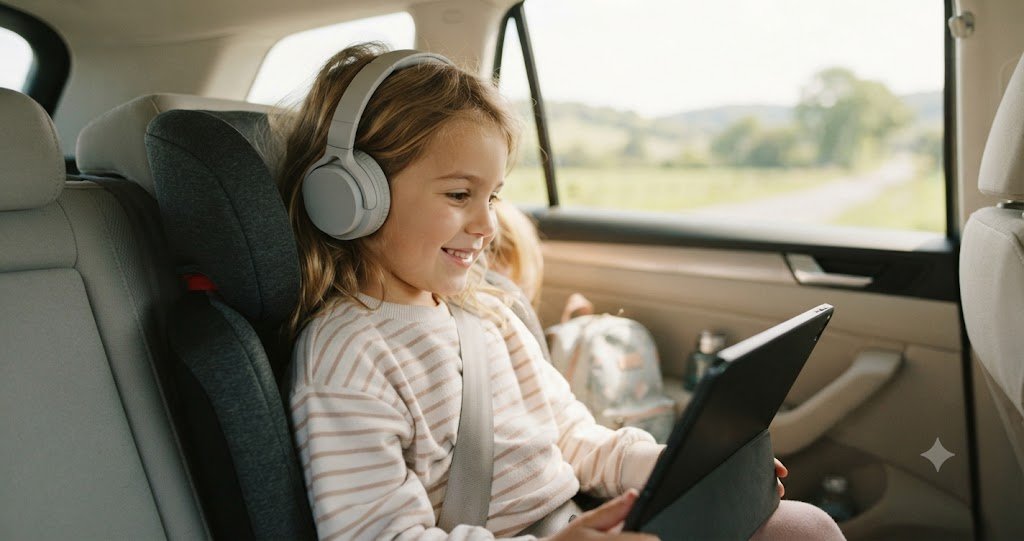
The first time it really hit me was somewhere over the middle of a very long flight. My daughter had her tablet, her show, and a pair of headphones she’d begged for, and she looked completely content. Then I leaned over to grab her cup, put my ear near hers, and I could hear her cartoon crisply from a foot away, right over the roar of the plane. That’s the moment most of us have. The headphones looked safe. The box said “85dB.” And the volume was still climbing, because the engine noise kept swallowing the sound and she kept nudging it up to hear.
After ten-plus years of raising three kids, and buying, returning, and side-eyeing more pairs of little headphones than I care to count, I’ve landed somewhere simple: volume-limited headphones are worth buying, but the “85dB = totally safe” story printed on nearly every box is doing a lot of quiet lying. So this guide does two things. It gives you picks I’d actually feel good handing a parent, sorted by how you’ll really use them. And it tells you the part the marketing skips, because that part matters more than which pair you choose.
What “85dB” actually means (and what it doesn’t)
The thing almost no product page explains: 85 decibels isn’t a magic “safe for kids” number. It’s borrowed from the workplace. The U.S. National Institute for Occupational Safety and Health (NIOSH) uses 85 dBA over an 8-hour shift as its reference exposure limit, a ceiling built for adult factory workers, not toddlers on iPads. OSHA’s legal limit is actually higher, at 90 dBA. So when a headphone brand calls 85dB “the safe level,” what they really mean is “the level a grown-up can tolerate for a full workday.” That is not the same promise.
For children it’s murkier, in a useful way once you know it. Kids’ ears keep developing into the late teens, their ear canals are smaller (which nudges the internal pressure up), and any damage compounds over a much longer life. Reviewing the evidence, the World Health Organization leans lower: it says you can safely listen at about 80dB for roughly 40 hours a week, and every few decibels up cuts that budget hard. At 90dB you’re down to about four hours a week. Hearing-health guidance commonly points parents toward keeping kids around 75dB, or about 60% of a device’s maximum volume.
None of this is meant to scare you off headphones. It’s context. Once you understand that 85dB is a generous ceiling and not a target, the rest of the shopping decision gets a lot clearer.
The uncomfortable truth about “volume-limited”
Now for the part that made me rethink my whole approach. When independent testers actually measured these headphones instead of trusting the label, the labels didn’t hold up.
The NIH’s own hearing-health project, It’s a Noisy Planet, summarized a well-known round of lab testing: up to a third of the kids’ headphones tested went past 85dB, and with music playing, nearly half exceeded it, sometimes by a wide margin. Testers could also defeat the volume limiter on many of them. A separate audio-lab teardown found the same pattern with a twist. Over a plain wired connection to a powerful source like a laptop, most “limited” headphones sailed right past their rated cap, while the same headphones behaved better over Bluetooth, because the amplifier is built in and easier to cap.
My favorite tell, honestly, is buried in the manuals themselves. One popular pair’s own instruction booklet quietly admits that even its 85dB setting comes with a roughly one-hour guideline, and recommends adult supervision. When the company selling you the safety feature is telling you the safety feature has a timer, believe them.
So here’s the mindset I want you to walk away with, and it’s the backbone of every pick below: volume-limited headphones are a tool, not a solution. A good pair lowers the ceiling and makes your job easier. It does not do your job for you. That’s why the last section of this guide, the three habits, is the one I’d tape to the fridge.
What actually matters when you’re buying
This is the checklist I used to narrow the field. If you only remember four things, remember these.
1. A real cap vs. a “defeat” switch. A lot of pairs advertise “85/94dB,” meaning two modes. The 85 mode is the safe one. The 94 mode, usually sold as “outdoor” or “travel,” quietly undoes the whole point. Having the higher mode isn’t evil (planes are genuinely loud), but know it’s there, keep it locked to 85 for everyday use, and treat 94 as a rare exception. A single fixed cap that can’t be bumped up is, in some ways, the more honest design.
2. Wired vs. Bluetooth. This one surprised me. Plain wired headphones can blow past their rated limit when plugged into a strong source like a laptop or tablet, the very devices your kid uses. Bluetooth pairs tend to hold their cap more consistently. The trade-off: wired never needs charging and never dies mid-flight; Bluetooth is tidier and travels better but needs juice. No universal winner, just the right pick for your situation.
3. Fit and age. Over-ear cups suit smaller heads and younger kids; on-ear pairs are lighter and fine for bigger kids. For a two- or three-year-old, look for a pair actually rated for that age and, ideally, a lower cap (some are built around 75 to 80dB).
4. The extras that earn their keep. A built-in mic if there’s any online class or video-calling in your life. A foldable build and adjustable headband so it survives a backpack. Non-toxic materials (BPA/PVC-free) for the age that still chews on things. Active noise cancelling matters specifically for travel, and I’ll explain why below.
The picks
A note on how I chose these: every pair here clears a basic quality bar. Strong, consistent ratings, a real track record of sales, in-stock and shipping now, and a genuine volume-limiting spec (not just the words on the box). I haven’t personally lived with every model, so where I’m leaning on specs and the weight of reviews rather than my own kitchen-table testing, I’ve said so plainly. Prices below are ballpark and drift with sales, so treat them as ranges.
Best Overall
JoySpark Kids Bluetooth Headphones
If I had to hand one pair to a typical family, this is the shape I’d reach for: over-ear, Bluetooth, a built-in mic for the occasional class call, and a genuinely long battery (rated around 60 hours, so charging is an occasional chore rather than a nightly one). It also keeps a 3.5mm cable in the box for when the battery finally does run flat, a small thing that saves a lot of backseat meltdowns. The volume runs in the familiar 85/94dB two-mode setup.
The honest caveat: that second 94dB mode is exactly the defeat switch I warned about, so keep it in 85 mode for daily use. And a scattering of reviews mention a unit going one-sided early, so buy somewhere with easy returns.
Best for Travel
iClever BTH20 Active Noise Cancelling Headphones
Remember my airplane story? This is the pair built to solve it. Real active noise cancelling is rare in kids’ headphones under $100, and this is one of the few that does it well. The counterintuitive magic: by canceling the low drone of an engine or a car, ANC lets your kid hear their show at a lower volume, since the noise is what drives the volume creep in the first place. It’s also capped lower than most, at 80dBA, and reviewers consistently praise how much abuse it survives. Battery is roughly 60 hours with ANC off, about 35 with it on.
The honest caveat: the noise cancelling only works over Bluetooth. Plug in the wired cable and the ANC switches off. For most modern tablets that’s a non-issue, but worth knowing before you pack.
Best for Toddlers & Preschoolers
iClever BTH27 Toddler Headphones
For the littlest listeners I’d want two things above all: a lower cap and proof someone thought about safety. This pair is rated for 2+, is CPC certified, and uses BPA-free materials, and it’s built around a 75/80dB limit rather than 85, which is right where you want a preschooler. Over-ear, foldable, long battery, with an aux cord included. When my boys were this age, the hard part was never sound quality; it was durability and a cap I didn’t have to second-guess, and this pair is built for exactly that.
The honest caveat: it’s newer than the others here with a shorter review history, and you pay a small premium for the toddler-specific design. Confirm the current price and exact in-box accessories on the listing before you buy.
Best Budget
New Bee KH20 Wired Kids Headphones
Sometimes you just need a solid, cheap, no-battery pair: for the school supply list, for a spare in the car, for the kid who loses things. Wired means nothing to charge and nothing to die. This one has a built-in mic for class, a braided cord that resists tangling, a stainless-steel slider that survives being sat on, and it ships with temporary tattoos, which is the kind of detail that buys you roughly three weeks of goodwill. Non-toxic materials, ages 4 to 16. It’s also exactly the kind of pair a lot of classrooms ask for by name on the supply list: wired, simple, and easy to label with your child’s name.
The honest caveat: because it’s wired, this is the pair most likely to exceed its printed cap on a high-powered laptop, so this is where the volume habits below matter most. It also has no audio-sharing port, so two kids can’t split one tablet from it. And keep it in 85 mode, not 94.
Best for the Fun Factor
gorsun Cat-Ear Wired Kids Headphones
Never underestimate what a pair of snap-on cat ears will do for a three-year-old’s willingness to wear headphones at all. Beyond the cute, there’s a genuinely nice safety point: this pair uses a single fixed cap under 85dB. No 94dB outdoor mode to accidentally leave on, no switch to defeat. It’s the honest-design example from earlier, wearing cat ears. Over-ear, foldable, well-padded, and about the price of a couple of coffees.
The honest caveat: there’s no microphone, so it’s for watching and listening, not online classes or video calls. And the cat ears are pure decoration, not, sadly, extra hearing protection.
The three habits that matter more than the headphones
This is the part I’d keep even if you bought the fanciest pair on the market. Because, say it with me, the headphones are a tool, not a solution.
The 60/60 rule. Keep the volume at 60% or below, cap a single stretch at about 60 minutes, then take a break of 10 to 15 minutes. This is the one pediatric audiologists repeat, and it works no matter what the headphones claim, because it protects the two things you actually control: loudness and time.
Watch the clock, not just the dial. The WHO frames safe listening as a weekly budget, not a moment-to-moment level, and it specifically flags all-day online classes as a real exposure risk. Breaks aren’t only for hearing, either; they help eyes and moods too. A ten-minute pause every hour is plenty.
Do the arm’s-length test. Put the headphones on yourself now and then, or hold them at arm’s length while they’re playing. If you can clearly make out the words from there, it’s too loud, full stop, no matter what the box promised. Ten seconds, no app required.
Signs to watch for, and when to get ears checked
Volume-limited headphones lower the odds, they don’t erase them, so it helps to know the early tells. Check in with your pediatrician if your child often asks “what?”, turns things up past where you’d expect, tugs or rubs at their ears, or seems to struggle to follow speech when there’s background noise. Ringing in the ears after a loud stretch is another flag. It’s also worth building in routine checks: many schools screen hearing in the early grades, and having a baseline on record makes any later change much easier to catch. None of this is cause for alarm on its own. It’s just the kind of quiet attention that catches small problems while they’re still small.
Grab the free Safe Screen-Time & Device Setup guide
A one-page cheat sheet: the exact volume-limit settings to flip on for iPad, Android, and Fire tablets, the 60/60 rule on a fridge-ready card, and a quick pre-trip checklist. Pop in your email and I’ll send it over.
Making headphones work for travel & tablet time
Most of the hardest headphone moments happen on the move, so a few specifics for the road and the sky:
- Set the limit on the device, too. Belt and suspenders. Every iPad, Android tablet, and Fire tablet has a built-in maximum-volume setting. My husband and I made it a rule that whoever packs the bag flips it on before we leave, so the cap never rides on the headphones alone.
- Download before you leave. Offline shows mean no scramble for airplane wifi, and, more importantly, no jump to a blaring auto-play ad after a quiet episode.
- For siblings, plan the split. If two kids want one screen, you’ll want a pair with a sharing port or a simple headphone splitter. Most of the wired options above don’t share on their own.
- Think past the headphones, too. A good travel setup is really about the whole kit. If you’ve got a long drive coming up, here’s the road-trip gear and logistics that actually matter once the headphones are sorted.
Frequently asked questions
Wired or Bluetooth, which is safer for hearing?
Slightly counterintuitively, Bluetooth pairs tend to hold their volume cap more reliably, because the amplifier is built in. Plain wired headphones can exceed their rated limit on a powerful source like a laptop. Bluetooth’s downside is simply that it needs charging. Neither is “unsafe” if you also manage volume and time.
Does active noise cancelling hurt a child’s ears?
ANC is an audio feature, not a hearing-protection rating. Unless a product carries an NRR, do not treat it as hearing protection, and keep managing playback volume and listening time. For concerts or other loud settings, our baby ear protection guide explains the difference between protective earmuffs and audio headphones.
What age can a child start using headphones?
Many volume-limited pairs are rated from age 2 or 3. For that age, choose a pair actually built for toddlers, ideally with a lower cap (75 to 80dB), and keep sessions short. Under two, most experts favor speakers over headphones.
Are the “94dB” modes safe?
Treat 94dB as an occasional, genuinely-loud-environment setting: a plane, not the living room. For everyday use, keep the headphones in their 85dB mode, or pick a pair with a single fixed cap so there’s nothing to switch.