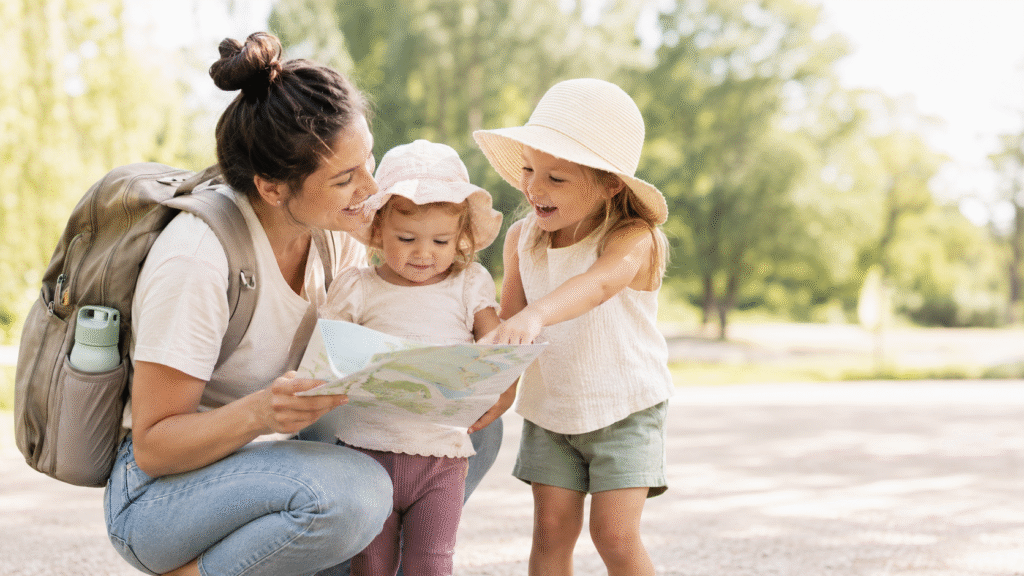
There is a specific kind of confidence that comes from being two hours from home, in a parking lot, with three kids, and realizing you packed exactly enough for a ninety-minute errand. I have felt that confidence drain out of my body in real time. It usually happens somewhere between the youngest needing a diaper change and the oldest announcing she has to pee right now, while the middle one quietly tips his entire snack onto the floor of the car.
A two-hour outing and an eight-hour outing are not the same activity scaled up. They are different sports. A short trip forgives almost anything; you can always just go home. But a full day out (the zoo, a theme park, a beach day, a road trip to see family, or one of those Saturdays that starts as “a quick Target run” and somehow becomes a nine-hour odyssey) punishes every gap in your bag. Miss a meal, run out of water, or get caught without a backup outfit after a blowout, and you are not having a fun day anymore. You are managing a crisis in a stranger’s bathroom.
After enough of those days with a six-year-old, a three-year-old, and an eighteen-month-old in tow, I stopped packing by vibes and started packing by systems. Instead of asking “what do I need,” I ask “what jobs does this day require.” Feeding. Diapering and potty. Sun and weather. Comfort. Entertainment. Cleanup. Each system gets a couple of reliable workhorses, and the rest goes on a checklist so I am not relying on memory at 6 a.m. Here is the kit, system by system.
First, the rule that makes the whole thing work
One bag, organized by system, beats three bags organized by panic. When everything has a home (bottles in the insulated pocket, diapers in one zip, the “uh oh” outfits in another), you can grab what you need one-handed while the other hand is occupied with a small person trying to launch themselves off a curb. The goal is not to carry more. It is to carry the right things in a way you can actually find them.
System 1: The bag itself
For a full day, a backpack-style diaper bag wins over a tote every time, for the boring reason that you need both hands free more or less constantly. The best ones for long days have insulated bottle pockets (so milk or cold water survives the afternoon), a wide opening so you are not excavating, and a way to attach to a stroller.
The workhorse: RUVALINO Diaper Bag Backpack
In researching the category, the RUVALINO keeps coming up as the do-everything pick, and the spec sheet explains why: two large compartments and well over a dozen pockets, insulated bottle pockets sized for 5 to 11 oz bottles, a padded laptop sleeve, and D-rings to hang it off a stroller. It ships with a wipeable changing pad and a pacifier case, and the fabric is water-resistant, which matters the day someone’s water bottle decides not to be leakproof. One honest note: the stroller hooks themselves aren’t included, just the D-rings, and you’ll want to detach the bag before lifting your child out so a loaded bag doesn’t tip the stroller backward.
If you want something with a bit more polish and a name you’ll recognize from every baby registry, the Skip Hop Forma is the step-up option in the same lane, with a built-in stroller attachment, more structured organization, and a price to match. Either way, the bag is the foundation. Get this one right and everything else just slots in.
System 2: Feeding (the make-or-break system)
Hunger is the fastest route to a meltdown, and on a long day you will feed everyone more times than you expect. I treat feeding as two separate problems: snacks they can graze on independently, and water they’ll actually drink.
Snacks: a cup they can dig into without redecorating the stroller
Itzy Ritzy Toddler Snack Cup
The whole genre of “snack catcher” exists because toddlers want to feed themselves and physics wants them not to. The Itzy Ritzy version uses a soft silicone lid your little one can push a hand through, with easy-grip handles and a no-slip base. It’s BPA-free and, fair warning, hand-wash only, because the dishwasher will slowly erase the cute printed face. Set your expectations correctly, though: this is a catcher, not a sealed container. A determined eighteen-month-old can pop the lid, and if it gets shaken hard upside down, a few puffs will escape. For containing normal grazing, it’s great. For loose liquids or a kid in full demolition mode, pack accordingly.
Water: insulated, because warm water gets refused
Thermos FUNTAINER 12 oz Straw Bottle
This is the one that shows up in basically every “what actually lasts” conversation among parents, and the reason is simple. The double-wall stainless steel keeps water cold for up to twelve hours, which on a hot day is the difference between a kid who drinks and a kid who refuses. The push-button straw lid stays hygienically covered between sips, the silicone straw pops out for cleaning, and there’s a handle small hands can grab. Two real-world tips that come straight from the one-star reviews of popular toddler bottles: pull the straw all the way up so the seal engages (most “it leaks!” complaints trace back to a half-seated straw or a misthreaded lid), and replace the straw periodically, because a worn one will start to seep. Pack it upright and it behaves.
If your kids are older or you just hate refilling, the Simple Modern kids’ bottle comes in a roomier 14 oz and is equally easy to clean. For a full day with multiple kids, give everyone their own labeled bottle. The alternative is refereeing whose backwash is whose.
System 3: Diapering and the potty curveball
If you’re still in diapers, this system is muscle memory: a travel pack of diapers (a few more than you think), wipes, and a changing pad, most of which your bag already handles. The part that catches people off guard is the in-between stage, the freshly potty-trained kid who will, with zero warning, need a toilet in a place that has only a giant, germy, terrifying adult one.
Frida Baby Fold-And-Go Potty Seat
My three-year-old will hold it forever rather than sit on a public toilet he might fall into, which is exactly the problem this solves. The Frida seat folds flat, weighs under a pound, tucks into its own little bag, and turns an oversized adult toilet into something a small kid feels secure on. It fits round and oval toilets, has a non-slip base and flexible silicone handles so nobody’s hands touch anything, and the panels wipe clean. One genuinely useful caveat from parents of boys: the spray geometry isn’t ideal for little guys, and some flip the seat around or just aim with a hand. For an all-day outing where you’re nowhere near your own bathroom, it’s the kind of thing you forget you packed until the moment it saves the entire afternoon.
For places with no bathroom in sight, like trailheads, long stretches of road, or a packed beach, a standalone collapsible potty such as the Nuby On-the-Go or the OXO Tot version is the backup, since it doesn’t need an existing toilet to work.
System 4: Sun and weather
Sun is the system people underestimate, because the morning feels fine and then it’s 2 p.m. and everyone is overheated and pink. Three pieces handle most of it: airflow, shade you wear, and sunscreen.
Airflow: a clip fan that clips somewhere safe
AMACOOL Battery-Operated Stroller Fan
A clip fan is small comfort and large peace of mind on a still, hot day. The AMACOOL is the long-standing favorite in this category: bendable tripod legs that wrap around a stroller bar, a head that rotates 360 degrees, three speeds, and a rechargeable battery that runs roughly two-and-a-half to ten hours depending on speed (plan for the lower end if you’re also using the LED light). Two honest notes from long-term users: the top speed is loud, and the battery isn’t replaceable, so the fan’s lifespan is the battery’s lifespan.
Shade you wear: a hat that stays on
SwimZip Wide-Brim Sun Hat
The best sun hat is the one your kid keeps on, and the feature that makes that happen is a real chin strap. SwimZip’s wide-brim hat is UPF 50+ and Skin Cancer Foundation certified, so it blocks the vast majority of UV. The brim shades the face, ears, and neck, and the side vents keep little heads from cooking. The feature that earns its price is the adjustable chin strap with a breakaway “no-choke” clip: it stays put on a windy beach but releases under pressure, which is the right trade-off for a toddler who treats every hat as a personal insult. It even floats if it ends up in the water. The brand was started by a founder who was diagnosed with skin cancer at 26, which tells you where their priorities are.
Sunscreen: mineral, and a quick word on babies
Blue Lizard Baby Mineral Sunscreen SPF 50+
Blue Lizard Baby is a 100% mineral formula, zinc oxide and titanium dioxide, with no chemical filters and no added fragrance or parabens, and it’s the most pediatrician-recommended mineral brand, with a top safety score from the Environmental Working Group. The genuinely charming feature is the Smart Cap, which turns blue in UV light as a built-in reminder to reapply. Mineral sunscreens come with a standard trade-off, and this one is no exception: expect a bit of white cast that settles after about ten minutes, a thicker texture, and a cap that can get messy. It’s water-resistant for 80 minutes, so reapply after swimming, sweating, or every couple of hours regardless.
System 5: Entertainment that doesn’t need a screen (or make a mess)
Eight hours is a long time to be charming. You don’t need a tablet, but you do need something quiet, contained, and ideally reusable, so a single item buys you more than five minutes.
Melissa & Doug On-the-Go Water Wow!
If there’s one activity most parents seem to swear by, it’s this one. The pen fills with plain water, your kid “paints” the page, and color appears like magic; the page then dries back to white and resets for next time. There’s no paint to spill, no ink to stain the car, and no marker caps to lose under the seat, which is the entire reason it earns its spot in the bag. It’s aimed at the 3 to 6 crowd and quietly builds fine-motor and pencil-grip skills while your preschooler thinks they’re just playing. One realistic note: each pad has four boards, so for a true all-day stretch, pack a couple of different themes and rotate them.
Pair it with the oldest trick in the book: a rotation of small snacks doled out one at a time. Novelty buys minutes, and minutes are the whole game.
System 6: Cleanup and “oh no” insurance
Somewhere in hour five, something will get wet, dirty, or both. A wet/dry bag is the unglamorous hero that keeps a soaked swimsuit, a blowout outfit, or a sand-caked shirt away from your clean things.
babygoal Wet/Dry Bags (3-Pack)
Two zippered pockets per bag let you keep “wet and gross” on one side and “still clean” on the other, and a snap handle hangs it off the stroller. The outer fabric is water-resistant with a TPU lining, and it machine-washes. The honest mechanics here matter: it’s water-resistant, not a sealed dry bag. The brand itself says to wring items out before they go in, because a dripping swimsuit can seep through the seams. Use it for damp, not drenched, and it’s perfect. Buying a three-pack means one lives in the diaper bag permanently and you stop “borrowing” it for laundry.
Round out the cleanup system with a generous pack of wipes (useful far beyond diapers), a small first-aid or “boo-boo” kit, a few extra zip bags for trash, and, learned the hard way, a complete backup outfit for each kid still prone to spills and blowouts.
System 7: The grown-up system everyone forgets
You are also on this outing for eight hours. Pack your own refillable water and a snack you actually like, a portable phone charger (your phone is your camera, map, and emergency line all day), and a tiny pouch for your own essentials so they don’t migrate to the bottom under the diapers. A parent who is hydrated and not running on fumes is a better parent at hour seven. This is the system I skipped for years, and the one I now refuse to skip.
How to actually carry all of this
Loaded up, it sounds like a lot. In practice it isn’t, because the systems nest. Bottles and snacks live in the insulated pocket. Diapers, wipes, and the folding potty seat share one compartment. The wet/dry bag, backup outfits, and sunscreen go in another. Hat and fan clip to the outside or the stroller. The water-reveal pad and your own pouch ride in the front. If you’re using a stroller, treat its basket as overflow for the bulky, low-frequency stuff, like the spare outfits and the bigger water bottles, and keep the backpack for what you reach for constantly. Split the load with a partner or co-parent if you’ve got one along: one wears the bag, one drives the stroller, and you trade off.
Tweaks by age (because three kids never need the same thing)
- Baby (under ~1): the system tilts toward feeding and shade: insulated bottles, more diapers than feels reasonable, a muslin for shade and impromptu naps, and a carrier for hands-free contact naps. When my daughter was this age, the carrier did more than the stroller on long days.
- Toddler (~1–2): snacks become currency. The snack cup, a water bottle, and one quiet activity carry a shocking amount of weight. A backup outfit is non-negotiable.
- Preschooler (~3–5): the gear shrinks, but the potty seat, the water bottle, and the entertainment matter most. This is the age the Water Wow really earns its keep, and the folding potty saves the day.
The night before a big outing, I pack by running down the systems out loud: feeding, diapering and potty, sun, comfort, entertainment, cleanup, and my own stuff. It takes five minutes and heads off the 6 a.m. scramble, plus the parking-lot panic that follows when you realize what got left on the counter.
A few quick questions parents ask
How much water should I actually pack for a hot day?
More than you think, and refill whenever you pass a fountain. Kids dehydrate faster than adults in heat, so an insulated bottle per kid plus a refill plan beats one giant jug you have to ration. The CDC has practical guidance on keeping infants and children safe in the heat, and it’s worth a skim before a peak-summer day out.
How do I keep packed food safe all day?
Cold foods need to stay cold. Use the insulated pocket or a small cooler bag with an ice pack for anything perishable, and don’t let it sit warm for hours. The basics at FoodSafety.gov are a good refresher.
What are the signs my kid is overheating?
Watch for flushed skin, fussiness, heavy sweating that then stops, or unusual sleepiness. Get to shade, offer water, and cool them down. Mayo Clinic’s overview of heat exhaustion covers what to watch for and when it’s more serious.
None of this is about packing more. It’s about packing on purpose: a few reliable pieces per system, a quick checklist so you’re not trusting your sleep-deprived memory, and the quiet confidence of knowing that whatever the day throws at you around hour six, you’ve already got it in the bag.
Product details reflect manufacturer and retailer information at the time of writing; always check the current listing before buying. This article is general information and isn’t a substitute for medical advice from your pediatrician.