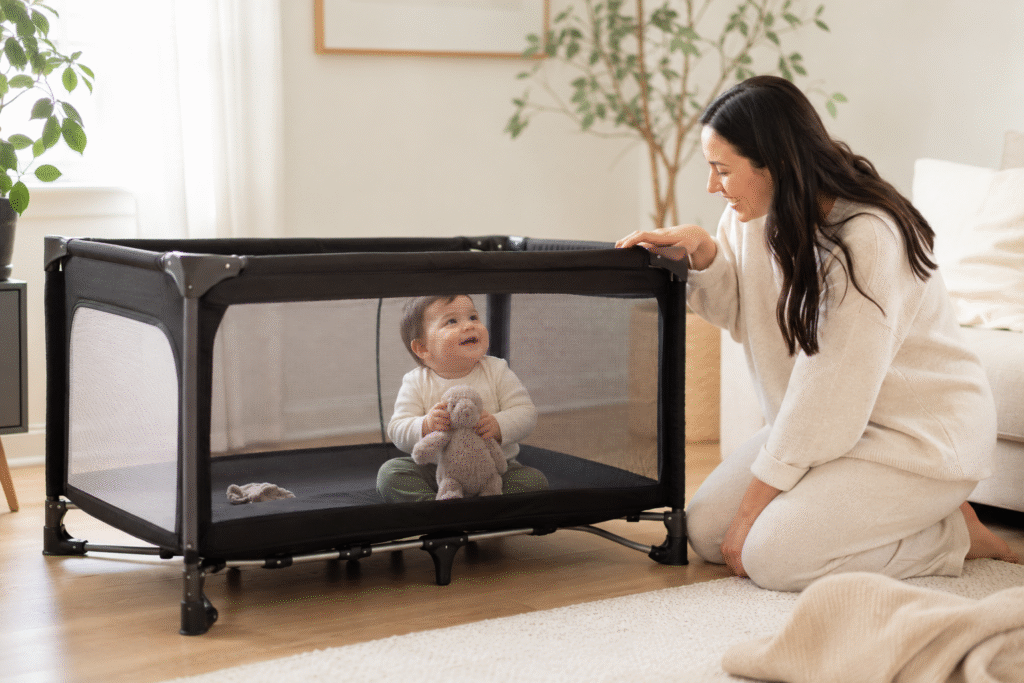
When my daughter was a few weeks old, I figured out very quickly that the problem wasn’t getting her to sleep. The problem was where to safely put her down for the ninety seconds it takes to answer the door, start dinner, or run to the bathroom while my husband was still at work. A crib lived upstairs. The couch was a no. And so, like a lot of new parents, I ended up with a playard parked in the middle of the living room, and it became the single most-used piece of baby gear in our house — more than the bouncer, more than the swing, arguably more than the actual crib.
Years and two more kids later, I have opinions about these things. A pack ‘n play (or playard, or play yard, or pack and play; they’re all the same category) is not glamorous. But the right one is a home base: a safe spot for naps, a contained place to play while you keep eyes on a toddler, a diaper station that saves you a flight of stairs, and a familiar bed you can fold into a bag for a night at grandma’s. The wrong one is a 20-pound argument you have with yourself at bedtime.
This guide is specifically about playards for home use — the feature-rich kind with bassinets and changing stations that earn their footprint in your living room. If what you actually need is something ultralight for airplanes and hotels, that’s a different tool, and I’d send you to our guide to the best travel cribs instead. There’s overlap, but the priorities are genuinely different, and buying the wrong one for your situation is how you end up with two.
First, the safety part — because this category has a real problem right now
I’m putting this before the picks on purpose. Playards themselves are one of the more tightly regulated baby products in the US: the Consumer Product Safety Commission requires enclosed mesh or fabric sides, a minimum side height, and a mattress a baby can’t lift or slip under. The big-name playards in this guide all meet that standard, and that’s exactly why I’m steering you toward established brands.
Here’s the part that doesn’t make the marketing copy. Across 2025 and 2026, the playard recalls haven’t mostly been the brand-name units — they’ve been cheap, no-name play yards and, especially, aftermarket “pack n play mattresses” sold by third-party sellers. Multiple replacement mattresses and pads (Modera, Criblike, Beianpp and others) were recalled or flagged by the CPSC because they didn’t properly fit the playards they were sold for, leaving gaps where a baby’s face can become trapped against the side — a deadly suffocation and entrapment hazard. At least one no-name play yard was recalled outright for the same reason.
None of this is meant to scare you off — a quality playard from a real brand is a genuinely safe place for your baby to sleep and play. It’s meant to keep you out of the $40-mystery-brand corner of the search results, where the savings aren’t worth it.
Quick picks at a glance
| Pick | Best for | The short version |
|---|---|---|
| Graco Pack ‘n Play Close2Baby | 🏆 Best overall | Bassinet + changer, the do-everything default |
| Maxi-Cosi Swift | 🪶 Lightest & easiest fold | One-step, one-handed fold, 3-in-1, ~18 lb |
| Joovy Room² | 📐 Most play space | ~10 sq ft, the “I just want to shower” pick |
| Graco Travel Dome LX | ⛱️ Indoor + outdoor | 4-in-1 with a UV canopy |
| Baby Trend Lil’ Snooze Deluxe III Twins | 👶👶 Twins | Two bassinets, one footprint |
What actually matters in a home playard
The features that count for a living-room playard are different from the ones that matter for travel. Here’s what I’d weigh, roughly in order.
A bassinet insert, if you have a newborn. This is the feature that makes a playard usable from day one. The insert clips to the top rails and raises your newborn to a height you can reach without bending to the floor at 3 a.m. The AAP recommends room-sharing (not bed-sharing) for at least the first six months, and a bassinet-equipped playard is one of the easiest ways to do that in a bedroom, a studio, or grandma’s guest room. Once your baby can push up on hands and knees or roll, you pull the insert out and use the deep playard floor.
A changing station, if you want to save your back and your stairs. A flip-over or removable changer turns the playard into a one-stop care station, which matters enormously in a two-story house when you do not want to climb to the nursery every two hours. It’s the difference between a playard and a “nursery center.”
Footprint and floor space. Standard playards give a baby a fairly snug rectangle. If you’re planning to use it as a daytime play pen — somewhere a crawler or new walker can actually move around while you cook — square footage becomes the whole game, and the larger models are worth their bulk.
Weight, honestly assessed. Home playards are heavier than travel cribs, usually 20–30+ pounds, and that’s fine if it mostly lives in one room and folds for the occasional car trip. Just don’t buy a 30-pound nursery center expecting to haul it through an airport. (Again: that’s the travel crib job.)
Certifications worth looking for. ASTM F406 and CPSC compliance are the US baseline every legitimate playard meets. GREENGUARD Gold (low chemical emissions) is a nice-to-have that a few models carry. And remember the firm, flat, included mattress is a safety feature, not a comfort flaw — it’s supposed to feel firmer than you’d want for yourself.
The best pack ‘n plays & playards of 2026
1. Graco Pack ‘n Play Close2Baby — Best overall
If a playard could be a Honda Civic, this is it: not flashy, available everywhere, and quietly excellent at the job. The Close2Baby is the full-feature version of Graco’s category-defining line, pairing a removable bassinet with a built-in diaper changer, so it works as a complete care station from the newborn weeks through the playpen stage. In researching this category, the Graco playards come up more than any other brand for one boring reason: they’re the established default, with a deep track record and parts and sheets available anywhere. It’s an Amazon best seller in baby playards as of this writing. The trade-offs are the usual ones for a feature-rich Graco: it’s on the heavier side, the fold takes a beat to learn, and it doesn’t carry a GREENGUARD certification. For a do-everything home base, none of that is a dealbreaker.
2. Maxi-Cosi Swift — Best lightweight pick (easiest one-handed fold)
This is the one I’d point you to if you want a smaller footprint and the least possible fuss. The Swift is a 3-in-1 — newborn bassinet, toddler snooze spot, and play yard — with a genuine one-step, one-handed fold, and at about 18 pounds it’s noticeably lighter than the big nursery-centers. Its clever 2-stage zip mattress converts from full play-yard size down to a snug bassinet for the early months. Maxi-Cosi, the European car-seat house behind it, gives it a modern, décor-friendly look, all-mesh sides for airflow and visibility, and a firm, flat sleep surface that meets the CPSC’s safe-sleep recommendations. Two honest notes: the bassinet mode tops out around 15 pounds, so it’s a first-few-months feature, and because it’s built light and packable, it doubles as a travel piece — if airplanes are your main use case, our travel crib guide compares the ultralight options directly. As a fuss-free home playard that’s easy to carry room to room, it’s a lovely, lighter alternative to the heavy combos.
3. Joovy Room² — Most play space
Joovy’s own pitch is blunt and accurate: if you’re a parent who likes to take a shower, this is the one. The Room² offers nearly 10 square feet of floor, roughly 50% more than a standard playard, which is the difference between a baby who tolerates the pen and a crawler who’s actually content to play in it while you get fifteen minutes. It has a low center of gravity for stability, 360-degree mesh windows so your little one doesn’t feel boxed in, a washable fitted sheet, and a durable steel-and-aluminum frame that holds up across multiple kids. It even expands with a separate Twin Nursery Center accessory if your family grows. The honest disclaimer comes straight from Joovy: it’s intentionally larger and not featherlight, so it’s a workhorse for home, grandparents’ houses, and the backyard far more than a carry-it-through-security travel piece. For a daytime containment zone, nothing else here gives you this much room.
4. Graco Pack ‘n Play Travel Dome LX — Best for indoor + outdoor
This is the one I’d reach for if “outside” is part of your routine — a backyard, a porch, a grandparent with a deck. The Travel Dome LX is a 4-in-1 playard that adds a full UV-protective canopy over the top, so it doubles as a shaded rest spot when you’re not indoors. It includes a bassinet for the early months, folds down with the same push-button system as the rest of the Graco line, and is a strong, highly rated seller. Two real notes: the canopy makes it bulkier and heavier than a basic playard, and as with any outdoor sleep setup, the usual heat-and-sun cautions apply — shade is not air conditioning, and a baby should never nap in direct sun or a hot enclosed space. Used sensibly, it’s a genuinely versatile pick for families who spend real time outside.
5. Baby Trend Lil’ Snooze Deluxe III — Best for twins
Outfitting for twins usually means buying two of everything, which is exactly the problem this solves. The Lil’ Snooze Deluxe III for Twins has two removable Rock-A-Bye bassinets side by side, each with its own canopy, so both babies have a contained nap space in a single footprint. It also includes a flip-over changing table, a parent organizer for the diaper-and-wipes pile, large wheels with brakes for moving it room to room, and a music-and-nightlight center. Once the bassinets come out, it converts to a full-size playard. The honest trade-off is heft — a twin nursery center is a big, heavy piece (north of 40 pounds), so think of it as furniture that stays put, not gear you travel with. For parents of two, the all-in-one consolidation is worth it.
What about a budget pick?
You can absolutely spend less, and you don’t have to sacrifice safety to do it, but here’s where I’d draw the line. A basic playard from an established brand like Graco (the no-frills models run well under $100 and show up at every Target and Walmart) is a perfectly safe, honest budget choice. What I’d steer you away from is the bottom of the marketplace: the $30–50 no-name playards and, especially, the aftermarket mattresses, which are exactly the products that have been turning up on recall lists. The right way to save money here is to buy a simpler model from a brand you recognize, not a cheaper unknown. If you’re mainly buying for occasional trips rather than daily home use, our travel crib guide also covers a budget-friendly option.
Which one is right for you?
If you want one playard to do everything from birth, the Graco Close2Baby is the safe default — bassinet, changer, and a track record, at a reasonable price.
If you want the lightest, least fiddly option — something you can fold one-handed and carry between rooms without a workout — the Maxi-Cosi Swift is the one, and it still has a bassinet for the newborn stage.
If you mostly need a daytime spot to contain a crawler while you cook, work, or shower, the Joovy Room² and its extra square footage will get used the longest.
If your life happens outside — patios, backyards, a grandparent’s deck — the Graco Travel Dome LX and its canopy are built for it.
And if you’re expecting two, the Baby Trend twin nursery center consolidates the whole operation into one footprint.
Frequently asked questions
Is it safe for a baby to sleep in a pack ‘n play every night?
Yes. A playard that meets current safety standards (ASTM F406 and CPSC) is considered a safe sleep surface for both naps and overnight sleep, as long as you use only the firm, flat mattress it came with, place your baby on their back, and keep the space free of pillows, bumpers, blankets, and inclined inserts. Many families use a playard as the primary sleep space for months. The key is the “as it comes” part — no added padding.
Can I add a softer or thicker mattress to make it more comfortable?
No, and this is the most important “don’t” in the whole category. Aftermarket pack ‘n play mattresses and toppers are precisely the products that have been recalled for creating dangerous gaps a baby can become trapped in. The included mattress is firm by design — that firmness is a safety feature, not a defect. If you want to protect it, add a fitted sheet made for that specific playard, and nothing else.
When do babies outgrow a playard, and when should I stop using one?
Most playards are rated to around 30 pounds or 35 inches, or until your child can climb out, whichever comes first. The bassinet insert has a much lower limit (often around 15 pounds, or roughly the first few months), so you’ll graduate out of bassinet mode well before you retire the playard itself. Once a child can pull themselves up and over the side, it’s time to stop, regardless of weight.
What’s the difference between a pack ‘n play and a travel crib?
They overlap, but they’re optimized differently. Pack ‘n plays / playards are home-base gear: feature-rich, often with bassinets and changers, roomier, and heavier. Travel cribs are stripped down for portability — ultralight, fast to fold, sized for an overhead bin. If you’re choosing a living-room workhorse, you’re in the right guide; if you fly often or need something for hotels, see our best travel cribs roundup.
How do I get my baby to actually sleep in it?
Familiarity does most of the work. Let your baby spend supervised awake time playing in the playard during the day so it isn’t a strange place that only appears at bedtime. Keep the sleep environment consistent — same firm mattress, same fitted sheet that smells like home — and run your usual wind-down routine. For travel, setting it up before your child is overtired (rather than at the moment of meltdown) makes the first night dramatically easier.
Product specs and included features reflect manufacturer information at the time of writing; availability, color options, and pricing change often, so check the current listing before you buy. This article is general information and isn’t a substitute for medical advice from your pediatrician.