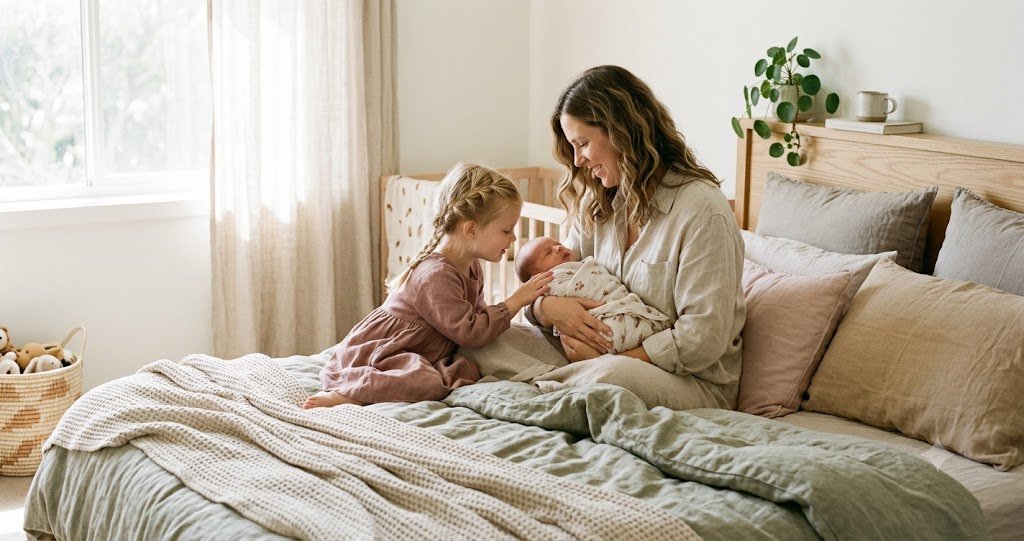
The day we brought our youngest home, my older son took one long look at the little bundle in my arms, then up at me, then back at the bundle. He was barely a year and a half, with no real words for any of it yet, but his face managed to say the whole sentence anyway: who is that, why are you holding it, and when is it leaving?
If you’re reading this, that look is probably headed for your house too. A new baby is wonderful. It is also, for the kid who used to be the baby, a small earthquake. A big sibling gift won’t make the jealousy vanish in a puff of glitter, but it does something quieter and useful: it tells your older one you still matter here, and it gives them something to do with all those feelings besides climb into your lap mid-feed.
Below are the gifts I’d actually reach for, sorted by what they’re for rather than by price, plus a few no-cost moves that worked as well as anything I wrapped. I’ve flagged the age each one suits, because the right present for a brand-new two-year-old big brother is very different from the one for a five-year-old big sister.
Does a big sibling gift actually do anything?
It’s fair to be a little skeptical. A toy won’t undo the fact that your older child just lost their spot as the center of the universe. But the strategy has real backing. The American Academy of Pediatrics specifically lists giving your child a special gift, and buying them a doll so they can care for “their” baby, among its tips for helping older siblings adjust, right alongside one-on-one time and letting the big kid help with real baby tasks (HealthyChildren.org).
What actually works isn’t the toy. It’s what the toy lets your child do: feel chosen, mirror what they see you doing all day, and stay busy with something of their own during the long stretches when your hands are full. Clinical psychologists make a similar point about giving kids a steady “constant” through the transition and casting them as a helper rather than a bystander (Child Mind Institute). A good gift is just an easy on-ramp to all three.
One honest expectation-setter: some regression and grumbling is normal no matter what you buy. Wanting a bottle again, a few potty accidents, suddenly needing to be carried everywhere. It usually settles over the first weeks and months. The gift greases the wheels. It is not a force field.
How to pick the right one
I find it easiest to think about two things: how old your big kid is, and what job you want the gift to do.
By age. A one- or two-year-old can’t really play “nurse the baby” yet and shouldn’t have anything with small parts, so think soft, simple, and snuggly. A three- or four-year-old is deep in pretend play and wants to do exactly what you do, which is where the doll-care gear shines (if that’s your kid’s age, our gifts for 3-year-olds guide pairs well with this list). A four-to-six-year-old can handle a real little “job” and loves feeling like a capable helper.
By purpose. Most big sibling gifts fall into one of four buckets: you’re special keepsakes, care for your own baby role-play, busy hands for the hours you’re feeding, and big helper tools. I’ve grouped the picks that way so you can grab whichever fits the kid you actually have.
For feeling special
A “big sibling” book that names the feelings
Best for ages 2–4 · read together before and after the baby arrives. Before any toy, I’d start with a book. A simple, repeatable story does the explaining you’re frankly too tired to do well yourself at 38 weeks. I Am a Big Sister and I Am a Big Brother by Caroline Jayne Church are the classics for a reason: short, sweet board pages aimed at the 2–4 crowd, all about the ways a big kid gets to help the new baby. Read it on repeat in the weeks before, and again in the hospital. For more titles that help little ones name big emotions, our books for toddler feelings roundup goes deeper.
Honest drawbacks: The brother and sister versions are nearly identical apart from the pronouns and a couple of illustration tweaks, so you only need the one that matches your kid. And the text is genuinely basic, so a five-year-old will find it thin. That’s by design.
A “Big Brother / Big Sister” announcement tee
Best for ages 1–6 · the first-meeting photo op. A little corny, completely effective. There’s something about wearing the title that makes a kid sit up straighter, and it gives visitors an easy first line that isn’t about the baby: “You’re the big sister? Wow.” This Promoted to Big Sister tee comes in a matching Big Brother version too — soft cotton, toddler and little-kid sizes, and it photographs beautifully for that first sibling meeting.
Honest drawbacks: These announcement tees tend to run a touch generous, so if your kid is between sizes, sizing down is usually the safer bet. It’s a keepsake more than a play item, so don’t expect it to entertain anyone.
For caring for “their own baby”
A soft baby doll of their very own
Best for ages 1–2 · the safe first pick. If your big kid is still a baby themselves, this is the one I’d reach for first. A cloth doll is the safest way for a one- or two-year-old to copy what they see you doing all day. This soft baby doll is fully plush with embroidered features (no buttons or hard eyes to pry off and mouth), it’s machine washable for the inevitable, and it comes in a range of skin tones so you can pick one that looks a bit like your family. Light enough for tiny arms, soft enough to take to bed.
Honest drawbacks: The one consistent gripe in the reviews is that it’s small — more “tuck under your arm” than “big baby to lug around.” If your kid has their heart set on a chunky baby to haul everywhere, size up to the bigger version of the same doll.
A doll feeding & diaper set
Best for ages 3+ · the “feed your baby while I feed mine” mirror. This is the gift that buys you the most peace during cluster feeds, because it lets your three- or four-year-old do exactly what you’re doing, right next to you. The big crowd-pleaser is a multi-piece feeding and diaper-bag set, and the magic “disappearing” milk and juice bottles genuinely delight little kids the first dozen times the milk vanishes as they tip the bottle. It comes loaded with a zip carry bag, bottles, a pacifier, bibs, play diapers, and a few dishes, and it fits most standard dolls.
Honest drawbacks: It’s rated for ages 3 and up, and it means it — there are small parts in here, so it’s not the pick for a one- or two-year-old who’s still mouthing things. Save it for the preschooler.
A doll carrier so they can “wear” their baby too
Best for ages 3+ · matches what they see you do. You’ll be wearing the newborn constantly. A doll carrier lets your big kid strap on their own baby and walk around being just like you, which is catnip for the three-to-five set. This one is soft cotton with three carry positions (front-in, front-out, and back), adjustable straps, and a buckle a kid can work themselves, plus a little front pocket for a pretend bottle.
Honest drawbacks: Like the feeding set, it’s marked for ages 3+, and the long crossing straps mean a younger toddler should only use it with you nearby. For a preschooler, it’s one of the most on-theme gifts on this list.
For keeping busy hands busy
A mess-free reusable activity pad
Best for ages 3–6 · the feeding-time hero. The thing nobody warns you about is how long you’ll sit there feeding, and how badly your older one will want you the second you do. A quiet activity that only comes out at feeding time is worth its weight in gold. A reusable water-reveal pad is my go-to suggestion: you fill the chunky pen with plain water (no ink, nothing to stain the couch), the pictures appear as they “paint,” then the pages dry blank so they can do it again and again. The pen can’t dry out, and there’s truly nothing to spill. If you want a few more low-mess options to rotate through, our busy boards roundup has ideas that hold up to real play.
Honest drawbacks: One pad only has four pages, so the novelty can wear off if it’s the only thing in rotation. The fix is cheap: grab a couple of different themed pads and keep them strictly for feed time so they stay special.
For the big helper
A kids’ instant-print camera
Best for ages 4–6 · the “official photographer.” This one’s for the older big sibling who’s past dolls and wants a real role. Hand a five- or six-year-old a camera, tell them they’re the official baby photographer, and watch them puff up with importance. A kids’ instant-print camera shoots color photos to a memory card and prints little black-and-white keepsakes on the spot, with a shockproof shell built for clumsy hands, plus filters and games for the inevitable downtime. (For more ideas at this age, see our gifts for 4-year-olds.)
Honest drawbacks: The prints are black-and-white, thermal, and charmingly grainy rather than crisp — think fun retro, not frameable. You’ll also be buying more paper rolls, and the little memory card is a small part to keep an eye on.
Three moves that work as well as any gift
Some of what helped us most cost nothing at all. Worth doing alongside whatever you wrap.
The “from the baby” trick. Tuck a small present in your hospital bag and let your older one discover that the baby brought it for them. It sounds silly and it works like a charm, especially for the two-to-five crowd who are very ready to decide this new person isn’t so bad after all. It works best if someone other than you holds the baby at the first meeting, so your arms are free for the big kid.
The feed-time basket. A basket of small novelties that only appears while you’re feeding the baby. I’ll be honest, this one’s hit or miss. It works beautifully when the items are genuinely new and stay locked away the rest of the day. It flops the second it becomes just another toy bin they can reach anytime. If you try it, ration it ruthlessly.
Flip it: let the big kid give a gift to the baby. Being the giver can do as much as being the receiver. Let your older child pick out a lovey or a board book “for the baby” and hand it over at the first meeting. It quietly casts them as the caretaker, not the one being replaced.
A few things that smoothed the landing for us
The gifts help, but they sit on top of the boring stuff that does the heavy lifting. When my daughter became a big sister at three, the single most useful thing wasn’t a present at all. It was giving her a real job: she was in charge of grabbing a clean diaper and “reading” to the baby during changes. Tiny tasks, but she felt essential, which is the whole point.
A few more that earned their keep:
- Protect a daily ritual. Even ten or fifteen minutes that belongs only to your older child, every day, with no baby. Psychologists call it a “constant,” and it matters more than any toy.
- Keep the routine boring and predictable. If they’re in daycare or preschool, this is not the week to change that. Sameness is comforting when everything else just shifted.
- Narrate the baby’s love. “Look how she stops crying when you talk to her.” Kids believe what you point out to them.
- Expect the backslide and don’t shame it. The bottle they suddenly want, the potty accidents. It’s a bid for connection, not bad behavior, and it passes.
- Don’t forget your co-parent and the grandparents. When my older son was melting down because the baby “had” me, a one-on-one ice cream run with Dad reset the whole afternoon.
Big sibling gift questions, answered
Should I give it before the baby comes, or after?
A little of both works best. Books and a doll are great before arrival, so your child gets used to the idea. Save one small “you’re the big sibling now” gift for the actual meeting at the hospital or when the baby comes home, when the feelings are running highest.
Do I have to say it’s “from the baby”?
Not at all. It’s a popular trick because it helps a wary toddler warm up fast, but plenty of families just say “this is a special present because you’re a big sister now.” Use whichever feels honest for your kid. Older children sometimes see right through the “from the baby” bit anyway, and that’s fine.
My older one is only 18 months. What’s appropriate?
Keep it soft and simple. A cloth doll they can cuddle and a sturdy board book are perfect at this age. Skip anything with small parts, including most of the doll-care sets, the carrier, and the camera, until they’re closer to three.
How much should I spend?
Honestly, less than you’d think. The point is the gesture, not the price tag. A board book and a soft doll together cost very little and tend to get loved harder than anything expensive. Save your budget for the coffee you’re about to need.
The short version
A big sibling gift won’t erase the jealousy, but it’s one of the easiest, kindest ways to tell your older child they still belong in this new, louder version of your family. Match it to their age, lean toward gifts that let them do what you do, and pair it with a protected daily ritual and a real little helper job. That combination did more for our homecomings than anything I found in a store.
Whatever you choose, your big kid is going to grow into the role. Usually right about the time you’ve stopped worrying about it.