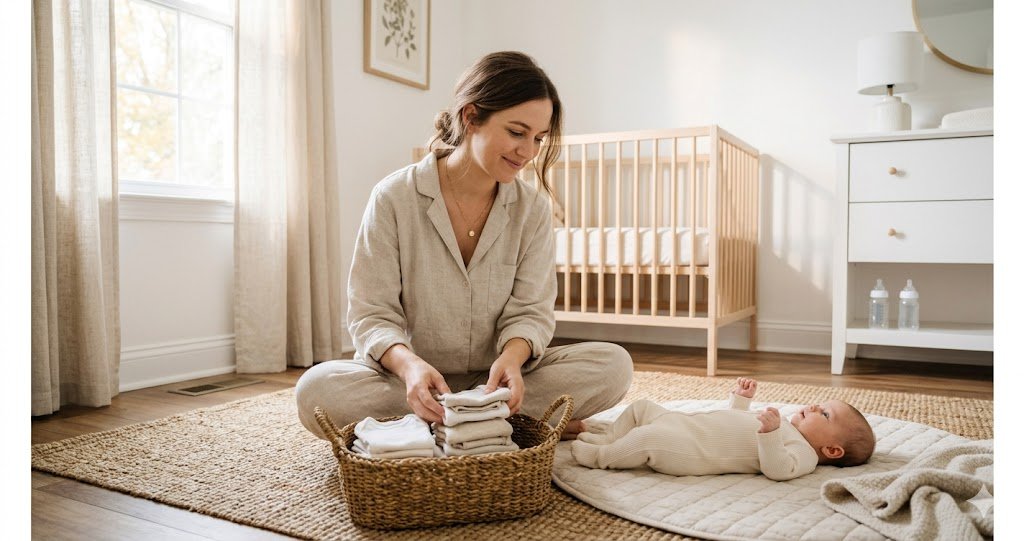
When I was pregnant with my daughter, my first baby, I did the thing every new mom does at 2 a.m.: I typed “how many newborn onesies do I need” into the search bar and got eleven different answers, none of which agreed. So I bought a lot. Way too many newborn-size everything. She blew past that size in about two and a half weeks, and half of those tiny onesies still had the tags on.
Three babies later, I’ve packed (and unpacked, and donated) enough newborn wardrobes to know the real numbers. Not the “register for all of it” numbers the shop sites want you to believe, but the honest, this-is-what-you-actually-reach-for numbers. So here’s the whole list in one place: clothing, bottles, and diapers, broken down by size and by how you plan to feed. Plus the part nobody tells you, which is what to buy less of.
The only math you need
Before any specific count, this is the formula I wish someone had handed me. For anything your baby wears or uses daily:
(How many you go through in a day) × (how many days between laundry loads) + a small buffer.
That’s it. A newborn goes through roughly 8 to 12 diapers a day and a couple of outfit changes (blowouts and spit-up are real). If you do laundry every two or three days, you can back into your own numbers instead of trusting a registry checklist that’s quietly trying to sell you a fourth pack. Buy for the wash cycle you’ll actually keep, not the one you imagine you’ll keep.
Clothing: how many of each
The single biggest money mistake is over-buying the newborn (NB) size. Most babies wear it for two to four weeks, and bigger babies skip it almost entirely. Put a little here and the bulk of your budget into 0–3 months, which is the size they actually live in.
Bodysuits / onesies
- Newborn: 7–10. A small starter stack, nothing more.
- 0–3 months: 10–12. This is the workhorse layer.
For the newborn stack, I like an organic-cotton set that comes in both short and long sleeve so you’re covered whatever the season. Burt’s Bees Baby bodysuits are a soft, gentle option that mixes both sleeve lengths in one listing. Kimono-style side-snap bodysuits are also worth a look for the first couple of weeks, since they don’t go over a tender umbilical stump or a fresh-from-the-bath wobbly head.
For the 0–3 month layer, plain neutral multipacks earn their keep, because they mix and match, survive bleach, and hand down to the next baby without looking “themed.” Gerber’s unisex short-sleeve 8-pack (an Amazon best seller in baby clothing for good reason) is the one I kept restocking across all three kids.
Footed sleepers / “sleep ‘n play”
- 4–6 total. Zip-front is a gift to whoever’s on the 3 a.m. shift; snaps are a punishment.
A neutral multipack like the Onesies Brand unisex 4-pack covers the rotation without committing you to one print or one gender of hand-me-down.
Swaddles
- 2–3. One on the baby, one in the wash, one as backup.
A wearable, fitted swaddle is far easier to use at 3 a.m. than wrangling a loose blanket, and it keeps the sleep space clear. A neutral multipack like the SwaddleMe 3-pack (an Amazon’s Choice pick) gives you the right number in one box.
The little stuff
- Hats & socks: 2–3 of each. Socks vanish; don’t over-invest.
- Footie-free rompers or gowns: 2–3 if you want them. Nighttime gowns make diaper changes faster.
Bottles: it depends on how you feed
This is the one category where a single number is useless, because the right count swings entirely on how you feed. Breastfeeding with the occasional bottle? You only need a few. Formula feeding or exclusively pumping? You’ll need the most, since every feed (and every pump session) ties up a clean bottle until it’s washed. Start with the smaller 4–5 oz bottles and slow-flow newborn nipples, size up to 8–9 oz around the four-month mark, and don’t commit to a dozen of one brand before your baby has voted on it.
Because the math really does change with your feeding plan, I broke the whole thing down separately: exactly how many baby bottles you need by feeding method, including the 4 oz vs 8 oz split and what to add once daycare enters the picture.
Diapers: don’t stock up on newborn
I’ll say it louder for the people registering in the back: do not buy cases of newborn-size diapers. A newborn can go through around 8–12 a day, which sounds like a reason to bulk-buy, but most babies are out of NB size within a few weeks, and plenty start in size 1 from day one. One or two packs of newborn is genuinely enough.
Here’s roughly how the first year shakes out by size:
| Size | Rough total you’ll use | Buy-ahead advice |
|---|---|---|
| Newborn (NB) | A few hundred at most | 1–2 packs only |
| Size 1 | The first big chunk | Safe to stock up a little |
| Size 2 | Several weeks’ worth | Buy as you go |
| Size 3 | The longest-worn size | Worth a subscription |
Sizes 1 and 3 are where babies linger longest, so those are the ones worth a Subscribe & Save setup once you know your baby’s brand. For the early weeks, the gentle standbys most parents reach for are Pampers Swaddlers and Huggies Little Snugglers, but wait until baby arrives to commit to a case, because skin and fit are personal. And if your little one is headed to daycare, keep an extra labeled stash on hand, since they’ll go through more outfits and diapers there than you’d expect.
The buy-less / buy-more cheat sheet
If you remember nothing else, remember this table. It’s the difference between a closet of unworn tags and a wardrobe that actually gets used.
| Buy LESS of | Buy MORE of |
|---|---|
| Newborn-size clothing | 0–3 month clothing |
| Newborn diapers (1–2 packs) | Size 1 & size 3 diapers |
| Fancy outfits & “going home” sets | Plain zip sleepers |
| Bottles, if you’re breastfeeding | Bottles, if you’re formula feeding |
| Shoes (newborns don’t need them) | Burp cloths & bibs |
| Matching nursery decor | A second crib sheet |
The pattern is always the same: the stuff that photographs well gets over-bought, and the boring, washable, size-up basics get under-bought. Spend like the second-time parent you’ll eventually become.
Want the rest of the must-haves (and the genuinely skippable stuff) in one printable list? My full newborn must-haves checklist covers what to actually pack and prep before baby comes.
Grab the free Baby Gear Registry Checklist
I turned everything above (quantities, sizes, and the buy-less/buy-more notes) into one printable checklist you can take straight to your registry. No guesswork, no over-buying.