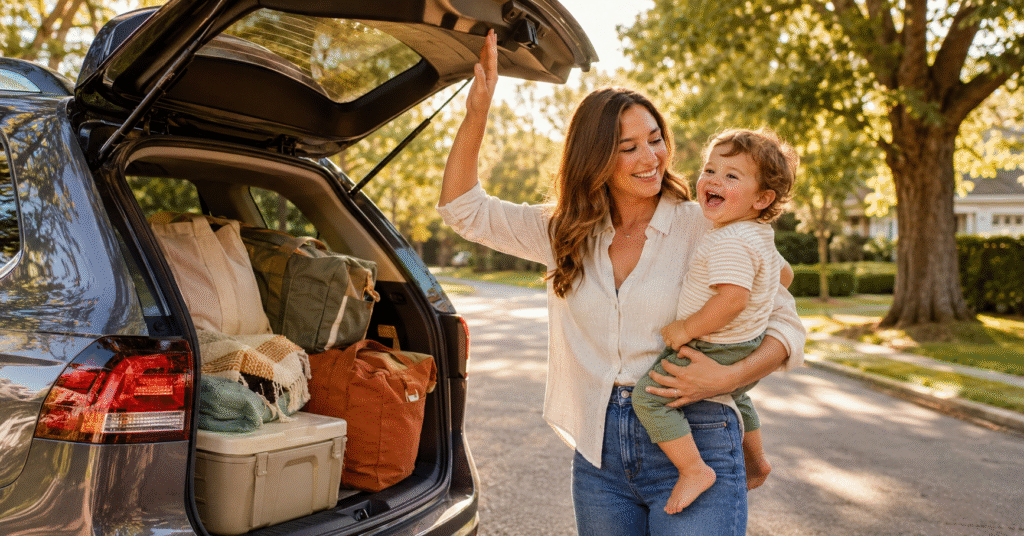
The first time we attempted a real road trip with all three kids, I spent two full evenings on the packing list and about four minutes thinking about how the car itself was set up. We made it ninety minutes before I understood the mistake. The snacks were in the trunk. The wipes were under a duffel bag. My youngest son dropped his water bottle into the one spot no adult arm can reach, and the sun tracked across his face for an hour like it had a personal grudge.
Entertainment was not the problem that day. Logistics were. So this guide is deliberately not about toys, games, or screen strategy; I’ve covered all of that in my toddler road trip activities guide. This one is about the physical setup: the car seat check before you leave, the gear that earns its spot in the car, and the routines that keep a long drive from unraveling. Think of the two posts as a pair. That one is “what to hand them,” this one is “how to build the car around them.”
Start With the Seat They’re Already In
The unglamorous truth: the most important piece of road trip gear is the car seat you already own, installed correctly. Before you spend a dollar on accessories, spend twenty minutes on this.
A large share of car seats are installed with some kind of error: wrong angle, loose base, twisted straps. The long highway miles of a road trip are exactly when you want zero doubt. If you’ve never had your installation looked at, NHTSA runs a free car seat inspection station locator, and many fire stations and hospitals offer checks by certified techs. It costs nothing and takes one errand.
Then do your own pre-trip check the night before:
- The wiggle test. Grab the seat at the belt path and try to move it. More than an inch of movement side-to-side or front-to-back means it needs to be reinstalled tighter.
- The pinch test. Buckle your child in, then try to pinch the harness webbing at their shoulder between your thumb and finger. If you can pinch a fold of strap, it’s too loose.
- Harness height. Rear-facing: straps at or below the shoulders. Forward-facing: at or above. Kids grow; trips are a good prompt to re-check.
- No bulky layers under the harness. If your route climbs into cold mountains, remember the AAP’s guidance on coats and car seats: puffy fabric compresses in a crash and leaves the harness dangerously loose. Buckle first, then layer a blanket or jacket over the top.
One thing most gear lists won’t tell you
Almost everything in this article — mirrors, shades, organizers — falls into a category NHTSA calls aftermarket or “non-regulated” products. The federal safety standard for car seats (FMVSS 213) covers the seat itself. It does not cover the accessories sold next to it. When a mirror’s packaging says “crash tested,” that’s the manufacturer’s own testing, not a government certification — because no government standard for these products exists.
That doesn’t mean the whole category is dangerous, and I’m not going to pretend a family of five can road-trip with a perfectly empty cabin. It means the honest selection criteria are different from what marketing suggests: choose light, choose soft or shatterproof, attach things to the vehicle rather than the car seat, and strap everything down like it might fly — because in a sudden stop, anything loose effectively does. Every product below was picked with that filter on.
Skip the add-ons your car seat manual doesn’t approve. Strap covers, headrest pillows, harness pads, and seat protectors that didn’t come in the box can change how the seat performs in a crash. If you want a specific accessory, check your seat manufacturer’s list of approved ones first.
The Mirror Question: Seeing a Rear-Facing Baby
With my daughter, our first, I drove her first months in a state of low-grade paranoia, doing that terrible thing where you crane your neck at red lights to confirm a sleeping baby is, in fact, sleeping. A backseat mirror solved a real problem for us: it turns “Is she okay back there?” into a one-second glance at the rearview, instead of a contortion act at 65 mph.
Given the no-federal-standard reality above, my screening rules for mirrors were strict: shatterproof acrylic only, lightweight, strap-mounted to the vehicle headrest (never attached to the car seat itself), and a long, consistent review history. After cross-referencing the most-reviewed options against independent owner feedback, three made the cut.
Shynerk Baby Car Mirror
This is the category’s perennial best seller, and after digging through what actual owners report over years of use, the popularity seems earned rather than algorithmic. It’s a large convex panel of shatterproof acrylic that straps to the rear headrest with two adjustable belts, arrives fully assembled, and pivots a full 360 degrees, so you can dial in a head-to-toe view of a rear-facing seat in about two minutes. The wide convex shape is the main draw: you see the whole baby, not a face-sized porthole.
One honest caveat from the listing itself: it mounts to an adjustable headrest, so if your car’s rear-middle position has a fixed or absent headrest, measure first or look at the budget pick below. Check the Shynerk mirror on Amazon.
Onco Convex Baby Car Mirror
The Onco has won parenting-press awards in the UK (a Mother&Baby safety award among them) and has one of the deepest review histories in the category. Functionally it’s a close cousin of the Shynerk: a roughly 9.6 x 6.8 inch convex shatterproof panel with a non-slip base, three attachment configurations, and 360-degree rotation. Owners consistently describe it as wobble-resistant once strapped down properly, which matters more than any other single trait — a mirror that vibrates is a mirror you can’t actually read at highway speed.
Between this and the Shynerk, you’re choosing between two good answers to the same question. Check the Onco mirror on Amazon.
Funbliss Baby Car Mirror
Half the price of the two above, and the spec that earns it a slot here isn’t the price. It’s that the dual-strap design works on fixed headrests as well as adjustable ones, which the premium picks can’t claim. The matte-finish acrylic panel is a bit smaller and the image slightly less crisp than the Shynerk’s, by owner accounts, but it’s shatterproof, tool-free, and does the one job. If your second car needs a mirror too, this is how you avoid paying for two premium ones. Check the Funbliss mirror on Amazon.
Mirror discipline: set it up so a glance at your rearview mirror shows the baby mirror — you should never be turning your head. If you catch yourself watching the baby instead of the road, angle it slightly away. The mirror is for “is everything okay,” not for entertainment.
Window Shades: The Category With a Ratings Problem
I want to be upfront about something I found while researching this section, because it changed what I’m willing to recommend. The best-selling car window shades on Amazon — the static-cling films, the suction-cup panels, the retractable rollers — almost uniformly carry mediocre ratings, hovering in territory most baby products never sink to. Read the reviews and the same three failure stories repeat: cling shades peel off in heat, suction cups let go on bumpy roads, and roller mechanisms snap. A shade that detaches mid-drive isn’t just annoying; it’s a flying object and a screaming, sun-blinded toddler at the same time.
So instead of a five-product roundup of a category that mostly disappoints, here’s the one design that solved the attachment problem, plus the selection logic if you shop elsewhere.
DIZA100 Magnetic Car Window Shade (2-Pack)
The fix turns out to be embarrassingly simple: magnets. The DIZA100 is a soft fabric curtain, roughly 27 x 20 inches, with five magnets along the top edge that grip the metal door frame. No suction cups to dry out, no static film to lose its will to live in August. It’s a double-layer design: a semi-transparent mesh layer for normal driving, plus an opaque blackout layer you can drop for nap mode. That blackout option is genuinely the killer feature on a road trip; more on naps below.
The honest limitations, straight from the manufacturer: it’s for rear side windows only, it won’t work on frameless windows (Tesla-style doors), and if your door frame is wrapped in plastic or rubber trim, the magnets have less to grab. Owner feedback on magnet strength is mixed for exactly that reason — on a bare metal frame it holds well; on a heavily-trimmed frame, less so. Check your door frame with a fridge magnet before ordering and you’ll know which camp you’re in. Check the DIZA100 shades on Amazon.
If you go a different direction: prefer fabric over rigid panels, prefer mechanical attachment (magnets, over-the-door “sock” styles that stretch around the whole door frame) over suction or static, and treat any shade as a consumable rather than an heirloom. And never put anything on the windshield or front side windows while driving — shade the kid, not the driver.
The Potty Situation
If you’re traveling with a newly potty-trained toddler, you already know the brutal math: “I have to go potty” on the interstate means you have somewhere between ninety seconds and four minutes. My older son potty trained the spring before a long family drive, and the single most stress-reducing object in the car was a self-contained potty within arm’s reach of the trunk.
Kalencom Potette Plus 2-in-1
The Potette has been quietly solving this exact problem for decades, and the current version is the rare piece of baby gear that does two jobs without compromising either. Legs locked down, it’s a freestanding potty for the shoulder-of-the-road emergency, lined with a disposable bag; legs folded flat, it becomes a toddler-sized trainer seat that sits on a standard toilet, with a raised splash guard built in. The patented hinged legs click into place with no ambiguity about whether they’re locked, the whole thing comes apart for a deep clean when the trip is over, and it folds flat enough to disappear into the included drawstring travel bag. It’s rated for kids up to fifty pounds, so it lasts the entire potty-training era rather than one season.
One detail worth knowing before you buy: the system runs on liners. Check the Potette Plus on Amazon, and add the official 30-pack of disposable liners in the same order. Liners run out faster than anyone budgets for, and improvising mid-trip is nobody’s favorite scavenger hunt. (Heads up: the official ones are lightly fragranced to mask odor — if your family is scent-sensitive, unscented universal liners fit it too.)
Frida Baby Fold-and-Go Potty Seat
Some toddlers refuse the standalone potty and insist on a “real toilet” — in which case the problem becomes the toilet itself: adult-sized, germy, and terrifying to small bodies convinced they’ll fall in. The Frida folds flat enough for a diaper bag, opens onto round or oval toilets with a non-slip base, and has silicone handles so your kid grips the seat instead of the rim. Solid panels wipe down fast, and it comes with its own travel bag so it isn’t loose in your tote afterward.
One pattern worth knowing from owner reviews: parents of boys note the splash guard is modest, so a quick “aim talk” before deployment is wise. Check the Frida Fold-and-Go on Amazon. And if you want the full field guide to this category — flights and public restrooms included — my travel potty roundup compares every style.
The potty protocol that actually works: everyone tries at every stop, no negotiations — make it boring routine, not a debate. And keep the potty kit (potty, liners, wipes, one full change of clothes, a plastic bag for casualties) together in one grab-and-go pouch, not scattered across three bags.
A Place for Everything: Organization That Survives Day Two
Every road trip car is immaculate at mile zero and a landfill by lunch. You can’t prevent that entirely — you’re sharing a small room with people who throw food — but the right structure slows the decay. After six years of family drives, my rule is: one organizer the kids can reach, one the adults can reach, and one in the trunk, and they hold different things.
Helteko Backseat Car Organizer (2-Pack)
This hangs on the back of the front seats, facing your kids, and turns dead space into the snack-book-and-toy zone, while doubling as a kick mat so tiny shoes don’t redecorate your upholstery. It’s made of waterproof 600D Oxford fabric with a rigid support bar across the top, so it doesn’t sag into a sad pouch when loaded, and the nine compartments include a clear touch-through sleeve that fits tablets up to about ten inches — your little one can watch or tap without the device ever being loose in the cabin (one less projectile; see the theme?). Reviewers note it ships folded, so the tablet window may have creases at first; they relax with use. Check the Helteko organizer on Amazon.
ONE PIX Backseat Organizer
Same concept, single unit, half the price per seat. Multiple elastic pockets, a touch-screen tablet sleeve that takes slightly larger tablets than the Helteko’s, wipe-clean waterproof fabric, and top-and-bottom straps with quick-release buckles. It’s lighter-duty than the Helteko — the fabric is thinner and there’s less structure — but for one kid’s seat-back or a second vehicle, it does the job for the price of a fancy sandwich. Check the ONE PIX organizer on Amazon.
Femuar Hanging Trunk Organizer
The trunk problem on a family trip is archaeology: everything you need is under everything you don’t. This one attacks it vertically — a 42 x 18 inch panel of pockets that hangs flat against the back of your rear seats, held by three buckled straps with a hook-and-loop backing so it doesn’t swing on rough roads. Eight pockets swallow the flat, losable stuff: wipes refills, diapers, the first-aid kit, sunscreen, plastic bags, the paper maps you swear you’ll use. Your suitcases stack in front of it, and the essentials stay visible and reachable without unstacking anything. It folds flat and washes when the trip is over. Check the Femuar trunk organizer on Amazon.
The adults’ reachable zone, for what it’s worth, needs no special product: a simple tote on the front passenger floor with the day’s snacks, the wipes, and the emergency entertainment. The trick is refusing to let anything that belongs in the trunk migrate into it.
The Logistics Layer: Rhythm, Food, and Sleep
Gear gets you to the starting line. The trip itself is won or lost on rhythm.
Plan stops like they’re part of the trip, because they are
With a baby or toddler aboard, plan a real stop every couple of hours: out of the seat, on the ground, moving. Young babies in particular shouldn’t spend long unbroken stretches semi-upright in a car seat, and toddlers bank wiggles the way clouds bank rain: it’s coming out one way or another. The counterintuitive math every veteran road trip parent eventually accepts: a drive with generous stops is faster than the theoretical nonstop version, because the nonstop version doesn’t exist. It just becomes an unplanned forty-minute meltdown stop at a gas station with no grass.
When my daughter was an infant we learned to scout rest stops with picnic areas ahead of time and treat them as destinations — fifteen minutes of blanket time and a feed, everyone reset. With three kids now, stops are non-negotiable calendar items, and I plan the day’s driving around two good ones rather than hoping to “make good time.”
Eat parked, not rolling
The boring rule that prevents the scary moment: babies and young toddlers don’t eat in a moving car. A choking child in a car seat behind you, while you’re driving, is the emergency you cannot respond to. Snacks happen at stops; in motion, stick to water in a spill-proof bottle for the toddler crowd. (This is also, not coincidentally, how you avoid excavating yogurt from a buckle three weeks later.) For what foods travel well at each age, my toddler snack guide covers the road-trip-friendly end of the spectrum.
Protect the nap, then protect your expectations
Time the longest driving leg to the strongest nap — usually the after-lunch one — and make the cabin nap-friendly: shade down on the sunny side (the blackout layer on the DIZA100 earns its keep here), white noise from a phone if your kids are used to it, and an agreement with your partner that nobody touches the radio for ninety golden minutes. Then hold the result loosely. Some kids sleep beautifully at 70 mph; some treat the car as a FOMO machine. If yours is the second kind, a shorter driving day is the gear upgrade no one sells.
One safety note for the destination end: car seats are for cars. When you arrive and the baby is asleep, the temptation to let them finish the nap in the carrier on the hotel floor is enormous, but sleeping infants belong flat on their backs in a crib or pack-and-play, not at a car seat’s angle. Transfer them and accept the risk of a wake-up.
Never leave a child alone in the car — not for a two-minute errand. Cabin temperatures climb shockingly fast even on mild days, and hot-car tragedies are most often accidents of routine, not neglect. NHTSA’s advice is to build a forcing habit: leave your phone, wallet, or left shoe in the back seat so you physically open the rear door every single time you park. See NHTSA’s heatstroke prevention page for more.
The Short Version: A Packing Checklist
- Pre-trip: car seat installation checked, harness height adjusted, wiggle and pinch tests passed
- Visibility: backseat mirror strapped to the headrest and angled (rear-facing babies)
- Sun: shades on the rear side windows, frame-mounted, blackout option for naps
- Potty kit: travel potty + liners + wipes + full change of clothes + sealable bags, all in one pouch
- Organization: seat-back organizer in the kids’ reach, adult tote up front, hanging organizer in the trunk
- Rhythm: stops every couple of hours planned like appointments; longest leg over the big nap
- Rules of motion: no eating while rolling; water only; nobody alone in the car, ever
FAQ
Do I really need a baby mirror, or is it a gimmick?
It’s optional, and some safety-minded parents skip it to keep the cabin minimal — a defensible choice, since every added object is a potential projectile. If you do use one, the risk calculus favors lightweight shatterproof acrylic, strapped tight to the vehicle headrest, never mounted on the car seat. What a mirror buys you is fewer over-the-shoulder glances, which is its own safety argument on a long highway day.
What age is hardest for road trips?
In my experience across three kids: roughly nine to eighteen months. Old enough to hate confinement, too young for negotiation, snacks, or plot. Before that, babies mostly sleep; after it, distraction starts working. If your trip is optional and your baby is squarely in that window, shorter daily legs help more than any product in this article.
How do I keep the car from becoming a disaster zone?
Lower the bar from “clean” to “findable.” Assign every category a single home (the three-organizer system above), do a two-minute reset at each stop where everything returns to its home, and keep one dedicated trash bag that gets emptied at every gas station. The car will still be sticky. But you’ll be able to find the wipes, which is the actual goal.
Should I buy a special travel car seat for the trip?
For a road trip in your own car — almost never. Your everyday seat, correctly installed, is the right seat; the money is better spent on the installation check and the supporting cast above. Lightweight travel seats earn their place for flying, which is a different article: my flying with a baby or toddler guide covers that gear question properly.