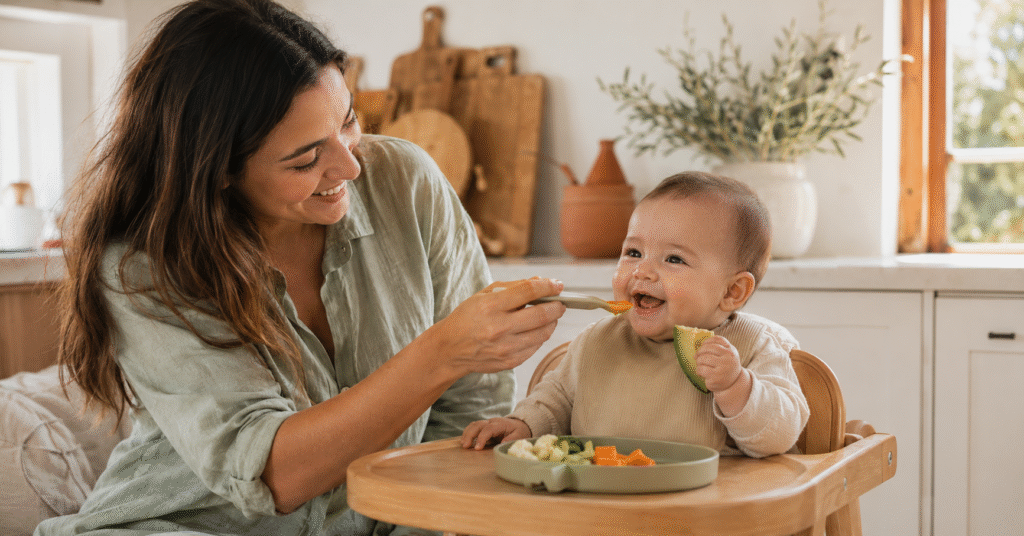
If you’ve spent more than ten minutes in a parenting group lately, you’ve watched it happen: someone innocently asks how to start solids, and within an hour there are 200 comments, two camps, and at least one person citing a study nobody has actually read. Baby-led weaning moms swear purees create picky eaters. Puree moms swear BLW is a choking hazard with a hashtag. Everyone is very sure.
I’ve now started solids three times. When my daughter was a baby, I made purees the way my mother and her mother did, ice cube trays of sweet potato lined up in the freezer like little orange soldiers. By the time my youngest son hit six months, our table looked completely different, with a lot more food in fists and a lot less of me hovering with a spoon. Neither version was wrong. The kid who started on purees and the kid who mostly fed himself are both, as far as I can tell, enthusiastic eaters who reject broccoli on alternating Tuesdays.
So this isn’t a post about which method wins. It’s the post I wish I’d had with my first: five honest questions that actually tell you which path fits your baby and your life, plus exactly what gear each path needs so you don’t buy the wrong half of the baby aisle.
The 30-Second Version
| Baby-Led Weaning | Purees | |
|---|---|---|
| Who controls the bite | Baby picks up soft finger foods and feeds themselves | You load the spoon and set the pace |
| Mess level | Biblical. Avocado in eyebrows | Mostly contained to the bib zone |
| Prep time | Low if baby eats what you eat; you mostly modify textures | Higher upfront: steaming, blending, freezing batches |
| Cleanup time | High. The floor is part of the meal | Lower per meal |
| Knowing how much they ate | Genuinely hard to tell | Easy to track by the spoonful |
| Daycare-friendly | Depends heavily on the center | Almost universally accepted |
| Allergen introduction | Works fine | Works fine |
And the spoiler, right up front: you do not have to pick a team. Most families I know, mine included, ended up somewhere in the middle. More on that below.
What Baby-Led Weaning Actually Means
Baby-led weaning (BLW) skips the spoon-feeding stage entirely. From the very first meal, around six months, your baby gets soft, graspable pieces of real food: a wedge of ripe avocado, a steamed sweet potato spear, a strip of toast with mashed banana. They pick it up, gnaw it, drop it, smear it, and occasionally eat it. The core idea is that babies regulate their own intake and learn to handle textures from day one.
What BLW is not: handing a six-month-old a chicken nugget and hoping for the best. Done properly, it follows the same readiness rules and food-safety rules as any other approach, and it asks a fair amount of nerve from the grown-ups at the table.
What the Puree Path Actually Means
Traditional weaning starts with smooth purees on a spoon, then deliberately marches through textures: smooth, then lumpy, then mashed, then soft finger foods, usually landing at table food somewhere around nine to twelve months. You control the pace, you can see exactly how much went in, and the early weeks are gloriously tidy by comparison.
The catch is that the texture progression isn’t optional. Babies who stay on smooth purees too long can get genuinely stuck there, so the puree path is less “easy mode” and more “scheduled difficulty increases.”
What the Research Actually Says (It’s Annoyingly Calm)
For all the online heat, the expert guidance is strikingly even-handed. The American Academy of Pediatrics recommends starting solids around six months, when your baby shows readiness signs, and does not crown either method the winner. The CDC’s infant feeding guidance focuses on what matters with either approach: iron-rich foods, early allergen introduction, and watching your baby’s cues.
I went down the research rabbit hole before my youngest son started solids, and the honest summary is this: studies comparing the two methods haven’t shown a meaningful difference in choking risk when BLW is done with appropriate foods, and they haven’t proven the picky-eating claims in either direction. The boring truth is that how you feed matters less than what you offer and whether you respond to your baby’s signals.
Which means the real question isn’t “which method is scientifically superior.” It’s “which method will actually work in my kitchen, with my baby, on a Tuesday when everyone is tired.” That’s what these five questions are for.
Question 1: Is Your Baby Actually Ready, and How Ready?
Every path starts at the same gate. Around six months, look for the full set of readiness signs: sitting upright with little or no support, solid head control, reaching for your food like it owes them money, and bringing objects to their mouth on purpose. The tongue-thrust reflex (where everything you put in gets pushed right back out) should be fading too.
Where this points you: a baby who sits rock-solid and grabs everything in reach is a strong BLW candidate. A baby who hit six months but still slumps a bit in the high chair, or who was born early and is catching up, may do better starting with purees and mashes while their trunk strength catches up. With my daughter, we waited an extra few weeks past the six-month mark because she simply wasn’t sitting steadily yet, and nothing bad came of starting a little later with readier skills.
Question 2: How Will You Cope With Gagging?
This is the question nobody asks themselves honestly, and it’s the one that decides more first-month experiences than any other.
Gagging is loud, dramatic, and almost always fine. It’s a protective reflex, the body’s way of moving food forward to be re-chewed, and in young babies the gag trigger point sits far forward in the mouth, so it fires a lot at first. A gagging baby is noisy and red-faced. A choking baby is the opposite: silent, unable to cough or cry. Knowing the difference cold, and taking an infant CPR class before you start, is non-negotiable for every method.
Where this points you: BLW babies gag more in the early weeks, full stop, because they’re learning to manage real textures from day one. If you know yourself well enough to say “I will white-knuckle through the gagging and trust the process,” BLW is open to you. If you know that every gag will send your heart rate to the moon and turn mealtimes into anxiety theater, that stress transmits straight to your baby, and starting with purees while you build confidence is the genuinely better call. There is no prize for suffering through a method that makes you miserable.
Question 3: Who Else Feeds Your Baby?
Here’s the question the Instagram debates always skip: you might not be the only person running mealtimes.
If your baby is in daycare, ask the center directly how they handle solids before you commit to anything. Many centers spoon-feed by default, some have policies against whole finger foods for infants, and a few are fully BLW-friendly. Grandparents matter here too. If Grandma watches the baby on Tuesdays and the very sight of a baby gumming a broccoli floret takes years off her life, that’s a real constraint, not a character flaw.
Where this points you: caregivers who only spoon-feed push you toward purees or a combo approach. The good news is that babies are remarkably flexible about being fed differently in different places. Self-feeding at dinner with you and spoon-feeding at daycare is a completely workable arrangement, and the pre-loaded spoon trick in the combo section below is the easiest bridge to hand a reluctant caregiver.
Question 4: What Do Mealtimes Look Like at Your House?
BLW works best when the baby eats with you, watching you chew, stealing glances at your plate, learning by imitation. That assumes a family meal actually happens. If your household runs on shift-eating, one parent eats at 5:30 with the kids, the other at 8:30 after work, or if the baby’s dinner has to happen solo at 5:00 before a chaotic bedtime, the “family table” advantage of BLW shrinks.
Where this points you: regular shared meals, even just a few per week, favor BLW. A baby who mostly eats alone, on their own schedule, loses nothing meaningful by being spoon-fed lovingly by a parent who’s making eye contact and chatting, which is its own kind of connection. Purees fed responsively are not a lesser experience; they’re just a different one.
Question 5: Where Would You Rather Spend the Time, Prep or Cleanup?
Both methods cost you the same currency, time, just at different points in the transaction.
Purees front-load the work: a Sunday hour of steaming and blending, trays in the freezer, then tidy weekday meals. BLW back-loads it: minimal prep if your baby eats modified versions of your dinner, but every single meal ends with a floor situation, a bath-adjacent baby, and a high chair that needs decontaminating. With my older son in his toddler years I learned to just accept that the dog ate better than anyone, and we didn’t even have a dog.
Where this points you: batch-cook personalities who find blending soothing will genuinely enjoy the puree path. People who would rather wipe a floor than wash a blender lean BLW. There’s no virtue ranking here, only an honest audit of which chore you hate less at 6 p.m. And if you’re splitting mealtimes with a partner, run the audit on both of you: one blender person plus one floor person is basically a combo-feeding dream team.
Adding It Up
If your answers leaned hard one way, congratulations, you have your answer, and you can skip straight to that gear list below. But if you’re like most of us and landed somewhere around “my baby seems ready-ish, I’m medium about gagging, daycare spoon-feeds, and I hate all chores equally,” then welcome to the third path, which is where a huge share of real families quietly end up.
The Third Path: Combo Feeding (And the Pre-Loaded Spoon Trick)
Combination feeding means exactly what it sounds like: some purees, some finger foods, adjusted to the day, the food, and the caregiver. Yogurt and oatmeal arrive on a spoon because physics; roasted sweet potato wedges go straight on the tray. Daycare spoon-feeds at lunch; baby self-feeds dinner at home. Babies adapt to this beautifully, and no feeding referee descends from the sky to issue penalties.
The single best tool of the combo path is the pre-loaded spoon: you load a baby-friendly spoon with puree, then hand it to your kiddo (or rest it on the tray) and let them steer it to their own mouth. You get the nutrition-tracking and iron-rich purees of traditional weaning, they get the autonomy and motor practice of BLW. It’s also the move that wins over skeptical daycares and grandmothers, because the grown-up still controls what’s on the spoon.
One principle holds the whole thing together no matter which path you pick: responsive feeding. You decide what’s offered; your baby decides whether and how much. When they turn their head, seal their lips, or start redecorating with the food, the meal is over, even if the pouch isn’t empty. Babies are born knowing when they’re full. The job is to not train it out of them.
If You’re Going BLW: The Four-Piece Setup
BLW gear is really about one thing: positioning and damage control. Here’s the short list, researched and cross-referenced against independent reviews so you don’t have to read 400 of them.
1. A high chair with the right three features
This is the only piece of BLW equipment that genuinely matters for safety and skill-building, and it comes down to three specs: an adjustable footrest (dangling feet make babies unstable, and unstable babies handle food worse), a fully upright seat with no recline at mealtime, and surfaces you can actually wipe without an archaeology degree. Cushioned, crevice-rich chairs look comfy in the registry and become biohazards by week two.
I’ve gone deep on this exact comparison already, footrests, tray sizes, and which chairs survive the avocado era, in our full guide: the best high chairs for baby-led weaning. If you’re choosing a chair right now, start there.
2. ezpz Mini Mat (suction plate + placemat in one)
An all-in-one silicone mat with three shallow compartments that suctions flat to the tray, designed by a pediatric feeding specialist. The flat, stable base is what makes it work for BLW: new eaters can rake food out of the compartments without flipping the whole thing onto the floor (the signature move of every six-month-old). It’s dishwasher safe, and the one thing worth checking before you buy is your tray size, since it needs around 10.75 by 7.75 inches of flat space to seal. Typically runs around $20–25.
3. Bumkins Sleeved Bib (the long-sleeve mess shield)
A regular bib at a BLW table is a polite suggestion. This one is a waterproof long-sleeve smock with elastic cuffs, a back-tie closure, and a crumb-catcher pocket that earns its keep daily. It’s a single layer of Bumkins’ signature waterproof fabric, which matters more than it sounds: no inner cotton layer means nothing funky grows between layers, and it machine-washes clean. Fits roughly 6–24 months and usually costs around $12–15.
4. Blissful Diary Splat Mat (floor insurance)
A wipeable, machine-washable waterproof mat that lives under the high chair and catches the percentage of dinner that was never going to make it to a mouth. This one is generously sized at just over 50 inches square with anti-slip dots on the back, and it’s currently the best-selling option in its category on Amazon, which tracks with how consistently it shows up in BLW gear roundups. Around $15–18, or roughly the cost of one professional carpet cleaning you won’t need.
If You’re Going Purees: The Four-Piece Setup
Puree gear is a small production line: make, freeze, transport, serve. One good tool per station and you’re done.
1. GROWNSY Baby Food Maker (steam + blend in one)
You can absolutely make purees with a pot and a regular blender. But if you’ll be making them for months, a one-step steamer-blender collapses the whole production into a single container: load chopped fruit or veg, press a button, come back to puree. This one is the best seller in its category, with an elevated steam basket (true steaming rather than boiling, which is gentler on water-soluble vitamins) and a Tritan blending bowl that’s free of BPA, lead, and phthalates. It typically runs around $70–90, so it’s the one considered purchase on this list, and the one that makes sense only if you’re committing to the puree path for real.
2. WeeSprout Silicone Freezer Tray (the batch system)
The engine of the puree path is the Sunday batch, and this tray is the standard for a reason: ten 1.5-ounce portions with measurement markings inside each cube, flexible silicone that releases frozen puree without a knife fight, and a rigid clip-on lid so trays stack in the freezer without spills or freezer burn. Dishwasher safe. Usually around $14–16, and most batch-cooking families end up with two or three.
3. Simple Modern Reusable Pouches (purees on the move)
Store-bought pouches add up fast, and an all-pouch diet isn’t the goal anyway (babies need spoon and texture practice too). For the diaper-bag and stroller moments, refillable pouches let you send your own purees out into the world. This ten-pack fills through a wide double-zipper at the bottom, is freezer safe, and goes in the top rack of the dishwasher. The set is highly rated by a very large number of parents and costs around $12, which it pays back within a couple weeks of skipped store pouches.
4. NETANY Soft-Tip Silicone Spoons (the actual workhorse)
Early spoon-feeding is gentler with a fully soft tip, and these are exactly that: one-piece food-grade silicone with no hard core inside the tip, so an enthusiastic chomp or a poorly aimed scoop doesn’t jab tender gums. The handles bend to whatever angle works, they survive the dishwasher and boiling, and a six-pack runs around $10, which matters because baby spoons migrate to the same dimension as missing socks.
If You’re Doing Combo: Two Bridge Tools
1. NumNum GOOtensils (the pre-loaded spoon, perfected)
This is the tool the whole combo strategy is built around. GOOtensils aren’t really spoons; they’re flat, textured “pre-spoons” with no bowl to balance, so puree clings to the surface and there is genuinely no wrong way to hold one. You dip or load it, hand it over, and your baby steers it home. The set includes a first stage with raised textures (which doubles as a gum-soother) and a second stage with channels that hold more food. They’re the best-selling toddler spoon on Amazon with an enormous review base, around $13, and the one item that shows up in practically every combo-feeding discussion I’ve read, usually with the word “finally.” Dishwasher safe; skip the microwave.
2. Haakaa Fruit Feeder + Mini Freezer Tray (texture practice with training wheels)
A silicone feeder pouch with fine holes that let only tiny, manageable bits of food through while your little one gnaws the whole strawberry-shaped situation, which is why it shows up so often as a confidence bridge for parents easing into self-feeding. The clever part of this set is the matching mini freezer tray: it molds frozen breastmilk or puree pops sized exactly for the pouch, which on teething days is worth its weight in sleep. It’s a category best seller, around $20. Standard rules still apply: upright, strapped in, eyes on baby.
FAQ: The Questions That Keep Coming Up
Can you really do both without confusing your baby?
Yes. Babies handle “spoon at lunch, finger foods at dinner” the same way they handle “Grandma’s house has different rules”: with total adaptability and zero existential crisis. The one thing worth keeping consistent across both is responsive feeding, letting your baby decide when they’re done.
Is baby-led weaning more dangerous for choking?
Research comparing methods hasn’t shown a higher choking risk for BLW when it’s done with appropriate, soft, properly shaped foods and proper supervision. What raises risk in any method is the stuff in the safety box above: unsafe food shapes, reclined or distracted eating, and unattended babies. Gagging, which BLW babies do more of early on, looks alarming but is protective and normal.
What if daycare will only spoon-feed?
Let them. Your little one can spoon-feed at daycare and self-feed at home without losing the benefits of either. If the center is open to a tiny step, sending pre-loaded GOOtensils with a container of puree is the lowest-friction compromise, since staff still control the food.
Do purees delay chewing skills?
Purees themselves don’t; staying on purees does. The texture clock matters more than the starting texture. Whichever path you start on, lumps, mashes, and soft solids should be showing up in the rotation over the months after starting, so your little one keeps getting jaw practice. If a baby approaching their first birthday still panics at anything non-smooth, that’s a conversation for your pediatrician, not a personal failing.
The Part Nobody Puts on Instagram
Three rounds of first foods taught me exactly one universal truth: the method matters less than the mood at the table. A spoon-fed baby with a relaxed parent making airplane noises is having a wonderful food education. A BLW baby whose parent is silently vibrating with choking anxiety is not. Pick the path that lets you show up calm, adjust it without guilt when life changes, and remember that every adult you know somehow learned to eat, most of them on whatever method was fashionable that decade.
Once you’ve picked your path, the next question is what to actually serve first. We’ve got you covered there too: the best first foods to start with walks through the opening lineup, and when you’re ready to expand the menu, our 100 foods before one checklist turns the whole thing into a (low-pressure) game.