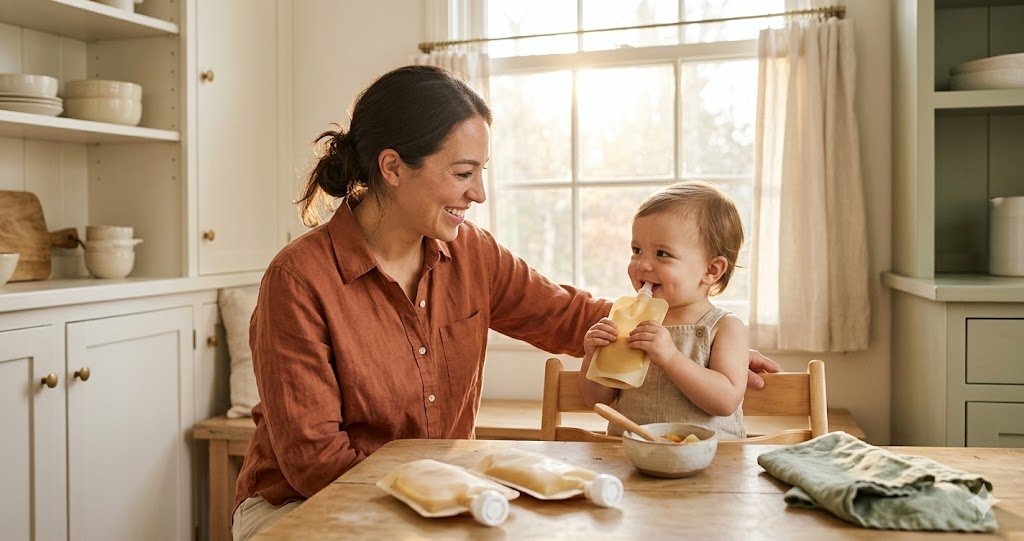
I’ve raised three kids through the purée years, and at some point every single one of them went through a phase where the only acceptable way to eat anything was by squeezing it out of a pouch. The store-bought ones add up fast though, both in money and in the little crinkly piles of foil that end up in the trash. Reusable food pouches fix both problems: you fill them with whatever you’ve already got in the fridge, your kid gets the squeeze-and-go experience they love, and you’re not buying a new pouch every single day.
The catch is that not all reusable pouches are built the same. Some leak the second a determined toddler gets hold of them. Some are a nightmare to actually clean. And a few are basically the same generic bag with a different logo printed on it. To pull this guide together I cross-referenced hundreds of parent reviews, checked each pouch against current FDA food-contact and CPSC material-safety expectations, and looked closely at the stuff that actually matters day to day: how they fill, whether they survive the dishwasher and freezer, and how well the seal holds when a one-year-old decides to test it.
Below are the seven I’d point a friend toward, plus one extra gadget for parents who batch-make their own purées.
The best reusable food pouches at a glance
- Best overall: Simple Modern Reusable Baby Food Pouches
- Best budget pick: Kirecoo 12-Pack (7 oz)
- Best leak-proof zipper: ChooMee SnakPack
- Best for picky eaters: Squooshi Animal Pouches
- Best silicone pouch: haakaa Happii Bear
- Best-looking (and easiest to clean): mushie Silicone Puree Pouch
- Best big-family value: Gemdom 20-Pack
1. Simple Modern Reusable Baby Food Pouches
Best Overall
Simple Modern is the brand a lot of parents already trust for kids’ water bottles and lunch boxes, and their pouches earn the same goodwill. They’re the most-reviewed pouch on this list by a wide margin, with tens of thousands of ratings sitting around 4.6 stars, which is about as close to a consensus pick as you’ll find in this category.
What makes them work is a wide double-zipper opening on the bottom. You flip the pouch over, unzip, spoon or pour your purée in, and zip it shut. The wide mouth is what makes cleanup bearable, since you can actually get a bottle brush down inside. They come in five designs (two of each), they’re freezer-safe, and they go on the top rack of the dishwasher.
The honest watch-out: like every bottom-zip pouch, the seal only works if you line the zipper up and press it fully closed. Rush it and you’ll get a leak. There’s also no filling funnel in the box, so you’re spooning food in or buying one separately.
2. Kirecoo Reusable Baby Food Pouches (12-Pack, 7 oz)
Best Budget
For the price of one fancy 2-pack, Kirecoo gives you twelve pouches, twelve caps, and a little flower-shaped filling funnel. That funnel is a genuinely nice touch at this price, because it turns the messiest part of the job into a thirty-second task.
These hold 7 ounces, which is the most generous capacity on the list. That’s great for a hungry preschooler or for stretching a batch of homemade purée, though it’s more than a younger baby will finish in one sitting, so you’ll want to fill them only partway for the little ones. The back panel is transparent, which sounds minor until you realize how much easier it makes spotting leftover purée stuck in a corner.
Reviewers consistently call out how much you get for the money. The trade-off is that you’re buying from a third-party seller rather than a big-name brand, so the prints and overall feel are functional rather than fancy.
3. ChooMee SnakPack
Best Leak-Proof Zipper
ChooMee is a small northern-California brand, and they’ve clearly spent their energy on the part of the pouch that actually fails: the seal. The SnakPack uses a double zipper with an extra-wide 3.5-inch bottom opening, which is both the easiest to fill and the hardest for little hands to pop open. It’s one of the most-reviewed pouches anywhere, and the company backs it with a limited lifetime warranty, which tells you something about how confident they are in the closure.
They meet and exceed US and European material-safety standards, and they’re freezer- and top-rack-dishwasher safe like the rest of the plastic options here.
The catch is the pack size. You only get four in the base set, and they’re not the cheapest per pouch, so realistically you’re buying two or three packs to have enough in rotation. For a leak-prone toddler, plenty of parents decide that’s worth it.
4. Squooshi Animal Pouches
Best for Picky Eaters
Squooshi was one of the original reusable-pouch brands, and the friendly animal prints aren’t just cute marketing. With a reluctant eater, a pouch that looks like a panda buys you exactly the kind of goodwill you need to get a few spoonfuls of spinach into a kid who has decided green is the enemy. It’s a small bit of theater, but parents of picky eaters report it works more often than it has any right to. (If mealtimes have become a daily standoff, our picky-eater survival guide goes deeper on no-pressure strategies.)
It’s a family-run, sustainability-minded company, and the design shows real thought: a top spout, a curved shape that fits small hands, and a wide bottom zipper you can fill two ways (by spoon or with their separate filling station). The double-zip closure is airtight and genuinely leak-proof, and the cap is designed so little hands can’t pop it off. You buy from Squooshi on Amazon.
Like the other character pouches, you’re paying a small premium for the designs, and the bottom zipper needs a thorough rinse so purée doesn’t hide in the seam.
5. haakaa Happii Bear Silicone Goody Pouch
Best Silicone Pouch
If you’d rather skip plastic entirely, haakaa is the name to know. Their Happii Bear pouch is a single piece of food-grade silicone with no zipper and no seams, which is the whole point: there’s nowhere for purée to get trapped, so cleaning is genuinely easy. It stands upright with a wide neck, so you just pour your homemade goodness straight in.
haakaa parents tend to be loyal, partly because the silicone pouches plug into the brand’s wider system of milk-storage bags and attachments, so the gear grows with your kid. They’re freezer- and dishwasher-safe and built to last for years.
Two honest caveats. You only get two per pack and they cost meaningfully more than the plastic options, so a full rotation is an investment. And like most silicone, they can pick up stains or smells from strongly colored foods like beets or tomato over time.
6. mushie Silicone Puree Pouch
Best-Looking & Easiest to Clean
If haakaa wins on ecosystem, mushie wins on looks. The muted, grown-up color palette is the kind of thing you won’t mind seeing on your counter, and the soft silicone is gentle on small hands and mouths. But the reason it’s really here is the safety paperwork: mushie pouches are third-party tested to CPSIA, ASTM, and California Prop 65 standards, which is more verification than most brands put in writing.
They’re top-rack dishwasher safe and, usefully, you can boil them to sterilize (up to 390°F), which is reassuring for the early months. Each pouch is a single piece of silicone, so cleaning is as fuss-free as the haakaa.
Same silicone trade-offs apply: just two in a pack, a premium price, and no spout-cap or straw variations if your kid prefers those.
7. Gemdom 20-Pack
Best Big-Family Value
When you’ve got more than one kid or you batch-prep for the whole week, you stop caring about prints and start caring about how many pouches you can keep in rotation. Gemdom’s 20-pack has the lowest per-pouch cost on this list, which means you can fill a big batch, freeze them, and not run out before the dirty ones make it back through the dishwasher.
They’re a straightforward bottom-fill plastic pouch: BPA-, PVC-, and phthalate-free, hand- or dishwasher-washable, and sized at a sensible 5 ounces for a single serving. The designs are basic and the brand is newer with fewer reviews than the established names, so go in expecting a workhorse rather than a showpiece.
Plastic vs. silicone: which should you get?
This is the question that trips up most parents, so here’s the short version.
Plastic zipper pouches (Simple Modern, Kirecoo, ChooMee, Squooshi, Gemdom) are cheaper, come in bigger packs, and pack flatter in the freezer. The downside is the bottom zipper: it’s one more thing to seal correctly and one more seam to clean. For most families, especially if you go through a lot of pouches, this is the practical choice.
Silicone pouches (haakaa, mushie) cost more and come in smaller packs, but they’re a single seamless piece, so there’s no zipper to fail and nowhere for food to hide. They also last for years and avoid plastic against your kid’s food, which matters to a lot of parents. If you’re buying fewer pouches and plan to keep them a long time, silicone can be the better value over its lifespan.
How to fill and clean reusable pouches without losing your mind
- Use a funnel or filling station. Spooning thick purée into a floppy pouch is the part everyone hates. A cheap funnel (Kirecoo includes one) or a dedicated filling station turns it into a non-event.
- Fill, don’t overfill. Leave about half an inch at the top, especially if you’re freezing, because the food expands as it freezes.
- Wash right away. Dried-on purée is the enemy. Rinse through the wide opening immediately, then let them air-dry inverted over a bottle rack or run them on the top rack of the dishwasher.
- Watch for stains and smells. Silicone in particular holds onto pigments from foods like beets, carrots, and tomato. A baking-soda soak or a sunny windowsill helps.
Filling pouches with homemade food? Store it safely.
The whole point of reusable pouches is filling them with your own food, so the storage rules matter. Homemade purées aren’t pasteurized like the store-bought kind, so they spoil faster and there’s less margin for error.
According to FoodSafety.gov, homemade baby food keeps in the refrigerator for only 1 to 2 days and in the freezer for 1 to 2 months. A few rules worth taping to the fridge:
- Refrigerate freshly made purée within two hours, and never leave a filled pouch out at room temperature for more than two hours.
- Don’t feed your baby straight from a pouch and then re-store it. Saliva contaminates the food and it’ll spoil fast. Squeeze out a portion into a bowl instead.
- Label every frozen pouch with the date, and toss anything past its window.
The FDA has a fuller rundown if you want to go deeper. If you’re new to making your own purées, a good baby food maker takes most of the work out of it, and our baby bottle guide covers the rest of the early feeding kit.
Want help starting solids?
Grab our free, printable First-Foods Tracker. It walks you through introducing the AAP’s recommended first foods, including the common allergens, over your baby’s first few months on solids, with space to note reactions and favorites.
Sign up below to download it free.
Bonus: the gadget that makes homemade pouches actually doable
If you’re making purées in bulk, the single biggest time-saver isn’t a better pouch, it’s a filling station. The Momcozy Squeeze Station loads your purée into a tube and pushes it cleanly into a pouch with an anti-splash design and a tip-proof base, so you can fill a week’s worth in one sitting without redecorating your kitchen. It’s not a pouch itself, and it’s the most expensive thing on this page, so it only makes sense if homemade is your regular routine rather than an occasional thing. For everyone else, a cheap funnel does the job.
Frequently asked questions
Are reusable food pouches actually worth it?
If your kid eats pouches regularly, yes. The pouches pay for themselves within a few weeks compared to buying disposables, and you control exactly what goes inside. If pouches are an occasional thing, the math is less dramatic but the waste savings still add up.
At what age can my baby use a pouch?
Once your baby has started solids, usually around six months. Just remember the dental advice above: for younger babies, squeeze the food onto a spoon rather than letting them suck it straight from the spout, and don’t let pouches replace spoon and finger feeding.
How many reusable pouches do I need?
Most families do well with somewhere between 6 and 12 in rotation, which covers a couple of days of meals and snacks while some are in the wash. If you batch-freeze, lean toward a larger pack like the Gemdom 20-count.
Can I put reusable pouches in the freezer?
All the pouches here are freezer-safe. Fill them only partway (leave room for expansion), lay them flat to freeze, and use homemade contents within one to two months.