The moment you add twins to a baby registry, every ordinary purchase seems to grow a second shadow. Two babies must mean two of everything, right?
Thankfully, no. You need two car seats and two separate safe sleep spaces. You need enough diapers, clothes, and feeding supplies for two babies between wash cycles. But one breast pump, one infant tub, one diaper bag, and one well-planned changing station can do plenty of work.
A matching pair only makes sense when safety or fit requires one for each baby. Otherwise, ask where the bottleneck really happens. Sometimes the useful duplicate is a small diaper caddy upstairs—not another piece of nursery furniture. And sometimes the smartest second purchase is the one you wait to make until both babies show you they will use it.
The true two-of essentials are two correctly fitted rear-facing car seats and two separate infant sleep spaces. For everything else, ask whether both babies must use it at the same time, whether one item can safely serve them in turn, and whether you are solving a baby problem or a room-layout problem.
| Buying rule | What it means | Typical examples |
|---|---|---|
| One per baby | Sharing or taking turns would not be safe or practical. | Car seats; separate cribs, bassinets, portable cribs, or play yards |
| Stock for two | You need enough to reach the next laundry, wash, or restock cycle—not two identical starter sets. | Diapers, clothes, burp cloths, sleepwear, bottles, nipples, pacifiers |
| One shared system | One item can serve both babies without making the routine harder. | Breast pump, infant tub, drying rack, cleaned grooming tools, diaper bag, twin-capable stroller plan |
| Per room or floor | Duplicate the small supplies that save steps, not the expensive furniture. | Changing caddy, night light, diaper pail, sound machine, monitor view |
| Start with one | Baby preference and your actual feeding or soothing routine should decide whether you add a second. | Bouncer, swing, rocker, carrier, bottle warmer, specialized feeding pillow |
If you are also building the broader, non-twin part of your list, our newborn must-haves checklist covers the basic categories. This guide is about the decisions that change when two babies arrive together.
Use the Simultaneous-Use Test Before You Buy a Second One
Some twin gear solves a real two-baby problem. Some simply gives you two bulky objects to step around. Before adding a duplicate, run through these questions:
- Will both babies regularly need this at the same moment?
- Can they safely take turns?
- Can one caregiver realistically operate two at once?
- Will a second one remove a repeated bottleneck, or only fill more floor space?
- Could the item be mistaken for a sleep space when it is not one?
If the second item protects each baby separately, buy it before birth. If it only promises convenience, start with one unless you already know how the two-item routine will work.
What Newborn Twins Truly Need Two Of
Two rear-facing car seats
Each baby needs a car seat that fits that baby and can be installed correctly in your vehicle. Twins are not guaranteed to be the same size at birth, so check the fit and harness position separately rather than treating them as a matched set.
The National Highway Traffic Safety Administration recommends keeping children rear-facing until they reach the top rear-facing height or weight limit allowed by the seat manufacturer. Read both the car-seat instructions and your vehicle manual; the correct seat on paper is not useful if it cannot be installed properly in the seating position you planned.
If either baby is born preterm, at low birth weight, or with medical needs, follow the hospital’s discharge instructions. The birth team may have additional guidance about fit or car-seat tolerance. Our baby car-seat guide can help with the broader decision once you know each baby’s needs and your vehicle layout.
Two separate safe sleep spaces
This is the second hard yes. The American Academy of Pediatrics advises separate sleep areas for twins and other multiples rather than placing them on the same sleep surface.
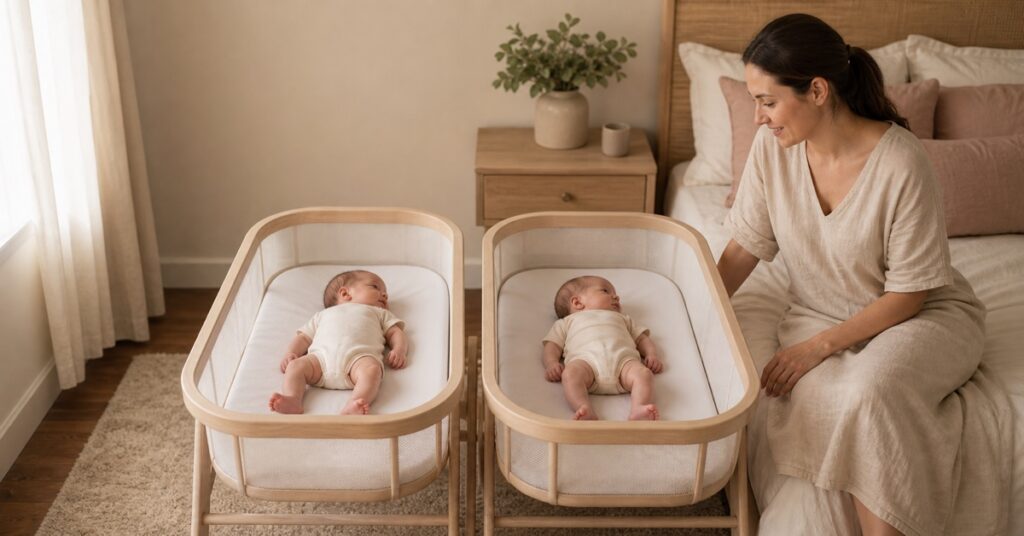
That can mean two cribs, two bassinets, two portable cribs, two play yards, or a combination that fits your room and each baby’s current limits. The babies can room-share with you and with each other. They should not share the same mattress.
A product marketed as a “twin bassinet” only solves this need if its instructions clearly identify two separate areas intended for infant sleep and each baby fits the relevant limits. The word twin on the box does not turn a divider, removable seat, or nursery attachment into a safe sleep surface.
Keep both sleep spaces firm, flat, and bare. Use a fitted sheet only—no pillows, blankets, bumpers, positioners, rolled towels, dividers, mattress toppers, or extra padding. The U.S. Consumer Product Safety Commission also says swings, rockers, gliders, and other inclined products should never be used for infant sleep. If a baby falls asleep elsewhere, move them to their own infant sleep space.
For at least the first 6 months, current AAP guidance supports room sharing without bed sharing. In a tight bedroom, two compact compliant sleep spaces are a better answer than squeezing both babies onto one surface. Use our bassinet guide when you are ready to compare the sleep-space options themselves.
Individual fit items—even when the babies look identical
A few categories are not really “buy two” so much as “check each baby.” Sleepwear size, swaddle fit, diaper size, bottle nipple flow, and car-seat positioning may not match from one twin to the other.
Color coding can help when sizes or feeding instructions differ. Keep the system simple: a colored bin label, bottle band used only during preparation, or a clear shelf assignment. Do not add strings, clips, labels, or accessories to a sleep space or to anything around a sleeping baby’s neck.
Stock for Two Babies—Without Buying Two Identical Sets
Diapers, pajamas, bottles, and burp cloths are inventory. The useful number depends on how often you wash, how often you restock, and whether the babies use the same size—not on a universal twin checklist.
Clothes and sleepwear
Build around your laundry rhythm. Each baby needs something to wear, a clean backup for the next spit-up or diaper leak, and enough remaining to reach the next load. A family running laundry daily needs far less clothing than one washing twice a week.
Avoid filling every drawer with newborn size. The babies may arrive at different weights and move into the next size at different times. A modest mix of newborn and 0–3 month basics gives you more room to adjust. Our newborn quantity guide goes deeper into planning around wash and restock cycles.
Diapers and changing supplies
You will use supplies for two babies, but you do not need two brands, two wipe dispensers, or two full changing tables. Start with a manageable diaper supply and keep receipts where possible. If one baby needs a different size or develops skin irritation, separate the baskets then.
One cream and one package of wipes can serve the changing station unless your pediatrician gives one baby a separate care plan. The more important duplicate is a clean outfit and fresh diaper within reach before you begin.
Bottles, nipples, and pump parts
Do not commit to a huge collection of one bottle before you know that both babies feed comfortably from it. Start with enough for your planned feeding method and the length of time you are willing to go between wash cycles. Add more of the bottle or nipple flow that actually works.
If one baby has a different formula, fortified feed, nipple flow, or medical feeding plan, label the preparation system clearly and follow the clinical instructions for that baby. For a method-based quantity guide, see how many baby bottles you may need.
The CDC advises holding a baby and the bottle during bottle feeding. Do not prop a bottle or leave it in a baby’s mouth. A self-feeding pillow is not a safe shortcut for feeding two babies at once.
Formula does not have to be warmed, so a bottle warmer is optional. Never use a microwave. Babies younger than 2 months, babies born prematurely, and babies with weakened immune systems may need extra precautions when powdered formula is prepared. Follow the current CDC preparation guidance and any instructions from your babies’ medical team.
What One Is Usually Enough For
Shared systems are where twin families can save the most space. One good workflow often matters more than a second appliance.
| Item | Why one usually works | When you might add or change it |
|---|---|---|
| Breast pump | One pump can support milk expression for both babies; extra compatible parts may reduce washing pressure. | Add parts based on pumping frequency, not a second pump by default. |
| Infant tub | Bathing one baby at a time keeps the caregiver’s attention where it belongs. | Replace only when the babies outgrow the product’s limits. |
| Cleaning and drying system | One large, clearly organized clean-to-dirty loop serves bottles and pump parts for both babies. | Add capacity if clean and dirty parts are constantly mixing. |
| Diaper bag | One comfortable bag can hold a change of clothing and supplies for each baby. | Change the bag if it becomes painful to carry or impossible to organize—not simply because there are two babies. |
| Baby monitor system | One parent unit or app can cover a shared room. | You may need a second camera angle if one view cannot clearly show both separate sleep spaces. |
| Sound machine | One machine serves a shared room. | Add another only if the babies later sleep in different rooms. |
| Large floor mat or play gym | Both babies can have supervised floor time on one washable open surface. | Expand the floor zone as they become more mobile. |
| Stroller plan | One twin-capable stroller or another deliberate two-baby transport plan replaces two everyday strollers. | Revisit after you know your car-seat compatibility, storage space, stairs, and usual caregiver setup. |
Start With One—and Let Real Life Decide on the Second
The most overbought twin items are often the ones babies have strong opinions about. One baby may love motion while the other wants the floor. One may accept a carrier while the other protests every strap. You do not need to predict both personalities before birth.
| Start with one | Add a second if… | Watch-out |
|---|---|---|
| Bouncer or supervised awake seat | Both babies regularly need a short awake seat at the same time and an adult can actively supervise both. | Move a sleeping baby to their own safe sleep space. |
| Swing or rocker | The first one is genuinely useful and your home has room for a second without crowding walkways. | These are not infant beds or routine nap spaces. |
| Baby carrier | Two adults often wear one baby each and each carrier fits the baby using it. | Follow the product’s newborn fit and airway instructions. |
| Bottle warmer | A real feeding queue develops and warming two bottles safely is the repeated bottleneck. | Milk does not have to be warm; never microwave it. |
| Specialized feeding pillow | Tandem feeding becomes your stable routine and the support improves positioning. | Use it for active feeding support only—never as a sleep or unattended lounging space. |
| Changing station | Stairs or nighttime travel repeatedly make the single station impractical. | A small caddy and floor pad may solve the problem without another piece of furniture. |
How to Set Up Each Part of Your Home for Newborn Twins
The goal is not to turn every room into a nursery. Give each active zone one job, keep the supplies for that job within reach, and send both babies back to their own safe sleep spaces whenever they sleep.
Parents’ bedroom: build a night shift, not a showroom
Place the two separate sleep spaces near your bed while following the clearance and setup instructions for each product. Add one dim light and one small caddy with diapers, wipes, cream, burp cloths, and clean sleepwear. Keep caregiver water and snacks somewhere they cannot fall into a bassinet or crib.
Do not tuck an adult pillow, feeding pillow, or folded blanket between the two sleep spaces. If you feed a baby in bed, return each baby to their own sleep area before you go back to sleep.
Monitor placement deserves attention now, even if the babies cannot reach far yet. The CPSC says to keep all monitor cords and parts at least 3 feet from infant sleep spaces.
Nursery: two sleep spaces, one care system
Leave an adult-sized path to both cribs rather than wedging them tightly around a dresser. One changing surface and one storage system are enough. Divide clothing and feeding items by size or need, not because matching baskets look tidy in a photo.
One sound machine can serve the room. One monitor system may also be enough, though two camera views can make sense when one crib blocks the other. Keep every cord away from both cribs.
Anchor the dresser and other top-heavy furniture when you assemble the room. Waiting until the babies can pull up is a task your future tired self does not need. The CPSC recommends securing top-heavy furniture according to the manufacturer’s instructions.
Living room: make the floor the default
A large washable floor mat gives both babies room for supervised awake time without automatically buying two seats. Add one diaper caddy and one basket for damp burp cloths and clothes headed to the laundry.
If you later discover that both babies need an awake seat while you sit beside them, a second bouncer may earn its footprint. It does not need to be in the house before they arrive.
The couch, an adult bed, a lounger, a swing, and a bouncer are not backup sleep spaces. If the living room becomes a regular nap zone, each baby still needs a separate compliant infant sleep surface there—or you take them back to the bedroom or nursery.
Kitchen or feeding zone: create a clean-to-dirty loop
At 3 a.m., the useful setup is one where a clean bottle cannot be confused with a partly used one. Keep clean bottles and pump parts in their own area, prepare feeds in one uncluttered spot, and send used parts straight to a defined dirty zone.
A single large drying rack or cleaning system is usually easier than two small setups. If the twins have different feeding instructions, use a plain labeling system that another caregiver can understand without calling you.
The workflow should make holding each baby easier, not create a way to prop two bottles. If feeding both babies alone feels unmanageable, ask your lactation consultant, pediatric team, or hospital feeding specialist to show you positions appropriate for your babies and feeding method.
Bathroom: one baby in the tub, one baby safely out
One infant tub is enough. Set out the towel, clean diaper, washcloth, and clothing before the water starts. The CPSC says a baby in the bath should stay within arm’s reach; if you must leave, take the baby with you.
Keep the other twin in their own crib or another appropriate safe place outside the wet zone. Do not try to bathe one baby while reaching across the room to settle the other. Bath time can be beautifully ordinary and one-at-a-time.
Entryway and car: make leaving repeatable
Keep one diaper bag ready with a change of clothing for each baby, enough diapers for the outing, burp cloths, and your feeding supplies. A small restock basket by the door lets you replace what you used as soon as you get home.
Store the stroller where it can actually leave the house. A wonderful double stroller buried behind boxes in a basement is not a practical system. Check its folded size, the path through your doorway, the trunk space it takes, and whether the configuration works with the car seats you chose.
Our diaper bag guide can help with the bag itself; the more important habit is the two-minute reset after every outing.
Two-story home: duplicate supplies, not furniture
Put a small changing and burp-cloth caddy on each active floor. That solves most stair frustration without buying two pumps, two tubs, two bottle warmers, and two dressers.
Add a second changing pad or diaper pail only if the stairs continue to interrupt the routine. Our newborn station setup guide has more ideas for building a compact station. Regular sleep still happens in each baby’s own safe sleep space, not wherever a seat happens to be available.
The Minimum Twin Setup to Finish Before Birth
Your home does not need to be finished down to the last labeled drawer. It needs to handle the first car ride, the first sleep, the next feeding, the next diaper, and one load of laundry.
Ready before the babies arrive
- Two installed rear-facing car seats that fit your vehicle plan.
- Two separate, compliant infant sleep spaces with fitted sheets.
- A feeding-method-neutral starter setup and a clean-to-dirty workflow.
- One primary changing area plus a small second-floor caddy if your layout needs it.
- Enough clothing, diapers, burp cloths, and sleepwear to reach the next wash or restock.
- One practical plan for moving both babies out of the house.
- One open, washable floor area for supervised awake time.
- A simple restock spot for nighttime and outings.
Safe to decide after you meet them
- A second swing, rocker, or bouncer.
- A second baby carrier.
- A second bottle warmer or diaper pail.
- A specialized tandem-feeding pillow.
- Large quantities of one bottle style, diaper size, or newborn outfit.
- Decorative nursery storage that does not solve a daily task.
Frequently Asked Questions
Do newborn twins need two bassinets?
They need two separate infant sleep areas. That may be two bassinets, two cribs, two portable cribs, two play yards, or another combination that meets current requirements and fits each baby. A single frame is only useful if its manual clearly provides two separate areas intended for infant sleep.
Can twins sleep in the same crib?
For a U.S. audience, follow AAP guidance to provide separate sleep areas and avoid cobedding twins on one sleep surface. They can sleep in the same room while each has their own crib, bassinet, portable crib, or play yard.
Do twins need two changing tables?
No. One stable changing setup is normally enough. In a two-story home, a small caddy and changing pad on the second active floor may save more time and space than a second piece of furniture.
Do I need two bottle warmers?
No. Breast milk or formula does not have to be served warm. Start without one or with one warmer, then add capacity only if safe warming becomes a repeated bottleneck. Never warm a bottle in the microwave.
How many bottles do I need for newborn twins?
Base the number on how the babies are fed and how often you want to wash. Start with enough to cover both babies between planned wash cycles, without buying a huge set of one bottle before you know that both babies accept it.
Do twins need two bouncers or swings?
Not before birth. Start with one if you want this type of awake-time gear. Add a second only if both babies use it, they often need it at the same time, you have room, and an adult can supervise. Neither product is a safe infant sleep space.
Can one baby monitor cover two cribs?
Often, yes. One system can cover a shared room. You may need two camera views if one angle cannot clearly show both cribs. Keep all cords and monitor parts at least 3 feet from both sleep spaces.
Do twins need two sound machines?
One sound machine is normally enough when both babies sleep in the same room. If they later move to separate rooms, that is the time to consider another.
Build for Two Babies, Not Two Shopping Carts
The safest parts of your twin setup are deliberately separate: two car seats, two sleep surfaces, and individual fit checks for each baby. The rest of the house can work as a shared system.
Keep enough washable basics to reach the next load, and put small supply caddies only where they spare a real trip. For the preference-driven gear, one is a sensible beginning. Your babies—not the registry algorithm—can tell you whether another would genuinely help.
A calm twin setup does not come from owning twice as much. It comes from knowing exactly where the second one matters.
This article provides general educational information and does not replace advice from your pediatrician, hospital team, lactation consultant, or child passenger safety technician.