Updated July 29, 2026
The Short Answer: Most Families Need Two Boards
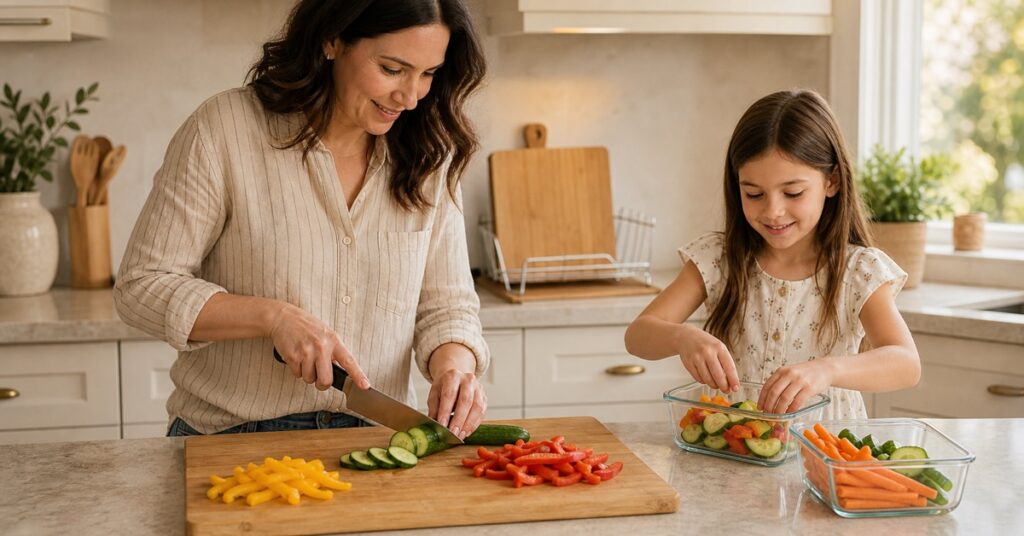
Meal prep gets crowded quickly. Fruit for my daughter’s lunch, onions for dinner, a loaf of bread and a package of chicken can all land on the counter within minutes. The problem is rarely that a family owns no cutting board. It is that the one available board is too small, still wet from the last task or suddenly doing double duty for foods that should stay separate.
For most busy families, the simplest answer is a two-board system:
- one roomy everyday board for produce, bread and other ready-to-eat foods;
- one clearly assigned, easy-to-clean board for raw meat, poultry and seafood.
That second board removes a decision when dinner is already running late. You do not have to remember which side touched chicken or hope a quick wipe was enough.
A huge board is not helpful if you have to wedge it into the sink or leave it flat on the counter to dry. Before you buy, picture the whole route: counter, sink or dishwasher, drying space and cabinet.
“Two-board system” describes the two jobs you need covered, not the exact number of boards you must buy. A three-piece set can still work well when two boards have permanent assignments and the third stays available for small clean tasks.
Two Practical Setups at a Glance
| Setup | Works best for | Board sizes | Set weight | Dishwasher safe | Main watch-out |
|---|---|---|---|---|---|
| OXO Good Grips 2-Piece Cutting Board Set | Compact two-board separation | 7.25 × 10.75 inches; 9 × 12.9 inches | About 2.04 pounds | Yes | The larger board is still compact, and the surface will show wear |
| Gorilla Grip Cutting Board Set of 3 | A multi-size family rotation | 11.8 × 8 inches; 13.8 × 9.6 inches; 16 × 11.2 inches | About 4.25 pounds | Yes | Takes more storage space; stability can vary by counter surface |
Neither set is a universal winner. The OXO set is easier to fit into a small kitchen. The Gorilla Grip set gives you more working room and one extra board to rotate through a long prep session.
OXO Good Grips 2-Piece Set: The Compact Two-Board Starter System
Works best for: smaller kitchens, lighter prep sessions and families that want both boards to go straight into the dishwasher.
The OXO set is the simpler starting point if you want two clearly assigned boards without filling an entire cabinet. According to the OXO product page, it includes a 7.25-by-10.75-inch Prep Board and a 9-by-12.9-inch Everyday Board. Both are double-sided and dishwasher safe, with non-slip feet, drip catchers and tapered edges that are easier to lift.
That size combination makes the household rule simple. The smaller board can handle a contained raw-protein task, while the larger one stays available for fruit, vegetables, bread or cooked foods. You could reverse those assignments if that fits the way you cook; consistency matters more than which board gets which job.
The larger board is also the main compromise. At about 12.9 by 9 inches, it is easy to wash and store, but it can feel crowded when you are chopping several vegetables or trying to keep finished ingredients out of the path of your knife. Good Housekeeping’s testing reached a similar conclusion: the board was smaller than its testers were used to, yet its dishwasher-friendly size quickly became part of the appeal.
OXO describes the feet as non-slip, and independent testing found that they helped the boards stay put. I would still test either board on your own counter before starting a fast chopping job. A damp or greasy surface can change how even a grippy board behaves. Plastic will also collect knife marks with use. Replace the board if those marks become deep, rough or difficult to clean, or if the board begins to warp or shed material.
Skip it if: you routinely prep several meals at once, carve large foods or want generous space for piles of chopped vegetables.
Gorilla Grip 3-Piece Set: More Room for a Family Rotation
Works best for: larger prep sessions and families that want different board sizes ready for different jobs.
The Gorilla Grip set gives you three usable sizes: 11.8 by 8 inches, 13.8 by 9.6 inches and 16 by 11.2 inches. Each board is about 0.37 inch thick, and the full set weighs about 4.25 pounds. They are reversible and dishwasher safe, with a juice groove on one side.
The extra board is useful when meal prep happens in waves. You can keep the largest one for vegetables and other everyday chopping, reserve another for raw meat or seafood and still have a clean small board for fruit, bread or a quick snack. That is more flexible than asking one board to cycle through every task, especially when the dishwasher is already running.
The 16-by-11.2-inch board gives you noticeably more room than the larger OXO board. It also takes more room in the sink, dishwasher and cabinet. Measure all three before buying, including the place where they will stand while drying. A set only saves time when none of its pieces becomes the awkward board everyone avoids washing.
Before you start chopping, make sure the counter is clean and dry. Gorilla Grip’s own care guidance says this helps prevent slipping. It also tells users to keep knife cuts off the rubber border. Check the board before each prep session, and stop using it for food if the surface develops deep grooves, cracks or loose material.
The surface can scratch and stain, and the rubber edge will not grip every counter in exactly the same way. If the board moves during your first check, do not keep chopping and hope it settles down.
Skip it if: cabinet space is tight, your dishwasher cannot comfortably hold the largest board or you prefer a lighter two-board setup.
How to Choose a Cutting Board for Family Meal Prep
Start With Usable Space, Not the Word “Large”
A board’s outside dimensions do not tell you how much room your knife will have. Juice grooves, handles and sloped edges all reduce the flat working area. Think about your usual ingredients instead.
If you chop one apple or a sandwich at a time, a compact board may be enough. If meal prep means onions, peppers, carrots and herbs waiting in separate piles, you need room to move finished food away from the blade. A too-small board creates extra transfers, more bowls and more chances for food to tumble onto the counter.
Measure the Entire Cleanup Path
Before buying, measure four places:
- the clear section of counter where you actually chop;
- the inside of the sink;
- the dishwasher rack, including spray-arm clearance;
- the cabinet, drawer or vertical slot where the board will dry and live.
This boring measurement step can save you from wrestling a board sideways under the faucet every evening. If a board is dishwasher safe, that does not mean it fits your dishwasher. If it must be hand-washed, make sure you can turn and rinse it without splashing half the kitchen.
Check Stability Before You Chop
Rubber feet and grippy borders can help, but no design guarantees the same hold on quartz, tile, wood and laminate. Set a new board on a clean work surface and press gently at the corners before bringing out a knife. Then repeat the check when you flip it, since a double-sided board may contact the counter differently on each side.
If the manufacturer allows a clean damp towel or purpose-made nonslip mat underneath, that can help a board without grips. Wash the towel or mat afterward. Do not use a workaround to excuse a board that is badly warped, cracked or unstable.
Choose Care You Will Follow on a Wednesday Night
Plastic is popular for raw-protein prep because many plastic boards can go into the dishwasher. Confirm that on the exact product; “plastic” alone does not make something dishwasher safe.
Wood and bamboo usually need hand-washing, prompt drying and sometimes regular oiling. That routine can be perfectly manageable for a board you enjoy maintaining. It is a poor match if the board will sit wet beside the sink until morning.
Composite boards vary. Follow the manufacturer’s instructions for the exact model rather than assuming every paper-composite or resin board handles heat and dishwashers the same way.
Think About Weight in Both Directions
A very light board may be easy to carry but more eager to move. A heavy board may feel planted yet become annoying to lift, rinse and put away. The useful weight is the one you can control safely with one normal trip from counter to sink.
This matters even more in a busy family kitchen, where the person carrying the board may also be moving a bowl, closing a dishwasher or asking a child to step back from the work area. Fewer awkward movements are worth more than an impressive specification.
A Faster, Safer Meal-Prep Order
FoodSafety.gov recommends using one cutting board for fresh produce and foods that will not be cooked, and another for raw meat, poultry and seafood. A simple order makes that separation easier to maintain:
- Wash your hands and clean the counter.
- Use the everyday board for fruit, vegetables, bread and other ready-to-eat foods.
- Move finished food into clean meal-prep containers.
- Bring out the raw-protein board only when you are ready for that task.
- Keep its juices away from clean utensils, produce and lunch containers.
- Do not wash raw meat, poultry, eggs or seafood; splashing can spread germs around the sink.
- Wash the used board with hot, soapy water or follow its dishwasher instructions.
- Let the board dry completely before storing it.
This order also makes freezer prep less chaotic. Portion and seal clean ingredients before the raw-protein board takes over the work area. Our vacuum sealer guide for freezer meal prep can help you choose a setup that fits that workflow. If you are stocking several weeks of meals, decide where the finished packages will cool and freeze before chopping begins. A dedicated freezer for breast milk and meal prep may help when household freezer space is already tight.
Using two boards does not replace handwashing, clean utensils or proper cooking temperatures. It simply gives the messiest part of meal prep a clear boundary.
Plastic, Wood, Bamboo, Composite, Glass or Titanium?
No material is best in every kitchen. Start with the care routine and trade-offs your family can live with.
Plastic is light, widely available and often dishwasher safe. It is easy to assign one plastic board to raw-protein prep, and visible wear gives you a clear cue to inspect it. The trade-off is that knives mark the surface.
Controlled studies have also observed plastic-particle release as knives abrade plastic boards. These include a 2023 study in Environmental Science & Technology and a 2026 laboratory study in Communications Materials. The latter examined release under controlled chopping conditions and was still labeled as an unedited version when this guide was prepared in July 2026.
That research is a reason to replace badly worn boards and avoid careless overuse. It is not proof that normal household use of a particular board has caused a specific human illness. Food safety still depends heavily on separating foods, washing the board properly and replacing surfaces that can no longer be cleaned.
Wood can feel comfortable under a knife and can last a long time when it is washed, dried and maintained correctly. It is usually heavier and should not go into the dishwasher unless the exact manufacturer says otherwise. Deep cracks, separation and persistent mold are replacement signs, not character.
Bamboo is often lighter and less expensive than a thick hardwood board. It can also feel harder under the knife, and its durability depends on construction and care. Hand-wash it, dry it promptly and follow the maker’s oiling instructions. Do not assume “natural” means maintenance-free or automatically safer.
Composite boards may offer a thinner profile with easier cleaning, but the category covers different materials and heat limits. Check the exact care instructions. A dishwasher-safe composite board can be convenient; one that requires special treatment may not simplify your routine at all.
Glass, stone and metal are easy to wipe, but a nonporous surface is not the only thing that matters. These materials can be noisy, slippery and hard on knife edges. I would not choose them as a family’s main chopping surface simply because they sound easier to sanitize.
Titanium has become a popular “plastic-free” talking point, but material alone does not answer the practical questions. A titanium board still needs stable footing, a usable size, safe edges, credible construction details and a surface you are comfortable using with your knives. Do not replace one absolute marketing claim with another.
When Should You Replace a Cutting Board?
There is no honest calendar rule for every board. Frequency of use, knife pressure, cleaning, heat and construction all affect wear.
Replace a cutting board when:
- grooves are deep or rough enough to be difficult to clean;
- it no longer lies flat and stable;
- the board is cracked, split, delaminating or shedding material;
- rubber feet or borders are loose or missing;
- wood or bamboo has persistent mold, odor or separation after proper cleaning and drying;
- damage creates an area that can trap food and moisture.
Staining alone does not always mean a board is unsafe, and a normal shallow knife mark is not an emergency. Replace the board when damage makes it harder to wash, causes it to rock or exposes loose material.
Frequently Asked Questions
Do I really need separate cutting boards for meat and vegetables?
Separate boards are the easiest family system because the assignment stays clear even when the kitchen is busy. FoodSafety.gov specifically recommends one board for fresh produce and foods that will not be cooked and another for raw meat, poultry and seafood.
If you have only one board, it must be thoroughly washed between tasks, along with your hands, utensils and work surface. A second board is not magic; it simply makes the safer routine easier to follow.
Is wood or plastic more sanitary?
Neither material stays sanitary without proper cleaning and drying. Plastic is often easier to put in a dishwasher, while wood can last well with careful hand-washing and prompt drying. Replace either material when damage makes the surface difficult to clean.
Choose based on the routine you will actually maintain, not a claim that one material is naturally perfect.
What size cutting board is best for family meal prep?
The best board is large enough to keep your ingredients and knife comfortably on the surface, but small enough to wash without awkward lifting or splashing. Measure your counter, sink, dishwasher and storage area before choosing.
For context, the larger OXO board is about 12.9 by 9 inches and favors compact cleanup. The largest Gorilla Grip board is 16 by 11.2 inches and gives you more room, with a larger storage footprint.
Can wooden or bamboo cutting boards go in the dishwasher?
Usually not. Dishwasher heat, water and long wet cycles can contribute to warping, cracking or separation. Follow the instructions for the exact board. If the manufacturer says hand-wash only, wash it promptly, rinse it and dry it upright with airflow.
When should I replace a plastic cutting board?
Replace it when deep grooves, rough edges, warping, cracks or loose material make the board difficult to clean or unstable. There is no universal replacement date. Inspect the surface as part of cleanup instead of waiting for a certain number of months.
Are color-coded cutting boards worth it?
They can be useful if the colors have fixed jobs and everyone in the household remembers them. A red board does not improve food safety if it slides, cannot be cleaned well or gets used for fruit a few minutes later.
Labels, a storage position or a clear size difference can work just as well. Pick the cue your family will follow consistently.
Are glass or titanium cutting boards better?
Not automatically. Glass can be slippery, noisy and hard on knives. Titanium avoids some concerns people have about plastic or wood, but it still needs to be stable, well made, comfortable under a knife and easy to handle.
Judge the whole board, not one material headline.
How do I stop a cutting board from sliding?
Start with a clean board and a clean counter, then follow the manufacturer’s instructions. Test the board with gentle pressure before cutting. Some boards are designed for a clean, dry surface; boards without grips may allow a clean damp towel or nonslip mat underneath.
Stop using the board if it moves unpredictably, is warped or has damaged grip components. A knife task is not the place to improvise around unstable equipment.
A Two-Board System Is Enough for Most Families
The best cutting-board setup is the one that still makes sense at the end of a long day. One roomy board for produce and ready-to-eat foods, plus one clearly separate board for raw proteins, gives most families enough structure without creating a cabinet full of equipment.
Choose the OXO set if compact storage and easy dishwasher cleanup matter most. Choose the Gorilla Grip set if you want a larger work surface and an extra board in rotation. Then keep the habit simple: assign the boards, clean them promptly, let them dry and replace them when wear affects stability or cleanability.
You do not need a perfect board. You need boards you can tell apart, wash without a struggle and reach for without thinking.