Updated July 28, 2026
A mixing bowl can look perfectly ordinary until pancake batter is creeping toward the counter, a child is trying to hold one side, and the whisk is pushing the whole thing in circles.
That is why the best mixing bowl set is not automatically the one with the most pieces. A deep stainless bowl can control splashes but still slide. A plastic bowl can feel steadier and easier to pour but will show scratches sooner. Glass is useful for microwave jobs only when the exact manufacturer directions allow it, and its extra weight and breakage risk make it a poor default for small helpers.
I compared exact current listings, manufacturer specifications, independent kitchen tests and recent low-star feedback patterns. I kept this list to three sets because each has a clear family job and a trade-off that can be explained honestly. Several popular alternatives were left out when their current quality or safety pattern was harder to accept.
Choose the Cuisinart stainless-steel set for a simple everyday workhorse, the OXO Good Grips plastic set when light weight and a non-slip base matter most, or the WHYSKO five-piece set when you need more inexpensive prep bowls at the same time. None is the right bowl for every kitchen task.
The Quick Picks
| Mixing bowl set | Best for | Material | Seller-listed sizes | Non-slip | Lids | Microwave | Main trade-off |
|---|---|---|---|---|---|---|---|
| Cuisinart CTG-00-SMB | Everyday stainless-steel mixing | Stainless steel | 1.5, 3 and 5 qt | No | Yes, but current fit complaints repeat | No | Buy it for the bowls, not dependable storage lids |
| OXO Good Grips 3-Piece | Lightweight, steadier mixing and pouring | Plastic | 1.5, 3 and 5 qt | Yes | No | Not listed for this exact set | Plastic scratches, and the soft base can age |
| WHYSKO 5-Piece, Silver | Budget mise en place and meal prep | Stainless steel | 0.75, 1.5, 3, 4 and 5 qt | No | No | No | Thin, shallow bowls are not meant for heavy mixing |
How I Chose Mixing Bowls for Real Family Use
The first question was not “How many accessories come in the box?” It was “What can this bowl do on a busy afternoon without creating a new problem?”
I looked for a useful size progression, enough depth to leave mixing room, a rim or handle that is comfortable to steady, and cleaning directions tied to the exact product. I also separated a bowl’s core job from the extras. A set can still be a good group of mixing bowls when its lids disappoint, but it cannot be recommended as a storage-led set if those same lids are the reason to buy it.
Independent tests helped with bowl shape, sliding, pouring and splash control. Current exact-product reviews helped identify what may show up after the test kitchen is finished: a lid that no longer fits, a soft base that leaves marks or a thin bowl that flexes under pressure. One complaint is not a verdict. A repeated, recent and configuration-matched pattern is a reason to narrow the recommendation or leave a product out.
I also checked current product identity, availability and targeted recall results. No exact recall match was located for these three current listings in the searches conducted, but that does not replace inspecting any bowl when it arrives and following the current care instructions.
The Best Mixing Bowl Sets for Family Baking and Meal Prep
1. Cuisinart CTG-00-SMB — Best Everyday Stainless-Steel Set
Cuisinart is the most balanced place to start when you want three uncomplicated metal bowls for baking and prep. The 1.5-quart bowl is useful for eggs, a small sauce or measured dry ingredients. The 3-quart bowl handles many cake and muffin batters. The 5-quart bowl leaves more room for cookie ingredients, a family salad or a larger batch of vegetables.
The shape matters as much as the numbers. Independent testing by Epicurious liked the set’s high sides and rolled lips, while other test kitchens have also treated it as a strong stainless-steel option. Deep sides help keep flour and dressing inside the bowl, especially when mixing starts gently.
Stainless steel is light enough to lift with one hand, does not hold onto food odors easily and will not shatter when it reaches the floor. Cuisinart lists the bowls as dishwasher-safe and freezer-safe. They nest into one stack, so the large bowl does not require its own shelf.
The weakness is easy to name: the lids. Several current reviews for this exact three-piece nesting set describe the largest lid as difficult or impossible to snap into place. Older independent tests were more positive about lid performance, but the recent pattern is current enough that I would not buy this set for sealing leftovers. Treat the lids as a possible short refrigerator cover, check every fit as soon as the set arrives, and use a purpose-built glass food storage container when a reliable seal really matters.
The bowls also have no rubber base. A smooth metal bowl can travel across a polished counter under vigorous whisking. Set it on a slightly damp folded kitchen towel or a silicone mat before mixing. Metal is not microwave-safe, so melting butter or chocolate requires a different bowl and a method approved for that bowl.
Best for: A family that wants a compact three-size stainless set for batter, cookie ingredients, salad and general prep.
Watch-outs: Current lid-fit complaints repeat, especially for the largest bowl. Check the rolled rims after washing and dry the set thoroughly.
Skip it if: Reliable storage lids, a built-in non-slip base or microwave use is central to the purchase.
2. OXO Good Grips 3-Piece Plastic Set — Best Lightweight Non-Slip Set
OXO is the easier set to manage when the person at the bowl needs help keeping it still. Each bowl has a soft handle on one side, a pour spout on the other and a non-slip base underneath. That combination is useful for pancake batter, beaten eggs, vinaigrette and any recipe that needs to move from bowl to pan without a wide, drippy arc.
The bowls follow the same practical 1.5, 3 and 5-quart pattern as the Cuisinart set. They are deep enough to give a whisk some room, and Epicurious’s testing found that the rubberized bases stayed steady during vigorous beating. Food Network’s tested roundup also selected OXO as its plastic-bowl choice.
For family baking, light weight can be a real feature. A child can steady a plastic bowl more comfortably than a heavy glass one, and the handle gives an adult a clear place to help. That does not make it a children’s utensil, though. An adult should handle hot ingredients, raw meat and every electric mixer. Keep small hands away from beaters, cords and the edge of the counter.
OXO says this exact set is BPA-free and dishwasher-safe. Its current official page does not list microwave-safe use. That missing direction matters more than a retailer answer or a broad statement about plastic, so I would use another explicitly microwave-safe bowl for melting or reheating.
Plastic will collect scratches sooner than stainless steel. A silicone whisk or flexible spatula is gentler than metal, and a fast hand mixer can leave marks as its beaters approach the sides. Long-term feedback for this exact White/Black set also includes the black base material rubbing off or leaving marks after several years. That is a maintenance and lifespan trade-off rather than a reason to ignore the set’s day-to-day handling advantage.
The OXO set has no lids. That keeps the nesting stack simple, but it also means batter or chopped produce needs a separate cover in the refrigerator. If meal prep means several days of finished meals, move the portions into dedicated containers; for longer freezer prep, a family vacuum sealer may be the more useful next tool.
Best for: Pancake and cake batter, eggs, salads and supervised family baking where light weight, grip and a controlled pour matter.
Watch-outs: The exact official page does not list microwave-safe use. Plastic scratches, and the soft grip material may wear over time.
Skip it if: You use metal mixer attachments frequently, need lids or want the same bowl to go into the microwave.
3. WHYSKO 5-Piece Stainless Steel Set — Best Budget Set for Prep Bowls
WHYSKO makes more sense as a group of staging bowls than as one serious mixing workhorse. The exact Silver set is sold with five sizes—0.75, 1.5, 3, 4 and 5 quarts—so several ingredients can wait separately while a recipe comes together. The smallest bowls can hold chopped herbs, eggs or measured sugar. The middle bowls work for vegetables and dry ingredients. The largest can handle salad or a light mixture when it is not filled close to the rim.
That five-bowl spread is useful during meal prep. One bowl can collect scraps, one can hold washed produce, and two more can keep ingredients apart before cooking. The bowls nest when the counter is clear, and the Silver version avoids making a colored exterior coating part of the purchase.
The low price comes with a physical trade-off: these are thin, light bowls. Current exact Silver feedback repeats that point, and Rouxbe chef Barton Seaver also described the linked set as light and inexpensive after a few weeks of use. He did not claim long-term heavy testing. That limited support fits the role here—affordable prep bowls—not a promise of professional thickness.
Capacity deserves another caution. The five numbers above are the seller-listed sizes, not comfortable working room. One current exact-product review measured the largest bowl below its 5-quart label even when filled to the top. Whatever the nominal number, batter needs empty space above it. If a recipe already approaches four quarts of ingredients, choose a genuinely larger and deeper bowl.
The shallow, flexible shape is not ideal for stiff dough or a fast hand mixer. There is no non-slip base, so a towel or mat may be needed. The set also has no lids, and stainless steel cannot go in the microwave. Choose it when simultaneous prep is the problem; choose a thicker, deeper bowl when force and splash control are the problem.
Best for: A budget-conscious cook who wants several nesting bowls for mise en place, washed produce, dry ingredients and salad.
Watch-outs: The bowls are thin and relatively shallow. Treat capacities as seller-listed maximums, not guaranteed working room.
Skip it if: You make stiff dough, use a hand mixer at high speed or need a dependable 5-quart working bowl.
Stainless Steel vs Plastic vs Glass Mixing Bowls
A material label does not tell the whole story, but it can eliminate the wrong bowl quickly. Start with what the bowl must do after the ingredients go in.
| Family task | Stainless steel | Plastic | Glass |
|---|---|---|---|
| Pancake or cake batter | Very good when the bowl is deep; may need a mat | Very good when it has a grip and spout | Stable but heavy |
| Cookie dough | Good in a deep, rigid bowl | Fine for lighter dough; more prone to scratching | Heavy; adult handling preferred |
| Microwave melting | Never | Only when the exact product says microwave-safe | Only when the exact product says microwave-safe |
| Marinating | Good; keep covered and refrigerated | Use food-grade plastic; keep covered and refrigerated | Good; handle carefully and keep refrigerated |
| A child helping | Durable but can slide | Usually the lightest and easiest to steady | Adult handling is the safer default |
| Long-term surface appearance | Resists deep scratches but can show scuffs | Most likely to scratch and stain | Stays clear, but chips and deep scratches end its use |
Glass can be the useful fourth bowl rather than the material for the whole set. If you regularly melt butter in the microwave, one clearly marked microwave-safe glass bowl may complement a stainless or plastic set. Follow the exact care directions. Pyrex’s use-and-care guidance, for example, warns against sudden temperature changes and says not to use chipped, cracked or severely scratched glass. A hot glass bowl should not be placed on a wet, cold or metal surface.
What Mixing Bowl Sizes Does a Family Actually Need?
A three-bowl set around 1.5, 3 and 5 quarts is enough for many households. It gives each bowl a different job without filling a cabinet with near-duplicates.
- 1 to 1.5 quarts: eggs, sauce, streusel, a small amount of dry ingredients or a single chopped component.
- About 3 quarts: pancake batter, muffin batter, cake mix, a side salad or ingredients for a smaller batch of cookies.
- About 5 quarts: cookie ingredients, a larger family salad, meatball mixture or several vegetables ready for roasting.
- 7 to 8 quarts: double batches, bread dough and party-size salad. Many families do not need this size every week.
Do not confuse maximum capacity with usable mixing capacity. A “5-quart” bowl may hold close to that amount only when liquid reaches the rim. Whisking, folding and using beaters require headroom. For dry flour or a fast mixer, leaving the top third of the bowl relatively open can save the counter from a white cloud.
Shape changes capacity too. A broad, shallow bowl makes salad easy to toss but lets batter climb out. A deep bowl controls splashes but may be harder for a child to reach into safely. If large-batch baking is common, buy one larger deep bowl instead of assuming that the biggest member of every set will be enough.
Mixing Bowl Features Worth Paying For
A non-slip base changes the experience more than a dozen small accessories. It is especially helpful when one hand is measuring or a child is learning to whisk. A removable mat or damp towel can do the same job for metal, but a built-in base is faster.
Depth and a comfortable rim matter for control. The bowl should leave room above a normal batch and give your supporting hand a safe place away from the ingredients. A handle is useful when pouring; a rolled metal rim is useful when lifting from any side.
A real pour spout earns its cabinet space if your routine includes pancakes, cupcakes or scrambled eggs. It matters less for stiff dough and salad.
Clear care instructions are worth more than a vague “does everything” claim. Microwave, dishwasher, freezer and heat directions belong to the exact bowl, not the material category. If the manufacturer does not list a use, choose another vessel.
Lids are useful only within their limits. A lid can keep a bowl from drying out during a short refrigerator rest, but a mixing bowl does not become a transport container just because plastic snaps over the top. For several days of leftovers, use containers designed for storage.
Extra graters, slicers, measuring cups and tiny bowls are not automatic value. Count the bowls you will use every week, check whether the largest one is deep enough, and make sure the stack fits your shelf. If attachments are already taking over the utensil drawer, our kitchen drawer organizer guide can help you decide what deserves the space.
Meal-Prep Safety: A Bowl Is Not a Food-Safety Shortcut
Mixing bowls are useful for washing, portioning and marinating, but material and lids do not replace temperature control.
Keep the refrigerator at 40°F or below. The USDA advises refrigerating perishable food within 2 hours, or within 1 hour when the temperature is above 90°F.
- Marinate in the refrigerator, not on the counter. The USDA’s poultry guidance allows a covered food-grade plastic, stainless-steel or glass container.
- Prevent raw juices from spreading. Store raw meat, poultry and seafood securely covered and below ready-to-eat foods.
- Do not reuse raw marinade as a sauce unless it has been brought to a boil as directed by the USDA.
- Move finished food into suitable storage. A loose bowl lid is not the right container for soup, a backpack or a long refrigerator stay.
- Use separate tools for raw and ready-to-eat foods. Wash the bowl, whisk, counter and hands after raw meat contact.
For a larger weekly routine, matching containers and suitable freezer storage may solve the problem more cleanly than keeping every ingredient in its mixing bowl.
A Safer Setup When Kids Help Bake
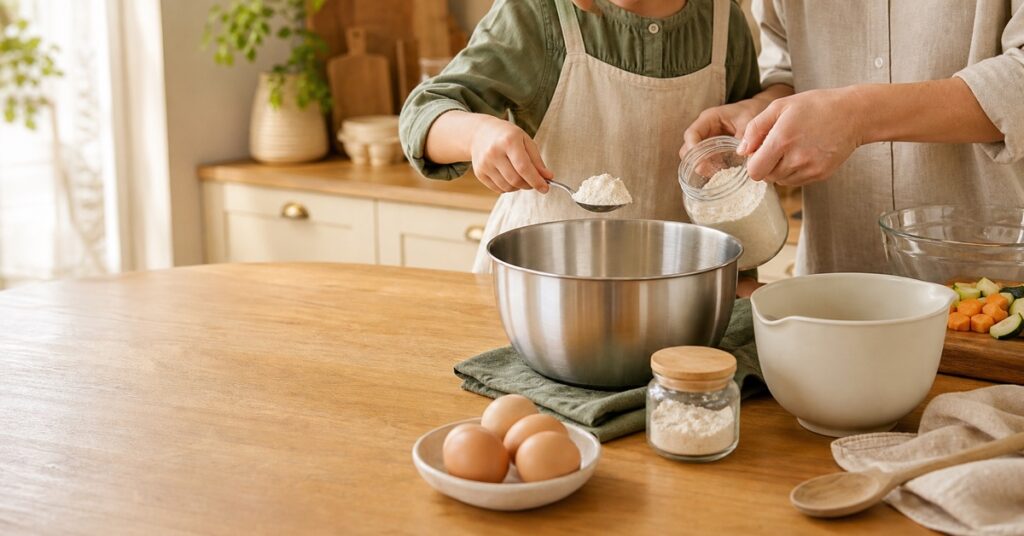
Put the bowl well back from the counter edge before opening any ingredient. A light plastic bowl with a non-slip base is easier for small hands to steady, but an adult should still control the setup. For more ideas beyond baking, these age-appropriate kitchen jobs for toddlers offer simple ways to help without putting a child near heat or blades.
Let a child scoop, pour pre-measured ingredients and hand-stir at a slow pace. An adult handles hot butter, raw meat, glass bowls and every electric mixer. Unplug beaters before a child comes close to them, and never let a child hold the bowl while a hand mixer is running.
Do not let children taste raw batter or dough. CDC food-safety guidance explains that raw flour and raw eggs can contain germs even when the batter looks harmless.
Start at the lowest speed after flour is added. A deep bowl helps, but it cannot contain a mixer switched on at full speed. Pause to scrape the sides with the appliance unplugged, then restart only after hands and tools are clear.
Frequently Asked Questions
What is the best material for mixing bowls?
Stainless steel is the most versatile starting point because it is light, durable and easy to clean. Plastic is better when low weight, grip and pouring control matter most. Glass is useful for microwave tasks only when the exact bowl is approved for them, but it is heavier and breakable.
How many mixing bowls does a family need?
Three bowls around 1.5, 3 and 5 quarts cover most everyday baking and prep. Add a 7- or 8-quart bowl only if double batches, bread dough or party-size salads are common. More pieces help when you frequently prepare several ingredients at once.
Are mixing bowls with lids good for meal prep?
They can cover chopped ingredients or resting dough in the refrigerator, but they should not automatically be treated as leakproof storage. Check the exact lid directions and current fit. Use a dedicated container for thin liquids, transport and longer refrigerator storage.
Can stainless-steel mixing bowls go in the microwave?
No. Metal should not go in the microwave. Transfer the food to a microwave-safe vessel and follow that product’s directions.
Can I use a hand mixer in any mixing bowl?
No. Choose a deep, stable bowl with enough headroom. Metal beaters can scratch plastic, shallow bowls can throw ingredients, and thin bowls can flex. Start at low speed, keep hands clear and let an adult operate the mixer.
How do I keep a stainless-steel bowl from sliding?
Set it on a silicone mat or a slightly damp folded kitchen towel. Keep the towel flat so the bowl does not wobble, and place the setup away from the counter edge.
Which Mixing Bowl Set Should You Choose?
Choose the Cuisinart CTG-00-SMB when you want a compact stainless-steel set for ordinary baking and prep. The bowls are the reason to buy it; do not depend on the lids for a reliable seal.
Choose the OXO Good Grips plastic set when a lighter bowl, non-slip base, handle and pour spout will make family baking easier. Use another bowl for the microwave and accept that plastic will show wear sooner.
Choose the WHYSKO five-piece Silver set when you need several inexpensive bowls for staging ingredients. Its thin, shallow construction is the trade-off, so keep stiff dough and high-speed mixing for a deeper, sturdier bowl.
If your routine crosses all three jobs, you may not need one magical set. A steady everyday set plus one separate microwave-safe glass bowl is often the more useful—and less cluttered—answer.