Updated July 28, 2026
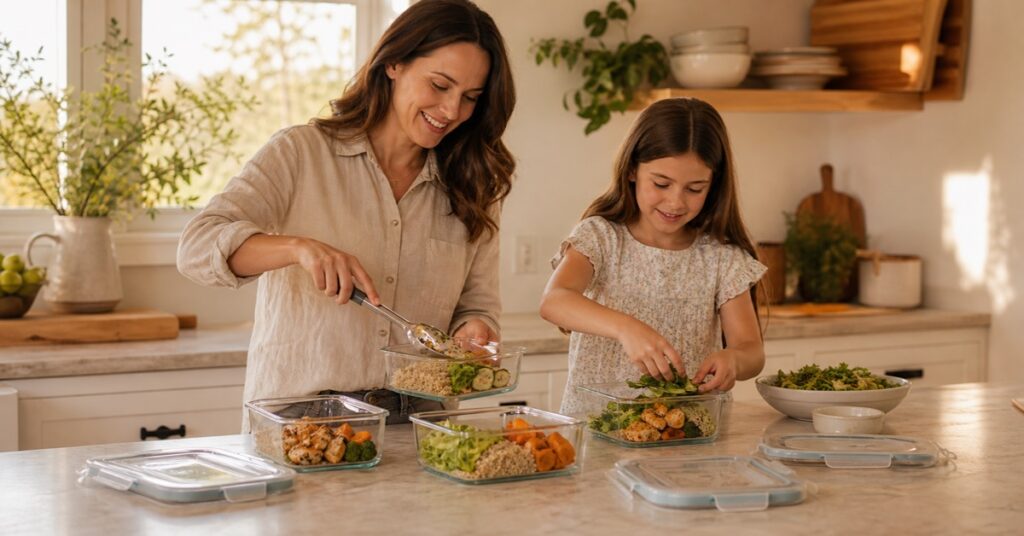
The cooking is done. The counters are covered. Somehow meal prep still is not finished, because five containers need five lids that actually match.
Glass can make that routine easier. It does not hold onto tomato-sauce stains or yesterday’s curry smell the way many plastic containers do, and the clear sides make leftovers easier to spot. The trade-off is just as real: glass is heavy, it can chip or break, and a tight locking lid may take more hand strength than expected.
I kept this list short on purpose. A high average rating does not cancel out repeated reports of chipped rims or glass fragments reaching food. I left those sets out. Tight lids, bulky sleeves and limited size choices are different. Those are buying trade-offs, and they are included here so you can decide whether they fit your routine.
There is no single winner for every family. Choose the Ello Duraglass Mixed Set if you need several sizes for everyday leftovers, the PrepNaturals 30-ounce set if you want five matching weekday portions, or the KOMUEE two-compartment set if you prepare a large batch of dry divided meals.
The Quick Picks
| Glass container set | Best for | Actual containers | Size pattern | Main trade-off |
|---|---|---|---|---|
| Ello Duraglass Mixed Meal Prep Set | Mixed-size family leftovers | 5 containers, plus 5 lids | 1, 1.75, 3.4, 3.4 and 5 cups | Protective sleeves add bulk, and independent testing found leakage and fragile lid clips in the 3.4-cup line |
| PrepNaturals 30 oz Set | Budget weekday portions | 5 containers, plus 5 lids | Five matching 30 oz containers | The lids can take real effort to close, and one size cannot cover every leftover |
| KOMUEE 2-Compartment Set | Dry divided lunches | 10 containers, plus 10 lids | Ten matching 30 oz divided containers | The center divider is not liquid-tight, and ten glass boxes need plenty of storage space |
Why Only Three Sets Made This List
Almost every glass storage set has complaints about weight, stiff lids or a gasket that needs extra cleaning. Those problems can be annoying, but they do not automatically make a container a poor buy. They tell you who should skip it.
Chipped rims and loose glass inside a food container are a different kind of problem. When that complaint repeated across the current version of a set, I did not include it. That removed several very popular options.
The three sets below are not flawless. They are the ones with the clearest useful role and drawbacks that can be explained without asking you to ignore a serious pattern. You should still inspect any glass container when it arrives and before every use.
The Best Glass Food Storage Container Sets for Family Meal Prep
1. Ello Duraglass Mixed Meal Prep Set — Best for Mixed-Size Family Leftovers
Ello is the most useful choice here when your refrigerator holds a little of everything. The set has one 1-cup container, one 1.75-cup container, two 3.4-cup containers and one 5-cup container. That mix works for chopped fruit, a small side, an individual lunch and a larger portion of leftovers without forcing every food into the same box.
The removable silicone sleeves are the feature that changes daily handling. They add grip when your hands are damp and keep bare glass from knocking directly against the counter or another container. They also make the set easier to identify in a crowded refrigerator. The sleeve is protection from ordinary bumps, though—not a promise that the glass cannot chip or break.
Ello says the sleeves can stay on for cleaning and that all parts are dishwasher-safe. The glass bases can go in the microwave without the lid and in an oven up to 450°F without the lid. The company also warns against placing a hot container on a wet or cold surface. Those clear directions are helpful, but I would still buy this as a storage set first, not as a replacement for your baking dishes. You can read the current Ello care instructions before using heat.
The lid is the weak point. In Good Housekeeping’s testing of the 3.4-cup Duraglass meal-prep set, the containers leaked and the lid clips broke off easily. That test covered the matching-size Duraglass line rather than this exact mixed assortment, but it is enough reason not to promise that a bowl of soup will survive sideways in a backpack. Some owners also report that the removable seal can work loose after repeated washing.
The sleeves make every container wider and create more surfaces that need to dry. If cabinet space is tight, five bare glass containers will usually pack more efficiently. If your goal is five identical lunches, the smaller Ello pieces may also feel like filler rather than useful storage.
Best for: A family that wants several practical refrigerator sizes and values grip and glass-on-counter protection more than compact storage.
Skip it if: You regularly carry soup or thin sauces, need five matching meal portions, or want the smallest possible cabinet footprint.
2. PrepNaturals 30-Ounce 5-Pack — Best Value for Uniform Portions
PrepNaturals solves a simpler problem: you want five lunches, and you do not want to think about which container gets which meal.
Every rectangular glass base holds a stated 30 ounces. That is a useful size for one adult meal with a main dish and a side, and five matching boxes line up neatly in the refrigerator. The set is also the least expensive of these three choices, so it makes sense for someone trying weekly meal prep without buying a ten-container system.
Thirty ounces is the maximum stated capacity, not the amount I would comfortably pack before snapping on a lid. Leave room for steam, shifting food and the seal. A saucy pasta or grain bowl will fit more comfortably than a container filled to the rim with soup.
The glass is straightforward. The lids are where this set asks for patience. Owners repeatedly describe lids that need firm, even pressure or refuse to close when the seal is not sitting correctly. Pressing down near the center while closing opposite sides can help. For longer lid life, I would hand-wash the plastic lids even though the product is sold as dishwasher-safe, and I would stop rather than force a tab that feels misaligned.
The glass is marketed for freezer, microwave and oven use, but I could not find a reliable care manual for this exact version with a specific temperature limit. That means I would remove the lid before reheating, avoid sudden temperature changes and follow the current instructions included with the set. A broad “freezer-to-oven” promise is not something I would rely on for family meal prep.
Five matching boxes are wonderfully simple until you need half a lemon, a cup of berries or a large family portion stored away. This set works best as one part of a kitchen system, not the only glass storage you own. It is also a poor match for anyone with arthritis or limited hand strength; a lid that takes two hands on a good day will become irritating very quickly.
Best for: One adult preparing five similar lunches, or a family that wants an affordable row of matching portions.
Skip it if: You need mixed capacities, have limited grip strength, or plan to carry thin liquids in a bag.
3. KOMUEE 2-Compartment 30-Ounce 10-Pack — Best for Dry Divided Lunches
KOMUEE is here for one reason: volume. Ten matching containers can cover two adults’ weekday lunches or give one serious meal-prepper enough boxes for a longer rotation.
Each 30-ounce glass base has two molded compartments. That makes it easy to pair chicken with rice, pasta with roasted vegetables, or a sandwich with fruit without adding a removable cup. The clear sides make every meal easy to identify, and the flat locking lids create a tidy stack in the refrigerator.
The word divided needs one important footnote. The glass wall does not form a liquid-tight seal against the lid. Salad dressing, curry sauce, yogurt and other thin foods can cross into the second compartment when the box tilts. The outer seal also receives mixed feedback, so I would carry these upright and keep runny sauce in a separate small container. If your dream lunch is crisp vegetables beside a very saucy main, this design may turn both sides into the same meal by lunchtime.
Lid and latch quality is the other issue to check as soon as the package arrives. Some owners report lids that leak or locking tabs that arrive damaged. Close every side on an empty container, look for warping, and return the set while the return window is open if a lid does not sit flat. Ten unreliable lids would be a much bigger problem than one.
KOMUEE markets the glass for oven, microwave, freezer and dishwasher use and directs owners to remove the lid before heating or cooking. I would keep the public promise that narrow. The brand also advertises an unusually high oven temperature, but I could not verify it in a detailed manual for this exact version. For this roundup, the set is a divided storage and reheating choice—not bakeware.
Ten glass boxes require a real shelf. They are also heavy when filled, and the set gives you no smaller snack box or larger family-leftover container. Buy it because you have a repeated two-compartment job, not because twenty “pieces” sound generous.
Best for: Adults preparing dry entrée-and-side combinations in larger weekly batches.
Skip it if: Your meals are mostly soup, curry, yogurt or dressing-heavy salads, or you need liquid-tight separation between foods.
Count Containers, Not Pieces
A “10-piece” glass storage set usually means five glass bases and five lids. A “20-piece” set usually gives you ten usable containers. The lids matter, of course, but they should not double the number in your head while you compare value.
Next, count how many bases are in a size you will actually use. Five matching 30-ounce containers can be more useful for weekly lunches than twelve assorted bases dominated by tiny sauce cups. For family leftovers, the opposite may be true: one or two larger containers and several smaller ones can prevent half-empty lunch boxes from taking over the refrigerator.
A Practical Family Meal-Prep Capacity Guide
| Meal-prep job | Useful capacity | Shape to look for | Lid reality |
|---|---|---|---|
| Dressing, nuts or a small side | 1–2 cups | Small round or rectangular | A simple secure lid is usually enough |
| One adult lunch | 3–4 cups, or about 24–32 oz | Wide rectangle | Locking tabs help with upright transport |
| Dry entrée plus side | About 30 oz divided | Two-compartment rectangle | Do not assume the center wall is liquid-tight |
| Shared side or larger leftovers | 5–8 cups | Wide rectangle or round bowl | A press-on lid may be enough for refrigerator use |
| Soup or thin sauce | 3–4 cups with headroom | Deep round or rectangle | Use a seal proven for liquids and still carry it upright |
If you batch-cook more than your refrigerator can hold, a small meal-prep freezer may solve more than another stack of containers. Leave enough room around freshly cooked food for it to cool quickly rather than cramming every warm box together.
Locking Lids, Gaskets and Dividers: The Part That Usually Wears Out First
The glass base may last for years, but the lid has moving parts. Locking tabs bend every time you open the container. Silicone gaskets collect moisture and food around their edges. Divided glass creates another line that must meet the lid correctly.
Before keeping a new set, close every lid on every base. One container should not require dramatically more force than the others. Check that the gasket lies flat, the lid does not bow and all four tabs close without twisting.
Remove a gasket only when the manufacturer says it is removable. Wash underneath it, dry both pieces completely and press it back into the groove evenly. A gasket that is partly raised can make an otherwise good lid seem impossible to close.
For divided containers, test with a tablespoon of water on one side while the box stays over the sink. Gently tilt it. This tells you whether the internal wall separates moisture before a dressing reaches the crackers in your actual lunch. It does not prove that the outer seal is safe for a backpack.
If you are packing for a child, glass is usually not my first choice. A lighter toddler bento box is easier for small hands and safer in a bag that will be dropped. Use a properly fitted lunch-box ice pack to manage temperature rather than depending on the container material.
When Glass Is Better—and When It Is Not
Glass is especially useful for refrigerator leftovers, tomato-based foods and meals that will be reheated. It stays clear, does not absorb odors easily and lets you see what needs to be eaten first.
Plastic or stainless steel is often the more practical choice for a young child, a rough commute or any meal that will be carried for hours. Those materials are lighter, and stainless steel avoids the breakage risk entirely. Plastic can stain and is not suitable for oven use, but it may still be the right tool for the job.
The same split applies to baby-food portions. Small, lightweight baby-food freezer trays may be easier for freezing individual portions, while glass works better after several portions are combined into a refrigerator meal.
Glass Container Safety Before Freezing or Reheating
Inspect the rim every time. Turn the empty container slowly under bright light and look closely at the edge before adding food. Stop using glass with a chip, crack, rough spot or deep scratch. Do not touch a damaged edge or try to smooth or repair it.
- Follow the directions for the exact set. One brand’s oven limit or freezer instructions do not apply to every kind of glass.
- Remove plastic lids before oven use. For microwave use, remove or vent the lid exactly as the manufacturer directs.
- Avoid sudden temperature changes. Do not move a frozen container straight to high heat unless the exact manufacturer instructions clearly allow it.
- Protect hot glass from cold or wet surfaces. Use a dry trivet or towel and keep the container away from a cold sink or damp counter.
- Do not stack bare rims carelessly. A sleeve, soft divider or lid between bases can reduce glass-on-glass knocks in a cabinet.
- Check the package on arrival. Bright light makes tiny edge chips and cracks easier to see before the container touches food.
The Food-Safety Clock Still Matters
A good seal does not make leftovers last forever. The container manages spills and drying; time and temperature manage food safety.
According to the USDA’s food-safety guidance, refrigerate perishable food within 2 hours, or within 1 hour when the temperature is above 90°F. Divide large amounts into shallow containers for faster cooling, use most cooked leftovers within 3–4 days and reheat leftovers to 165°F.
Date the lid when several similar meals go into the refrigerator at once. Put the oldest container where you can see it. Clear glass helps, but it cannot tell you when the food was cooked.
Frequently Asked Questions
Are glass meal-prep containers better than plastic?
Glass is better for stain resistance, odor resistance and many reheating jobs. Plastic is lighter, less likely to break and usually easier for children to carry. The better material depends on where the food is going and whether it needs heat.
What size glass container is best for meal prep?
For one adult meal, start around 24–32 ounces. Use 1–2 cup containers for sauces and small sides, and 5 cups or more for shared leftovers. A mixed set is useful for family refrigerator storage; matching 30-ounce boxes are easier for a weekly lunch routine.
Can glass containers go from the freezer to the microwave?
Do not assume they can. Read the directions for the exact set, inspect the glass first and follow the lid instructions. Even when both freezer and microwave use are listed, avoiding a sudden temperature swing is the safer routine unless the manufacturer clearly says otherwise.
Are divided glass containers leakproof between compartments?
Not necessarily. Many molded dividers stop below the lid, so thin sauce can move from one side to the other when the container tilts. Use divided glass for foods with similar moisture levels, or pack dressing in a separate small cup.
How can I keep locking lids from breaking?
Keep the gasket seated evenly, close opposite sides with gentle pressure and never force a tab that is misaligned. Hand-washing lids can reduce heat stress. Let every part dry fully before reassembly and storage.
How many meal-prep containers does a family need?
Five matching containers cover one adult’s weekday lunches. Ten can cover two adults. For family leftovers, add a few smaller side containers and one or two containers of 5 cups or more. Buy for repeated jobs rather than aiming for the largest piece count.
Which Set Should You Choose?
Choose the Ello Duraglass Mixed Set when leftovers come in different sizes and the silicone sleeves are worth the extra cabinet space. Keep liquids upright and treat the lid clips gently.
Choose the PrepNaturals 30-ounce 5-pack when you want an affordable, uncomplicated row of weekday meals. Skip it if stiff four-tab lids will become a daily battle.
Choose the KOMUEE two-compartment 10-pack when you prepare many dry entrée-and-side combinations. Keep dressing separate and do not expect the center divider to stop liquid.
If none of those jobs sounds familiar, keep your money for now. The right container is not the one with the longest feature list. It is the one whose size, lid and weight still make sense on a tired Wednesday night.