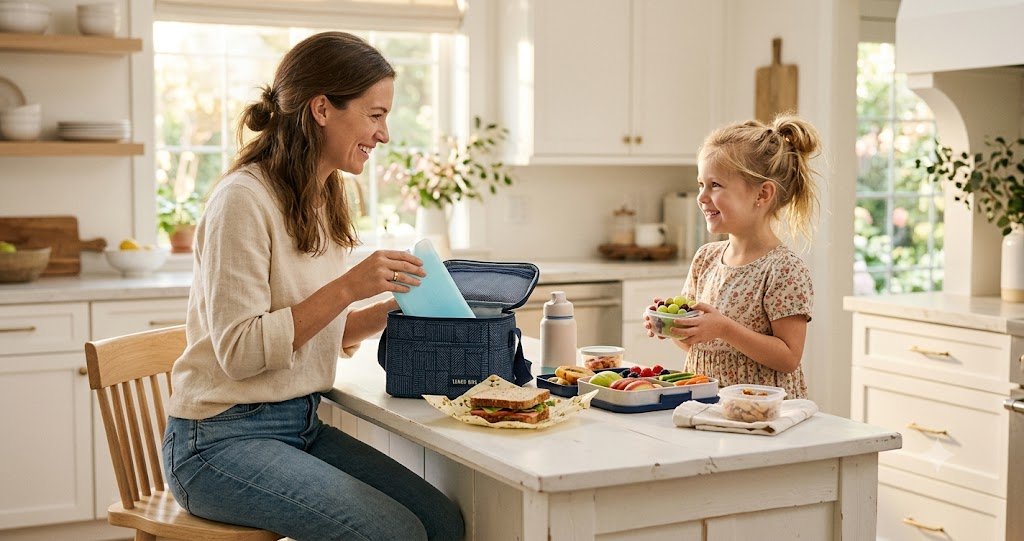
Last spring I opened my daughter’s lunch box after school and found a yogurt tube that was, to put it kindly, room temperature. It had been sitting in her kindergarten cubby since 8 a.m. No fridge. No shade. Just a vinyl lunch bag doing its best against a warm hallway for four and a half hours.
That warm yogurt sent me down a rabbit hole, and here’s the short version of what I found: most school lunches sit in the food-safety danger zone for hours, and the fix costs about ten dollars. This guide covers the ice packs that actually earn their freezer space, how many you really need (the answer surprised me), and the packing mistakes that quietly cancel out even the best gel pack.
The Rule Worth Knowing Before You Buy Anything
The USDA’s guidance on packed lunches comes down to two numbers. Perishable food needs to stay at or below 40°F, and once it climbs above that, the clock starts: bacteria multiply fastest between 40°F and 140°F, and food shouldn’t sit in that zone for more than two hours (just one hour when it’s above 90°F outside).
A kindergarten lunch packed at 7:30 and eaten at 11:45 blows past that window without help. Which is why the USDA doesn’t just suggest an ice pack. It recommends at least two cold sources in every insulated lunch bag: two frozen gel packs, or one gel pack plus a frozen juice box or frozen water bottle, placed above and below the perishable food. One lonely ice pack tossed on top is doing about half the job.
Quick Picks
| Ice Pack | Best For | Price Range |
|---|---|---|
| Fit & Fresh Cool Coolers Slim (4-pack) | Best overall for everyday lunch boxes | around $10–12 |
| Fit & Fresh Cool Coolers Soft Ice (2-pack) | Best flexible pack (no soggy sandwiches) | around $10–13 |
| Everlasting Ice RX Rapid Performance (4-pack) | Best for long days and hot climates | around $14–16 |
| PackIt Freezable Lunch Bag | Best “never find the ice pack again” solution | around $25–28 |
| Bentgo Chill Kids Lunch Box | Best all-in-one with a built-in ice pack | around $30–35 |
1. Fit & Fresh Cool Coolers Slim Ice Packs — Best Overall
If lunch box ice packs had a default answer, this would be it. The Cool Coolers slim packs have been the workhorse of American lunch bags for years, with tens of thousands of reviews and a rating that has stayed remarkably high for a product this cheap. In my research across review threads and independent roundups, the same phrase kept coming up: “just works.”
The half-inch profile is the whole point. Thicker packs steal room from the actual food, and a first grader’s lunch bag is not exactly a walk-in cooler. These slide flat against the side or lie under a sandwich container without crushing anything, and at this price you can keep two in the bag and two in the freezer on rotation. Fit & Fresh recommends freezing them overnight and stacking multiples for hotter days, which lines up neatly with the USDA’s two-cold-source rule.
They’re BPA-free, non-toxic, and rated safe to sit against unpackaged food. Cleaning is a rinse and a pat dry. The kids’ versions come in cheerful prints, which matters more than you’d think when a five-year-old is deciding whether lunch is exciting.
What works
- Slim enough for small lunch bags
- Cheap enough to buy the two-pack-rotation lifestyle
- Break-resistant hard shell handles being thrown into a cubby
What to know
- Hard packs sweat; condensation can dampen paper wrappers
- Hand wash only, no microwave
- Lots of print variations, so double-check which set you’re ordering
2. Fit & Fresh Cool Coolers Soft Ice — Best Flexible Pack
The soft version solves the two complaints people have about hard packs. First, flexibility: the stretchy nylon stays bendable even when frozen, so it can drape over a container of grapes or curl around a milk bottle instead of sitting next to it like a cold brick. Cold transfers better with contact, so this isn’t just a comfort feature.
Second, and this is the part I’d underline: the nylon shell is sweatproof. Anyone who has pulled a soggy, half-dissolved napkin out of a lunch bag knows exactly why that matters. The fabric catches the condensation that hard plastic packs shed all over everything, which is the quiet reason sandwiches come home damp.
Reviewers also mention using these as boo-boo packs for bumped knees, which I’d call a legitimate bonus feature in any house with kids under six.
What works
- Bends around bottles and containers while frozen
- Sweatproof fabric means no soggy sandwich wrappers
- Doubles as an injury cold pack
What to know
- Only two per pack, so a rotation system needs two sets
- Fabric shell takes slightly longer to wipe clean than bare plastic
3. Everlasting Ice RX Rapid Performance — Best for Long, Hot Days
If your child’s lunch has to survive until an afternoon snack break, or you live somewhere August feels personal, this is the heavier artillery. Each pack carries noticeably more gel than a slim pack, and the brand rates them for up to 12 hours of cooling in a cooler. In a soft lunch bag you shouldn’t expect anywhere near that, but the extra thermal mass is exactly what buys you the margin between “eaten at 11:30” and “still safe at 2 p.m. pickup.”
These are larger than the USDA’s minimum recommended gel pack size, and cross-referencing independent cooler roundups, the block-style format gets consistent praise from experts for holding its shape through refreezes and resisting punctures better than thin pouches.
The trade-off is honest physics: more gel means more weight and more space. For a preschooler’s tiny bag, one of these plus a frozen water bottle makes more sense than two.
What works
- Serious cooling capacity for long days
- Durable block format that survives repeated refreezing
- BPA-free and food-safe
What to know
- Heavier and bulkier than slim packs
- Smaller brand with a shorter track record than Fit & Fresh or PackIt
- Multiple size variants; check you’re ordering the lunch box size
4. PackIt Freezable Lunch Bag — Best No-Ice-Pack Solution
PackIt flips the whole problem: instead of adding cold things to an insulated bag, the bag itself is the ice pack. Freezable gel is sealed inside the walls, so you fold the empty bag flat, park it in the freezer overnight, and in the morning you just fill it. There is nothing to find, nothing to forget, and nothing for your kiddo to leave in the cafeteria.
The honest fine print, confirmed both by PackIt’s own FAQ and by independent testers: it needs a full 8 hours (realistically, overnight) in the freezer, and it keeps food cold for hours depending on the ambient temperature, which in practice means comfortably through lunchtime rather than until dinner. Testers consistently report food still cool at midday and the walls thawed by late afternoon. For a school lunch eaten before noon, that’s precisely the window that matters.
One detail I liked from my research: the company was founded by a single mother of three, and the design decisions show it. The bag folds flat so it doesn’t hog the freezer, and the buckle handle clips onto a backpack strap.
What works
- Nothing separate to freeze, find, or lose
- Folds flat in the freezer
- Whole interior is cold, not just one corner
What to know
- Needs overnight freezing; forget once and there’s no backup
- Hand wash only, and it must air-dry fully before refreezing
- Cold through lunchtime, not all day
5. Bentgo Chill Kids Lunch Box — Best All-in-One
The Bentgo Chill takes the third path: the ice pack lives inside the lunch box itself, as a slim removable tray that nests underneath the food compartments. Freeze the tray overnight, click it in under the bento tray in the morning, and the cold rises through everything above it. It has held the top spot in Amazon’s lunch box category, and the patented design is genuinely clever rather than gimmicky.
Everything else about it is built for the preschool-to-first-grade crowd: a single latch small hands can open independently (worth testing before the first day of school, since teachers cannot open twenty lunch boxes at once), a leakproof seal that handles yogurt and hummus, PFAS-free and BPA-free materials, and a rubberized shell that shrugs off drops. The food tray goes in the microwave and the top rack of the dishwasher; the shell and ice pack are hand wash.
Combing through critical reviews, the recurring complaint is that the inner tray can occasionally lift up stuck to the lid when opening. It shows up in a small minority of reviews, but it’s worth knowing, and worth a practice run at home.
What works
- Ice pack is built in, so it can’t be forgotten separately
- Genuinely leakproof; packs wet foods with confidence
- Kid-operable latch and drop-resistant shell, 2-year warranty
What to know
- Priciest option here
- Shell and ice pack are hand wash only
- Some reviewers report the tray sticking to the lid
How Many Ice Packs Does One Lunch Box Actually Need?
Two. That’s the USDA’s floor for any lunch with perishable food, and after reading the reasoning I stopped treating it as overkill. Cold sinks and warmth rises, so a single pack on top leaves the bottom of the bag drifting toward room temperature by mid-morning, and a single pack on the bottom does the reverse. Sandwiching the food between two cold sources is what actually holds the interior below 40°F until the lunch bell.
The second cold source doesn’t have to be a second gel pack. A frozen water bottle or frozen juice box counts, does double duty as a cold drink, and costs nothing. The USDA’s back-to-school guidance explicitly blesses this combo, and it’s the version most real families actually stick with.
Four Mistakes That Make a Good Ice Pack Useless
- Packing warm food with cold packs. An ice pack maintains cold; it doesn’t create it. Refrigerate the packed containers overnight, per the USDA, so the ice pack’s only job is holding the line. We started packing my daughter’s lunch the night before and it fixed this and the morning chaos in one move.
- Using an uninsulated bag. A gel pack in a canvas tote is fighting the whole room. Soft-sided insulated bags are what every food safety agency assumes you’re using. If yours has seen better days, replacing the bag helps more than upgrading the ice pack.
- Leaving air space. Half-empty bags warm faster. Fill gaps with a rolled napkin or that frozen water bottle so the cold air has less territory to defend.
- Ignoring the pack’s condition. Any gel pack that’s punctured, leaking, or bulging goes in the trash, not back in the freezer. Modern packs from reputable brands use non-toxic gel, but “non-toxic” is a reason not to panic, not a reason to keep using a leaking pack against your child’s food.
If mornings are the real bottleneck in your house, the lunch-packing piece pairs well with the rest of the routine; we covered the tools that untangled our own school-morning scramble in our guide to getting out the door faster, and if you need things to actually put between those ice packs, here are 20 high-protein snack ideas kids actually eat.
Quick Answers
How long do lunch box ice packs actually stay cold?
In an insulated bag with two cold sources, expect food to stay safely cold through a typical school lunchtime. Extension food-safety programs are blunt that gel packs are a “until lunchtime” tool, not an all-day one, which is why afternoon leftovers should be tossed rather than eaten at pickup.
Are gel ice packs safe if they leak?
Gel from major current brands is non-toxic and BPA-free, but a leaking pack should still be discarded immediately. Older packs are a different story: a large recall in 2012 involved gel packs containing ethylene glycol, so if you’ve inherited ancient ice packs from a relative’s garage, retire them and buy current ones.
Can I just freeze a water bottle instead?
Yes, and the USDA counts it as a legitimate cold source. The catch is that it works best as the second source alongside a gel pack: a frozen bottle thaws unevenly, sweats heavily, and your child ends up with lukewarm water by afternoon. Pair it with a gel pack rather than replacing one.