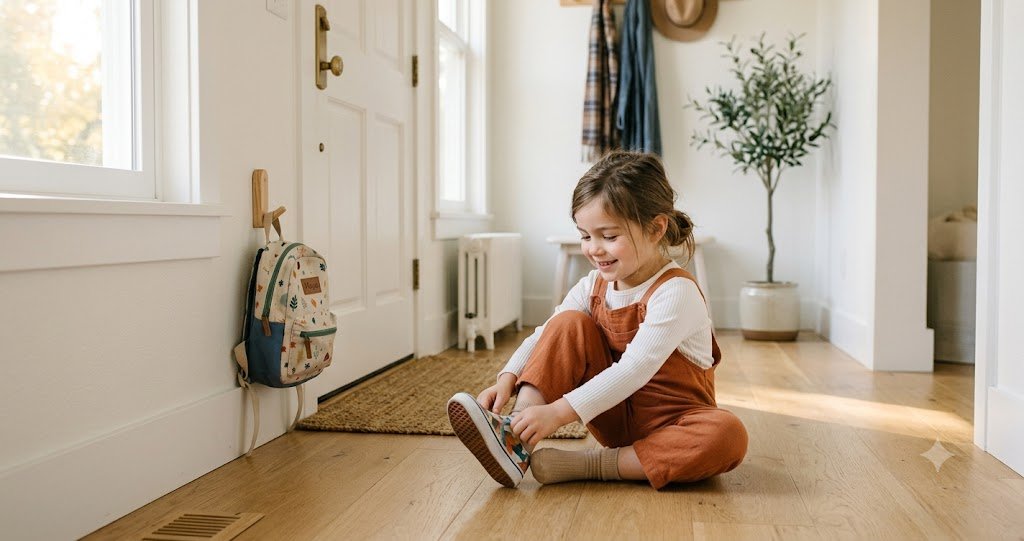
It’s 7:40 a.m. My daughter has one shoe on and is reading a book with the other foot bare. My three-year-old is refusing pants on principle. The baby has just located the dog’s water bowl. And somewhere in this house, allegedly, is a second small sneaker.
Sound familiar? With three kids, our mornings used to feel like herding cats through a car wash. What finally changed things wasn’t yelling louder or waking up at 5 a.m. (I tried both, zero stars, do not recommend). It was rebuilding the routine so that the kids could run more of it themselves, and setting up our home so the stuff they need is actually where they need it.
This post rounds up the tools that make that possible: a wake-up clock that ends the “is it morning yet” debate, visual routine charts, shoes and laces little hands can manage solo, an entryway setup that swallows the shoe chaos, and a backpack your preschooler can actually pack. Plus a sample 20-minute routine at the end if you want the whole playbook.
Why Mornings Fall Apart (It’s Not Just You)
Young kids aren’t stalling to torture you — mostly. Preschoolers genuinely struggle with transitions and multi-step instructions because the planning part of their brain is still very much under construction. “Get ready” sounds like one task to us; to a four-year-old it’s an eight-step mystery novel.
That’s why pediatricians keep coming back to the same advice: predictable routines. The American Academy of Pediatrics notes that consistent family routines help kids feel secure and learn what’s expected of them, and the CDC recommends structure and consistency as a core parenting strategy for toddlers. When the sequence is the same every day (and kids can see the sequence), you stop being the drill sergeant and start being the cheering section.
The tools below all serve that one goal: making the routine visible, physical, and doable by the child. None of them are magic. All of them remove one argument from your morning, and honestly, some days that’s the whole ballgame.
Step Zero: Win the Morning the Night Before
Before we get to the gear: the cheapest morning hack in existence is moving decisions to the evening. Clothes picked and laid out (let your kiddo choose between two outfits, not the whole closet). Backpack packed and parked by the door. Water bottles filled and in the fridge. Shoes reunited with their partners.
Ten minutes at 7 p.m. buys you twenty at 7 a.m., because evening-you is a calm, rational person and morning-you is negotiating a hostage situation involving socks.
Try this: make “launch prep” the last step of the bedtime routine, done by the kids with your help. My daughter picks her outfit while my older son ferries his backpack to its hook. If you’ve got a partner in the trenches, split the prep: one adult on lunches, one on gear patrol. It takes longer than doing it yourself. It is still worth it.
Wake Up on the Right Side: An OK-to-Wake Clock
Windflyer “Little Teddi” OK-to-Wake Clock
Half the morning battle happens before the morning starts: either your early bird is up at 5:30 asking if it’s time yet, or your snoozer won’t surface at all. An OK-to-wake clock settles it, and this one is our favorite. Instead of just switching colors, Little Teddi cycles through actual bear faces: closed eyes for sleep, a winky face with pale green light for an optional “quiet play” window, and a full smile with green light when it’s truly time to get up. Even a two-year-old who can’t tell time can read a face.
That middle “quiet play” stage is the killer feature for early risers. Set it for up to 90 minutes before wake time and it tells your kid “you can look at books in your room, but it’s not morning yet.” It covers the practical stuff too: a child lock so curious fingers can’t reprogram it, settings that survive a power outage, five night light colors, sleep sounds, and a nap timer.
Worth knowing: it has to stay plugged in, a few parents report the white noise occasionally cutting out early, and the pale-green “play” light can look a lot like the real green light to a determined toddler; some families simply turn that stage off.
The Little Teddi took the top spot when we tested this whole category, but it isn’t the only good one. We compared five OK-to-wake clocks, from a $20 budget pick to a screen-free audio-player splurge, in our full OK-to-wake clock roundup.
Make the Routine Visible: Picture Charts They Can Follow
A visual schedule is the single highest-leverage tool here. Instead of you repeating “brush your teeth” for the fourth time, the chart says it. And preschoolers who can’t read yet can follow pictures just fine. The trick is letting your child physically interact with it: flipping a card, moving a magnet, checking a box. That little dopamine hit of “done!” is the engine.
JJPRO Magnetic Routine Chart with Reward Jar
This is the budget-friendly workhorse: a magnetic dry-erase board that lives on the fridge, with washable picture stickers covering morning, bedtime, and daily tasks, plus a magnetic reward jar with smiley tokens. The stickers mean you can build a routine that matches your morning, and the dry-erase surface handles anything the sticker set doesn’t cover. The reward jar is optional (some kids are motivated by tokens, some just like sliding the checkmarks), but it’s nice that it’s included instead of being a separate purchase.
Worth knowing: it’s fridge-first by design. If your kitchen isn’t on the path to the front door, plan to mount it somewhere your kids actually pass, or the chart becomes very organized wall art.
TinyKidz Wooden Routine Chart
If your home leans Montessori (or you simply can’t face one more piece of laminated rainbow plastic), this wooden version is the pretty one. It comes with dozens of activity cards sorted by morning, afternoon, and evening, blank cards for your family’s oddball tasks, a stand, and a little wooden storage box. Kids slot the cards for the day’s sequence, then work through them. It doubles as a talking point — “what comes after breakfast?” — which quietly builds the exact planning skills mornings demand.
Worth knowing: this is a tabletop tool, not a wall chart. The cards sit in slots rather than locking in, so treat it as a kitchen-counter station; mounted flat on a wall, pieces can slip out, and the stand prefers a stable surface away from toddler drive-bys. It’s also the pricier of the two charts.
Not sure which style fits your kid? If they’re motivated by checking things off, go magnetic. If they’re motivated by ritual and handling beautiful objects, go wooden. If they’re motivated by absolutely nothing before 8 a.m., solidarity. Our guide to daily routine charts for toddlers walks through introducing a chart without a power struggle, and it includes a free printable chart, so you can test-drive the habit before you spend a dime on hardware.
Clothes and Shoes They Can Actually Manage
Here’s an unpopular truth: half of “my kid won’t get dressed” is really “my kid can’t get dressed in the clothes we bought.” Buttons, stiff jeans, laces, tiny zippers: they’re all fine-motor bosses your preschooler hasn’t beaten yet. Swap the hard stuff for pull-on pants, roomy necklines, and shoes that go on solo, and the whining drops in direct proportion.
Footwear is the biggest offender, so that’s where these two picks come in.
LeIsfIt Wide Toe Box Slip-On Sneakers
These are built around one job: a kid getting their own shoes on without help. There’s a stretchy elastic opening instead of laces, a pull tab at the heel for little fingers to grab, and a wide toe box so chubby or wide feet aren’t fighting their way in. They’re also featherlight (each shoe weighs about as much as a granola bar), with a flexible, grippy sole, so they work for the playground sprinting that happens immediately after drop-off.
Worth knowing: wide-fit shoes are a blessing for wide feet and a bit roomy for narrow ones, so check the brand’s size chart against your child’s foot rather than buying their “usual” size on autopilot.
Lock Laces No-Tie Elastic Shoelaces
For the kid who loves their lace-up sneakers but can’t tie yet (or ties a knot that unravels by the mailbox), these are a tiny genius purchase. You thread the elastic laces into any lace-up shoe once, trim to length, and a small lock holds the tension; the shoe becomes a slip-on forever after. One size covers kids and adults, they’re water resistant, and installation takes a few minutes per shoe. They were invented for triathletes shaving seconds off transitions, which is essentially what a school run is.
Worth knowing: the one fiddly moment is snapping the little end clips on after you trim the laces; it takes a surprisingly firm squeeze. Do the install during naptime with your full grip strength, not at 7:45 a.m.
Independence tip: teach the “magic flip” for jackets — coat on the floor upside down, hands in the sleeves, flip over the head. Most three-year-olds can learn it in a week, and it’s one more thing off your plate. Pair it with self-serve shoes and your preschooler handles the entire out-the-door sequence.
Build a Launch Pad: Shoe & Gear Storage by the Door
Every family I know loses the most morning minutes to the Great Shoe Hunt. The fix isn’t discipline; it’s geography. Shoes need exactly one home, at kid height, on the path out the door — what a lot of moms call a “launch pad.” Backpack hook, shoe spot, done. When the system is physical, you’re not enforcing a rule; the house is.
SAVERHO Over-the-Door Shoe Organizer
If your entry is more “narrow hallway” than “mudroom,” this hangs over any standard door and disappears. It has two dozen breathable mesh pockets in three sizes, and if you hang it so the small pockets sit at kid height, it becomes your kids’ self-serve shoe library. Mesh means wet sneakers can dry out instead of marinating, and the adjustable hooks fit a range of door thicknesses without chewing up the trim.
Worth knowing: it’s a fabric organizer, not furniture: great for everyday sneakers and sandals, not the place for muddy rain boots. Give soaked shoes a head start drying elsewhere first.
LNYZQUS 4-Tier Kids Shoe Rack
Pocket organizers stump some little kids; an open rack is more obvious: shoes go on the shelf, the end. This one is deliberately small (under two feet wide and about knee-to-hip height on an adult), so it fits kid-scale and tight corners. It snaps together without tools, holds a family’s worth of small shoes, and comes in black, pink, or blue. Assign each child a shelf and suddenly “get your shoes” is a one-step instruction. Two caveats hide in the fine print: the connectors snap together snugly (the maker literally suggests gloves for assembly), and each shelf has a weight limit; it’s a shoe rack, not a climbing gym, a distinction your toddler will want to test.
Zero-budget version: a plain basket by the door, one per kid. It works. The upgrade earns its keep when you have multiple kids and the baskets turn into shoe soup — which, with three kids, took our household approximately eleven days.
The Grab-and-Go Backpack
The last link in the chain: a bag that’s packed the night before, lives on a hook by the door, and is light enough for your child to carry themselves. (A kid who carries their own bag is a kid who remembers their own bag. Eventually. We’re building toward a dream here.)
mibasies Toddler Backpack
For the preschool set, this scaled-down pack is the sweet spot: big enough for a change of clothes and a snack, small enough that your three-year-old wears it instead of dragging it. The clever bit is the insulated front pocket: snack or small lunch goes straight in, no separate lunch bag to track. Add a smooth zipper little hands can work, side bottle pockets, padded straps, a chest buckle (with a built-in whistle your child will discover at the worst possible moment), and a name tag inside.
Worth knowing: the main pocket won’t fit a standard school folder, so this is a preschool bag, not one that carries into elementary. Small parts on the whistle buckle also make it a 3-and-up pick.
Heading into kindergarten with a bigger-kid load? Backpacks are a rabbit hole of their own, so we compared the favorites (name labels and all) in our toddler daycare backpack roundup.
A Sample 20-Minute Morning (Ages 2–6)
Here’s roughly how the pieces snap together once the night-before prep is done. Times are aspirational: some mornings you’ll crush it, some mornings someone will need to wear the red socks that are in the wash and the whole thing detonates. That’s parenting.
Wake-up (0:00): the clock turns green; kids can get up. No debate, the light decides.
Dressed (0:00–0:05): clothes are already laid out from last night. Slip-on shoes wait at the launch pad, not the bedroom.
Breakfast + chart (0:05–0:15): kids eat while working the routine chart; the chart nags so you don’t have to. Teeth and hair happen off the chart’s last two cards.
Launch (0:15–0:20): everyone to the launch pad. Shoes from the rack or pockets, backpack off the hook, out the door. High-fives optional but recommended.
The first week is bumpy while everyone learns the system. By week three, the chart and the launch pad are doing jobs you used to do with your voice, and you might even eat your own breakfast sitting down, like a person.
Want the chart without the shopping? We made a free printable daily routine chart: morning, afternoon, and bedtime steps young kids can follow by picture. Download it here and tape it to the fridge tonight.
Quick Questions from Real Mornings
My child has never used a routine chart. Where do I start?
Start small: three picture cards, one routine, and let your child help build it. We wrote a full guide to introducing routine charts by age, free printable included, over at our daily routine chart guide.
Do rewards for morning tasks create bribery monsters?
Used briefly to launch a habit, token rewards are a well-worn behavioral tool, not a moral failing. Most families phase them out naturally once the routine is automatic; the routine itself, and getting out the door without tears, becomes the reward.
What actually saves the most time?
Night-before prep, and it isn’t close. Every product in this post works better when the deciding is already done. If you change one thing, change that; the gear turns a good system into a smooth one.