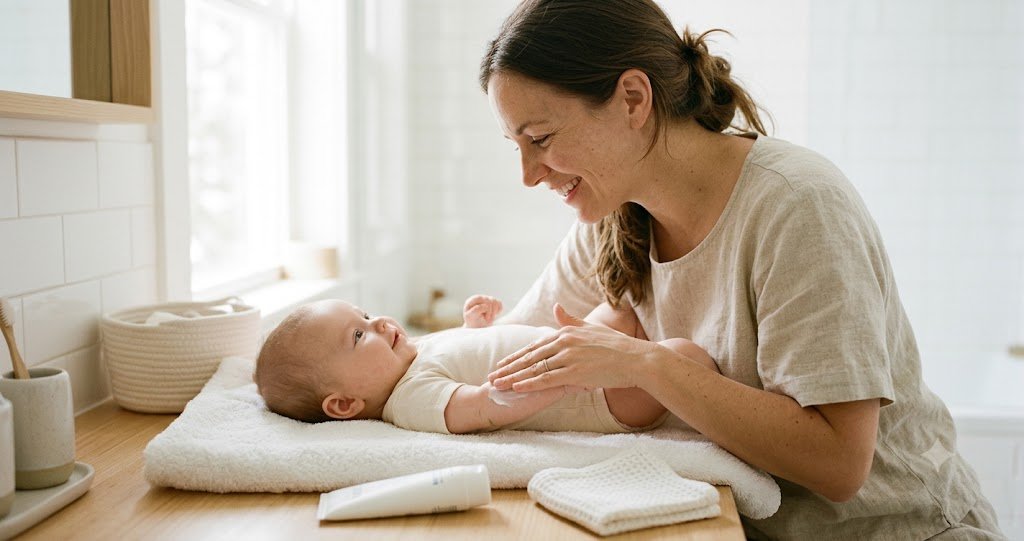
The first time my daughter had a real eczema flare, she was about five months old, and I remember standing in the bathroom at some ungodly hour googling one-handed while she rubbed her cheek raw against my shoulder. Red, weepy patches on her cheeks and in the creases of her elbows, and a baby who could not stop scratching long enough to sleep. Neither could we.
Here’s what I wish someone had told me back then: you can’t always prevent a flare, but you can absolutely be ready for one. Baby eczema tends to show up in waves, and the difference between a rough night and a truly miserable week often comes down to whether the right things are already in your bathroom cabinet when the itching starts.
So this is that list. Not fifteen products, not a skincare “routine” with nine steps. Just the four things that actually matter during a flare, according to the National Eczema Association’s guidance and roughly a decade of parenting three kids with varying degrees of cranky skin: a gentle cleanser, a serious moisturizer, something to stop the scratching, and better air.
One thing before we start: nothing here treats eczema. These are comfort-and-care tools. Diagnosis, prescription creams, and anything involving broken or infected skin belong to your pediatrician, full stop. More on that at the end.
The Flare Playbook (a.k.a. What the NEA Actually Recommends)
Eczema-prone skin has a leaky moisture barrier. Water escapes fast, irritants get in fast, and the itch-scratch cycle does the rest. Almost everything the National Eczema Association recommends for daily care comes back to one sequence they call “soak and seal”:
- A short, lukewarm bath, about 5 to 10 minutes. Not hot. Hot water feels great and strips the skin barrier, which is a rude combination.
- A gentle, fragrance-free cleanser, no scrubbing.
- Pat the skin lightly dry, leaving it slightly damp.
- If your pediatrician prescribed a topical medication, that goes on the affected areas first, as directed.
- Then, within three minutes, a liberal layer of moisturizer over the whole body to lock that bath water in.
That three-minute window is the whole trick. Bath water hydrates the skin; the moisturizer seals it there before it evaporates. Miss the window and you’ve basically taken a bath that dries your baby out.
Beyond bath time, the other two levers are mechanical (keep those tiny nails from doing damage, especially overnight) and environmental (dry indoor air is a classic flare trigger, particularly in winter with the heat running). The American Academy of Pediatrics covers the same territory in its parent guide to eczema, and it’s worth a read before your next pediatrician visit so you know what questions to ask.
The toolkit below follows that exact playbook: bathe, seal, protect, humidify.
Step 1: The Lukewarm Bath (Gentle Cleansers)
Regular baby wash isn’t automatically fine for eczema-prone skin. What you’re looking for: fragrance-free, no traditional soap, and ideally something formulated specifically for reactive skin. During my daughter’s flare months, bath time went from “fun splashy ritual” to “medical procedure with a rubber duck,” and honestly, the right cleanser made it feel less clinical.
Eucerin Baby Eczema Relief Cream Body Wash
The eczema-specific pick
This one is built for exactly this job. It’s a non-foaming, low-pH cream cleanser with colloidal oatmeal, free of fragrance, dyes, and soap, and labeled for babies as young as 3 months. The instructions on the bottle read like they were copied from the NEA playbook: massage onto wet skin, rinse with lukewarm water, pat dry.
Fair warning that moms mention constantly: it barely lathers. That’s the design, not a defect. Foam comes from stronger surfactants, which is precisely what irritated skin doesn’t need. If you’re used to bubbly baby wash, the first use feels like you’re rubbing lotion on a wet baby. You’ll adjust.
The Honest Company 2-in-1 Shampoo + Body Wash (Fragrance Free)
The everyday whole-family backup
Not an eczema product per se, but a solid fragrance-free daily wash for the stretches between flares, and for siblings sharing the tub. It’s tear-free, hypoallergenic, made without synthetic fragrance, sulfates, or parabens, and it has earned EWG Verified status, which is a meaningfully hard bar to clear. One bottle handles hair and body, which matters when you’re bathing multiple kids on a school night and your patience budget is already spent.
If your little one is mid-flare, reach for the Eucerin above. This one is for keeping the baseline gentle the rest of the time.
Step 2: Seal It In Within Three Minutes (Moisturizers)
This is the heart of the toolkit, and the one place I’d genuinely tell you not to cheap out or improvise. Whatever you choose, the routine matters as much as the product: towel-pat, then cream, generously, while the skin is still damp. I used to keep the tube sitting on the towel so there was zero chance of getting distracted mid-transfer. (With a slippery, cranky baby, three minutes is shorter than it sounds.)
All three picks below are steroid-free, fragrance-free formulas built around 1% colloidal oatmeal, the over-the-counter skin protectant that’s the workhorse ingredient in this category. They differ in texture, price, and philosophy.
Aveeno Baby Eczema Therapy Moisturizing Cream
The pediatrician-office classic
If you ask around any mom group about baby eczema creams, this is the name that comes back first. Colloidal oatmeal plus vitamin B5, pH-balanced, no steroids, no fragrance, no parabens or phthalates. It carries the National Eczema Association Seal of Acceptance, which means it passed the NEA’s review for ingredients and formulation suitability for sensitive, eczema-prone skin. It’s also easy to find in any US drugstore at a price that lets you apply it as liberally as the routine actually requires, which is a real consideration when you’re doing full-body coverage twice a day.
Texture-wise it’s a proper thick cream. A few parents find it heavier than a lotion, which, for flare care, is kind of the point.
Eucerin Baby Eczema Relief Body Cream
The barrier-repair formula
Same colloidal oatmeal foundation, but Eucerin adds Ceramide-3, one of the lipids that a healthy skin barrier is literally made of, plus a licorice root extract for soothing. It’s labeled for babies 3 months and up, fragrance-free and steroid-free, and the brand cites its own clinical study in which most children using it daily stayed flare-free over a six-month stretch. That’s a manufacturer study, so hold it loosely, but the ceramide logic is sound and this formula has a devoted following among parents whose kids flare in cycles.
It pairs naturally with the Eucerin wash above if you like keeping bath and cream in the same formula family.
Tubby Todd All Over Ointment (Fragrance Free)
The mom-group cult favorite
You have almost certainly seen this one in your feed. Tubby Todd built an entire brand on parents posting before-and-after photos of baby cheeks, and the All Over Ointment is the product that did it: 1% colloidal oatmeal in a rich, plant-based balm with jojoba esters, camellia leaf, and avocado extract. Steroid-free, and the fragrance-free version is the one to grab for reactive skin.
Two honest notes. It costs noticeably more than the drugstore options, which is why it’s the splurge slot in this toolkit and not the default. And the company itself says the sensible things on its own site: patch test first, and talk to your pediatrician if eczema is severe or the skin is broken. A brand that volunteers those caveats earns some trust from me.
Step 3: Winning the Scratch Battle (Nails + Mittens)
Everything above falls apart if your baby spends the night sanding their own cheeks off. Scratching turns an itchy patch into a raw one, raw skin itches more, and broken skin is how flares get infected. The unglamorous foundation here is nail care: keep them short and smooth, ideally filed right after a bath when they’re soft. My husband and I used to split this chore because neither of us could face trimming twenty tiny nails alone, and I stand by that division of labor.
For overnight, mittens buy you protection during the hours you can’t intercept little hands. Two picks, because babies at different stages defeat mittens differently.
Burt’s Bees Baby Organic Cotton Mittens (3-Pack)
The newborn-stage staple
Soft, breathable, GOTS-certified organic cotton in a stretchy rib knit with a gentle encased elastic wrist. Simple, washes well, and comes as a three-pack so one pair can always be in the laundry. This is the classic hospital-bag mitten, and for the youngest babies who aren’t yet on a mission to remove things from their own hands, it does the job with zero fuss.
Honest limitation, echoed in plenty of parent reviews: the one-size fit runs roomy on small newborns, and a determined wiggler can eventually flick them off. Which brings us to the next pick.
HAPIU Stay-On No Scratch Mittens (Newborn–12M)
For the baby who treats mittens as a puzzle
Around four or five months, most babies discover that mittens come off, and eczema babies are extra motivated. These add an adjustable hook-and-loop strap over the elastic wrist, designed to stay put through exactly that phase, and they come in sized options up to 12 months rather than one-size-fits-newborns. The listing even calls out eczema and itchy-skin protection as a primary use case, which tells you who’s actually buying them.
Care note that shows up across reviews: the cotton shrinks and the hook-and-loop wears if you machine-dry them. Cold wash, air dry, and they hold up much better.
While you’re thinking about skin-to-fabric contact: soft, breathable 100% cotton sleepwear and one fewer layer than you think, since sweating is itself a common trigger. If overheating and sleepwear are a whole separate puzzle in your house, our TOG and room temperature dressing chart settles the what-should-baby-wear-to-sleep question.
Step 4: Fix the Air (Humidifiers)
If your baby’s skin falls apart every winter, the furnace is a suspect. Heated indoor air can drop humidity to desert levels, and dry air pulls moisture straight out of skin that already can’t hold onto it. My youngest son’s cheeks go rough and pink almost on schedule when the dry season hits, and running a humidifier in his room overnight is one of the lowest-effort levers we have.
Go with a cool mist unit for a child’s room. The American Academy of Pediatrics recommends cool mist over warm because hot-steam vaporizers are a burn hazard around curious kids. And whichever unit you buy, commit to the boring part: fresh water daily, a real cleaning weekly. A neglected humidifier grows mold, and misting mold into an eczema kid’s bedroom is a spectacular own goal.
Levoit Classic 160 Top-Fill Cool Mist Humidifier
The simple, quiet workhorse
A best-seller for reasons that map perfectly onto nursery life: top-fill design you can refill without flipping a tank, a wide opening you can actually get a hand into for cleaning, whisper-quiet operation, zero lights in night mode, and auto shut-off when the water runs out. The tank runs through the night on its low setting with room to spare, and it’s sized right for a bedroom or nursery.
It’s deliberately basic: a manual dial, no built-in humidistat or auto mode. For a set-it-at-bedtime nursery unit, most parents find that’s a feature, not a gap. If you want a target number, an inexpensive standalone hygrometer gets you there.
Frida Baby 3-in-1 Cool Mist Humidifier + Nightlight
The nursery-native option
Frida designs for parents in the trenches, and it shows: top-fill tank with a carry handle, filter-free design, auto shut-off with a low-water indicator, a long runtime on the low setting so you’re not refilling nightly, and a built-in nightlight that earns its keep during dream feeds and midnight scratch patrols. Coverage suits a standard nursery or bedroom.
One important caveat: it doubles as an essential oil diffuser, and for an eczema baby’s room, skip that feature entirely. Fragrances and botanical oils are among the most common irritants for sensitive skin, and misting them into the air defeats the purpose. Use it as a humidifier and a nightlight, leave the oil tray empty.
When to Call the Pediatrician
Everything in this toolkit lives on the comfort-and-maintenance side of the line. The doctor’s side of the line looks like this:
- You suspect eczema but it’s never been diagnosed. Plenty of rashes impersonate it, as our guide to common toddler rashes makes very clear, and you want the right label before you build a routine.
- Signs of infection: weeping or oozing patches, honey-colored crusting, swelling, warmth, or fever. Same-day call.
- The flare isn’t improving after about a week of consistent gentle care, or it clears and roars right back. The OTC product labels themselves tell you to stop and ask a doctor at that point, and they mean it.
- Sleep is wrecked night after night. Persistent itch that’s costing your baby (and you) real sleep is exactly what prescription options exist for. Suffering through it is not a parenting merit badge.
A practical trick that changed our appointments: photograph the flare at its worst. Eczema loves to look mysteriously mild the morning of a doctor visit, and a photo from the 2 a.m. peak tells the real story. If fevers tend to ride along with your kid’s rough patches, a reliable thermometer earns its spot in the same drawer; we compared the ones worth owning in our pediatrician-backed thermometer guide.
FAQ
How do I know it’s eczema and not just dry skin?
Dry skin is usually flaky and uniform; eczema shows up as distinctly red, itchy, sometimes rough or weepy patches, classically on the cheeks and scalp in young babies and in the elbow and knee creases as they get older. The itch is the tell. But truly, this is a diagnosis question for your pediatrician, not a blog.
How often should I bathe a baby during a flare?
Daily short lukewarm baths followed by immediate moisturizer are consistent with NEA guidance, and many pediatric dermatologists favor them because the bath hydrates and rinses away irritants. The old advice to bathe less often assumed you’d skip the sealing step. Do the full soak-and-seal sequence and bathing becomes part of the fix. Your pediatrician may tune the frequency for your child.
What does “fragrance-free” actually mean on a label?
It means no added fragrance ingredients, which is what you want. “Unscented” can legally mean fragrance was added to mask other smells, which is not the same thing. For an eczema kid, fragrance-free is the word to hunt for on washes, creams, detergents, all of it.
Cream, lotion, or ointment?
Thicker seals better. Ointments and rich creams hold moisture in longer than thin, pump-bottle lotions, which is why every pick in Step 2 leans thick. The trade-off is greasiness, and the best product is genuinely the one you’ll apply generously twice a day without dreading it.
Will my baby grow out of it?
Very often, yes, or at least into a much milder version. Many kids see eczema fade substantially through early childhood. My daughter’s cheeks, the ones that started this whole article, are six years old now and you’d never guess. In the meantime, consistent daily care genuinely reduces how often and how hard it flares.