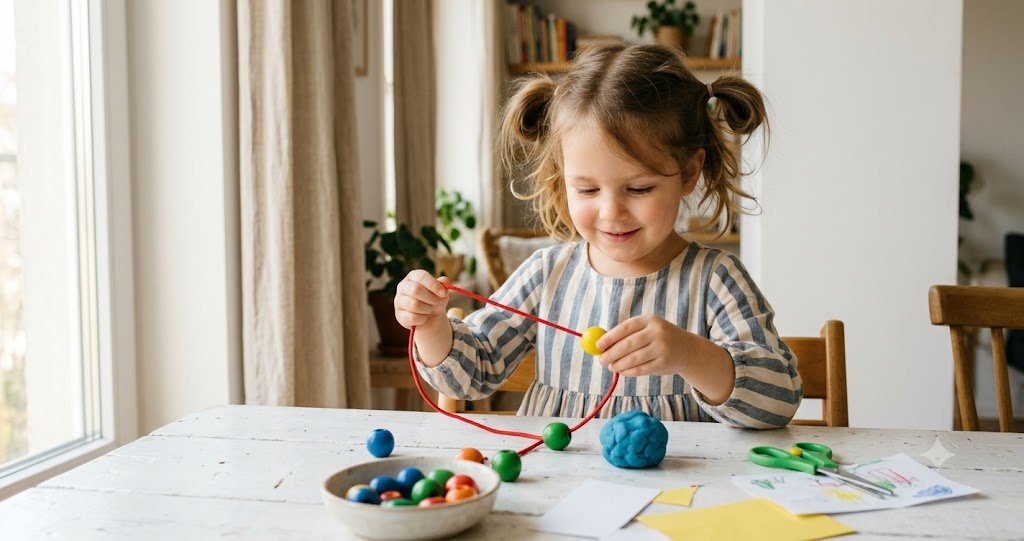
At my daughter’s kindergarten orientation last year, a mom raised her hand and asked the question we were all thinking: “Should they already know how to write their letters?”
The teacher smiled like she’d heard it a hundred times, because she probably had. Her answer stuck with me. The kids who struggle in the fall, she said, usually aren’t the ones who can’t write an A. They’re the ones whose hands get tired after two minutes of anything: coloring, cutting, zipping a jacket, opening a lunchbox. Letters she could teach. Hand strength was the thing she wished more kids showed up with.
So this is not a post about getting your preschooler to write early. Honestly, please don’t. It’s a post about the unglamorous, playdough-under-the-fingernails work that makes writing feel easy later, and the handful of things that earned a permanent spot in our craft cabinet along the way.
What “handwriting readiness” actually means (hint: not worksheets)
Writing looks like one skill, but it’s really a stack of them: shoulder and core stability, hand and finger strength, a mature grasp, the ability to use two hands doing different jobs, and enough control to steer a line where you want it to go. Pediatric occupational therapists build all of that through play, because that’s genuinely how those muscles and connections develop at this age.
The American Academy of Pediatrics has been unusually blunt on this point. Their clinical report The Power of Play pushes back directly on the pressure to make early childhood more academic, calling playful learning central to healthy development, not a break from it. And if you look at the CDC’s developmental milestone checklists, the writing-related expectations for this age are modest: holding a crayon between fingers and thumb around four, writing some letters of their own name around five. That’s it. Nobody official expects a three-year-old with a pencil grip.
What follows is roughly the order these skills develop, which conveniently is also the order your kid will gravitate toward them. Start wherever yours is.
1. Start with squishing: playdough is the whole gym
If you only get one thing on this list, get dough. Squeezing, rolling snakes, pinching off pieces, flattening pancakes with a palm: every single one of those motions is strength training for the same small muscles that will eventually hold a pencil. Occupational therapists reach for dough constantly for exactly this reason, and it requires zero setup and zero instruction from you.
The classic Play-Doh 10-pack of 2-ounce cans is my honest recommendation over the fancier options. The small cans are the right amount for one kid at one sitting, the colors stay separate longer (a fantasy, I know, but longer), and losing a can to the couch cushions doesn’t hurt. My older son is deep in his dough era right now, and my daughter still drifts over to the table when it comes out, which tells you something about how long the appeal lasts.
Two upgrades worth knowing about. First, hide small beads or coins-sized trinkets inside a ball of dough and have your kiddo dig them out; that pinching-and-extracting motion is one of the best finger-strength exercises there is. Second, hand them a rolling pin and cookie cutters from your own kitchen before buying a tool set. Half the fun is using the real thing.
2. Lacing beads: the pincer grasp workout disguised as jewelry
Threading a lace through a bead makes a child do three hard things at once: pinch something small, hold something steady with the other hand, and aim. That combination, the two hands doing different jobs while the eyes supervise, is precisely what handwriting demands later, when one hand steadies the paper while the other steers the pencil.
The Melissa & Doug Primary Lacing Beads have been the default answer here for a generation of parents, and having gone through a long necklace-manufacturing phase in our house, I get why. The wooden beads are chunky enough for a three-year-old to manage, the shapes and colors quietly invite sorting and pattern games, and the wooden storage box means cleanup is part of the activity instead of a fight. My daughter made necklaces for everyone in the family for a solid month, including one for the stuffed rabbit that still wears it.
If your child already has a busy board or activity cube with threading elements, you may not need a separate set right away. We covered our favorite fine-motor busy boards in a separate roundup, and there’s real overlap between the two.
3. Scissors, in two acts
Scissor skills get their own line on most kindergarten-readiness lists, and cutting is fantastic hand-strengthening besides. The open-shut motion uses the same muscle groups as a mature pencil grasp. But “give your preschooler scissors” is a sentence that makes a lot of us break out in hives, so here’s a two-stage approach that keeps everyone’s hair attached.
Act one: plastic training scissors
The Crayola Toddler Safety Scissors are fully plastic with rounded tips, and parents who have bravely tested them report they won’t cut hair or skin, only paper. The three-pack comes with straight, wavy, and zigzag blades, which turns cutting practice into a game rather than a chore, and the handles work for both right- and left-handed kids.
Full honesty, because this is the part most roundups skip: plastic blades cut paper reluctantly. Some kids find them frustrating, and you’ll often need to hold the paper taut while they snip. I’d frame these as a confidence tool for the 2.5-to-3.5 crowd, something they can use while you’re making dinner without your heart rate spiking. The point is learning the open-shut motion, not producing clean snowflakes.
Act two: real blades, blunt tips
Once the motion clicks, usually somewhere around four, kids need scissors that actually cut, or the frustration undoes the confidence. The Huhuhero blunt-tip kids scissors are the straightforward next step: metal blades that actually cut, rounded tips, soft grips, and covers for the drawer. A four-pack means there’s always a findable pair, which anyone who has watched a craft project die over a missing tool will appreciate. (Fiskars makes the teacher-classic version of these if you’d rather go with the brand your kid will meet at school.)
4. Dot markers: pre-writing strokes without the pencil pressure
Here’s the sleeper pick of this whole list. Before a child can write letters, they need to be able to steer a mark: vertical lines, horizontal lines, circles, crosses. Occupational therapists call these pre-writing strokes, and dot markers are a sneaky-brilliant way to practice them, because the fat bottle needs no grip strength at all. Your kiddo gets the aiming and steering practice while their hand strength catches up separately, courtesy of the playdough.
The Do A Dot Art! rainbow markers are the original, invented by a preschool teacher decades ago and still made in the USA. The sponge tip makes a fat, satisfying dot with a gentle press, the paint is washable, and the chunky bottles were clearly designed by someone who has watched a three-year-old hold things. Dot markers got used hard in our house: dot-the-letter pages, “traffic lights,” and a memorable period in which every drawing my daughter produced was rendered entirely in dots, like a very small pointillist.
One caveat from the trenches: check that the caps are screwed on tight when they arrive and after each use. “Washable” is real, but a full open bottle rolling off the table will test your faith in it.
5. The first real pencil (when they ask for it)
Notice this is item five, not item one. The pencil comes last, and ideally it comes because your child asked, usually because they’ve decided they want to write their name, or make a birthday card, or label a drawing of the dog. That self-generated interest is worth more than any amount of parent-led practice.
When that day comes, a standard skinny pencil is genuinely harder for small hands to control. The V-Opitos jumbo triangle pencils are what you want instead: fat barrels that fill a small hand, a triangular shape that naturally parks the fingers in a three-finger grasp, and thick soft lead that makes a dark line without much pressure. They come pre-sharpened with erasers, and a fourteen-pack costs about what two coffees do. Ticonderoga’s “My First” line is the schoolhouse-classic alternative if you’re brand loyal; they’re the pencils half of America learned on.
What I’d skip at this stage: correcting their grip constantly. A funny grasp at three or four is normal and usually resolves on its own as hand strength builds. If a grip still looks effortful or painful by kindergarten, that’s a conversation for your pediatrician or the school’s occupational therapist, not a thing to drill at the kitchen table.
Bonus: the kindergarten-bag item nobody warns you about
Somewhere between preschool and kindergarten, shoe-tying appears on the readiness radar, and it is somehow both a fine motor task and a test of parental patience science has yet to fully measure. The Melissa & Doug wooden lacing sneaker exists for exactly this: a weighted wooden high-top with one extra-long lace, so kids can practice lacing and tying on something that doesn’t wiggle, isn’t attached to their own foot, and doesn’t have stubby real-shoe laces. Parents consistently report the weight and the long lace are what make it click. In our family, shoe-tying instruction got outsourced to my husband, who is a bunny-ears loyalist and defends the method with the seriousness of a man defending a dissertation. Not essential at three; quietly brilliant at five.
What you can skip entirely
In the interest of your budget and your counter space: you do not need handwriting workbooks for a three-year-old, letter-tracing apps (a finger swiping a screen builds none of the strength any of this is about; we’ve written before about screen-free alternatives that do more), or the drawer full of silicone pencil-grip trainers the algorithm will offer you. Grips have their place for older kids with specific needs, ideally chosen with an OT. For a preschooler, dough and beads and scissors do the same job better, and they’re more fun.
Signs the hands are getting there
Instead of a checklist to drill, here’s what readiness quietly looks like in the wild, drawn from the CDC’s milestone ranges and a couple of years of watching it happen at my own kitchen table:
- They start using one hand consistently for tools while the other hand helps, instead of switching back and forth constantly.
- Crayon grasp drifts up from the whole-fist hold toward fingers and thumb, on its own, without coaching.
- They can snip paper with intention, roughly where they meant to.
- Drawings start containing deliberate shapes: circles, suns, people who are mostly heads with legs.
- They ask you how to make the first letter of their name.
When that last one happens, you’ll be ready, and so will they. Not because anyone raced. Because they spent a couple of years squishing, threading, snipping, and dotting their way there, which, as the AAP keeps telling us, was the curriculum all along.