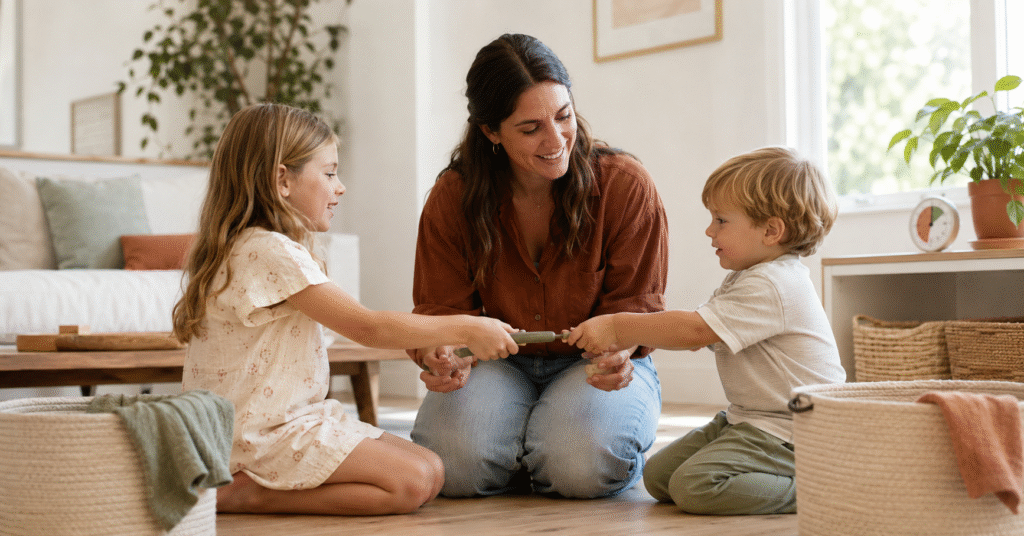
The toy that started last Tuesday’s war was a plastic dinosaur nobody had touched since March. My daughter found it under the couch, my older son decided in that exact instant that it was the only toy he had ever loved, and within forty seconds we had two children pulling on one T-rex while my youngest son stood nearby, delighted, waiting to see who would cry first.
If you have more than one kid, you know this scene. You’ve probably lived it today.
After years of refereeing three children, I’ve stopped looking for things that end sibling fighting, because those things don’t exist. What I have found are tools that shrink the number of fights worth having, and that’s a trade I’ll take. This post covers the three categories that pulled real weight in our house: turn-taking timers, big-feelings tools, and giving each kid a little territory of their own.
First, the Honest Part
Anyone selling you a product that “ends sibling rivalry” is selling you a plastic dinosaur. The American Academy of Pediatrics is refreshingly blunt about this: no matter how hard you try, your kids are going to fight over toys, tattle, tease, and criticize each other. It’s a normal part of growing up, and it’s actually how they practice negotiating, losing, and recovering.
The realistic goal is fewer flashpoints and faster recoveries. The tools below work on exactly those two levers: they remove the most common triggers (whose turn is it, whose stuff is that) and they give kids something to do with a big feeling besides body-slamming their brother.
One more thing worth knowing before you spend a dollar: Nemours KidsHealth points out that a lot of sibling conflict is developmental, not moral. Toddlers are naturally possessive because they’re just learning to assert themselves, while school-age kids run on a fierce sense of fairness. My daughter and my older son aren’t fighting because one of them is a jerk. They’re fighting because a six-year-old’s brain and a three-year-old’s brain are playing two completely different games on the same rug.
Turn-Taking Timers: The Referee Who Never Gets Tired
A visual timer has been running turn-taking duty in our living room for a long time now, and here is the entire magic trick: the timer becomes the bad guy, so you don’t have to be. “Mom said” starts a debate. A red disk running out of color does not. My older son can’t read a clock, but he can absolutely see that his sister’s turn is almost over, and somehow that’s enough to keep him from launching a rescue mission for the dinosaur.
Two picks here, depending on your budget.
The classic: Time Timer Home MOD
The Time Timer is the one you’ll spot in half the kindergarten classrooms in America, and there’s a reason: the company invented the disappearing-disk concept over thirty years ago, after the founder’s own child struggled with transitions. The Home MOD version is a palm-sized desk unit with a sixty-minute dial, it runs quietly with an optional beep at the end, and the design just picked up a Wirecutter award. It’s a family business that donates a slice of every sale to inclusive education programs, which is a nice bonus when you’re handing over roughly twice what the generic versions cost.
Honest notes: the silicone protective case is sold separately (the classroom edition includes one, this home version doesn’t), and if a unit ever develops an audible tick, the company treats that as a defect and replaces it.
The budget pick with a toddler-proofing bonus: Yunbaoit Visual Timer
The Yunbaoit timer costs noticeably less and comes with a protective case in the box, plus a few thoughtful extras the classic doesn’t have: three alert volumes (including a flash-only silent mode, a gift during nap windows), a low-battery light, and fun disk patterns like rainbows and dinosaurs that let a kid feel some ownership over “their” timer. It carries a Best Seller badge in its category with thousands of reviews.
One genuinely important warning from the less happy reviewers: the dial cannot be cranked past zero in either direction without damaging the mechanism. If your toddler treats every knob in the house like a race car steering wheel (hello, my youngest son), keep this one on a shelf between turns and let grown-ups do the setting.
Strategy matters as much as hardware here. The phrasing that works in our house is “when the red is gone, it’s brother’s turn,” announced before the turn starts, not negotiated mid-turn. And the timer sets the turn length, not the child, because a six-year-old given that power will propose a turn lasting until college.
Big Feelings Tools: Because “Use Your Words” Doesn’t Work Mid-Meltdown
Half of sibling fights aren’t really about the object. They’re about the volcano. A kid who’s already tired, hungry, or stewing about something from school will detonate over a dinosaur that, on a better afternoon, she’d have handed over without looking up. These two tools give kids a way to notice and name the volcano before it erupts on a sibling.
Breathing Exercise Cards by Kids Yoga Stories
This deck comes from a mom-run American small business founded by a former teacher, and it shows: thirty kid-friendly breathing techniques, each on a wipeable card sized for small hands, with the instructions printed right on the back so you don’t need to memorize anything. The techniques have names like Bunny Breath and Balloon Breath, which sound ridiculous until you watch a furious six-year-old do three quick bunny sniffs and visibly lose track of what she was mad about. Breathing exercises are one of the few calm-down strategies young kids can actually pull off mid-upset, and having a physical card to hold gives them something to do with their hands.
Fair warning: this is a do-it-together tool, especially under age six. Handing the box to a raging preschooler and walking away will get you a box of cards thrown at a sibling.
ALSLEA Feelings Pocket Chart
This hanging chart is borrowed straight from preschool classrooms: twenty-one illustrated emotion cards in fabric pockets, and thirty little wooden people that kids decorate and name as their own. Each kid parks their person under the feeling they’re having. It sounds almost too simple, but “point at the feeling” is a much lower bar than “explain the feeling,” and for a three-year-old mid-scowl, that’s the difference between communication and a shove.
The sneaky sibling benefit: each child gets their own wooden person to decorate, which means the chart itself never becomes the next thing they fight over. Reviewers’ honest gripe is that the pockets run a little shallow, and the whole thing does look more classroom than living room. Ours would hang inside a closet door and nobody would care.
“Mine” Zones: The Counterintuitive Fix
This one felt backwards until it worked: less sharing, not more. When everything in the playroom is communal, every single object is contestable, all day, forever. Giving each kid a small territory that is officially, publicly theirs (and that siblings need permission to touch) removes a whole class of fights before they start. Nemours recommends exactly this: kids need some space and things of their own, without having to split everything 50-50.
In practice this means one labeled bin per kid. The label is doing serious psychological work: it turns “he took my stuff” from a matter of opinion into a matter of public record.
The one-per-kid set: NaturalCozy Cotton Rope Cube Baskets (3-pack)
A three-pack of matching eleven-inch cubes: if you’re running a three-kid household, the math writes itself. These are woven cotton rope with hidden reinforced handles, no chemical treatments (relevant when the youngest member of the audit team still tastes furniture), and they’re square, so they hold more than round baskets the same size and actually fit cube shelving. They also hold their shape when empty instead of slumping into a sad fabric puddle.
They don’t come with name labels, and honestly, don’t pay Etsy prices to fix that. A few dollars of iron-on letters or a wooden name tag on a ribbon does the job, and decorating their own tag is exactly the kind of ownership ritual that makes kids defend the system instead of the toys. Only real downsides: they cost more than plastic, and light-colored rope will eventually show what your children’s hands have been doing all day.
The budget version kids pick themselves: HIYAGON Pattern Storage Bins
At under ten dollars a bin, these fabric bins take the opposite approach: instead of matching, every kid picks a completely different pattern from a huge lineup (race cars, dinosaurs, basketballs, animals, and plenty more in the listing’s variations). The pattern is the label, no crafting required, and a bin a kid chose personally gets defended like national territory. They’re collapsible fabric with reinforced handles, so they fold flat when not needed.
Trade-offs: soft sides mean they’ll slouch under heavy loads, and the prints run young and cartoonish, so they won’t age with your decor the way the plain rope cubes will. For a first “mine zone” experiment, though, this is the cheapest possible way to find out how much peace the strategy buys you.
What Didn’t Work for Us
In the interest of saving you money: a sticker reward chart for “being kind to your sibling” collapsed in under a week at our house, mostly because it turned my daughter into a full-time prosecutor documenting her brother’s violations (I’ve written before about why reward charts backfire, and sibling conflict is where they backfire hardest). And buying two of everything, the strategy every grandparent and, once, my husband suggested, just produces two identical toys with one microscopic difference that becomes the new battlefield. Ask me about the two absolutely identical blue cups and the fight over which blue was “the good blue.”
Forced apologies also did nothing except teach my kids to say “sorry” in a tone that should itself require an apology. What replaced it, slowly, was the boring stuff above: predictable turns, named feelings, defended territory.
FAQ
Should I intervene every time they fight?
The AAP’s advice is to stay out of it where you safely can: don’t take sides, and let kids practice settling their own differences, stepping in mainly when someone might get hurt. The tools in this post are really just ways of making “work it out yourselves” a fair fight.
At what age can kids actually share?
Later than the fighting starts, unfortunately. Toddlers are developmentally wired to be possessive; that’s asserting their brand-new sense of self, not a character flaw. My youngest son has no concept of a turn, which is why some of these tools (the timer, the feelings chart) only really start paying off around age three or four. Before that, your best tools are distraction and distance.
Do I need all five of these?
No. If I had to start over with one purchase, it’d be a visual timer, because “whose turn is it” is the single most common fight in any multi-kid house. Add a mine-zone bin per kid next. The feelings tools are the slow-burn investment: less dramatic day one, but they’re the ones building a skill your kids keep after they’ve outgrown the dinosaur.
My kids fight constantly. Is that normal?
Almost always, yes, especially with close age gaps. But if the conflict feels relentless for months, is always one-directional, or anyone’s getting hurt, that’s worth raising with your pediatrician rather than solving with a shopping cart.
The dinosaur, in case you’re wondering, is back under the couch. Nobody has touched it since. That’s siblings for you: the fight was never really about the dinosaur, which is exactly why the right tools help more than the right toys.