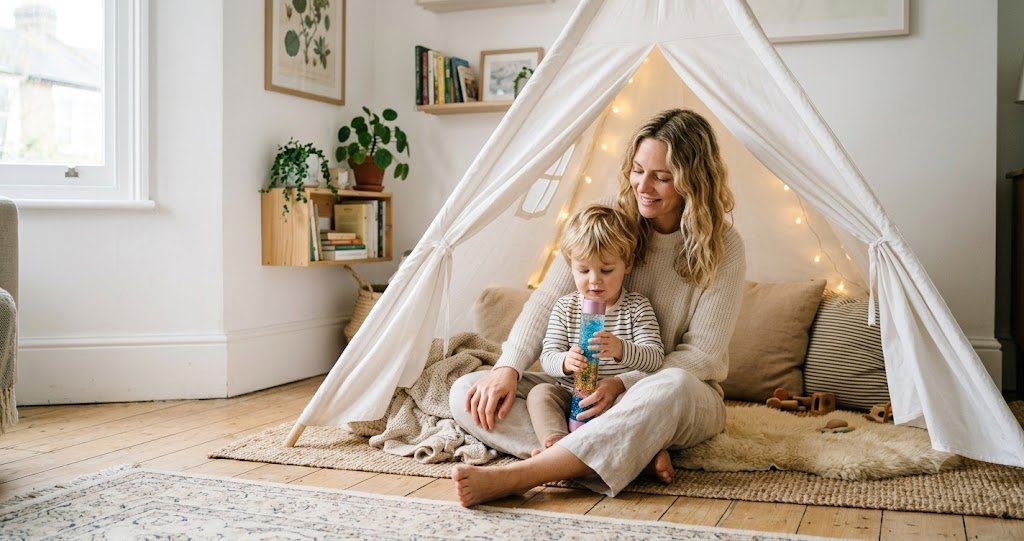
Last month my older son had a complete meltdown because I peeled his banana. He wanted to peel it. The banana could not be un-peeled. The laws of physics did not care that he was three, and neither did his nervous system.
Nobody told me this with my first baby, so let me say it plainly: a toddler mid-meltdown isn’t giving you a hard time. He’s having a hard time. The part of the brain that handles impulse control and big emotions — the prefrontal cortex — is barely under construction at this age. Expecting a two-year-old to “calm down” on command is a bit like expecting him to parallel park.
What toddlers can learn is what calming down feels like, and where it happens. That’s the whole idea behind a calm-down corner: a small, predictable spot in your home stocked with a few tools that help a little body settle. Ours has been through three kids now, and it’s one of the few parenting setups I’d rebuild in a heartbeat.
Below is everything that goes into a calm-down corner that toddlers actually use — the cozy spot, the sensory tools, the feelings books, and the one thing I’d skip buying entirely (because I made you a free version).
First: A Calm-Down Corner Is Not a Time-Out Corner
This distinction is everything, so let’s get it out of the way before we talk shopping.
A time-out is something that happens to a child. A calm-down corner is something a child learns to use. The moment your little one gets “sent” there as a punishment, the corner stops working. It just becomes the naughty step with better throw pillows.
The American Academy of Pediatrics moved away from harsh, punishment-first discipline years ago, emphasizing warm and consistent responses instead — you can read their guidance on healthy discipline at HealthyChildren.org. (For the record, the AAP still considers a proper time-out a reasonable tool, so this isn’t about time-outs being evil.) A calm-down corner simply does a different job. Child psychologists call it “co-regulation”: toddlers borrow our calm before they can generate their own. The Child Mind Institute has a great explainer on how self-regulation is a skill built through practice, not a behavior demanded in the moment.
So in our house, the corner works like this: when big feelings show up, I offer it. “Do you want to go to your cozy corner? I’ll come with you.” Sometimes he says no and screams into the rug instead. That’s fine. It’s an invitation, not a sentence. Over time — and I mean months, not days — he started walking there on his own. The first time I watched him stomp over, grab his sensory tube, and flop down without a word from me, I nearly cried into my coffee.
Where to Put It (and the Two Ground Rules)
You don’t need a Pinterest-worthy reading nook. You need about three feet of floor space that meets two conditions:
- It’s visible. Pick a corner of the living room or playroom — somewhere your child can see you, and you can see them. A toddler alone behind a closed door isn’t calming down; he’s just alone.
- It’s never used for punishment. Not once. Not even on the day someone bites his brother. The corner has one job, and the second it doubles as a consequence, you lose it.
We squeezed ours between the bookshelf and the window in the living room. It is not beautiful. My husband still calls it “the yelling tent.” It works anyway.
Now, the five things that go in it.
1. A Little Tent (the Cozy Factor)
There’s a reason overwhelmed toddlers crawl under tables. Small, enclosed spaces cut down visual noise and make a dysregulated kid feel contained — in the good, hugged-by-the-world way. A play tent or teepee gives you that “den” feeling without giving up a whole room.
Ours started as a hand-me-down canopy from a cousin, but if I were buying today, the Tiny Land Teepee Tent is the one I’d pick. It’s the teepee that shows up in every occupational therapist’s classroom photo for a reason: 100% cotton canvas (no chemical-smell plastic), a genuinely padded half-inch mat so your child isn’t sitting on bare floor, and a string of soft star lights that turn “go calm down” into “go to your glowy cave.” It’s roomy enough for a parent to squeeze in for co-regulation duty, which matters more than any other spec. The brand also says its bottom poles are wrapped into the fabric base and the whole thing is tested to CPSIA safety standards. That’s the kind of detail I always check on anything my kids will be climbing on.
If the budget says otherwise, the Little Dove play tent runs about half the price and is one of the top-selling kids’ tents on Amazon, with star lights and flags included. It’s a dome style rather than a teepee, which some toddlers actually prefer — lower ceiling, more cave-like.
2. Sensory Tools (Something for the Hands)
When a toddler is flooded, words are useless, but hands still work. Slow-moving visual toys give the nervous system something rhythmic to lock onto, which is why sensory tubes are the backbone of nearly every classroom calm-down kit.
For this age I’d stick to sealed sensory tools only — no bins of rice, no loose water beads, nothing that fits in a mouth. Two picks that clear that bar:
- Learning Resources Sensory Trio Fidget Tubes — three chunky, sealed tubes that each move at a different mesmerizing slow speed, from a brand that’s been making classroom materials since before we were born. Nothing opens, nothing spills, which is exactly what you want at meltdown intensity.
- JOYIN Sensory Fidget Tubes (4-pack) — same idea, four tubes, and they’re literally marketed for calm-down corners. Thousands of families use these; the reviews are full of teachers and parents of sensory-seeking kiddos.
You need two or three items here, not fifteen. A calm-down corner with a toy-store inventory becomes a play corner, and then you’ve just built a very cozy distraction.
3. A Weighted Lap Pad (Ages 3+ Only)
Deep pressure is the closest thing toddler regulation has to a cheat code: it’s the same reason a tight hug can stop a spiral. A weighted lap pad delivers that steady, grounding pressure across the legs while your child sits.
The one I’d trust here is the Harkla Weighted Lap Pad. Harkla is a US small business founded around occupational-therapy tools, and it shows: the pad is a two-piece design (washable minky cover plus a separate weighted insert filled with sealed glass beads), it’s CPSC safety certified, and it comes with a lifetime guarantee, which reviewers with sensory kiddos mention a lot. It’s 5 pounds, which per the manufacturer’s own guidance suits kids from around age three and up.
In our corner, the lap pad belongs to my older son now that he’s three; his little brother gets a regular soft cushion and is none the wiser.
4. Feelings Books (Naming the Storm)
You can’t regulate what you can’t name. Toddlers experience rage, disappointment, and jealousy long before they have words for any of it — which is why every calm-down corner needs one or two books about feelings, ready for the quiet moment after the storm passes.
- The Color Monster by Anna Llenas — the modern classic, translated into over 25 languages. Each feeling gets a color, and the monster (whose emotions are all tangled together) sorts them out one jar at a time. My kids will point at the red monster and announce “he’s SO angry” with enormous satisfaction. That’s the skill, right there.
- Torlam Feelings Wheel flip book — less a storybook, more a tool: a sturdy flip-chart of faces your child can point to when words fail. For pre-verbal and barely-verbal toddlers, pointing at a face is often the first “I’m frustrated” they can manage. It was designed for classroom calm-down corners and it earns its spot in a home one.
Keep the books in the corner, not in the general rotation. Scarcity keeps them special.
5. Breathing Cards (Don’t Buy These — Print Ours)
Here’s the one category I’ll talk you out of buying. Breathing card decks for kids cost about as much as a nice hardcover picture book, and what you’re paying for is illustrations of techniques you can teach in ninety seconds.
Two that work at this age:
- Bunny breathing: three quick sniffs in through the nose (“sniff the carrot!”), one long breath out. Toddlers find this hilarious, which is half the point — laughter downshifts the nervous system too.
- Birthday candle: hold up a finger, have your child take a big breath and blow out the “candle” slowly. Repeat with five fingers, folding each one down.
We keep a small set of illustrated breathing cards clipped to the tent — and rather than sending you to Amazon for them, I made a printable version you can grab for free. Our Calm-Down Kit printable is linked at the bottom of this post: breathing cards plus a feelings check-in page, sized for little hands. Print, laminate if you’re fancy, clip a ring through the corner, done.
One honest caveat: cards don’t teach breathing. You teach breathing, at calm times, by doing it together until it’s a familiar game. The cards are just the reminder that lives in the corner.
How to Introduce the Corner (This Is the Step Everyone Skips)
Here’s where most calm-down corners die: parents build them, wait for a meltdown, and then try to introduce the corner to a child who is currently levitating with rage. That’s like teaching someone to swim during the shipwreck.
Instead:
- Tour it when everyone’s happy. Show each item. Let your child play with everything. Make it theirs.
- Practice pretend visits. “Teddy is SO frustrated. Should we take him to the cozy corner? Let’s help him do bunny breathing.” Toddlers rehearse through play — use it.
- Go with them, every time, at first. Co-regulation comes before self-regulation. For months, the corner is a place you calm down together. The solo version comes later, on their timeline.
- Narrate the win afterward. “Your body was so upset, and then it got calm again. You did that.” That’s the story you want their brain to keep.
Three Ways Calm-Down Corners Go Wrong
- It becomes a time-out with cushions. If you ever hear yourself say “GO to your corner,” pause. The corner is offered, never ordered.
- It’s overstuffed. Five items max. If your child is playing happily in there for forty minutes, you’ve built a fort, not a regulation tool. (A lovely fort! But now build the corner somewhere else.)
- You expect it to work immediately. The corner is a practice space, not an off switch. Some days it does nothing. You’re planting a skill that pays off at four, five, six — and honestly, the deep-breathing habit pays off at thirty-five. Ask me how I know.
For more on what’s actually happening in that little brain mid-tantrum — and why waiting it out calmly works better than any hack — I went deep on that in why time-outs fail during toddler meltdowns. And if your kiddo craves hands-on input in general, the corner pairs beautifully with the picks in our roundup of the best calm-down tools for toddlers.
FAQ
What age can we start a calm-down corner?
Around 18 months, in a stripped-down version: cozy spot, one sensory tube, one board book, you sitting there with them. The full setup shines from about age two and keeps working well into the school years. Under 18 months, regulation is entirely your job — a corner won’t add much yet.
My toddler refuses to go there when upset. Now what?
Totally normal, and don’t force it — a corner you’re dragged to is a punishment with extra steps. Keep offering, keep modeling (“I’m feeling frustrated, I’m going to sit in the cozy corner for a minute” — and then actually do it; the first time they watch you calm yourself down there is worth a hundred invitations), and let pretend play with stuffed animals do the heavy lifting.
Can we use both time-outs and a calm-down corner?
If you use time-outs, keep them in a completely different location and never blur the two. But honestly? Once the corner started working, we reached for time-outs less and less, and most moms I’ve compared notes with say the same. At this age, connection simply got us further than isolation did. In our house, anyway.