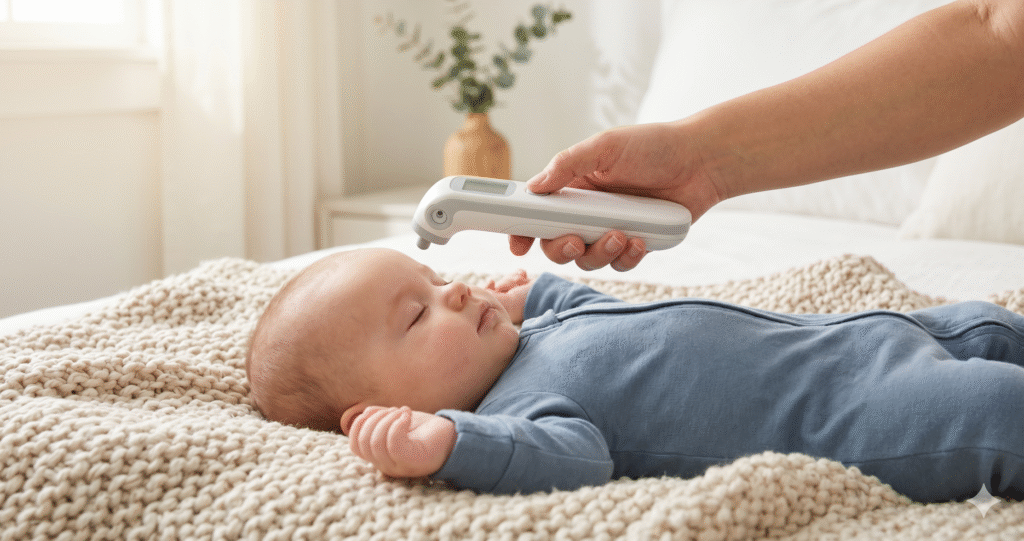
The first time my daughter spiked a fever, she was eight weeks old. It was 2 a.m., she felt warm against my neck, and I realized I owned exactly one thermometer: a cheap stick I’d grabbed from the drugstore the week she was born. I had no idea if she actually had a fever, what counted as a fever at that age, or whether I should call the pediatrician at that hour. I ended up in the ER by sunrise, mostly because I couldn’t trust my own reading.
Three kids later, I own four thermometers. Not because I’m a gear hoarder, but because I learned something most baby registry checklists skip: the right thermometer depends on how old your baby is. A rectal thermometer is medically essential for a newborn and completely unnecessary for a preschooler. An ear thermometer is useless on a two-month-old (their ear canals are too small) but perfect for a wiggly toddler.
So instead of giving you one “best” pick, I’m going to walk you through four thermometers that each solve a different problem, organized by the age of your baby. All four have been in rotation in my house across three kids. All four are still on the market, still recommended by pediatricians, and still priced under $60.
Quick Picks: Best Baby Thermometers by Age
| Best For | Pick | Method | Price |
|---|---|---|---|
| Newborns (0-3 months) | Frida Baby Quick-Read Rectal | Rectal | ~$13 |
| Babies 3+ months | Braun ThermoScan 7 | Ear (tympanic) | ~$60 |
| Wiggly toddlers (budget) | iProven DMT-489 | Forehead + Ear | ~$28 |
| Sleeping babies (no-wake) | Exergen TAT-2000C | Temporal artery | ~$38 |
How We Chose
I’m not a pediatrician. I’m a mom who’s taken roughly a thousand temperatures across three kids over six years, some of them at 3 a.m. while trying not to cry. My picks prioritize three things: clinical accuracy backed by AAP guidance, a reading speed that works on an uncooperative baby, and a price point that doesn’t assume you’re buying only one.
Every thermometer in this roundup meets the accuracy benchmark of plus or minus 0.2°F that pediatric practices use. I’ve cross-checked each one against the manufacturer’s current specs (not marketing blurbs from five years ago), and every pick is still actively sold on Amazon with recent reviews from real parents. Nothing here is discontinued or being quietly phased out.
Understanding Baby Fever Basics (Before You Buy)
The American Academy of Pediatrics defines a fever as a rectal temperature of 100.4°F (38°C) or higher. That number matters for one specific reason: for a baby under three months old, any rectal reading at or above 100.4°F is a medical emergency and requires an immediate call to the pediatrician. Not “wait and see.” Not “give Tylenol.” Call.
For older babies and toddlers, the threshold changes depending on the method. Oral readings run slightly lower than rectal. Forehead and ear readings run a little lower still. Armpit readings are the least reliable. This is why pediatricians care so much about how you took the temperature when you call, not just the number.
It’s also why age matters for choosing a thermometer. Ear thermometers don’t work well on babies under six months because their ear canals are too narrow for accurate placement. Temporal (forehead) thermometers are gentler and faster but slightly less accurate than rectal. And rectal, while the gold standard for infants, becomes impractical the moment your baby can roll over and protest. For a deeper look at what counts as a fever and how to respond at each age, our guide on what to do when your child has a fever walks through the thresholds in detail.
Best Rectal Thermometer for Newborns (0-3 Months)
Best for 0-3 Months
Frida Baby Quick-Read Digital Rectal Thermometer
About $13 on Amazon
If your baby is under three months old, this is not optional gear. The AAP specifically recommends rectal measurement for at least the first twelve months (and up to three years is considered most accurate), because skin-surface methods can be off by a full degree on a tiny body, which is the difference between “fine” and “emergency.”
I bought the Frida Quick-Read when my daughter was a newborn, and it’s still the thermometer I hand to every friend having their first baby. The reason is the stopper at the base of the probe. If you’ve never taken a rectal temperature on a baby before (most of us haven’t), the terror is that you’ll push the probe too far in. The flexible tip plus the parent-proof stopper physically prevent that. You literally cannot insert it past the safe depth. That single design choice makes the whole experience tolerable for a sleep-deprived new parent at 3 a.m.
The reading takes about ten seconds, which feels like a long time when you’re holding a wriggling newborn, but it’s the price of rectal accuracy. The display is backlit, so you don’t have to fumble with a phone flashlight. It stores the last ten readings, which matters more than you’d think: when you’re on the phone with the pediatrician, being able to say “it was 99.8, then 100.2, now it’s 100.5” is useful information.
Pros
- Safe insertion stopper
- Flexible tip
- 10-reading memory
- Backlit display for night checks
- BPA-free, water-resistant
- FSA/HSA eligible
Cons
- Rectal only (no forehead or ear mode)
- 10 seconds feels slow vs. infrared models
- Your baby will outgrow the use case by toddlerhood
Best Ear Thermometer for Babies 3+ Months
Once babies pass the three-month mark and especially after six months, the rectal thermometer starts to lose its case. Your baby is mobile, has opinions, and doesn’t love being held down. This is where the Braun ThermoScan 7 earns its price tag.
Braun is the brand most pediatrician offices use, and two specific features explain why. The first is the Age Precision technology: you set your child’s age group (0-3 months, 3-36 months, or 36+ months), and the display color-codes the result green, yellow, or red based on what actually counts as a fever at that age. That matters because “fever” is not a fixed number. What’s borderline for a two-year-old is an emergency for a two-month-old. The color coding takes the math out of it at 2 a.m.
The second is the pre-warmed tip. Most ear thermometers have a cool metal probe, and when you insert it into a warm ear canal, the canal cools slightly and the reading comes out lower than the true core temperature. Braun’s probe pre-warms itself, eliminating that variable. The ExacTemp positioning system beeps and lights up when the probe is in the right spot, which is genuinely helpful the first few times you use it.
I’ll be honest about the downsides. The single-use lens filters are an ongoing cost (the box includes 21), and there’s a small learning curve to getting the probe angle right on a squirming toddler. But once you have the muscle memory, you get a reading in about one second, which is transformative when you’re trying not to wake a napping baby.
Pros
- Age Precision color-coded results
- Pre-warmed tip for accuracy
- 1-second readings
- Night light on display
- Used by more pediatrician offices than any other infrared brand
- Works for the whole family
Cons
- Most expensive pick on this list
- Lens filters are an ongoing consumable
- Earwax buildup can affect readings
- Not reliable under 3 months
Best Budget Dual-Mode Thermometer (Forehead + Ear)
Best Budget
iProven DMT-489 Digital Ear and Forehead Thermometer
About $25-30 on Amazon
If the Braun’s price makes you wince, the iProven DMT-489 is the pick that covers most of the same bases for less than half the cost. It has two modes: pop the sensor cap on for a forehead swipe (3 seconds), pop it off for an ear reading (1 second). It has a color-coded fever alarm (the display turns red with three beeps when the reading is elevated), stores twenty past readings, and includes a silent mode for sleeping babies.
One detail matters for parents of younger babies: the ear mode is only suitable for children six months and older, per the manufacturer. The forehead mode works from birth. This is the thermometer my youngest son uses most often right now. At eighteen months, he will not hold still for an ear reading if he’s awake, so forehead mode is the realistic daily option.
The honest downside is accuracy consistency. Some parents on Amazon report getting different readings taking the same temperature twice in a row, which I’ve also experienced occasionally. The trick, which the manual does explain, is to make sure the thermometer and the person have been in the same room for at least thirty minutes before measuring, and to keep the forehead sensor lightly touching the skin rather than pressing. With correct technique, I find it’s consistent enough for everyday use. I wouldn’t use it as my only thermometer for a newborn, but for a toddler monitoring a known virus at home, it’s the one I reach for first.
Pros
- Dual mode (forehead + ear)
- Color-coded fever alarm
- 20-reading memory
- Silent mode available
- Less than half the price of Braun
- 100-day money-back guarantee from iProven directly
Cons
- Ear mode not suitable under 6 months
- Readings can vary between attempts if technique is off
- Brand less widely stocked in pediatrician offices
Best No-Wake Thermometer for Sleeping Babies
Best for Sleep Checks
Exergen TAT-2000C Temporal Artery Thermometer
About $35-40 on Amazon
Exergen is the brand the hospital sent us home with after my daughter was born, and there’s a reason you see it clipped to the wall of nearly every pediatric clinic. Temporal artery thermometry uses a sensor that gently strokes across the forehead, capturing heat from the artery that runs just under the skin between the center of the forehead and the hairline. It’s not the same as a no-contact infrared thermometer (which measures skin surface temperature and is less accurate). It’s contact-based, uses a patented arterial heat balance algorithm, and is backed by more than a hundred peer-reviewed clinical studies.
What makes it my go-to for sleep checks is the combination of speed and silence. The scan takes about two seconds, requires only a gentle stroke across the forehead, and never beeps unless you turn the sound on. The display uses a soft glow you can read in a dark nursery without turning on a lamp. I’ve taken my youngest son’s temperature three times in one night without ever waking him, which is honestly why I bought this one in addition to the Frida.
The quirks: it runs on a 9V battery instead of AA, so you’ll need to buy a spare (I keep one in the bathroom cabinet). It doesn’t come with a storage case, and if you want a Celsius/Fahrenheit toggle button on the device itself, Exergen sells an updated TAT-2000C+ sibling for a few dollars more. The technique also matters: you stroke from the center of the forehead straight to the hairline, then if your baby is sweating, you lift and touch the skin just behind the earlobe. Done right, it’s the closest thing to effortless I’ve used.
Pros
- Backed by 100+ peer-reviewed clinical studies
- Used in thousands of hospitals
- Silent mode + soft glow for sleep checks
- Accurate from newborn through adult
- 2-second scan
- No probe covers required
Cons
- Runs on 9V battery (less common)
- No included storage case
- Requires correct stroke technique
- Beep toggle requires holding a button during startup
Head-to-Head Comparison
| Model | Method | Best Age Range | Reading Time | Memory | Silent Mode | Price |
|---|---|---|---|---|---|---|
| Frida Quick-Read | Rectal | 0-12 months | 10 sec | 10 | No | ~$13 |
| Braun ThermoScan 7 | Ear | 3 months+ | 1 sec | 9 | No | ~$60 |
| iProven DMT-489 | Forehead / Ear | Forehead: 0+ / Ear: 6+ months | 1-3 sec | 20 | Yes | ~$28 |
| Exergen TAT-2000C | Temporal | Newborn+ | 2 sec | 8 | Yes | ~$38 |
How to Take Your Baby’s Temperature Accurately
Rectal (most accurate for infants)
Clean the probe with rubbing alcohol or soap and water. Apply a small dab of petroleum jelly to the tip. Lay your baby on their back with knees bent toward the chest, or across your lap face-down. Gently insert the probe no more than half an inch until the stopper meets skin. Hold still until the thermometer beeps, then read. If this is your first time, ask your pediatrician or a nurse to walk you through it once. It’s far less scary after you’ve done it with supervision.
Ear (tympanic)
Only use on babies six months and older. Gently pull the outer ear up and back to straighten the canal (this is the step most people skip). Insert the probe snugly, aiming toward the opposite eye. Press the scan button and hold still for one to two seconds until the beep. If you suspect earwax buildup, take the reading in the other ear.
Temporal (forehead)
Make sure the forehead is dry and uncovered (no hat, no sweaty bangs stuck to skin). Place the probe at the center of the forehead, press the button, and stroke smoothly in a straight line across the forehead to the hairline on the side. Lift and release. If your baby is sweating or has been bundled in a warm blanket, take a second reading behind the earlobe for accuracy. Sometimes fever comes with a rash, so if you spot anything unusual on the skin while you’re at it, our guide to common toddler rashes can help you identify it.
When to Call the Doctor
The AAP guidance is clear and worth memorizing. Any rectal temperature of 100.4°F (38°C) or higher in a baby under three months old is a call-the-pediatrician-immediately situation, any time of day or night. For babies between three and six months, call if the temperature reaches 101°F (38.3°C) or higher. For babies six to twenty-four months, call if a fever of 102°F (38.9°C) or higher lasts more than a day, or if your baby seems unusually sick regardless of the number.
The number is only part of the picture. Call the pediatrician at any temperature if your baby seems unusually lethargic, is refusing fluids, has a stiff neck, is having trouble breathing, is crying inconsolably, has a rash that doesn’t fade when you press on it, or just looks wrong to you in a way you can’t quite name. That last one is not silly. Parent instinct is diagnostically meaningful, and every pediatrician I’ve ever worked with has told me the same thing: if you feel like something is off, call. For a more detailed walkthrough of warning signs and what to say on the phone, see our piece on when to call the doctor for common childhood illnesses.
Frequently Asked Questions
Do I really need two thermometers?
For a newborn, yes. A rectal thermometer for the first three months (when accuracy is medically critical), plus one of the faster options (ear, forehead, or temporal) for everyday checks once your baby is older. After the first year, one good multi-use thermometer is usually enough.
Can I use a regular drugstore thermometer instead of a baby-specific one?
For older babies and toddlers, many standard digital stick thermometers are accurate for oral, armpit, or rectal use. But most adult-focused thermometers lack the features that actually matter for babies: a flexible tip, an insertion stopper, a fast read time, or a backlit display for nighttime. The baby-specific options are worth the small price difference.
Why do I get different readings each time with a forehead thermometer?
Usually it’s technique, not a broken thermometer. Common culprits: the baby’s forehead is sweaty, they just came out from under a blanket, the room temperature changed, or the scan stroke was too fast or uneven. Wait five minutes, make sure the forehead is dry and uncovered, and try again. If you still get wildly different numbers on the same person in the same conditions, compare against a rectal or oral reading to see if the thermometer needs recalibration or replacement.
How often should I replace my baby thermometer?
Digital thermometers generally last three to five years with normal use. Replace sooner if you notice consistently off readings, the display fades or flickers, or the battery compartment has corroded. Probe covers and lens filters should be replaced per the manufacturer’s instructions (every use for Braun’s lens filters, for example).
Is a no-contact (infrared gun) thermometer the same as temporal?
No, and this one is worth knowing. A no-contact thermometer reads skin surface temperature from an inch or two away, which makes it fast and hygienic but noticeably less accurate than a contact-based temporal thermometer like the Exergen. If you’re using a no-contact model and the reading is borderline, confirm with a more accurate method before deciding whether to call the doctor.
Can I share one thermometer across multiple kids?
Yes, with cleaning between uses. For oral or rectal sticks, wipe with rubbing alcohol or wash with soap and water before and after each use. For ear thermometers, use a fresh lens filter each time. For temporal scanners, a quick alcohol wipe across the sensor is enough.
The Bottom Line
If you’re setting up for a new baby and can only buy one thermometer, buy the Frida Quick-Read Rectal. It’s thirteen dollars, it’s the only method that gives you a medically reliable reading for the first three months, and every pediatrician on the phone at 3 a.m. will ask you if that’s what you used. You can add a faster option later once your baby is older and the stakes of each reading are lower.
If you already have a newborn-era thermometer and you’re upgrading for a toddler, the Braun ThermoScan 7 is worth the splurge for its Age Precision feature and hospital-grade accuracy. If the budget won’t stretch that far, the iProven DMT-489 covers the same daily use cases with forehead and ear modes for less than half the price. And if you have a baby who gets sick often, or you need to check a temperature without waking a sleeping child, the Exergen TAT-2000C is the one you’ll reach for most. Four thermometers sounds excessive until you have three kids and a stomach bug running through the house. Then it sounds like planning.